

Four card poker deals the dealer five cards and the player four, then removes the qualifying rule that every other stud variant leans on. The dealer always plays. The player may raise one, two or three times the Ante, and that choice is where the whole game lives. For the wider market picture, start at our online casino Canada hub.
The table below sets out how the game behaves. Read it first, then work through the detail beneath.
| Trait | Detail |
|---|---|
| Cards | Five to the player, six to the dealer, best four count |
| Bets | Ante plus Play, or the standalone Aces Up wager |
| Dealer qualifying | None, the dealer always plays |
| Raise sizes | One, two or three times the Ante |
| House edge | Roughly 2.8 percent on the Ante |
| Canadian supply | Ontario lobbies, Niagara floors, provincial platforms |
What is four card poker?
A house banked poker variant where the player builds the best four card hand from five dealt cards. The dealer builds a four card hand from six. Rankings, betting and payouts all work on four cards.
The name describes the hand rather than the deal. Every four card poker decision is made on five cards the player can see.
Nothing is hidden on the player side. The dealer cards arrive last.
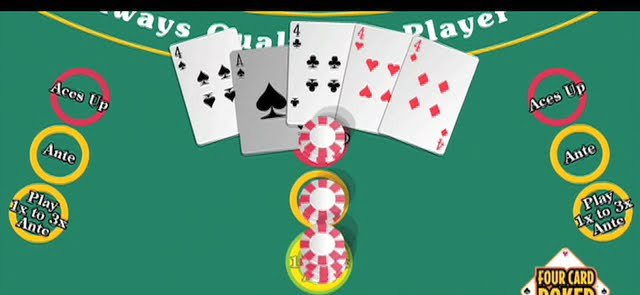
Who invented four card poker?
Roger Snow designed the game for Shuffle Master, the company now folded into Light and Wonder. It reached casino floors in the early two thousands and spread through North America from there.
Shuffle Master placed the title on floors across Nevada and then across Canada. Four card poker travelled with the same catalogue that carried three card poker a decade earlier.
Light and Wonder holds the rights today. The rules have not changed.
The designer also produced Ultimate Texas Holdem. Both titles share a raise ladder rather than a fixed bet.
How does a hand play out?
The player posts an Ante, an Aces Up wager, or both. Five cards arrive face up. The player then folds or raises one to three times the Ante, and the dealer turns six cards.
No further cards are drawn after the raise. A four card poker hand reaches a result in one betting decision.
Speed follows from that. Rounds finish quickly at a software table.
Why does the dealer get an extra card?
The extra card replaces the qualifying rule. A dealer picking four from six beats a player picking four from five often enough that no minimum hand requirement is needed to protect the house.
Six cards produce a stronger four card hand than five do. That structural edge is what four card poker uses in place of a queen high minimum.
The dealer therefore plays every hand. No Ante ever pushes.
What beats what in four card poker?
Rankings follow five card poker with two changes. A four card straight beats a four card flush, and four of a kind sits at the top with no straight flush above it on most paytables.
Four of a kind tops the ladder because a four card straight flush uses the same cards as a four card straight and a flush together. Four card poker ranks the quads above it.
The order is printed on the felt.
Hand rankings are the first thing to learn and the easiest to get wrong. A four card poker player carrying holdem habits misreads the ladder on the very first deal.
Why does a straight beat a flush here?
Frequency decides ranking order. Four card flushes appear more often than four card straights in a fifty two card deck, so the straight takes the higher rung.
Five card poker reverses the pair because the maths reverses with the extra card. Four card poker follows its own frequencies rather than the familiar order.
A player used to holdem misreads this constantly.
What is the Ante and Play bet?
The Ante is the opening wager. Play is the raise that follows the deal, sized at one, two or three times the Ante. Both settle against the dealer hand.
Raising is not optional in the way the Ante is. A four card poker player either raises or folds, and folding surrenders the Ante outright.
The Aces Up wager can be placed alone.
What happens when the player wins?
Ante and Play both pay even money. A winning hand on a five dollar Ante with a three times raise returns twenty dollars of profit on twenty dollars risked.
A minimum raise on the same Ante returns ten dollars. That spread is the reason four card poker rewards reading the raise thresholds properly.
Both wagers pay at the same rate.
What happens when the dealer wins?
Ante and Play are both collected. There is no half stake return and no push on the Ante, because the dealer never fails to qualify in this game.
The absence of a qualifier cuts both ways. A four card poker player never receives the half stake refund that three card poker hands out on a non qualifying dealer.
Losses are clean and total.
What is the Ante bonus?
Strong hands pay a bonus on the Ante regardless of the dealer. Three of a kind, a straight flush and four of a kind each carry a fixed multiple that the dealer cannot take away.
Common ladders pay one to one on three of a kind, twenty to one on a straight flush and twenty five to one on four of a kind. Four card poker pays those multiples on top of the Ante result.
Operators publish the exact ladder.
The bonus is the reason premium hands feel rewarding here. Four card poker pays them whatever the dealer holds.
Does the Ante bonus pay on a loss?
It pays even when the dealer holds a better hand. The bonus is settled on the player cards alone, so a losing four of a kind still collects its multiple.
That property makes the bonus a genuine return rather than a side bet dressed up. A four card poker premium hand always collects something.
The Play wager still loses in that case.
What is the Aces Up bet?
A standalone wager that pays on the player hand alone. A pair of aces or better wins, anything weaker loses, and the dealer hand plays no part in the result.
It can be wagered without an Ante at all. A four card poker player may sit and play the side bet alone, which no other stud variant permits.
Most tables allow it.
What does Aces Up pay?
Paytables differ by operator. A common ladder pays even money on a pair of aces and climbs through two pair, straight and flush to fifty to one for four of a kind.
Three of a kind and straight flush rungs vary most. Comparing them across two four card poker tables identifies the better paytable before a wager is placed.
The ladder sits on the rules screen.
Is Aces Up worth playing?
The house edge runs above three percent on most ladders and past six percent on poor ones. The bet is optional, and the main game costs less per dollar risked.
Some ladders are close to fair and most are not. A four card poker session that skips the circle entirely gives up nothing of value.
The main game carries the better return.
When should a player raise three times?
The published rule raises the maximum with a pair of tens or better. That threshold captures every hand strong enough to justify committing four units to the table.
Below that line the maximum raise loses money over time. A four card poker player raising three times on a pair of sixes is donating on every deal.
The threshold is exact rather than approximate.
When should a player raise once?
A minimum raise covers the middle band. Hands from a pair of threes up to a pair of nines play for one unit, which keeps exposure low on marginal holdings.
Ace high and king high hands also fall here on some published charts. A four card poker player treats them as one unit holdings rather than folds.
The band is narrow and easy to memorise.
Ace king and ace queen sit at the bottom of the band. A four card poker chart still raises them for one unit rather than folding.
When should a player fold?
Folding costs the Ante alone. Hands below a pair of threes lose more often than the raise can recover, so surrendering one unit beats risking two.
Two units risked against a dealer picking four from six is a poor trade on a weak holding. Four card poker punishes optimism more than timidity.
Folding is the most common correct action.
What is the house edge?
Correct play leaves roughly two and a fifth percent against the Ante on standard bonus tables. Measured against total money wagered the figure drops under two percent.
The bonus ladder decides the exact figure. A four card poker table paying twenty five to one on quads returns more than one paying twenty to one.
Both figures are published by the supplier.
Two and a fifth percent against the Ante is the figure most references publish. A four card poker table with a shorter bonus ladder costs a little more.
Why are two house edge numbers quoted?
One measures loss against the Ante alone. The other measures loss against every dollar that reaches the felt, including raises, and that second figure is the fairer comparison.
Element of risk accounts for the raises the player actually makes. Four card poker looks far cheaper on that basis than the headline Ante figure suggests.
Comparisons between games need the same measure on both sides.
How often does the player fold?
Roughly two hands in five end without a raise. Folding that often is correct rather than weak, because the alternative commits money to hands that trail the dealer.
A chart folding that often is working correctly. Four card poker gives back the surrendered Antes through the three unit raises on premium hands.
Patience is the whole strategy.
Does the paytable vary?
Ante bonus ladders and Aces Up ladders both differ between operators. Comparing the four of a kind rung and the three of a kind rung identifies the better table in seconds.
A single rung can move the return by a quarter of a percent. Choosing the better four card poker table costs nothing but a moment of reading.
Operators rarely advertise the difference.
How does it compare with three card poker?
Three card poker qualifies the dealer on queen high and offers one raise at one unit. Four card poker removes the qualifier and allows a raise of up to three units.
The larger raise is what makes four card poker a different game rather than a variation. Money goes in when the hand is strong.
Pair plus and Aces Up serve similar roles.
Pair plus and Aces Up both settle on the player cards alone. Neither touches the dealer hand.
How does it compare with Caribbean stud poker?
Caribbean stud pays a bonus multiple on the raise when the dealer qualifies. Four card poker pays its bonus on the Ante instead, and pays it whether the hand wins or loses.
Caribbean stud loses value every time the dealer fails to qualify. Four card poker never faces that outcome because the dealer plays unconditionally.
The trade is the extra dealer card.
How does it compare with Mississippi stud?
Mississippi stud asks for three separate raise decisions against a paytable. Four card poker asks once, against a dealer hand, with the raise size as the only variable.
Mississippi stud has no opponent at all. Four card poker keeps a dealer hand and settles the Ante and Play against it.
Both games reward folding weak holdings early.
Where can Canadians play four card poker?
Ontario registered operators carry it in their table sections, and Niagara and Windsor run live layouts. Provincial platforms outside Ontario list it under speciality poker.
Availability is narrower than for blackjack or roulette. A Canadian searching by name finds four card poker faster than browsing the table lobby.
Live dealer versions are uncommon.
Ontario has the deepest catalogue in the country. A four card poker table is easier to find there than on most provincial platforms.
Is four card poker certified in Ontario?
Registered operators run builds tested by an approved laboratory. The shuffle, the paytable and the dealer rules are all fixed at certification and cannot be altered afterwards.
Certification covers the market as well as the title. A four card poker build approved elsewhere is retested before an Ontario release.
The operator displays its registration number.
Does four card poker count toward wagering?
Table games usually contribute at a reduced rate, and some bonus terms exclude them outright. Reading the contribution clause before depositing avoids a dead wagering requirement.
Excluded games can void a bonus rather than simply contributing nothing. That clause matters more than the rate printed beside four card poker.
Terms differ between operators.
Contribution rates for table games run from zero to twenty percent. The figure sits in the bonus terms.
Is four card poker good for a small bankroll?
Correct play averages close to two and a half units per hand. A table with a one dollar Ante therefore costs a few dollars an hour at realistic hand speeds.
The three unit raise arrives on a minority of hands. A four card poker bankroll therefore stretches further than the maximum raise size suggests.
Deposit limits sit inside every Ontario account.
Folding two hands in five keeps average exposure low. That is a four card poker advantage over fixed raise games.
What does a Canadian check before playing four card poker?
Four checks cover it. The Ante bonus ladder, the Aces Up ladder, the table minimum and the operator registration status all sit on screen before any money moves.
None of it requires a deposit to read. Four card poker publishes every relevant number before the first Ante is posted.
The habit transfers to every table in the lobby.
Reading takes under a minute. Four card poker rewards that minute more than any amount of play does.
Which game pages are worth reading next?
Four pages sit closest to this one. Each covers a game or a rule that touches the subject above, and each stands on its own.
Four card poker trades the qualifying rule for an extra dealer card and hands the player a raise worth up to three units. Learn the three raise thresholds and the rest of the table looks after itself.