
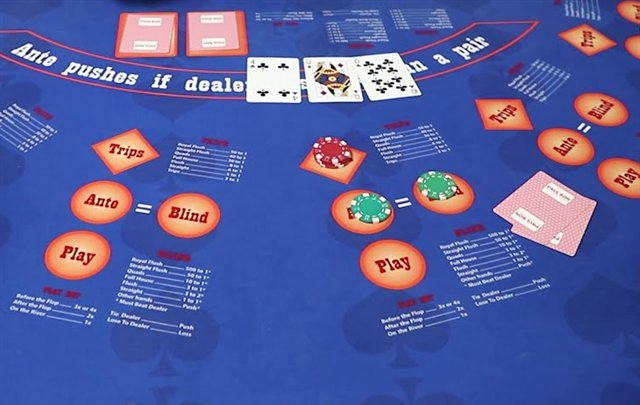
Ultimate Texas Holdem charges you for waiting. Raise before the flop and the bet is four times the Ante; wait for the flop and it drops to two times; wait for the river and it is one. The information gets better and the money you are allowed to put behind it gets smaller. For the wider market picture, start at our online casino Canada hub.
The table below sets out how the game behaves. Read it first, then work through the detail beneath.
| Trait | Detail |
|---|---|
| Cards | Two to the player, two to the dealer, five community |
| Compulsory bets | Ante and Blind, equal in size |
| Raise ladder | 4x before the flop, 2x after it, 1x at the river |
| Dealer qualification | A pair or better for the Ante to pay |
| House edge | Roughly 2.2 percent against the Ante |
| Canadian supply | Ontario operators and provincial platforms |
What is Ultimate Texas Holdem?
A house banked table game where the player and the dealer each receive two cards and share five community cards. The player never competes against anybody else at the table.
The dealer is the only opponent. Nobody bluffs anybody.
The game sits in the table section of a Canadian lobby rather than the poker room, and that placement is the clearest signal of what it is. A poker room takes a rake from players competing with each other, and a table game takes an edge from every hand.
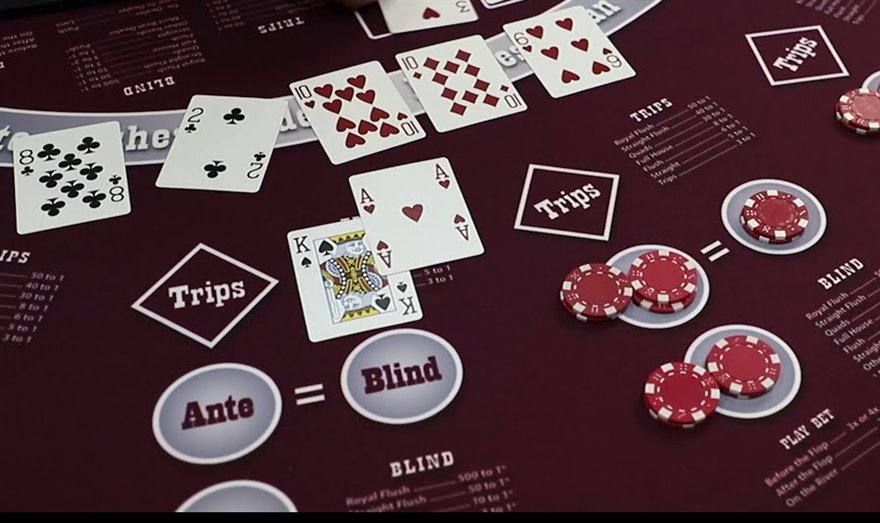
Ultimate Texas Holdem was designed by the company behind several casino floor staples and licensed widely from there. It now appears on registered Ontario sites, provincial platforms and land based floors across the country.
A Canadian meeting the game for the first time usually finds it beside blackjack and baccarat in the table filter. The name creates an expectation of a poker room and the reality is a house banked table with a fixed structure.
Nothing about it requires poker experience. A player who can recognise a pair and a flush has everything Ultimate Texas Holdem asks for.
The table seats up to six players and every seat plays its own hand against the same dealer. Nobody at the table competes with anybody else, and one player winning has no effect on another.
That independence is worth stating because the layout looks like a poker table. Ultimate Texas Holdem borrows the furniture and keeps none of the competition.
The game reached Canadian floors through a supplier licence rather than a single operator. Ultimate Texas Holdem now deals under identical rules in every province that carries it.
Canadians usually arrive at the table through the lobby filter rather than a search. Ultimate Texas Holdem sits under table games beside blackjack and baccarat on most registered Ontario sites.
The felt itself carries most of the rules. An Ultimate Texas Holdem layout prints the qualification condition, both bonus ladders and the raise sizes where a player can read them.
How is it different from Texas Holdem poker?
The casino banks every hand rather than taking a rake from a pot. There is no betting round against other players, no bluffing, and no decision about how much to bet beyond a fixed ladder.
Only the timing of the raise is a choice. Nothing else is.
Reading the hand is the only skill that carries across. A player who knows that two pair beats a pair will follow the showdown, and everything else about poker strategy is irrelevant here.
Position, pot odds, bluffing and reading opponents all disappear. Ultimate Texas Holdem replaces them with one question asked three times, and the answer is a fixed threshold rather than a judgement.
The absence of other players changes the whole psychology. Nobody is representing a hand, nobody is pot committed, and no amount of table reading affects what the dealer turns over.
Variance also behaves differently. A poker session swings on decisions and an Ultimate Texas Holdem session swings on the cards, because the correct decision is fixed by the threshold.
Bankroll requirements differ sharply as well. A poker session can be played patiently with most hands folded before the flop for the cost of a blind.
Nothing here is that cheap. Every Ultimate Texas Holdem hand costs two units minimum whether the cards are worth playing or not.
No rake exists anywhere in the structure. Ultimate Texas Holdem takes its margin from the paytables instead.
Hand rankings are the one thing carried over intact. Ultimate Texas Holdem uses the standard five card order with no reversals of the kind three card games apply.
What bets are compulsory?
The Ante and the Blind, and they must be equal. Both go down before any cards are dealt and neither can be withdrawn once the hand starts.
A third bet, Trips, is optional. Most players add it.
Both sit on the layout before any card is exposed. The Ante is the bet the dealer qualification rule applies to, and the Blind is the one that pays the bonus ladder on a strong winning hand.
They must match in size and neither can be adjusted mid hand. A player sitting down at Ultimate Texas Holdem commits two units before seeing anything at all.
Committing two units before seeing a card is unusual among table games. Blackjack asks for one, roulette asks for whatever a player chooses, and this layout asks for a matched pair every hand.
The Blind is the reason. Ultimate Texas Holdem funds its bonus ladder from a compulsory second bet rather than from an optional side wager.
Raising the table stake raises both compulsory bets together. A player moving from a one dollar minimum to five is committing ten before cards rather than five.
That scaling catches people out. Ultimate Texas Holdem exposure grows twice as fast as the nominal stake suggests.
Both sit in marked circles on the felt. An Ultimate Texas Holdem layout labels the Ante and the Blind clearly.
Trips is the only optional wager on the layout. Everything else in an Ultimate Texas Holdem hand is committed before the cards arrive.
Chips go into marked circles rather than an open area. Every Ultimate Texas Holdem wager has its own labelled spot on the table.
How does the raise ladder work?
A player may raise once per hand and the size depends on when. Four times the Ante before the flop, two times after the flop, and one time after the river card lands.
Waiting costs leverage. That trade is the whole game.
Three chances exist and only one raise is allowed. A player may commit four times the Ante after seeing two hole cards, two times after three community cards, or one time after all five have landed.
Declining at every point folds the hand. That is the fourth possible outcome of Ultimate Texas Holdem and it is the most expensive one available.
Checking is free at each stage and costs nothing directly. A player who checks before the flop simply moves to the next decision with a smaller maximum raise available.
The cost is opportunity rather than money. Every check on Ultimate Texas Holdem halves the leverage a strong hand can carry into the showdown.
The ladder is printed on the felt in three numbers beside the raise box. Reading it once before the first hand removes any confusion about what is available when.
Only one raise per hand is permitted. An Ultimate Texas Holdem player who commits before the flop has no further decision to make.
Checking is labelled Check rather than Fold on the interface. Nothing is surrendered by declining a raise early.
Interfaces grey out the unavailable options as the hand progresses. An Ultimate Texas Holdem client shows only the raise size currently on offer.
Why does the raise shrink?
Because the information improves. A player looking at five community cards knows far more than one looking at two hole cards, and the ladder prices that knowledge by cutting what can be committed.
Nothing else in a Canadian lobby works this way.
The design prices certainty. A hand raised before the flop is a genuine gamble with five unknown cards to come, and a hand raised at the river is close to a settled proposition.
Charging less for the safer bet is how Ultimate Texas Holdem keeps its edge low without giving the house away. The ladder is the balancing mechanism.
The structure would collapse without it. If the four times raise were available at the river a player could wait for certainty and commit heavily only on made hands.
Casinos price information everywhere and rarely this visibly. Ultimate Texas Holdem puts the trade on the layout in three numbers a player can read at a glance.
The same principle appears in other house banked games in weaker form. Caribbean stud allows one fixed raise and three card poker allows one matched raise, and neither prices the timing.
This layout is the explicit version. Ultimate Texas Holdem states the cost of waiting in numbers rather than burying it in the paytable.
The numbers are fixed by the rules rather than by the operator. Every Ultimate Texas Holdem table uses the same ladder.
The ladder is printed under the Play circle on the felt. Reading it once settles how Ultimate Texas Holdem prices each street.
What happens if you never raise?
The hand is folded at the river and both the Ante and the Blind are lost. Checking through all three streets and then declining to raise is the most expensive outcome available.
Folding costs two units. Raising once costs one more.
Folding is available only at the river and only by declining the final raise. There is no early exit, no surrender option and no way to recover part of the Ante or the Blind.
That structure pushes a player toward action. Ultimate Texas Holdem punishes passivity harder than almost any table game in a Canadian lobby.
The fold is the only outcome where a player loses both compulsory bets without any showdown. Every other route puts the hand in front of the dealer and gives it a chance to win.
Folding correctly still matters. Ultimate Texas Holdem strategy calls for it on genuinely hopeless hands at the river rather than as a default habit.
The Trips bet survives a fold and still settles on the player final hand. That is the one wager on the table unaffected by the decision to give up.
Everything else is lost. Folding an Ultimate Texas Holdem hand forfeits the Ante and the Blind with no showdown at all.
Folding is the only voluntary loss in the game. Everything else reaches a showdown.
The interface warns before a fold on most clients. An Ultimate Texas Holdem player has to confirm the decision rather than click through it.
When should you raise four times?
On any pair, any ace, and most hands containing a king or a queen with a decent kicker. Roughly a quarter of starting hands justify the maximum raise.
The threshold is wider than instinct suggests. Raise often.
The correct threshold surprises most players. Any pair, any ace, king with a five or better, queen with an eight or better and jack with a ten all justify the maximum commitment.
That covers roughly a quarter of starting hands. A Canadian playing Ultimate Texas Holdem more tightly than that is handing back the low house edge the game advertises.
Any pair means any pair, including a pair of deuces. The hand is ahead of a random dealer holding often enough to justify the maximum commitment before the community cards land.
Aces are the other automatic case. Holding one ace on Ultimate Texas Holdem beats more dealer hands than intuition credits, and the threshold reflects that.
Suited holdings widen the threshold slightly. A suited king with a low kicker justifies the maximum where the offsuit version of the same hand does not.
The difference is small in practice. A Canadian applying the simple Ultimate Texas Holdem threshold without suit adjustments gives up a fraction of a point.
Roughly one starting hand in four qualifies. That frequency is worth internalising before the first deal.
Memorising the threshold takes one reading. Ultimate Texas Holdem asks for nothing beyond it before the flop.
What is the Blind bet for?
It pays a bonus ladder when the player wins with a straight or better, regardless of how large the raise was. A straight pays one to one and a royal flush pays five hundred to one.
It pushes on a lower winning hand. It never loses alone.
The bonus ladder typically runs one to one on a straight, three to two on a flush, three to one on a full house, ten to one on four of a kind, fifty to one on a straight flush and five hundred to one on a royal.
Winning with a lower hand pushes the Blind. Losing the hand loses it, so the bet on Ultimate Texas Holdem is a conditional bonus rather than an independent wager.
The five hundred to one royal flush rung is the headline and it is almost never reached. A royal appears roughly once in thirty thousand hands, so the rung contributes little to the actual return.
The straight and flush rungs carry the value. Those appear often enough that the Blind on Ultimate Texas Holdem is a meaningful part of a winning session.
Winning with a pair or two pair pushes the Blind rather than paying it. The bet is therefore doing nothing on the majority of winning hands.
Its value is concentrated in rare outcomes. The Blind on Ultimate Texas Holdem is a compulsory lottery ticket attached to the main game.
It cannot win on its own. The player hand must beat the dealer for the Blind ladder to pay at all.
The ladder is printed beside the circle on most layouts. Reading it once covers every Ultimate Texas Holdem hand that follows.
What is the Trips bet?
An optional side wager paying on the player final five card hand alone. Three of a kind or better pays whether the dealer wins the hand or not.
The dealer result is irrelevant to it. Rank decides everything.
It behaves like a side bet in every meaningful respect. The dealer hand, the qualification rule and the raise ladder all have no bearing on whether it pays.
A player can back it without raising at all. That independence makes it the simplest wager on an Ultimate Texas Holdem layout to understand.
Adding it changes the shape of a session rather than the edge on the main game. A player backing Trips every hand is running two wagers with different costs from the same deal.
Skipping it is entirely reasonable. Ultimate Texas Holdem works as an Ante, Blind and Raise game with no side bet attached at all.
Some tables label it Trips Plus or Bonus depending on the supplier. The structure is the same wherever it appears and only the paytable moves.
Reading the label is quicker than reading the rules. An Ultimate Texas Holdem layout names its side bet clearly beside the circle.
It is settled before the main hand on most interfaces. The Ultimate Texas Holdem showdown then resolves the other three wagers.
It can be left empty on any hand without affecting the rest. Ultimate Texas Holdem settles the main wagers identically either way.
What does Trips pay?
Three of a kind typically three to one, rising through straight, flush and full house to a royal flush at fifty to one. Ladders vary between operators.
The house edge sits near one point nine percent. Read the ladder.
The exact ladder varies enough to matter between operators. A table paying four to one on three of a kind rather than three to one moves the house edge by roughly a point and a half.
Reading it takes one glance at the rules screen. Two Ultimate Texas Holdem tables on different Ontario sites can carry noticeably different value.
The frequency of three of a kind or better across seven cards is roughly one hand in seven. That is often enough for the bet to feel active without being generous.
Ladder quality decides the value. An Ultimate Texas Holdem table paying nine to one on a full house rather than eight is worth finding.
The straight flush and royal flush rungs are effectively decorative. Both appear rarely enough that the difference between fifty and forty to one barely registers across a session.
Three of a kind and straight carry the weight. Those two rungs decide whether an Ultimate Texas Holdem side bet is worth backing at all.
Ladders differ by a rung or two between suppliers. Reading it takes one glance at the rules screen.
Comparing two Ontario operators takes two minutes. The Ultimate Texas Holdem ladder is published in the client on both.
What is the dealer qualification rule?
The dealer needs a pair or better for the Ante to pay. Below that the Ante pushes, and the Blind and the Raise are settled normally against the dealer hand.
The push applies to one bet only. The others still resolve.
The condition applies to the Ante alone and to nothing else. When the dealer fails to make a pair the Ante is returned rather than paid, and the Blind and the Raise settle normally.
A player winning that hand still collects. Ultimate Texas Holdem simply pays less than the layout appears to promise on those occasions.
It works in the opposite direction to the three card poker version most Canadians meet first. There the dealer needs a high card, and here the dealer needs an actual made pair.
Seven cards make that easier than it sounds. The Ante on Ultimate Texas Holdem pays more often than the rule initially suggests.
The rule applies after the showdown rather than before it. A dealer failing to qualify still wins the hand outright when their cards beat the player.
Qualification only changes how the Ante settles. An Ultimate Texas Holdem hand lost to an unqualified dealer loses everything on the table.
The condition is printed on the felt beside the Ante circle. Nothing about it is hidden from a player.
Why does the Ante push so often?
Because a pair is a high bar with seven cards available. The dealer fails to qualify frequently enough that a player winning the hand routinely collects less than the table layout suggests.
The rule funds the low house edge. It is the trade.
Seven cards are available to the dealer and a pair is still missed regularly. The rule bites often enough that a player meets it several times in an ordinary session.
Understanding it prevents a common complaint. Ultimate Texas Holdem is not withholding a payout, it is applying a printed condition that funds the low edge everywhere else.
A push is not a loss and the distinction matters. The Ante is returned intact, and the Raise and the Blind still pay if the player hand wins the showdown.
Complaints about the rule usually come from players expecting three bets to pay. Ultimate Texas Holdem pays two of them on an unqualified dealer.
Board pairs help the dealer qualify more often than a newcomer expects. Five community cards are shared, so a pair on the board qualifies the dealer automatically.
That shared board is the reason. Ultimate Texas Holdem sees the Ante push less often than the rule suggests on paper.
A push returns the stake intact. It is the least damaging outcome after a win.
The rule applies on every hand without exception. Ultimate Texas Holdem never waives it for a strong player holding.
What is the house edge?
Roughly two point two percent measured against the Ante with correct play. Against total money wagered across a hand the figure falls closer to half a percent.
That is competitive with blackjack. Few table games match it.
Two point two percent against the Ante is the figure most sources quote. Expressed as element of risk, which measures against the total money actually committed across a hand, the number drops close to half a percent.
Both figures describe the same game. Ultimate Texas Holdem is among the cheapest table games in a Canadian lobby on either basis.
Comparing published figures across games only works when the basis matches. A percentage quoted against the Ante and a slot percentage quoted against total stake are not the same measurement at all.
Element of risk is the fairer comparison. Ultimate Texas Holdem at roughly half a percent on that basis sits alongside blackjack rather than behind it.
Published figures assume correct play throughout. A player using the wrong pre flop threshold is facing a considerably more expensive game than the number describes.
Nothing about the figure is a guarantee. Ultimate Texas Holdem prices its edge on the assumption that a player uses the four times raise properly.
Both measures appear in published references. The rules screen states the return figure for the deployed table.
Element of risk is the number worth quoting between games. Ultimate Texas Holdem near half a percent on that basis is genuinely competitive.
No table game in the section publishes a materially better figure with a rule this simple. Ultimate Texas Holdem is the value choice for a player willing to raise properly.
Why is the edge so low?
Because the four times raise gives a well played hand genuine leverage. A player committing five units on a strong holding takes a real position rather than a token one.
Playing timidly gives that back. The edge assumes aggression.
The four times raise is doing the work. A player who commits five units on a genuinely strong hand is taking a position the house has to respect, and the mathematics assume that behaviour.
An edge calculated on correct play is not a promise to everybody. A timid player at Ultimate Texas Holdem is playing a considerably more expensive game than the published figure describes.
The structure rewards correct aggression and punishes nothing else. A player who raises four times on the right quarter of starting hands is extracting most of the available value.
Nothing else in the game can be optimised. Ultimate Texas Holdem hands a player one lever and sets the edge assuming they pull it properly.
The compulsory Blind is part of the balance. Requiring a second unit that usually pushes lets the game price the main contest more generously than it otherwise could.
Remove the Blind and the maths change. Ultimate Texas Holdem is a package rather than three independent wagers sharing a felt.
Correct play is the condition attached to the figure. Ultimate Texas Holdem assumes a player uses the ladder properly.
Few table games in a Canadian lobby publish a better figure. Ultimate Texas Holdem sits alongside blackjack at the cheap end.
What is the most common mistake?
Raising too rarely before the flop. Players treat the four times raise as reserved for premium hands, and the correct threshold includes any ace and any pair.
Timidity costs more than a bad call. It costs the structure.
Waiting for a premium hand before committing the maximum. Players arriving from poker treat the four times raise as reserved for big pairs and high suited connectors, which is far too narrow.
The second most common error follows from it. Ultimate Texas Holdem players who miss the pre flop raise then check twice more and fold at the river, losing both units for nothing.
The second mistake compounds the first. Having checked before the flop, players then check again on a made pair rather than taking the two times raise, and arrive at the river with one unit available.
Both errors come from poker instincts. Ultimate Texas Holdem rewards commitment at the point of least information, which feels wrong to anybody trained on a poker table.
Backing Trips on every hand while playing the main game timidly is the third error. A player doing both is paying the side bet cost without collecting the main game value.
The priority runs the other way. Ultimate Texas Holdem rewards raising properly far more than it rewards any side wager.
All three errors share one cause. Poker instincts do not transfer to a house banked layout.
Correcting it costs nothing and gains most of the value. Ultimate Texas Holdem rewards the four times raise more than any other decision.
Can you use a simple strategy?
Yes, at a small cost. Raising four times on any pair or any ace, raising two times on any made pair after the flop, and raising at the river with any hand beating the board captures most of the value.
The full chart adds under half a point. Simple is enough.
A full chart exists and runs to several dozen lines. Most of it covers marginal decisions that arise rarely, which is why an abbreviated version costs so little.
Three rules cover almost everything. A Canadian playing Ultimate Texas Holdem with the simplified approach gives up well under half a percentage point against perfect play.
The abbreviated version fits on a single line each for three decisions. Raise four times on a pair or an ace, two times on any made pair, and one time at the river on anything beating the board.
Perfect play adds detail around kickers and board texture. A Canadian using the short version of Ultimate Texas Holdem strategy is giving up very little.
Writing the three thresholds on a note beside the screen is entirely legitimate online. Nothing in the rules prevents a player from consulting a chart mid hand.
Live tables allow it too at most venues. An Ultimate Texas Holdem player with a printed threshold is following the rules rather than bending them.
Three lines cover the whole approach. Ultimate Texas Holdem needs nothing longer than that to play well.
The short version costs well under half a point against perfect play. That is a reasonable trade for three lines of Ultimate Texas Holdem strategy.
Where can Canadians play Ultimate Texas Holdem?
Registered Ontario operators carry software and live dealer versions, the provincial lottery platforms in Ontario and Alberta run their own, and land based floors across the country deal it.
Availability is broad for a table variant. Three channels carry it.
The provincial platforms in Ontario and Alberta both list it, which is unusual for a table variant. Crown catalogues usually stick to blackjack, roulette and baccarat.
Private Ontario operators carry it more widely still. Ultimate Texas Holdem appears in both software and live dealer form on most registered sites.
Provincial listings are the notable part. A crown catalogue carrying a table poker variant is unusual, and both the Ontario and Alberta platforms list this one.
Land based floors carry it widely too. Ultimate Texas Holdem appears in casinos from British Columbia through Quebec under the same rules.
Availability differs from the slot market in an important way. Table variants reach crown platforms more readily than instant formats do, which widens access outside Ontario.
Search by name rather than browsing. Ultimate Texas Holdem surfaces immediately in a table filter on any lobby that carries it.
Both provincial platforms and private lobbies carry it. Availability is unusually wide for a table variant.
Land based floors deal it across the country under the same rules. Ultimate Texas Holdem travels without variation between provinces.
Does the live dealer version differ?
The rules match and the pace does not. A live table deals to a schedule shared with other seats, and a software table waits for one player indefinitely.
Minimums run higher live. Software tables start lower.
Rules and paytables match closely and the experience does not. A live table runs to a schedule with other seats, and the betting window closes whether a player has decided or not.
Software versions wait indefinitely. A Canadian learning Ultimate Texas Holdem is better served by the software table until the thresholds are automatic.
Table minimums differ sharply between the two routes. A software table starts around a dollar and a live table typically starts considerably higher.
Decision time is the other difference. A live Ultimate Texas Holdem dealer moves the hand along whether a player has settled on a threshold or not.
Side bet availability sometimes differs between the two routes. A live table may carry an extra progressive wager that the software version does not offer at all.
Rules and thresholds stay constant. The correct Ultimate Texas Holdem strategy applies identically on both.
Both are certified for the province separately. Rules and paytables match across them.
Learning on the software table is the cheaper route. An Ultimate Texas Holdem live dealer moves faster than a new player can decide.
Is Ultimate Texas Holdem certified in Ontario?
Yes. Every table on a registered Ontario lobby has passed independent laboratory testing of the shuffle, the paytables and the published return before deployment.
Live tables are audited separately. Both routes are covered.
Certification covers the shuffle, the paytables and the published return figure before a table reaches a registered lobby. The tested build is the deployed build.
Live tables sit under separate audit arrangements covering equipment and studio procedure. Both routes into Ultimate Texas Holdem are regulated identically.
The regulator publishes its registered supplier list openly. Confirming that a lobby dealing the game operates legally takes one search rather than trust in an operator claim.
Certification is per market as well as per title. An Ultimate Texas Holdem table cleared elsewhere needs separate Ontario testing before deployment.
Testing covers the shuffle as well as the paytables. A certified table produces an independent deal every hand with no sequence carrying forward.
The tested build is the deployed build. An operator changes nothing inside a certified Ultimate Texas Holdem table.
Certificates cover the exact deployed table. Two versions are tested separately.
Does Ultimate Texas Holdem count toward wagering?
Usually at a reduced rate or not at all. A table game with a two percent edge clears a bonus far more cheaply than a slot, so the contribution table restricts it.
Check the rate before claiming. It is rarely full.
Operators set contribution rates by expected cost rather than by preference. A table game clearing a requirement at half a percent element of risk is far cheaper for a player than a slot at four percent.
The terms restrict it accordingly. Finding Ultimate Texas Holdem listed at ten percent or excluded outright is ordinary rather than unusual.
Excluded games sometimes void an entire bonus rather than simply contributing nothing. That clause is worth reading carefully because the consequence is far larger than a zero rate.
Rates differ per operator rather than per game. One Ontario site may count Ultimate Texas Holdem at ten percent and another may exclude it outright.
Element of risk is why operators restrict table games so heavily. A game costing half a percent of money wagered clears a requirement at a fraction of a slot cost.
Reading the rate before claiming is the whole check. A bonus excluding Ultimate Texas Holdem is common rather than unusual.
Contribution tables sit in the account area. Reading one takes a minute before depositing.
Is Ultimate Texas Holdem good for a small bankroll?
It asks for more per hand than most table games. A four times raise means five units at risk on a single deal, and a session needs enough behind it to absorb that.
Skipping Trips helps a little. The raise ladder does not bend.
The arithmetic is worth doing before sitting down. Ante, Blind and a four times raise total six units on a single hand, and adding Trips makes seven.
A table minimum of one dollar therefore risks up to seven. Ultimate Texas Holdem asks for a deeper balance per hand than most of the table section.
Setting a hand count before sitting works better than setting a time. Fifty hands at the table minimum gives a measurable session with a known worst case attached.
Skipping Trips reduces the per hand exposure by one unit. That is the only lever Ultimate Texas Holdem offers a modest balance.
Table minimum selection matters more here than on most games. A one dollar table risking six units per hand is a very different proposition from a five dollar table risking thirty.
Deposit limits sit inside every registered Ontario account. Setting one before the first Ultimate Texas Holdem hand is the practical step.
Six units per hand is the working figure. Seven with Trips attached.
Choosing the lowest table minimum available does most of the work. Ultimate Texas Holdem exposure scales directly with it.
How does it compare with three card poker?
This game carries a lower edge and asks considerably more of the player. Three card poker settles on one threshold, and this one asks for a decision on each of three streets.
Effort buys about a point. That is the whole difference.
Both are house banked poker variants and the resemblance ends there. One resolves on three cards with a single threshold, and this one runs three streets with a shrinking raise attached to each.
The edge difference is about a point. Ultimate Texas Holdem returns more and demands considerably more attention to get it.
Both games use a dealer qualification rule and both carry an optional rank based side bet. The resemblance is real and the structures underneath are completely different.
Decision load separates them. Three card poker asks once and Ultimate Texas Holdem asks three times with a shrinking maximum attached to each answer.
Side bets behave differently between them. Trips pays on the final seven card hand and Pair Plus pays on three cards, which makes the frequency and the ladder incomparable.
Both reach Ontario through the same route. Choosing between three card poker and Ultimate Texas Holdem is a choice about effort rather than oversight.
Both use a dealer qualification rule. The similarity ends at that line.
What should a Canadian check before playing Ultimate Texas Holdem?
Three things before the first hand. The Blind bonus ladder, the Trips paytable, and the bonus contribution rate in the terms.
Then raise four times more often than feels right.
All three sit in the client rather than in a review. The paytables appear in the rules screen and the contribution rate appears in the bonus terms of the account area.
Reading takes under a minute. That minute decides whether an Ultimate Texas Holdem table is worth sitting at before any money moves.
A fourth check helps anyone on a modest balance. The table minimum decides the size of the six or seven unit commitment a single hand can require.
None of the four requires a deposit. Demo tables publish the same paytables, and Ultimate Texas Holdem states its rules in the client before any money moves.
The routine generalises past one game. Reading the paytables, the table minimum and the bonus terms works on every table in an Ontario lobby.
The raise threshold is the part unique to this layout. Nothing else in the table section charges a player for waiting the way Ultimate Texas Holdem does.
Everything sits in the client before a deposit. Ultimate Texas Holdem publishes its own figures.
The habit transfers to every table in the lobby. Ultimate Texas Holdem is simply where the raise threshold makes it urgent.
Which game pages are worth reading next?
Four pages sit closest to this one. Each covers a game or a rule that touches the subject above, and each stands on its own.
Ultimate Texas Holdem hands a player the best edge on the table floor and takes it straight back from anybody who waits for certainty. Raise early or pay for the information.
4 thoughts on “Ultimate Texas Holdem Canada: The Raise Shrinks the Longer You Wait”