

Double exposure blackjack shows you both dealer cards before you act, and then takes the money back through the two rules nobody reads. Ties lose. Blackjack pays even money. Those two lines cost more than seeing the dealer hand is worth. For the wider market picture, start at our online casino Canada hub.
The table below sets out how the game behaves. Read it first, then work through the detail beneath.
| Trait | Detail |
|---|---|
| Dealer cards | Both dealt face up before the player acts |
| Ties | Lose, except a tied blackjack on most tables |
| Blackjack pays | Even money rather than three to two |
| Doubling | Usually restricted to nine, ten and eleven |
| House edge | Roughly 0.7 percent with favourable rules |
| Canadian supply | Ontario lobbies and provincial platforms |
What is double exposure blackjack?
A blackjack variant where both dealer cards are dealt face up. The player sees the complete dealer hand before making any decision, which removes the guesswork blackjack is usually built on.
Every other rule is then tightened to pay for it.
A Canadian meeting it for the first time usually finds it filed under blackjack variants. Double exposure blackjack sits there beside Spanish 21 and multi hand tables rather than in a category of its own.
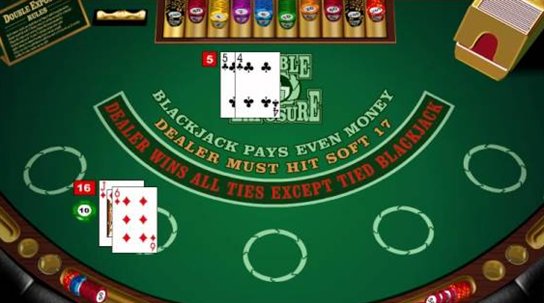
The screen looks ordinary until the deal. Both dealer cards arriving face up is the only visible difference.
The variant is sometimes branded Face Up 21 or similar. Double exposure blackjack rules sit underneath whatever name the client carries.
Checking the rules screen confirms it. Both dealer cards face up is the marker.
Table minimums online start low. A double exposure blackjack table opening at one dollar is common on an Ontario lobby.
The interface otherwise matches any blackjack client.
Both dealer cards arrive face up on the deal itself. A double exposure blackjack player therefore never waits for a hole card reveal at any point in the hand.
Everything else on screen matches a standard blackjack client.
Why show both dealer cards?
Because perfect information is worth roughly nine percent to the player. That is an enormous advantage, and the game exists to sell it back through a set of restrictions.
The information is genuine. The price is steep.
Perfect information removes the central uncertainty of blackjack. A player who knows the dealer holds sixteen plays a completely different hand from one who sees only a six.
Nine percent is an enormous swing. Double exposure blackjack has to claw all of it back somewhere.
Nine percent is larger than any rule concession in standard blackjack. No table could offer that information and survive without taking it back.
Double exposure blackjack is therefore a trade rather than a gift.
Removing the hole card removes the single largest unknown in blackjack. A double exposure blackjack player knows exactly what total they have to beat before acting.
That certainty is the product being sold.
How is the advantage taken back?
Ties lose, blackjack pays even money, doubling is restricted, and splitting is limited on most tables. Together those rules recover the nine percent and leave the house ahead.
No single rule does it. The set does.
Each restriction is worth a stated amount. Losing ties is the largest single recovery, the even money blackjack payout is second, and the doubling limits finish the job.
Remove any one and the game favours the player. Double exposure blackjack depends on the full set.
Reading all four restrictions before sitting is the whole preparation. A double exposure blackjack table publishes every one of them in the rules screen.
Tables differ enough to matter. Two versions can sit half a point apart.
Nothing about the restrictions is hidden. A double exposure blackjack rules screen lists every one before the first hand.
Comparing two tables takes two minutes.
Four restrictions do the work between them. A double exposure blackjack table loses ties, pays even money on naturals, restricts doubling and limits splitting.
Removing any one would tip the game.
Why does losing ties hurt so much?
Because pushes are common in blackjack and each one now becomes a loss. Roughly eight percent of hands tie at a standard table, and converting those to losses is the single largest cost here.
Tied blackjacks usually pay. Everything else does not.
Pushes are frequent in blackjack because both sides make the same totals regularly. Twenty against twenty is the most common tie on any table.
Converting those to losses is worth roughly eight percent. That is the core of the double exposure blackjack edge.
Twenty is the most common standing total on both sides. A double exposure blackjack player meeting a dealer twenty with their own twenty loses rather than pushes.
That single outcome arrives constantly.
Eight percent of hands is a large share to convert. That single rule does most of the work in double exposure blackjack.
Tied blackjacks are the exception on most tables.
A push costs nothing in standard blackjack. Converting every one of them into a loss is the largest single transfer in double exposure blackjack.
Twenty against twenty is the common case.
What happens on a tied blackjack?
Most tables pay the player, which is the one concession the tie rule makes. A handful of stricter versions treat it as a loss like any other tie.
Reading that line before sitting is worth doing.
The concession costs the house very little because blackjacks tie rarely. Most double exposure blackjack tables therefore pay it without much reluctance.
Stricter versions exist. Reading the rule before sitting costs one glance.
Naturals tie rarely enough that the concession costs the house little. Most double exposure blackjack tables therefore pay it.
A version that does not is meaningfully worse.
Two naturals arriving together is rare enough to cost the house almost nothing. That is why most double exposure blackjack tables concede it.
A version treating it as a loss is worth avoiding.
Why does blackjack pay even money?
Because three to two would hand back too much of the recovered edge. Removing the bonus payout is worth roughly two and a quarter percent to the house.
That rule alone matches a bad blackjack table.
Three to two on a natural is worth roughly two and a quarter percent at a standard table. Removing it is one of the largest levers available to any variant.
Double exposure blackjack uses it in full. No version pays the bonus rate.
Removing the three to two payout is worth more than every doubling restriction combined. It is the second largest lever in the game.
No double exposure blackjack version pays the bonus rate.
Even money on a natural matches the worst rule in standard blackjack. Double exposure blackjack applies it universally.
No version pays three to two.
The bonus payout is the largest single rule a blackjack table can give away. Removing it entirely is worth more than two percent.
Every double exposure blackjack build applies it.
What are the doubling rules?
Doubling is usually restricted to hard totals of nine, ten and eleven. A minority of versions allow any two cards, and those tables are worth finding because the freedom is valuable here.
Doubling after splitting is often refused.
Restricting doubles to nine, ten and eleven removes the soft doubling that good blackjack play relies on. That restriction is worth a meaningful fraction of a percent.
Tables allowing any two cards are better. A double exposure blackjack player should prefer them where available.
Soft doubling is where standard blackjack earns much of its value. Removing it costs a double exposure blackjack player a meaningful share of the advantage.
Tables allowing any two cards are worth finding.
Nine, ten and eleven cover the hands where doubling earns most. A double exposure blackjack table restricting further than that is expensive.
Any two card doubling is the version to look for.
What are the splitting rules?
Splitting is generally allowed once, sometimes twice, while resplitting aces is rarely permitted. Split aces usually receive one card each with no further action.
Restrictions vary more than in standard blackjack.
Split limits vary more than any other rule between suppliers. Certain versions allow three splits and others allow one.
Aces are the important case. A double exposure blackjack table permitting a hit on split aces is unusually generous.
Split restrictions vary more between suppliers than any other rule. A double exposure blackjack table allowing resplits is unusual and favourable.
Split aces almost always receive one card.
One split is the common limit. A double exposure blackjack table allowing three is unusual and favourable.
Split aces receive a single card on almost every version.
Does the dealer hit soft 17?
On most versions yes, which adds roughly two tenths of a percent to the house edge. A table where the dealer stands on soft seventeen is meaningfully better.
The rule is stated in the rules screen.
Hitting soft seventeen is standard across most versions. The rule costs the player roughly two tenths of a percent wherever it appears.
Standing versions exist and are better. A double exposure blackjack rules screen states which applies.
The rule is stated in one line of the rules screen. A double exposure blackjack table standing on soft seventeen is worth about two tenths of a percent.
Most versions hit. Standing versions exist.
Standing versions exist and are worth seeking. A double exposure blackjack table that stands is meaningfully cheaper.
The line sits in the rules screen.
What is the house edge?
Roughly 0.7 percent on a favourable rule set with correct strategy, rising past one percent when tied blackjacks lose or doubling is tightly restricted.
Rule variation matters more here than in blackjack.
Rule variation swings the figure further here than in standard blackjack. A generous table sits near 0.7 percent and a restrictive one climbs past one and a half.
Reading four lines decides it. Double exposure blackjack publishes all of them before the first hand.
Four rule lines decide the figure entirely. A double exposure blackjack player reading them knows what the table costs before the first hand.
Guessing is expensive. Rule spread is wide here.
Rule spread here is wider than in standard blackjack. A double exposure blackjack table can sit anywhere between seven tenths and one and a half percent.
Four lines of the rules screen decide which.
Does blackjack strategy work here?
No. Knowing the dealer total changes almost every decision, and applying a standard chart costs several percentage points rather than a fraction of one.
The correct chart is completely different.
Applying a blackjack chart is not a small error at this table. Standard strategy is built entirely around an unknown dealer hole card, and that uncertainty no longer exists.
The gap runs to several percentage points. Double exposure blackjack demands its own chart.
The two charts diverge on most borderline hands. A double exposure blackjack player using a blackjack chart is paying several points for the habit.
Correct charts are published freely online.
Loading the correct chart takes a minute. A double exposure blackjack session played on it reaches the published figure.
Guessing costs several points.
How does the strategy differ?
Play is driven by the dealer’s exact total rather than an up card. A player stands on twelve against a dealer sixteen and hits sixteen against a dealer twenty, because the outcome is already known.
Most decisions become obvious. Others become counterintuitive.
The dealer total replaces the up card as the input to every decision. A player facing a dealer eighteen must reach nineteen or better and plays accordingly.
Standing ranges collapse against strong dealer hands. Double exposure blackjack turns cautious play into an automatic loss.
Every decision reduces to one question. A double exposure blackjack player asks whether their total beats the dealer total already on the table.
Uncertainty disappears. Arithmetic replaces it.
The dealer total replaces the up card entirely. Every double exposure blackjack decision follows from it.
Nothing else is needed.
Standing ranges collapse against a strong dealer total. A double exposure blackjack player facing nineteen hits totals blackjack would never touch.
Against a weak dealer they stand on anything.
What is the clearest example?
A dealer standing total of seventeen through twenty. The player must reach a higher total or lose, so hitting hard sixteen against a dealer twenty is correct rather than reckless.
Standing there loses automatically. Hitting wins sometimes.
Hard sixteen against a dealer twenty is the textbook case. Standing loses with certainty, so drawing is correct however uncomfortable it feels.
Blackjack players find that decision alien. Double exposure blackjack makes it obvious once the dealer hand is visible.
Standing on sixteen against a dealer twenty loses one hundred percent of the time. Drawing loses most of the time and wins occasionally.
Double exposure blackjack makes that comparison explicit.
Hitting sixteen against a dealer twenty is the decision blackjack players resist hardest. Standing there loses every time.
Double exposure blackjack removes the doubt entirely.
When does the player stand low?
Against a dealer hand that will bust. A dealer showing a hard twelve through sixteen must draw, so the player stands on anything and lets the dealer break.
Perfect information makes that decision certain.
Any dealer total from twelve through sixteen must draw under the house rules. A double exposure blackjack player facing one of those stands on anything and waits for the bust.
Standing on a hard twelve is correct there. Blackjack would rarely allow it.
House rules force the dealer to draw on twelve through sixteen. A double exposure blackjack player facing one of those hands stands and waits.
Standing on a hard twelve is correct there.
House rules force a draw on every dealer total from twelve to sixteen. A double exposure blackjack player facing one simply waits.
Standing on a hard twelve is correct there.
Can you count cards?
The count matters less than in blackjack because the dealer hand is visible. Online shoes reshuffle every hand anyway, which removes the question entirely.
Strategy accuracy is worth far more than counting.
Visible dealer cards reduce the value of a count considerably. The information a counter is trying to infer is already on the table.
Online play settles it entirely. A certified double exposure blackjack shoe reshuffles every hand.
The dealer hole card is the information a counter usually chases. Double exposure blackjack gives it away for free on every hand.
Online reshuffling removes the question entirely.
Online shoes reshuffle every hand. A double exposure blackjack count carries nothing forward.
Chart accuracy matters far more.
Who makes double exposure blackjack?
A range of suppliers ship versions with differing rules. Play n GO, Microgaming and a small number of live studios all carry a build, and the tie and blackjack rules differ between them.
The supplier decides the rule set. Read it first.
Rule sets differ enough that two versions can publish edges half a point apart. Checking the supplier is less useful than checking the four rule lines.
The loading screen names the studio. A double exposure blackjack rules screen names the rules.
Rule sets differ enough between builds to change the published figure noticeably. Checking the rules matters more than checking the studio name.
The loading screen names the supplier.
Rule sets differ enough between builds to change the cost meaningfully. Checking four lines matters more than checking the studio.
The supplier name sits on the loading screen.
Is there a live dealer version?
Rarely. The format suits software because the dealt cards are exposed immediately, and live studios prefer formats built around a reveal.
Most Canadians meet it as a software table.
Live studios build around suspense, and exposing both cards immediately removes it. That is why double exposure blackjack has never become a live dealer staple.
Software versions are everywhere. Ontario lobbies list several.
Live formats are built around a reveal. Double exposure blackjack removes the reveal entirely, which is why studios rarely run it.
Software tables are the practical route.
Are there side bets?
Certain versions carry pair or match side bets. They resolve on the player cards and carry far higher house edges than the main game.
The main game is the reason to sit down.
Side bets on this format resolve on the player cards rather than the dealer hand. Their house edges typically run several times the main game.
Skipping them is free. A double exposure blackjack player leaving the circles empty keeps the published figure.
Side bets here resolve on the player cards alone. Their house edges run far above the main double exposure blackjack game.
Leaving the circles empty is free.
Pair and match side bets resolve on the player cards alone. Their edges run far above the main double exposure blackjack game.
Leaving the circles empty costs nothing.
How does it compare with blackjack?
Standard blackjack on good rules costs about half a percent and this one costs around seven tenths. The difference is small, and the playing experience is completely different.
One hides the dealer hand. One shows it.
The edges are close and the experience is not. One game asks a player to guess and the other asks them to calculate.
Preference decides it. Double exposure blackjack suits a player who dislikes uncertainty more than they dislike losing ties.
Published edges sit within a quarter of a point on good rule sets. The playing experience differs completely.
Double exposure blackjack replaces judgement with calculation.
Good rule sets put the two within a quarter of a point. A double exposure blackjack player is buying certainty rather than value.
Preference decides between them.
How does it compare with Spanish 21?
Both are blackjack variants that trade a structural concession against a set of restrictions. Spanish 21 removes the tens and loosens the rules, and this one reveals the dealer and tightens them.
Published edges land in a similar range.
Both variants make one structural concession and recover it through rules. Spanish 21 gives away the tens and loosens everything, and this one gives away the dealer hand and tightens everything.
Both demand their own chart. Neither works on a blackjack one.
Both variants demand their own chart and neither works on a blackjack one. That is the practical similarity.
Double exposure blackjack tightens rules where Spanish 21 loosens them.
Where can Canadians play double exposure blackjack?
Registered Ontario operators carry software versions from a range of suppliers, and the provincial platforms list the game among their blackjack variants rather than as a category of its own.
Land based tables are very rare in Canada.
Catalogue depth decides availability. A registered Ontario operator carrying a full table agreement usually lists double exposure blackjack among its variants.
Searching by name is quicker than browsing the blackjack filter.
Catalogue depth decides availability more than operator size. A registered Ontario site with a full table agreement usually lists double exposure blackjack.
Searching by name is quicker than browsing.
Provincial platforms list it among blackjack variants. Double exposure blackjack reaches players outside the private Ontario market that way.
Land based tables are rare.
Software catalogues carry it more often than live studios do. A registered Ontario operator with a deep table agreement lists double exposure blackjack among its variants.
Land based tables are very rare.
Is double exposure blackjack certified in Ontario?
Yes. Every table on a registered Ontario lobby has passed independent laboratory testing of the shuffle, the paytable and the published return before deployment.
The tested build is the deployed build.
Testing covers the shuffle and the rule set together. A certified double exposure blackjack table applies exactly the rules its screen states.
Certification is per market as well as per title.
Testing covers the shuffle and the rule set together. A certified double exposure blackjack table applies exactly what its screen states.
Certification is per market as well as per title.
Does it count toward wagering?
Usually at a reduced rate or not at all. A blackjack variant costing under one percent clears a bonus requirement far too cheaply for an operator to allow at full rate.
Check the contribution table before claiming.
Element of risk is why operators restrict blackjack variants so heavily. A game costing under one percent clears a requirement at a fraction of a slot cost.
Reading the rate before claiming is the whole check.
Excluded games sometimes void an entire bonus rather than contributing nothing. That clause matters more than the rate beside double exposure blackjack.
Rates differ per operator.
Is it good for a small bankroll?
Yes, on a favourable rule set with the correct chart. The low edge stretches a modest balance, and restricted doubling keeps exposure per hand lower than standard blackjack.
Side bets undo that immediately.
Restricted doubling keeps per hand exposure lower than a standard blackjack table. A double exposure blackjack player rarely commits more than two units on a hand.
Deposit limits sit inside every registered Ontario account.
Restricted doubling caps per hand exposure at two units on most tables. A double exposure blackjack session is therefore predictable.
Deposit limits sit inside every registered Ontario account.
Two units is the usual maximum per hand. A double exposure blackjack session is predictable as a result.
Side bets break that.
Restricted doubling caps exposure at two units on most hands. A double exposure blackjack session is therefore easier to budget than standard blackjack.
Deposit limits sit inside every registered account.
What does a Canadian check before playing double exposure blackjack?
Three things before the first hand. Whether a tied blackjack pays, which totals can be doubled, and whether the dealer hits soft seventeen.
Then load a double exposure chart, never a blackjack one.
A fourth check is worth adding. Loading the correct chart before the first hand is worth more than any of the three rule checks on their own.
None of it requires a deposit. Double exposure blackjack publishes its rules in the client.
The habit transfers to every blackjack variant in the lobby. Double exposure blackjack is simply where the rule spread is widest.
None of it requires a deposit to read.
All four checks sit in the rules screen before a deposit. A double exposure blackjack table publishes its tie rule, its blackjack payout and its doubling limits together.
Reading them takes under a minute.
Which game pages are worth reading next?
Four pages sit closest to this one. Each covers a game or a rule that touches the subject above, and each stands on its own.
Double exposure blackjack sells certainty and charges for it in ties and in blackjack payouts. Read those two lines and the rest of the table is straightforward.