
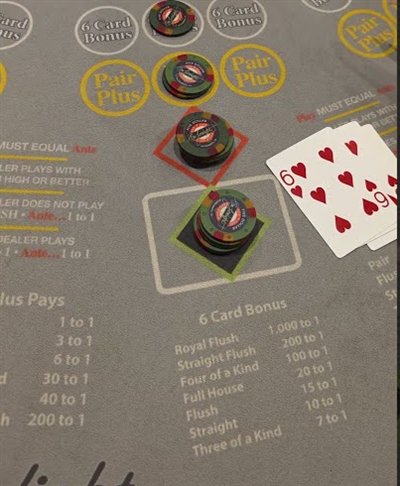
Three card poker is two bets pretending to be one. The Ante and the Pair Plus sit side by side on the same felt, they are settled under different rules from the same three cards, and a player who treats them as a single wager is paying for a game they did not choose. For the wider market picture, start at our online casino Canada hub.
The table below sets out how the game behaves. Read it first, then work through the detail beneath.
| Trait | Detail |
|---|---|
| Cards dealt | Three to the player, three to the dealer |
| Wagers | Ante and Play, plus an optional Pair Plus |
| Dealer qualification | Queen high or better |
| House edge | Roughly 3.4 percent on Ante and Play |
| Optimal rule | Play with Queen six four or better |
| Canadian supply | Ontario operators and provincial platforms |
What is three card poker?
A casino table game where a player receives three cards and beats the dealer three cards or does not. There is no drawing, no community cards and no betting round against other players.
One decision exists per hand. Play or fold.
The game reached casino floors relatively recently by table standards and spread faster than anything around it. A hand resolves in under a minute and the rules take one sentence to explain.
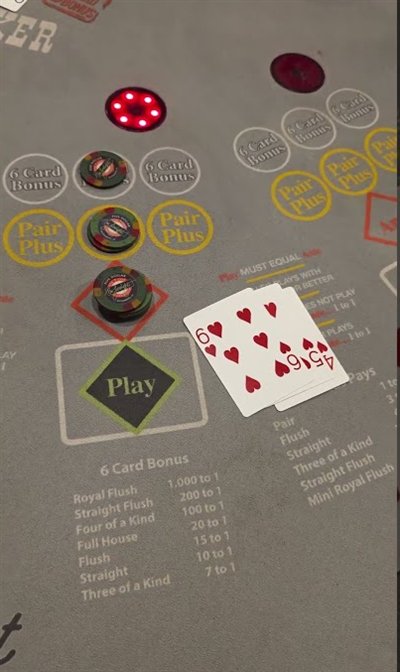
That speed is why three card poker sits beside blackjack on almost every Ontario lobby rather than in a specialist corner of the table section.
The house banks every hand, which is the structural difference from the poker most Canadians picture. Nobody at the table competes against anybody else and no bluffing exists anywhere in the format.
Canadians meet it in the table section rather than the poker room. Three card poker sits with the house banked games because that is exactly what it is.
Table minimums online start around one dollar. Three card poker is among the cheaper table games to sit at.
Why are there two separate bets?
Because they answer different questions. The Ante plays against the dealer hand, and the Pair Plus pays on the strength of the player three cards alone whatever the dealer holds.
Either can be placed without the other. Most tables allow both.
The felt encourages treating them as one. Both circles sit within a few centimetres of each other and both accept chips at the same moment, which is exactly how players end up backing a wager they never evaluated.
They carry different house edges. Placing both on every hand of three card poker means paying two different rates on the same three cards.
Backing one and not the other is entirely normal. Plenty of regulars play the Ante route alone and leave the Pair Plus circle empty every hand of three card poker they sit through.
Splitting a bankroll across both halves every hand is the habit worth avoiding. Three card poker charges two different rates on the same deal.
The Ante circle and the Pair Plus circle settle independently. A three card poker hand can lose one and win the other.
How does a hand play out?
The player posts an Ante, receives three cards face up, and chooses to fold or to match the Ante with a Play wager. The dealer hand is then revealed and the two are compared.
Folding forfeits the Ante. Playing doubles the money at risk.
The player sees their own cards before deciding, which is unusual for a house banked table game. That single piece of information is what makes a correct strategy possible at all.
Everything else is fixed. The dealer draws nothing, the player draws nothing, and three card poker resolves on the cards already dealt.
The pace suits a short session. A hand of three card poker resolves in well under a minute online and the decision itself takes a second once the threshold is known.
The dealer cards stay face down until the decision is made. Nothing in three card poker reveals them early, and nothing about the player hand changes after the deal.
What is the dealer qualification rule?
The dealer needs Queen high or better to qualify. Below that the Ante pays even money and the Play wager is returned, which means a winning hand can pay less than expected.
Roughly a third of dealer hands fail to qualify. That matters.
Roughly thirty percent of dealer hands fail to reach Queen high. That is not a rare event, and a player who has not read the rule will meet it several times in an ordinary session.
The push is the part that surprises people. A premium hand in three card poker can win and still collect only the Ante when the dealer misses qualification.
The rule is the single biggest source of complaints about the game. Players who read it once stop being surprised, and players who do not keep meeting an outcome that reads as unfair.
Reading it once before the first hand costs nothing. Three card poker prints the condition on the felt and in the rules screen.
The condition applies to every hand without exception. Three card poker never waives it.
Why does non qualification reduce a payout?
Because the Play wager is pushed rather than paid. A strong hand facing an unqualified dealer collects on the Ante alone, so the best outcome of the hand is capped by the dealer weakness.
The rule protects the house. It is stated on the felt.
The rule exists to balance the game rather than to trap anybody. Without it the player advantage from seeing their own cards first would be considerably larger than the paytable could absorb.
It is published on the felt and in the rules screen. Nothing about three card poker hides the condition, and plenty of players still miss it.
An unqualified dealer is still a win rather than a loss. The hand pays even money on the Ante and returns the Play wager, which beats the alternative even though it disappoints.
The Ante bonus still pays on a premium hand regardless. That is the one part of three card poker qualification does not touch.
The felt itself prints the condition. A three card poker layout carries the qualification line beside the Ante circle.
What beats what in three card poker?
A straight beats a flush here, which reverses the usual order. With only three cards a straight is rarer than a flush, and the ranking follows the actual probability.
Straight flush is highest. Then three of a kind.
The reversal catches experienced poker players more often than beginners. A five card habit says a flush beats a straight, and three cards make a straight the harder hand to reach.
Reading the ranking once fixes it permanently. Every version of three card poker uses the same order and every rules screen prints it.
Three of a kind sits above a straight for the same reason. Fewer cards make the combination rarer, and every ranking in three card poker follows the probability rather than the five card convention.
A pair is the lowest paying combination on the side bet. Everything below it loses the Pair Plus wager outright.
An ace high hand beats nothing but a lower high card. Three card poker still folds it under the threshold rule.
What is the Pair Plus bet?
A wager paying on the player hand alone, starting at a pair. The dealer cards are irrelevant to it and so is the qualification rule, which makes it the simpler of the two wagers.
It pays on rank rather than on a contest. Nothing else applies.
It is a side bet in structure even where the felt gives it equal billing. Nothing about the dealer hand affects it, and a player can back it without ever placing an Ante.
That independence is its appeal. A Pair Plus wager on three card poker resolves on rank alone and needs no decision after the cards arrive.
Roughly a quarter of three card hands contain a pair or better. That frequency is what makes the wager feel active even when the ladder is a poor one.
Skipping it entirely is a legitimate way to play. Three card poker works perfectly well as an Ante and Play game alone.
What does Pair Plus pay?
Even money on a pair, rising through flush, straight and three of a kind to a straight flush. The exact ladder varies between tables and the difference is real money.
Read the paytable before sitting. Two tables differ.
The ladder typically runs one to one on a pair, three or four to one on a flush, six to one on a straight, thirty to one on three of a kind and forty to one on a straight flush.
Every step varies between operators. The flush rung moves most often, and on three card poker it is the one worth checking before anything else.
The top rungs are almost never reached. A straight flush appears roughly once in four hundred hands, so the forty to one payout contributes very little to the actual return.
The pair rung carries most of the return. Everything above it on a three card poker ladder is rare enough to contribute little.
Paytables are published before a hand is dealt. Three card poker prints the ladder in the rules screen.
Land based felts print the ladder directly on the table. Online three card poker moves it into the rules screen instead.
Which paytable should you look for?
The one paying four to one on a flush rather than three to one. That single step is worth more than a percentage point of house edge over a session.
Operators publish it in the rules. It takes one glance.
The difference between a three to one flush and a four to one flush is roughly a point and a half of house edge. A flush is the most common qualifying hand above a pair, so the rung carries real weight.
Two Ontario operators can run different ladders on the same title. Checking the three card poker paytable takes one glance at the rules screen.
Operators rarely advertise the ladder outside the game. The information sits in the rules screen because regulation requires it there, and a player who never opens it never sees which three card poker table they chose.
Comparing two operators takes two minutes. The three card poker ladder is published in the client on both of them.
The flush rung is the one that moves. Everything else on a three card poker ladder is usually standard.
What is the Ante bonus?
A payment on the Ante for a strong player hand regardless of the result. A straight, three of a kind or straight flush pays the bonus even when the dealer wins the hand.
It applies to the Ante alone. The Play wager is unaffected.
It pays regardless of the hand result, which makes it genuinely separate from the contest. A straight typically pays one to one, three of a kind four to one and a straight flush five to one.
The bonus is automatic rather than optional. Every Ante placed on three card poker carries it and no additional stake is required.
The bonus is the reason the Ante route holds its edge. Without it the qualification rule would push the house advantage well above what the game could sustain.
It pays even on a losing hand, which surprises players. Three card poker settles the bonus separately from the contest.
What is the correct playing strategy?
Play any hand of Queen six four or better and fold everything below it. That single rule captures almost all of the available value and takes no memorisation beyond one line.
Deviating costs money. The rule is genuinely optimal.
Compared with a full blackjack chart this is trivially easy. One threshold covers every hand a player will ever be dealt, and no exceptions or side conditions apply to it.
The rule captures almost all available value. Playing three card poker at Queen six four or better reaches the published edge without any further study.
Applying it costs nothing and takes no time. A player who checks whether their hand reaches Queen six four is playing three card poker at its published figure from the first hand.
No chart is needed and no memorisation beyond one line. That simplicity is what three card poker sells.
The rule applies from the very first hand. Three card poker asks nothing further of a player.
Why Queen six four exactly?
Because that is the point where matching the Ante becomes better than surrendering it. Above it the Play wager returns more than the forfeited Ante, and below it folding loses less.
The threshold is arithmetic rather than instinct. It holds everywhere.
The arithmetic compares two outcomes. Folding forfeits the Ante outright, and matching it risks a second unit for a hand that wins often enough to justify the exposure above that threshold.
Below it the second unit loses more than the forfeited Ante does. That is the whole calculation behind the three card poker rule.
Hands close to the threshold are the ones worth checking carefully. A Queen seven is a play and a Queen six three is a fold, and the difference between them is genuinely small.
Rounding the rule to any Queen costs very little. Playing any Queen at three card poker is close enough for most sessions.
What is the house edge?
Roughly three point four percent on the Ante and Play combination with correct strategy, measured against the Ante alone. Against total money wagered the figure is lower.
Pair Plus differs by paytable. It runs from two to seven percent.
Quoting the figure against the Ante alone is the industry convention and it overstates the cost. Measured against every dollar actually wagered across a session the figure is closer to two percent.
Either way it is competitive. Three card poker sits between blackjack and most slots on a Canadian lobby.
Comparing published figures across games only works when the basis matches. A three point four percent figure quoted against the Ante and a slot percentage quoted against total stake are not the same measurement.
Element of risk is the fairer comparison figure. On three card poker it sits closer to two percent than to three.
Both figures appear in the rules screen. Three card poker publishes them alongside the paytables.
Is Pair Plus worth playing?
On a four to one flush table it is competitive with the main game. On a three to one table it is considerably worse and the Ante and Play route is the better value.
The paytable decides it entirely. Nothing else does.
The honest position is that it depends entirely on one number. A four to one flush makes the side bet reasonable value, and a three to one flush makes it clearly worse than the main game.
Nothing else about three card poker changes between those two tables. The rest of the rules are identical.
Variance is the other consideration. Backing Pair Plus every hand adds a third unit to the exposure and produces a session with larger swings in both directions.
The decision is per table rather than per session. One three card poker table can justify it and the next cannot.
The answer changes with the table rather than the day. Three card poker publishes the ladder before the first hand.
Can you count cards in three card poker?
Not in any practical sense online. The shoe is shuffled every hand by a certified generator, so no information carries between hands at all.
Live dealer tables shuffle frequently too. The edge stays put.
Online the question does not arise. A certified generator shuffles a full deck for every hand, so no card seen in a previous hand carries any information into the next.
Live dealer tables shuffle frequently as well. Neither route offers a countable edge at three card poker.
Shoe based versions exist on a handful of land based floors. Even there the penetration and the hand structure leave nothing worth tracking across hands.
Online shuffles are per hand and certified. No sequence carries forward at a three card poker table.
Where can Canadians play three card poker?
Registered Ontario operators carry both software and live dealer versions, and the provincial lottery platform runs its own table alongside blackjack and roulette.
Land based floors carry it too. The rules match closely.
Availability is unusually broad for a table game. Registered Ontario operators carry software and live versions, the provincial lottery platform runs its own, and land based floors across the country deal it.
The rules match closely across all three. What changes between them is the paytable and the minimum stake rather than how three card poker is played.
Table minimums differ sharply between the channels. A software table starts around a dollar, a live table starts higher, and a land based floor sets its own minimum by the hour.
Search by name rather than browsing the table section. Three card poker surfaces immediately on any lobby that carries it.
Availability is broad across the regulated market. Three card poker appears on almost every Ontario lobby.
Does the live dealer version differ?
The rules match and the pace does not. A live table deals to a schedule shared with other players, and a software table waits for one player indefinitely.
Stakes usually start higher live. Software minimums run lower.
The social element is the visible difference. A live table shows other players making the same decision, and a software table shows nothing but the cards.
Pace is the practical one. Three card poker dealt live runs to the table schedule, and the software version waits indefinitely for one decision.
Side bet availability sometimes differs as well. A live three card poker table may carry an extra wager that the software version of the same game does not offer.
Streaming quality and studio schedule set the pace. The rules of three card poker are identical on both routes.
Both routes are certified for the province. Three card poker rules do not change between them.
Is three card poker certified in Ontario?
Yes. Every table on a registered Ontario lobby has passed independent laboratory testing of the shuffle, the paytable and the published return before deployment.
Live tables are audited separately. Both routes are covered.
Certification covers the shuffle, the paytable and the published return figure before a table reaches a registered lobby. The tested build is the deployed build.
Live tables sit under separate audit arrangements covering the physical equipment and the studio procedures. Both routes into three card poker are regulated.
The regulator publishes its registered supplier list openly. Confirming that a lobby dealing three card poker operates legally takes one search rather than trust in a claim.
The tested build is the deployed build. An operator changes nothing inside a certified three card poker table.
Does three card poker count toward wagering?
Usually at a reduced rate or not at all. Table games clear a bonus requirement more cheaply than slots, so the contribution table restricts them.
Check the rate before claiming. It is rarely one hundred percent.
Table games clear a requirement more cheaply than slots, so operators restrict them. A ten or twenty percent contribution rate is common and a zero rate is not unusual.
The table sits in the bonus terms rather than in the game. Checking where three card poker falls takes one look before claiming anything.
Excluded games sometimes void a bonus entirely rather than simply contributing nothing. Reading the clause matters more than reading the percentage beside it.
Rates differ per operator rather than per game. One site may count three card poker at ten percent and another at zero.
Is three card poker good for a small bankroll?
Reasonably, with one condition. Playing the Ante and Play route alone and skipping Pair Plus keeps the variance modest and the edge at its lowest.
Adding Pair Plus every hand doubles exposure. That is the trap.
The Ante and Play route risks two units per hand at most, which is predictable in a way a slot is not. A modest balance survives a long session at the table minimum.
Adding Pair Plus changes that arithmetic. Three units per hand on three card poker moves through a balance considerably faster.
Setting a hand count before sitting works better than setting a time. Fifty hands of three card poker at the table minimum is a measurable session with a known worst case.
Deposit limits sit inside every registered Ontario account. Setting one before the first three card poker hand is the practical step.
Skipping the side bet halves the exposure. Three card poker played on the Ante route alone is the cheaper session.
How does three card poker compare with blackjack?
Blackjack carries a lower edge and asks far more of the player. One threshold covers this game completely, and blackjack needs a full strategy chart to reach its published figure.
Simplicity is the trade. It costs about two percent.
Blackjack published edges sit near half a percent with perfect play and a favourable rule set. Reaching that number requires a full chart and constant attention.
The trade is explicit. Three card poker asks for one threshold and charges roughly three points for the simplicity.
Session length differs too. A blackjack hand involves several decisions and a three card hand involves one, so the same clock covers far more hands here.
Both reach Ontario through the same registration route. Choosing between them is a choice about effort rather than oversight.
Neither game rewards intuition. Three card poker rewards one threshold and blackjack rewards a full chart.
What should a Canadian check before playing three card poker?
Three things before the first hand. The Pair Plus paytable, the Ante bonus ladder, and the bonus contribution rate in the terms.
Then apply one rule. Queen six four or better.
All three sit in the rules screen or the account area rather than in a review. The paytables appear in the game itself and the contribution rate appears in the bonus terms.
Reading takes under a minute. That minute decides whether a three card poker table is worth sitting at before any money moves.
None of the three checks requires a deposit. Demo tables publish the same paytables, and three card poker states its rules in the client before any money moves.
The habit transfers to every table in the lobby. Three card poker is simply the easiest place to build it.
None of it requires a deposit to read. Three card poker publishes every figure inside the client.
Which game pages are worth reading next?
Four pages sit closest to this one. Each covers a game or a rule that touches the subject above, and each stands on its own.
Three card poker hides two different wagers behind one layout, and the flush payout on the side bet decides whether the table is worth sitting at. Read the paytable, then play Queen six four or better.