
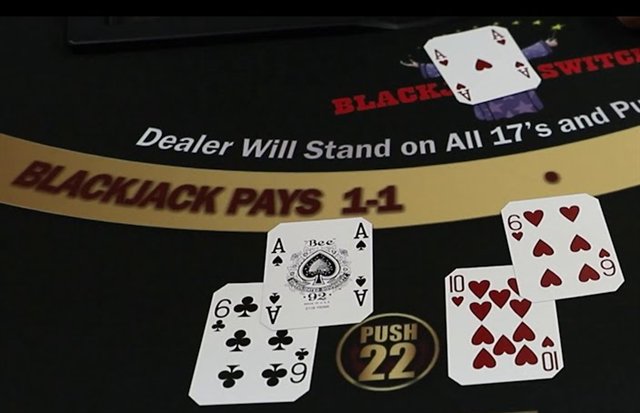
Blackjack switch hands the player something no other blackjack table allows. Two hands are dealt, and the second card of each may be swapped with the other. That single move is worth far more than the house can afford, so a dealer total of twenty two pushes instead of losing. For the wider market picture, start at our online casino Canada hub.
The table below sets out how the game behaves. Read it first, then work through the detail beneath.
| Trait | Detail |
|---|---|
| Hands per player | Two, wagered at equal stakes |
| The switch | Swap the second card of each hand, once, before drawing |
| Dealer 22 | Pushes against every unbusted player hand |
| Blackjack pays | Even money |
| House edge | Roughly 0.6 percent with correct play |
| Canadian supply | Ontario lobbies, Lac Leamy floor, provincial platforms |
What is blackjack switch?
A blackjack variant where the player wagers on two hands at once and may exchange the second card dealt to each. Two compensating rules pay for the privilege, and both cost the player money.
The two wagers must be equal. A blackjack switch table will not accept five dollars on one box and twenty on the other.
That restriction exists because the swap links the hands.
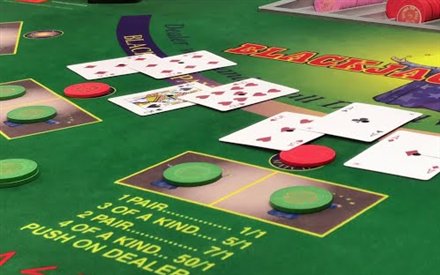
Equal stakes keep the two boxes interchangeable. A blackjack switch player therefore commits double the table minimum on every round they sit for.
The screen enforces the match automatically. Raising one box raises the other.
Nothing about the pairing can be overridden.
The variant runs under other names on some platforms. Rules rather than branding identify a blackjack switch table.
The rules screen is the authority on any given table.
Two boxes and one exchange describe the whole format. A blackjack switch player learns the shape of the game in a single round.
A blackjack switch table states its rules before any wager is accepted.
Who invented blackjack switch?
Geoff Hall patented the game and licensed it to Playtech for online release. Land based floors picked it up first, and the software version followed into regulated markets afterwards.
The design solves a real problem. Blackjack switch turns two mediocre hands into one strong hand and one weak one, which suits the drawing rules far better.
Casinos accepted it quickly.
Patent protection kept the rules identical across licensed builds for years. A blackjack switch table in a Canadian lobby plays the same as one on a Las Vegas floor.
Later clones altered the payouts. The core swap survived unchanged.
Two stiff hands were the problem the designer set out to solve. Blackjack switch answers it directly.
Licensed builds kept the original rules intact.
The patent named the push twenty two rule alongside the exchange. Blackjack switch was designed as one balanced package.
How does a hand play out?
Two equal wagers are placed. Four cards arrive, two to each hand, and the dealer takes one card up. The player then switches or stands pat, and both hands play out in the usual order.
The dealer peeks for a natural where the upcard is an ace or a ten. A blackjack switch round ends immediately on a dealer natural, before the swap is offered.
Both wagers lose in that case.
Round order is fixed and the interface enforces it. A blackjack switch deal presents the swap prompt before any hit button becomes active.
Skipping the prompt keeps the cards as dealt. The prompt cannot be revisited.
Round speed matches a normal blackjack table. The swap prompt adds a second at most.
The dealer draws last, as at any blackjack table.
Hitting, standing, doubling and splitting all follow the exchange. A blackjack switch round then resolves both boxes against the dealer total.
Blackjack switch resolves both boxes in the same dealer sequence.
Which cards can be switched?
Only the second card of each hand moves. The first card of each stays where it was dealt, and the swap happens once, before any hit, double or split decision.
Position is fixed and the cards move between boxes rather than within them. A blackjack switch interface shows arrows between the two second cards.
Clicking either arrow completes the exchange.
No other exchange exists in the game. A blackjack switch player cannot move a first card, cannot swap after hitting and cannot switch between split hands.
One exchange, one moment. That is the entire mechanic.
The restriction is what keeps the game solvable. A blackjack switch chart would be unusable without it.
One exchange is offered and no more.
Interfaces label the movable cards clearly. A blackjack switch screen highlights the two second cards and leaves the others static.
Must the player switch?
The swap is optional on every hand. A player holding two strong totals declines it, and declining costs nothing beyond the two compensating rules that apply to the table regardless.
Declining is a live decision rather than a default. A blackjack switch player who never swaps is paying for a tool they refuse to use.
The compensating rules apply either way.
Two pat hands arrive often enough to matter. A blackjack switch player standing pat on nineteen and twenty is playing correctly rather than passively.
The prompt appears regardless. Declining takes one click.
Roughly a third of deals call for no exchange. Standing pat is a frequent correct answer.
Declining is recorded as a decision, not a timeout.
Forcing the exchange would break the strategy entirely. Blackjack switch leaves the choice open on every deal.
Blackjack switch treats the decline as an ordinary move.
What is the clearest switch example?
Holding a six and a ten alongside a five and an ace gives sixteen and sixteen. Swapping the second cards produces a seven card total of eleven and a hard fifteen turns into a soft sixteen.
Two stiff hands become one doubling hand and one soft hand. Blackjack switch converts a losing pair of totals into a profitable one in a single click.
That conversion is the whole game.
Eleven against a dealer six is the strongest doubling hand in blackjack. Creating one from two stiff totals is exactly what the swap exists to do.
The second hand becomes soft. Soft hands cannot bust on one card.
The example appears in every published tutorial. It shows the mechanic in one deal.
Doubling on the new eleven is the follow up.
Sixteen is the worst total in blackjack and holding two of them is worse still. Blackjack switch removes both in one move.
Why does dealer 22 push?
The switch is worth close to three percent to the player. Pushing on a dealer twenty two removes most of that and keeps the table profitable without touching the swap itself.
The rule is stated plainly on the felt. A blackjack switch table prints dealer twenty two is a push beside the betting boxes.
It applies to doubled and split hands too.
Compensation had to be large and invisible. A blackjack switch player sees the push once every fourteen hands and rarely counts the cost.
The switch feels generous by comparison. Both effects are deliberate.
Designers call the rule a push twenty two. It appears in several later variants as well.
The push applies to every box the player holds.
A bust that pays nothing is the quiet cost of the game. Blackjack switch collects it on the hands a player expects to win.
Blackjack switch prints the rule beside the betting circles.
Does dealer 22 beat a player blackjack?
A natural blackjack still wins against twenty two. Every other unbusted player total pushes, so the natural is the only hand the rule cannot reach.
A switched twenty one does not carry that protection. Blackjack switch treats it as an ordinary total and pushes it against twenty two.
The distinction matters on the payout.
Naturals arrive on roughly one hand in twenty one. A blackjack switch table therefore surrenders very little by paying them against twenty two.
The payout is still even money. Three to two never applies.
The exception is narrow and worth knowing. It applies to naturals alone.
Naturals are paid at even money regardless.
Payouts differ between a natural and a switched twenty one. A blackjack switch screen distinguishes them without comment.
How often does the dealer make 22?
Roughly seven hands in a hundred finish on twenty two. That frequency is enough to strip the player advantage from the switch without appearing on screen very often.
Frequency rises when the dealer hits soft seventeen. A blackjack switch table using that rule reaches twenty two slightly more often than one that stands.
The rules screen states which applies.
Seven percent sounds small against a three percent giveaway. The rule bites on every player hand at once, which is why it covers the cost.
Doubled wagers push as well. Split hands push individually.
The figure comes from simulation rather than estimate. Published studies agree closely.
Six deck and eight deck figures differ marginally.
Simulation puts the figure near seven percent across standard rule sets. Blackjack switch builds vary by a fraction either way.
Why does blackjack pay even money?
Removing the three to two payout is worth about two and a quarter percent. Together with the dealer twenty two rule it accounts for the entire cost of the switch.
No version pays the bonus rate. A blackjack switch table advertising three to two naturals would give the player a clear long term advantage.
Even money is universal here.
Two and a quarter percent is the largest single rule change in the game. Nothing else on a blackjack switch felt moves the figure as far.
The payout is printed on the layout. Checking it takes a second.
Players used to three to two feel the change immediately. The felt states the rate plainly.
The rate is fixed across every licensed build.
Naturals arrive often enough for the change to matter. A blackjack switch player gives up half a unit each time.
Blackjack switch applies the rate to both boxes alike.
Is a switched blackjack still a blackjack?
A hand made by swapping counts as twenty one rather than a natural. It wins even money against a dealer twenty two on most tables and pushes against a dealer twenty one.
Some builds treat it differently on a dealer natural. Reading the blackjack switch payout rules settles the question for the specific table.
The difference is worth a fraction of a percent.
Two twenty one totals can sit side by side with different values. A blackjack switch player holding a natural and a switched twenty one is paid differently on each.
The interface labels them separately. Payouts follow the label.
The rule prevents an obvious exploit. Building naturals by swapping would break the game.
A natural must arrive in the cards as dealt.
Payout labels settle any confusion. A blackjack switch interface marks the natural and leaves the switched hand unmarked.
How many decks are used?
Six decks are standard, and some builds run eight. The count is printed on the rules screen, and the difference between six and eight is worth only a few hundredths of a percent.
Penetration is irrelevant online because the shoe reshuffles each round. A blackjack switch software table never runs deep into the deck.
Live layouts cut the shoe conventionally.
Deck count barely moves the return here. A blackjack switch player choosing between a six deck and an eight deck table can ignore the difference entirely.
Other rules matter far more. The soft seventeen line is worth ten times as much.
Six is the common figure across suppliers. Eight appears on a minority of builds.
The figure appears on the first line of the rules.
Deck count is the least important line on the screen. A blackjack switch player can safely skip past it.
Does the dealer hit soft 17?
Most versions hit. A table standing on soft seventeen returns roughly two tenths of a percent to the player, which makes it the single best rule variation to look for.
The rule interacts with the twenty two push. A blackjack switch dealer hitting soft seventeen busts more often and lands on twenty two more often.
The net effect still favours the house.
Standing tables are the exception rather than the rule. A blackjack switch lobby carrying one is worth returning to for that alone.
The line sits near the top of the rules screen. It reads stands on all seventeens.
This line is the single most valuable one on the screen. It is worth checking first.
Two tenths of a percent is a large swing here.
Standing versions exist and are worth seeking out. A blackjack switch table using that rule is the best version available.
Blackjack switch tables split roughly evenly on this line.
Can the player double after splitting?
Doubling after a split is permitted on the common rule set. Removing it costs the player about a tenth of a percent, so the rules screen is worth a glance before sitting.
Splitting itself works normally. A blackjack switch player may split pairs on either box, and the swap decision happens before any split is taken.
Resplit limits vary between builds.
Doubling on any two cards is the standard permission. A blackjack switch table restricting doubles to nine, ten and eleven costs the player noticeably more.
The restriction is uncommon. It appears on older builds.
The permission is standard on modern builds. Older tables sometimes withhold it.
The rule applies to both boxes equally.
Restricted doubling costs about a tenth of a percent. A blackjack switch table allowing any two cards is preferable.
Can the player surrender?
Late surrender appears on some builds and not others. Where it exists, it applies after the switch decision and returns half the wager on the hand surrendered.
Surrender is worth roughly a tenth of a percent where offered. A blackjack switch table carrying it is a better table than one that does not.
The option appears after the swap.
Late surrender applies once the dealer has checked for a natural. A blackjack switch hand can therefore be surrendered only after the peek resolves.
Half the wager returns. The other half is lost.
Surrender suits stiff hands against a dealer ten. Those arrive often in this game.
Surrender returns half the wager on that box alone.
Stiff totals against a dealer ten arrive frequently here. A blackjack switch table with surrender handles them cheaply.
What is the house edge?
Correct play leaves roughly a fifth of a percent against the player on the best rule sets. Weaker versions push the figure past half a percent.
Rule spread decides the figure. A blackjack switch table standing on soft seventeen and allowing surrender sits at the favourable end of the published range.
Both rules appear on one screen.
Published figures assume perfect switch decisions. A blackjack switch player guessing at the swap loses considerably more than the quoted number.
The scoring table closes that gap. It is freely available.
Rule spread here is wider than at a blackjack table. Table choice matters more as a result.
The best builds sit close to a fifth of a percent.
Poor rule sets push past half a percent. A blackjack switch player choosing carefully keeps the figure near a fifth.
Blackjack switch publishes the figure through its supplier.
Is that better than blackjack?
A good blackjack table returns more per dollar. Blackjack switch compensates by removing much of the variance, because two hands settle on every round instead of one.
Variance and return are separate questions. A blackjack switch player trades a small amount of expected value for far steadier results.
Bankroll requirements drop accordingly.
Two hands per round halves the swing. A blackjack switch bankroll survives a bad session more comfortably than a blackjack bankroll of the same size.
Expected loss rises slightly. Volatility falls sharply.
The comparison depends on what the player values. Steadiness and return pull in opposite directions.
A good blackjack table returns slightly more per dollar.
Lower swings suit a modest bankroll. A blackjack switch session lasts longer on the same deposit.
What is the Super Match side bet?
A wager on the four cards dealt to the player. A pair, three of a kind, two pair or four of a kind each pay a fixed multiple, and the dealer hand is irrelevant.
It settles before the switch decision. A blackjack switch Super Match uses the four cards exactly as dealt, so swapping them changes nothing.
The wager is placed separately.
Four cards give the side bet a reasonable hit rate. A blackjack switch player sees a qualifying pair on roughly one round in four.
Frequent small wins mask the cost. The ladder is where the money goes.
The wager sits in its own circle. It is never compulsory.
It resolves on the opening four cards only.
The exchange never affects the result. A blackjack switch Super Match reads the cards exactly as they arrived.
Blackjack switch settles it before the exchange prompt appears.
What does Super Match pay?
A common ladder pays one to one on a pair, five to one on three of a kind, eight to one on two pair and forty to one on four of a kind.
Ladders differ between suppliers. Comparing the four of a kind rung across two blackjack switch tables shows which build treats the side bet better.
Neither is generous.
Four of a kind is the rung operators trim first. A blackjack switch Super Match paying forty to one is better than one paying thirty.
Two pair varies as well. Both rungs are printed.
Ladders are printed before the first deal. Comparing two takes a glance.
Four of a kind carries the top rung.
The ladder is short and easy to compare. A blackjack switch table trimming the top rung is the weaker choice.
Is Super Match worth playing?
The house edge runs near three percent on the standard ladder. That is five times the main game, so the circle is best left empty on every hand.
Leaving it empty costs nothing. A blackjack switch player forfeits no access and no feature by declining the side wager entirely.
The main game remains fully available.
Three percent against the main game figure is a poor trade. A blackjack switch player funding the side bet is paying five times the table rate on that money.
Skipping it changes nothing else. The swap remains available.
The cost per dollar is the whole argument. Frequency of wins is beside the point.
The circle can be left empty on every round.
Five times the main game rate is the figure that matters. A blackjack switch player skipping it loses nothing.
Blackjack switch loses none of its features when the circle stays empty.
Does blackjack strategy work here?
Basic strategy covers the drawing decisions once the switch is settled. The switch itself needs its own rules, because no blackjack chart contains a column for swapping cards.
Drawing charts need small adjustments for the twenty two rule. A blackjack switch player stands slightly more often against a dealer ten than a blackjack chart advises.
Correct charts are published freely.
Standing totals gain value when a dealer bust becomes a push. A blackjack switch player therefore hits marginally less often than a blackjack chart advises.
The adjustments are few. Most decisions match exactly.
A plain chart gets most decisions right. The gap costs a fraction of a percent.
Standing gains value when a bust becomes a push.
Most decisions carry across unchanged. A blackjack switch player using a plain chart errs only on the margins.
Blackjack switch needs a separate rule set for the exchange alone.
How does the switch decision work?
Compare the two possible pairs of totals and pick the stronger set. The published method scores each hand against the dealer upcard and totals the two scores.
Published scoring tables assign a value to each total against each upcard. A blackjack switch player adds the two values and takes the higher sum.
Software versions rarely warn about mistakes.
Scoring reduces the choice to arithmetic. A blackjack switch player comparing two sums needs no judgement about which pairing looks stronger.
The tables fit on one page. Memorising them is optional.
Scoring tables assign each total a numeric value. Adding two numbers settles the choice.
The higher total score identifies the correct pairing.
Two sums and one comparison end the question. A blackjack switch player needs no intuition at all.
What is the simplest switch rule?
Move toward eleven, twenty and twenty one. A swap that creates any of those three totals is almost always correct, and a swap that destroys one is almost always wrong.
The shortcut covers most hands correctly. A blackjack switch player using it gives up a fraction of a percent against full scoring tables.
Memorising three numbers is enough.
Eleven, twenty and twenty one carry the most value of any totals in the game. A blackjack switch swap that produces one of them is nearly always right.
Destroying one is nearly always wrong. Two rules cover the field.
Three target totals cover the field. The shortcut fits on one line.
Eleven, twenty and twenty one are the target totals.
The shortcut gives up very little against full scoring. A blackjack switch player can use it from the first hand.
Blackjack switch rewards the three target totals above all others.
When should a player not switch?
Two pat hands of nineteen or twenty stay where they are. Breaking a made twenty to chase a double down costs more than the double is worth.
Pat hands are worth protecting. A blackjack switch player holding nineteen and twenty already has the two strongest realistic totals on the felt.
Swapping can only weaken one of them.
Nineteen and twenty win outright against most dealer hands. A blackjack switch player breaking that pair is trading two likely winners for one.
The temptation is a visible eleven. Resisting it is correct.
Made hands deserve protection. Breaking them is the most common beginner error.
Nineteen and twenty are already close to the best pair.
Strong pat totals stay together. A blackjack switch player protecting nineteen and twenty is playing the hand correctly.
Blackjack switch punishes breaking a made twenty more than any other error.
Does the dealer upcard change the switch?
A weak upcard favours keeping two standing totals. A strong upcard favours creating one powerful hand even when the other falls to a stiff total.
Upcard sensitivity is why scoring tables exist. A blackjack switch decision against a six differs from the same cards against a ten.
The shortcut rule ignores that distinction.
A dealer showing five or six busts frequently. A blackjack switch player facing one keeps two standing totals and waits rather than building a doubling hand.
Against a ten the reverse applies. One strong hand beats two weak ones.
Weak and strong upcards pull in opposite directions. Scoring tables capture that automatically.
Fives and sixes bust more often than any other upcard.
The same four cards can call for opposite decisions. A blackjack switch chart reads the upcard before anything else.
Can you count cards in blackjack switch?
Counting works in principle and earns less than it does at a blackjack table. Online shoes reshuffle every round, which removes the question from software play entirely.
Live layouts remain countable in principle. A blackjack switch shoe dealt to a normal cut card behaves like any other multi deck game.
The edge gained is smaller than at blackjack.
The switch reduces what a count is worth. A blackjack switch player already receives information that a counter would normally pay to estimate.
Software shoes remove the question. Every round starts fresh.
The theory holds and the return is thin. Live layouts are the only place it applies.
Online reshuffling ends the discussion entirely.
Software play removes the opportunity entirely. A blackjack switch shoe reshuffles between every round.
Is there a live dealer version?
Live tables have appeared at intervals and rarely stay in the lobby. The software version is the reliable route for a Canadian player who wants the game on demand.
Studio support has been intermittent. A blackjack switch live table appears in some lobbies for a season and then disappears again.
Software availability is far steadier.
The swap is awkward to stage on camera. A blackjack switch live table needs a physical card exchange that slows the round considerably.
Studios prefer faster formats. Software carries the game instead.
Availability comes and goes by season. Checking the live lobby costs nothing.
Software tables remain available at all hours.
Physical exchanges slow a live round noticeably. Blackjack switch therefore suits software dealing better.
Who makes blackjack switch?
Playtech holds the best known online build. Other suppliers run variants under different names with the same core rules and slightly different paytables.
Licensing decides which operators carry it. A blackjack switch table appears in lobbies built on the supplier catalogue that holds the rights.
The loading screen names the studio.
Supplier choice decides the paytable. A blackjack switch clone under another name can carry a worse Super Match ladder and the same core rules.
The rules screen settles it. The name on the felt does not.
The studio name appears on the loading screen. Paytables differ between them.
Playtech builds are the most widely distributed.
Clones under other names carry different ladders. A blackjack switch player checks the rules rather than the title.
How does it compare with blackjack?
Standard blackjack pays three to two and settles one hand. Blackjack switch pays even money, settles two hands, and gives the player a decision that no other table offers.
Two boxes settle on every round. A blackjack switch session produces twice the hand count of a blackjack session at the same table speed.
Results smooth out much faster.
Blackjack pays more per winning hand. Blackjack switch pays more often, because the swap converts losing pairs of totals into winning ones.
Both games reward reading the rules screen. Neither rewards guessing.
One pays more per win and the other wins more often. Both are worth learning properly.
Two boxes settle on every single round here.
The exchange is the only real difference in play. Blackjack switch keeps every other blackjack decision intact.
Blackjack switch doubles the hand count at the same table speed.
How does it compare with double exposure blackjack?
Double exposure shows both dealer cards and takes payment through losing ties. Blackjack switch keeps the hole card hidden and takes payment through the dealer twenty two push.
Both variants demand their own chart. A blackjack switch player using a plain blackjack chart loses less than a double exposure player doing the same.
The adjustments here are smaller.
Double exposure removes uncertainty and charges heavily for it. Blackjack switch adds a decision and charges less, which leaves a better return on the best rule sets.
Charts differ for both. Neither uses a plain blackjack chart.
Both variants trade information for cost. The pricing differs sharply.
One hides the hole card and the other reveals it.
One charges through losing ties and the other through a pushed bust. Blackjack switch takes the cheaper route on good rule sets.
How does it compare with Spanish 21?
Spanish 21 removes the tens and repays the player through bonus payouts and liberal drawing rules. Blackjack switch keeps the full deck and repays through the swap instead.
Spanish 21 rewards long drawn hands with bonus payouts. Blackjack switch rewards pairing the right cards together before any drawing begins.
Neither game uses a standard chart.
Spanish 21 pays bonuses for five card and six card twenty ones. Blackjack switch pays nothing extra for a long hand and rewards the opening four cards instead.
Both sit near half a percent. Rule sets decide which is cheaper.
One rewards long hands and the other rewards the opening four cards. Rule sets decide the cheaper table.
Spanish 21 strips the tens from every deck.
Removing the tens changes every drawing decision. Blackjack switch leaves the deck alone and changes the deal instead.
Where can Canadians play blackjack switch?
Ontario registered operators carrying the Playtech catalogue list it in their table section. Casino du Lac Leamy has run a live layout, and provincial platforms stock the software build.
Catalogue depth decides availability. A registered Ontario operator without the relevant supplier agreement will not list blackjack switch at all.
Searching by name is quicker than browsing.
Lobby search boxes accept the full title. A Canadian typing blackjack switch into one finds the table in seconds where the operator carries it.
Absence usually means no supplier agreement. Another operator will list it.
The search box is faster than the table filter. Typing the full name finds it.
Ontario carries the deepest table catalogue in the country.
Supplier agreements decide the lobby. A Canadian looking for blackjack switch checks operators carrying the relevant catalogue.
Blackjack switch appears under the table games heading in most lobbies.
Is blackjack switch certified in Ontario?
Registered operators run laboratory tested builds. The shuffle, the payout table and the dealer rules are all fixed at certification, and no operator can change them afterwards.
Certification is granted per market and per title. A blackjack switch build approved in another jurisdiction is retested before an Ontario release.
The operator displays its registration number.
Testing covers the shuffle, the payouts and the dealer rules together. A certified blackjack switch table applies exactly what its rules screen states.
Operators cannot alter a tested build. The laboratory report fixes it.
Certification is per market and per title. The registration number sits in the footer.
Laboratory testing precedes every market release.
An operator cannot alter a tested build. A certified blackjack switch table plays exactly as its rules screen states.
Blackjack switch builds are tested before any Ontario release.
Does blackjack switch count toward wagering?
Blackjack variants usually contribute at a reduced rate, and several bonus terms exclude them completely. The contribution clause matters more than the headline bonus figure.
An excluded game can void an entire bonus. That clause matters more than the rate printed beside blackjack switch in the terms.
Rates differ between operators.
Reading the exclusion list takes longer than reading the headline. A bonus excluding blackjack switch is worthless to a player who only plays that table.
The list sits in the terms. It is rarely on the promotion page.
Exclusion clauses matter more than contribution rates. Both appear in the terms.
Table game contribution often sits at ten percent or lower.
The exclusion list decides whether a bonus is usable. A player who only plays blackjack switch reads it first.
Is blackjack switch good for a small bankroll?
Two hands means two stakes on every round. A table with a one dollar minimum therefore costs two dollars a round, and the effective minimum is double the printed one.
Doubling and splitting raise the exposure further. A blackjack switch round can reach four units on an aggressive pair of hands.
Table minimums start low online.
The doubled stake is the main consideration. A blackjack switch player on a one dollar table is really playing a two dollar game.
Lower variance offsets it partly. Session length improves as a result.
The effective minimum is double the printed one. Planning around that avoids surprises.
Deposit limits sit inside every registered account.
Two boxes double the stake per round. A blackjack switch player plans around that from the start.
Blackjack switch charges two units on every round it deals.
What does a Canadian check before playing blackjack switch?
Four lines decide the table. The soft seventeen rule, the double after split rule, the surrender rule and the Super Match ladder are all on the rules screen before any money moves.
None of it requires a deposit to read. Blackjack switch publishes every relevant rule before the first wager is placed.
The habit transfers to every blackjack variant in the lobby.
Four rules and one ladder decide the table entirely. A blackjack switch player reading them knows the cost before the first card is dealt.
Registration status is the fifth check. It appears in the site footer.
Five checks and a minute of reading cover it. Nothing here needs a deposit.
Every figure is published before the first wager.
The rules screen carries four of the five checks. Blackjack switch publishes the rest in the site footer.
Blackjack switch asks for nothing that is not already on screen.
Which game pages are worth reading next?
Four pages sit closest to this one. Each covers a game or a rule that touches the subject above, and each stands on its own.
Blackjack switch gives the player a move worth three percent and charges for it twice, through even money naturals and a dealer twenty two that pushes. Learn the swap rules and the table plays close to even.
2 thoughts on “Blackjack Switch Canada: Two Hands, One Swap, Dealer 22 Pushes”