
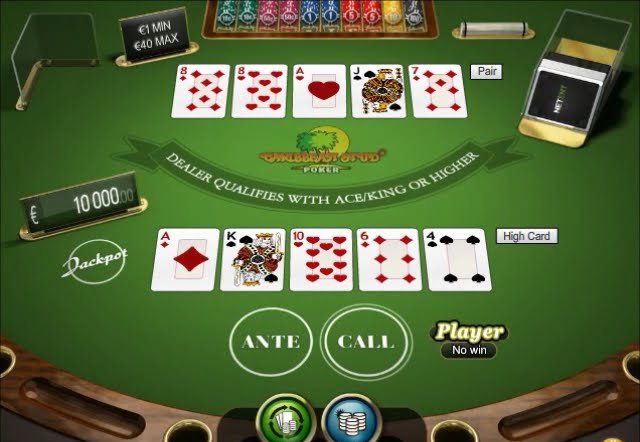
Caribbean stud poker can hand you a straight flush and pay you even money. If the dealer fails to qualify, the Ante pays one to one and the Raise is returned, no matter what you are holding. That single rule explains most of the game’s house edge and most of the complaints about it. For the wider market picture, start at our online casino Canada hub.
The table below sets out how the game behaves. Read it first, then work through the detail beneath.
| Trait | Detail |
|---|---|
| Cards | Five to the player, five to the dealer, one dealer card face up |
| Bets | Ante, a fixed Raise of twice the Ante, optional progressive |
| Dealer qualification | Ace and King or better |
| Top payout | 100 to 1 on a royal flush against the Raise |
| House edge | Roughly 5.2 percent against the Ante |
| Canadian supply | Ontario lobbies, provincial platforms, land based floors |
What is Caribbean stud poker?
A house banked five card poker game where the player and the dealer each receive five cards. The player sees one dealer card, decides whether to raise, and then both hands are compared.
No drawing happens. The five cards dealt are final.
The game grew up on cruise ships and Caribbean resort floors before reaching Canadian casinos. Caribbean stud poker kept its name and its progressive jackpot, and both remain its main selling points.
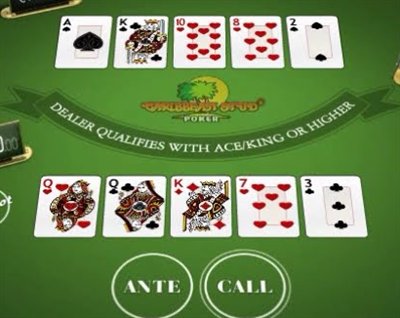
A Canadian meeting the game usually finds it in the table filter beside three card poker. The five card hand looks familiar to anybody raised on draw poker, and the absence of a draw is the first surprise at a Caribbean stud poker table.
Nothing about it involves other players. Every seat plays the dealer alone, and one player folding changes nothing for the next.
Table minimums online start around one dollar for the Ante. A raise then commits two more, so every Caribbean stud poker hand played to showdown costs three units.
The progressive is the reason most players sit down. Caribbean stud poker is rarely chosen for its main game edge, and the jackpot display above the table does the selling.
How does a hand play out?
The player posts an Ante and receives five cards face down, while the dealer shows one card face up. The player then folds and loses the Ante, or raises exactly twice the Ante to continue.
Raise or fold. There is no other option.
The dealer reveals the remaining four cards after every player has decided. Caribbean stud poker then settles each seat against the dealer hand independently.
The dealer up card is the only information beyond a player own hand. Correct Caribbean stud poker strategy uses it on marginal hands and ignores it on everything with a pair or better.
Hands resolve quickly. A deal, a single decision and a reveal complete the round in well under a minute online.
The fold button returns nothing. A Caribbean stud poker fold forfeits the Ante outright with no partial refund of any kind.
Every seat decides in turn before the dealer reveals anything more. A Caribbean stud poker table resolves all raises against the same dealer hand at once.
Why is the raise fixed?
Because the game offers no betting skill beyond one yes or no decision. A fixed two times raise keeps the structure simple and makes the paytable the only variable a player can influence.
The raise never scales. Strong hands cannot bet more.
That rigidity separates it from other table poker. Caribbean stud poker gives a player with a monster hand exactly the same commitment as one with a marginal pair.
Fixed commitment keeps the paytable honest. A player cannot size the raise to hand strength, so the Caribbean stud poker paytable carries all of the reward for a strong hand instead of the bet size.
That is why the Raise ladder climbs so steeply. It replaces the leverage a variable raise would otherwise provide.
Commitment never changes with hand strength. Caribbean stud poker charges a pair and a royal flush exactly the same raise.
No option exists to raise less on a marginal hand. Caribbean stud poker offers exactly one size of commitment.
What is the dealer qualification rule?
The dealer needs Ace and King or better to qualify. If the dealer fails, the Ante pays even money and the Raise is returned untouched, whatever the player’s hand ranks.
A royal flush can collect one to one. That is the trap.
Roughly forty four percent of dealer hands fail to qualify. Caribbean stud poker therefore returns a disappointing payout on a large share of the hands where a player raised.
The rule is printed on the felt and in the rules screen. Nothing hides it, and every regular at a Caribbean stud poker table has met a premium hand collapsing into an even money payout.
Emotionally it is the hardest part of the game. Mathematically it is simply the cost of the published edge.
The dealer up card offers a partial clue about qualification. An ace or king showing makes a qualifying Caribbean stud poker dealer hand more likely.
Qualification is checked before any hand comparison. A Caribbean stud poker dealer showing King high with no ace fails immediately.
What happens when the dealer qualifies?
The hands are compared normally. A winning player collects even money on the Ante and the paytable amount on the Raise, which rises steeply for strong hands.
A dealer win takes both the Ante and the Raise.
Ties push both bets. Caribbean stud poker settles an identical ranking as a stand-off with no money moving in either direction.
Qualified dealer hands are where the paytable does its work. A straight against a qualifying dealer pays four to one on the Raise, which is eight units on a single Caribbean stud poker hand.
Big results depend entirely on that condition. Nothing on the ladder pays against an unqualified dealer.
Strong hands finally collect the full ladder. That is the moment Caribbean stud poker pays what the felt advertises.
What does the Raise pay?
Even money on one pair, two to one on two pair, three to one on trips, four to one on a straight, five to one on a flush, seven to one on a full house, twenty to one on quads, fifty to one on a straight flush and one hundred to one on a royal.
Payouts apply only when the dealer qualifies.
Certain tables cap the Raise payout at a stated maximum. A Caribbean stud poker royal flush on a large stake can hit that cap well before one hundred to one is reached.
Ladders vary slightly between suppliers and between floors. The lower rungs rarely move, and differences usually appear on the full house and quads payouts of a Caribbean stud poker paytable.
Reading the ladder takes one glance. Two Ontario tables can differ by a rung.
The lower rungs carry most of the return. One pair and two pair account for the bulk of Caribbean stud poker Raise payments.
Payout caps apply per hand on most land based tables. A Caribbean stud poker royal flush at a high stake can collect less than one hundred to one as a result.
When is a raise correct?
Always with a pair or better. With no pair, raise holding Ace and King plus a card matching the dealer’s up card, and fold everything weaker than that.
That rule covers nearly every decision correctly.
Roughly half of all hands qualify for a raise under it. Caribbean stud poker players who raise more often than that pay for the extra action at a steep rate.
The rule is short enough to memorise before sitting down. Pair or better raises, Ace King with a match to the dealer up card raises, and everything else folds at a Caribbean stud poker table.
Refinements exist and add very little. The simple version is close enough for any ordinary session.
Following the rule keeps losses near the published edge. Caribbean stud poker punishes improvisation more than most tables.
Players who follow the rule raise roughly half of all hands. Caribbean stud poker regulars treat the other half as the cost of seeing cards.
Why fold Ace King high?
Because a hand with no pair beats a qualifying dealer rarely. When it does win, the dealer often failed to qualify anyway, and the Raise earns nothing extra on those hands.
The Raise risks two units for very little return.
The exception is when the dealer’s up card matches one of the player’s cards. That overlap reduces the dealer’s pairing chances enough to make the Caribbean stud poker raise marginally correct.
Folding feels wrong because Ace King looks strong. In Caribbean stud poker it is the weakest hand that can win, and the Raise it requires loses two units whenever the dealer pairs.
The Ante is lost on a fold. That single unit is cheaper than the three units a bad raise puts at risk.
The fold is correct far more often than it feels. Caribbean stud poker regulars fold roughly half of every hand dealt.
The dealer pairing chance is the whole calculation. Caribbean stud poker dealers make a pair or better often enough to make a bare Ace King raise expensive.
What is the house edge?
Roughly five point two percent against the Ante with correct strategy. Measured against total money wagered, including raises, the figure falls to about two point six percent.
That is higher than most table poker variants.
The qualification rule accounts for most of the cost. Caribbean stud poker takes back value on every strong hand that meets an unqualified dealer.
Comparing the two measures clarifies what a session costs. Five point two percent against the Ante overstates it, and two point six percent against total money wagered is the fairer Caribbean stud poker figure.
Either way it sits above blackjack and baccarat. The game is not a value choice.
Correct play is the condition attached to the figure. A player raising too often faces a Caribbean stud poker edge well above five percent.
Side bets push the combined cost higher again. A Caribbean stud poker player buying the progressive every hand pays far more than the main game figure.
Why is the edge higher than Ultimate Texas Holdem?
Because the raise cannot scale and the qualification rule bites on the Raise rather than only the Ante. Ultimate Texas Holdem lets strong hands commit four times and pushes only one bet.
Structure decides the cost. This one is expensive.
Players choosing between the two on value are better served by the other game. Caribbean stud poker sells a progressive jackpot rather than a low edge.
Both games use a dealer qualification rule and the consequences differ sharply. Ultimate Texas Holdem pushes the Ante alone, and Caribbean stud poker returns the entire Raise on an unqualified dealer.
Leverage is the other half. One game rewards a strong hand with a larger raise and this one never does.
Both reach Ontario through the same registration route. The difference between them is structure rather than oversight.
What is the progressive jackpot?
An optional one dollar side bet paying on the player’s five card hand regardless of the dealer. A royal flush wins the whole pool, a straight flush wins ten percent, and lower hands pay fixed amounts.
Qualification does not apply to it. Only the player’s hand counts.
The pool grows with every side bet placed across linked tables. Caribbean stud poker progressives on busy networks can climb well into six figures before paying.
Pools on land based Canadian floors are usually linked across a handful of tables within one property. Online Caribbean stud poker progressives link across operators and grow faster as a result.
Fixed payouts sit beneath the top prize. A flush or a full house pays a stated dollar amount.
The pool is displayed above the table on most interfaces. A Caribbean stud poker player sees the current figure before buying the side bet.
Seed values reset the pool after a royal flush pays. The Caribbean stud poker jackpot restarts at a published floor and climbs again from there.
Is the progressive worth playing?
Almost never, unless the pool is exceptionally large. The side bet typically carries a house edge above twenty five percent, and it only approaches break even when the jackpot grows very high.
A royal flush appears once in 649,740 hands.
Those odds are the reason. A Caribbean stud poker player buying the side bet every hand is funding a pool they are extremely unlikely to collect.
Break even requires a pool several times larger than the seed value. A Canadian checking the current Caribbean stud poker jackpot before buying the side bet is making the only calculation that matters.
Most of the time the answer is no. The pool rarely reaches the level that changes it.
Treating it as entertainment is the honest framing. The Caribbean stud poker progressive sells a story rather than value.
Break even thresholds are published by some studios and calculated by players for others. Either way the figure sits well above the typical Caribbean stud poker pool.
What happens on a tie?
Both the Ante and the Raise push. Ties are compared card by card down to the fifth card, so a genuine tie is rare but does occur on identical rankings.
Suits never break ties. Only ranks matter.
Ties are genuinely rare in five card stud. Identical rankings down to the last card require an unusual deal, and a Caribbean stud poker session can pass without a single one.
Nothing is lost when it happens. Both bets return intact.
Both bets return and nothing changes hands. A Caribbean stud poker tie costs nothing at all.
Ties compare the highest card first, then the next, down to the fifth. Caribbean stud poker never uses suits to separate hands.
Can you see other players’ cards?
No. Players are not allowed to share information at a land based table, because knowing extra cards would change the correct raise decision and shift the house edge.
Online every hand is dealt from its own deck anyway.
Collusion is the concern the rule addresses. Caribbean stud poker strategy assumes a player knows five cards and one dealer card and nothing else.
Online the question does not arise. A certified generator deals every Caribbean stud poker hand independently, and no seat ever shares a deck with another.
Live tables follow the land based rule. Players keep their cards to themselves.
Online versions deal each seat independently. No Caribbean stud poker player sees anything beyond their own hand and one dealer card.
Land based dealers enforce the rule firmly. A Caribbean stud poker table stops the game when players show cards to each other.
Where can Canadians play Caribbean stud poker?
Registered Ontario operators carry software and live versions, the provincial platforms list it, and a number of land based floors across the country deal it with a linked progressive.
Live tables usually carry the progressive. Software may not.
Search by name on an Ontario lobby. Caribbean stud poker sometimes sits under poker rather than table games.
Availability is broad across the regulated market. Ontario lobbies, provincial platforms and floors from Niagara to British Columbia all carry Caribbean stud poker in one form or another.
Progressive tables are the land based norm. Software tables vary.
Search by name rather than browsing. Caribbean stud poker surfaces immediately on any Ontario lobby that carries it.
Niagara and Ontario floors deal it with a linked progressive. Caribbean stud poker online usually runs as a live dealer table with the jackpot attached.
Is Caribbean stud poker certified in Ontario?
Yes. Every table on a registered Ontario lobby has passed independent laboratory testing of the shuffle, the paytable and the published return before deployment.
Progressive pools are audited as part of it.
Testing covers the shuffle, the paytable and the progressive contribution rate. The tested build is the deployed build, and an operator changes nothing inside a certified Caribbean stud poker table.
Live tables sit under separate audit arrangements covering equipment and studio procedure.
Certificates cover the exact deployed table. Two Caribbean stud poker versions are tested separately.
Does Caribbean stud poker count toward wagering?
Usually at a reduced rate or not at all. Table games clear a bonus requirement more cheaply than slots, so operators restrict them in the contribution table.
Check the rate before claiming.
Excluded games sometimes void an entire bonus rather than simply contributing nothing. That clause is worth reading carefully before playing Caribbean stud poker on bonus funds.
Rates differ per operator rather than per game.
Contribution tables sit in the account area. Reading one takes a minute before playing Caribbean stud poker on bonus funds.
Progressive side bets rarely count at all. Caribbean stud poker jackpot stakes sit outside most contribution tables.
Is Caribbean stud poker good for a small bankroll?
Reasonably, with discipline. A raise risks three units in total, which is modest, but the house edge is higher than most table alternatives and it adds up over a long session.
Skipping the progressive helps more than anything.
Folding correctly protects a modest balance more than anything else. A player raising only with a pair or a qualifying Ace King keeps Caribbean stud poker losses close to the published edge.
Deposit limits sit inside every registered Ontario account. Set one first.
Three units per raised hand is the working figure. Four with the progressive attached.
Skipping the progressive cuts the per hand cost by a full unit. That single change makes Caribbean stud poker workable on a modest balance.
How does it compare with three card poker?
Three card poker carries a lower edge and resolves faster. This game offers a five card hand, a larger paytable ceiling and a progressive jackpot, and charges more for them.
Choose on excitement or on value. Not both.
Both games use a raise decision against a dealer who has to qualify. Three card poker needs Queen high and this one needs Ace King, which is why Caribbean stud poker pushes the Raise far more often.
Both reach Ontario through the same regulated route.
Three card poker resolves faster and costs less. Caribbean stud poker offers a larger ceiling and a jackpot in return.
Pace separates them too. Caribbean stud poker hands take slightly longer to resolve than three card hands at the same table speed.
What does a Canadian check before playing Caribbean stud poker?
Three things before the first hand. The Raise paytable and any payout cap, the progressive pool size if one is attached, and the bonus contribution rate in the terms.
Then raise with a pair or better, and fold most of the rest.
None of it requires a deposit. Demo tables publish the same paytables, and Caribbean stud poker states its qualification rule in the client before any money moves.
Reading takes under a minute.
The habit transfers to every table in the lobby. Caribbean stud poker is simply where the qualification rule makes it urgent.
Checking the pool size takes one glance at the display. A Caribbean stud poker jackpot figure sits above the table on every linked version.
Which game pages are worth reading next?
Four pages sit closest to this one. Each covers a game or a rule that touches the subject above, and each stands on its own.
Caribbean stud poker charges one of the steeper edges at the table in return for a jackpot most players will never touch. Know the qualification rule before you raise.
2 thoughts on “Caribbean Stud Poker Canada: The Qualification Rule and the Jackpot”