

Mississippi stud asks for money three times and never once asks you to beat a dealer. There is no dealer hand. A pair of sixes returns the stake, anything below it loses everything committed, and the five card ladder above it pays up to five hundred to one. For the wider market picture, start at our online casino Canada hub.
The table below sets out how the game behaves. Read it first, then work through the detail beneath.
| Trait | Detail |
|---|---|
| Cards | Two to the player, three community cards |
| Bets | An Ante plus three optional raises of one to three times |
| Opponent | None, the paytable settles every hand |
| Break even hand | A pair of sixes through tens |
| House edge | Roughly 4.9 percent against the Ante |
| Canadian supply | Ontario lobbies, Niagara floors, provincial platforms |
What is mississippi stud?
A house banked five card poker game where the player receives two cards and three community cards are turned one at a time. The player raises or folds before each community card is revealed.
No dealer hand exists. The paytable decides everything.
A Canadian meeting the game usually finds it under novelty poker in a table filter. The layout shows an Ante circle and three raise circles in a row, which is the clearest picture of how mississippi stud works.
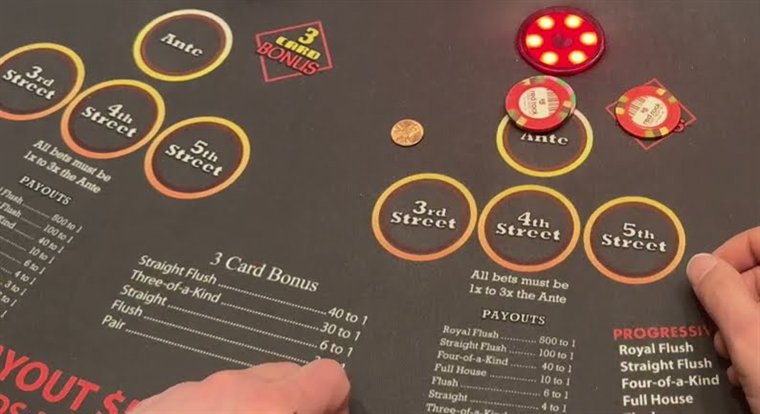
Nothing on the felt marks a dealer position. The three community cards belong to the player alone.
Table minimums online start low. A mississippi stud table opening at one dollar keeps the ten unit worst case manageable.
The game spread from American floors through the same suppliers that sell three card poker. Mississippi stud reached Canadian tables the same way.
The three raise circles are marked third street, fourth street and fifth street. A mississippi stud felt names them in that order from the player outward.
The Ante circle sits apart from all three.
How does a hand play out?
An Ante goes down first and two cards are dealt face down. The player then folds or raises one to three times the Ante before the first community card, again before the second, and again before the third.
Three raise decisions. Each one is optional.
Each raise decision comes before a card rather than after it. A mississippi stud player commits money three times on incomplete information, which is the opposite of how most table games are built.
Folding forfeits everything already staked. Nothing is returned on a fold at any point.
The raise size is chosen from one, two or three. A mississippi stud interface offers no other amounts.
Community cards are turned one at a time between decisions. A mississippi stud hand therefore reveals information in three steps rather than all at once.
The player two cards stay visible throughout.
What does the paytable pay?
A pair of sixes through tens pushes, jacks or better pays even money, two pair pays two to one, trips pays three to one, a straight pays four to one and a flush pays six to one.
A full house pays ten to one and quads pay forty to one.
Every unit still on the felt is paid at the same rung. A mississippi stud flush with four units committed collects six to one four times over.
That multiplication is why the raise decisions matter so much. The ladder itself never changes.
The ladder is printed on the felt. A mississippi stud rules screen repeats it in full.
What pays the most?
A royal flush at five hundred to one, with a straight flush behind it at one hundred to one. Both apply to every unit still on the felt, which is why the ceiling is so high.
Four units riding turns five hundred into two thousand.
Royal flushes appear roughly once in six hundred and fifty thousand hands. The rung exists as a headline rather than as a meaningful part of the mississippi stud return.
Quads and full houses carry far more weight. Both appear often enough to matter across a session.
Straight flushes arrive far more often than royals. That rung carries more of the mississippi stud return.
What is the break even hand?
A pair of sixes through tens. It returns every bet without profit, which makes it the hand the whole strategy is built around chasing.
Below sixes everything is lost. That threshold matters.
The push band is narrow and specific. Sixes, sevens, eights, nines and tens all return the stakes, and a pair of fives loses everything on the felt.
That single rank boundary shapes the whole mississippi stud strategy chart.
Pairs of jacks and above pay rather than push. A mississippi stud hand crosses from recovery to profit at that rank.
Reading the push band once removes most confusion. A mississippi stud felt prints it directly above the ladder.
The push band is five ranks wide. A mississippi stud pair of sixes, sevens, eights, nines or tens returns every unit staked.
Jacks and above cross into profit.
Why is the push so important?
Because it converts a large group of otherwise losing hands into recovered stakes. Without it the game would be unplayable at any raise level a player could sensibly use.
Roughly one hand in five ends as a push.
Without it the game would demand a paying hand on every deal. The push band converts a large group of ordinary hands into recovered money rather than losses.
Chasing it is correct. A mississippi stud player raising toward a low pair is playing the game as designed.
Recovered stakes are what keep a session alive. Nothing else in mississippi stud returns money without a paying hand.
When should you raise three times?
On a made paying hand or a very strong draw. A pair of sixes or better, or two high cards on the first decision, justify the maximum commitment rather than the minimum.
The maximum is used far less often than the minimum.
The maximum raise is reserved for hands already worth money or very close to it. A mississippi stud player using it on speculative holdings is paying for optimism at three times the rate.
Made paying hands always take the maximum. Nothing else is automatic.
Made hands are the clear case. A mississippi stud player holding jacks or better maximises every time.
What is the first decision rule?
Raise three times with any pair, raise one time with two cards jack or better, and raise one time with most suited connectors. Fold everything else before the first community card.
Roughly forty percent of starting hands are folded outright.
Two cards is very little information, which is why the fold rate is so high at this point. A mississippi stud player folding four hands in ten on the first decision is playing correctly.
Pairs are the clear raise. High cards and suited connectors take the minimum.
Folding here costs one unit only. That is the cheapest exit a mississippi stud hand offers.
Suited connectors are the marginal case. A mississippi stud chart lists exactly which ones raise.
Folding four hands in ten feels excessive and is correct. A mississippi stud chart is built around that discipline.
The Ante is the only loss on an early fold.
What is the second decision rule?
Raise three times with any made paying hand or any pair. Raise one time with four cards to a flush, four to an outside straight, or two high cards, and fold the rest.
Draws start to matter once three cards are visible.
Three visible cards change the picture considerably. A mississippi stud hand holding four to a flush now has a genuine draw rather than a hope.
Made hands take the maximum. Draws take the minimum.
Two units are already committed at this point. A mississippi stud fold now costs both of them.
What is the third decision rule?
Raise three times with any made paying hand. Raise one time with a four card flush draw, an open ended straight draw, or a low pair that can still improve.
Anything with no draw and no pair folds.
Four cards are visible and one remains. A mississippi stud player with no pair and no draw at this point should fold rather than pay for a single card.
Draws still justify the minimum raise. Nothing else does.
One card remains to come. A mississippi stud draw needs it to complete or the hand is lost.
What is the house edge?
Roughly 4.9 percent measured against the Ante with correct play. Against total money wagered across a hand the figure falls closer to 1.4 percent.
Average total bet sits near three and a half units.
The two figures describe the same game on different bases. Comparing a mississippi stud percentage against the Ante with a slot percentage against total stake is not a like for like comparison.
Average total commitment is what decides session cost. It sits near three and a half units.
Both figures appear in published references. A mississippi stud rules screen states the return for the deployed table.
Correct play is the condition attached. A mississippi stud player guessing pays far more than the published figure.
Element of risk is the fairer basis for comparison. Mississippi stud near one and a half percent on that measure sits alongside the better table games.
The Ante based figure overstates it.
Why does the edge look so high?
Because the convention measures against the single Ante rather than everything staked. A player raising correctly commits three or four units on most hands that reach a showdown.
Both figures describe the same game.
Convention quotes table poker games against a single unit. A mississippi stud player raising correctly stakes far more than that on the hands that reach a showdown.
Dollar cost is the number a session actually feels. It is considerably lower.
Element of risk is the fairer measure. Mississippi stud sits near one and a half percent on that basis.
What is the fold rate?
Roughly forty percent on the first decision alone, and a further share on the second and third. Folding costs only what is already on the felt at that point.
Folding early costs one unit. Folding late costs more.
Folding early is the cheapest outcome available. A mississippi stud player folding on the first decision loses one unit and nothing more.
Later folds cost whatever has already been committed. That is why the first rule matters most.
Folding often is correct rather than timid. A mississippi stud chart folds more hands than it plays.
Nearly half of all hands never see a third raise. Mississippi stud is built around that.
Can you improve the edge?
Only by following the three decision rules exactly. There is no dealer to read, no bet sizing beyond the one to three choice, and no information other than the community cards.
Guessing costs well over a percentage point.
Three rules cover every decision in the game. Nothing else about mississippi stud can be optimised, because no dealer behaviour exists to read.
Guessing is expensive. The published figure assumes the chart is followed.
Three written rules reach the published figure. Nothing else about mississippi stud is adjustable.
What is the three card bonus?
An optional side bet paying on the three community cards alone, starting at a pair and climbing to a mini royal. It resolves independently of the main hand.
House edges usually sit near seven percent.
The side bet settles on the community cards alone and is unaffected by the player two cards. A mississippi stud bonus can pay on a hand where the main bets all lose.
Ladders differ between operators. Reading one takes a glance.
It settles on the community cards alone. A mississippi stud main hand is unaffected either way.
Is the bonus bet worth playing?
Not on value. Seven percent against a main game costing under one and a half percent of total action is a poor trade, however quickly it resolves.
Leaving the circle empty costs nothing.
Comparing the two costs settles it. Seven percent against roughly one and a half percent of total action means the side bet is several times more expensive per dollar.
The circle is optional on every mississippi stud table.
Leaving it empty costs nothing at all. Every mississippi stud table treats it as optional.
Ladders differ between operators. Even the best mississippi stud bonus costs several times the main game.
Does the paytable vary?
Yes, and the flush and straight rungs move most often. A table paying six to one on a flush is better than one paying five, and the difference is worth most of a percentage point.
The ladder is printed on the felt and in the rules screen.
Flush and straight rungs move most often between operators. A mississippi stud table paying six to one on a flush is worth finding over one paying five.
Lower rungs rarely change. The push band never does.
Comparing two operators takes a glance. A mississippi stud ladder is published before the first hand.
How does it compare with let it ride poker?
Both settle against a paytable with no dealer hand, and the direction of the money is reversed. Let it ride starts with three bets and takes them back, and this one starts with one and adds to it.
The paytable threshold differs sharply too.
Both games settle against a ladder with no dealer hand, and the direction of the money differs entirely. Let it ride starts with three bets and removes them, and mississippi stud starts with one and adds.
The paying threshold differs too. One needs tens and the other needs sixes.
Both games pay every unit still on the felt. Mississippi stud simply adds units where the other removes them.
How does it compare with three card poker?
Three card poker resolves on one decision against a dealer hand. This one asks three times, pays a much longer ladder, and never compares the player against anybody.
Edges are similar once the basis is matched.
Three card poker resolves against a dealer hand on one decision. Mississippi stud never compares the player against anybody and asks three times instead.
Both reach Ontario through the same regulated route.
Three card poker resolves in one decision. Mississippi stud asks three times for a longer ladder.
Where can Canadians play mississippi stud?
Registered Ontario operators carry software versions, Niagara and other land based floors deal it, and the provincial platforms list it among novelty poker games.
Live dealer versions are rare. Software dominates online.
Land based coverage is broader than online coverage. Niagara and several western floors deal mississippi stud, and Ontario lobbies carry it as a software title.
Searching by name is quicker than browsing. It surfaces immediately where it exists.
Live dealer versions are rare. Most Canadians meet mississippi stud as a software table.
Searching by name is quicker than browsing. Mississippi stud surfaces immediately where it exists.
Is mississippi stud certified in Ontario?
Yes. Every table on a registered Ontario lobby has passed independent laboratory testing of the shuffle, the paytable and the published return before deployment.
The tested build is the deployed build.
Side bet ladders are tested alongside the main paytable. A certified mississippi stud table pays exactly what its felt prints on every hand.
Certification is per market as well as per title.
The tested build is the deployed build. An operator changes nothing inside a certified mississippi stud table.
Does mississippi stud count toward wagering?
Usually at a reduced rate or not at all. Table games clear a bonus requirement more cheaply than slots, so the contribution table restricts them.
Check the rate before claiming.
Excluded games sometimes void an entire bonus rather than contributing nothing. That clause matters more than the percentage beside mississippi stud in the table.
Rates differ per operator rather than per game.
Reading the clause matters more than the rate. A bonus excluding mississippi stud is common.
Is mississippi stud good for a small bankroll?
Only with discipline. Raising three times on every street risks ten units on a single hand, and correct play keeps the average far below that.
Folding early is what protects a modest balance.
Maximum exposure is ten units on a single hand. A mississippi stud bankroll has to cover that even though correct play reaches it rarely.
Deposit limits sit inside every registered Ontario account.
Correct play rarely reaches the maximum. A mississippi stud session averages well under four units a hand.
Deposit limits sit inside every registered Ontario account. Setting one before the first mississippi stud hand is the practical step.
Maximum exposure is ten units and correct play rarely reaches it. A mississippi stud session averages far below that per hand.
Skipping the bonus keeps it lower still.
What does a Canadian check before playing mississippi stud?
Three things before the first hand. The main paytable and its flush rung, the side bet ladder if one is offered, and the bonus contribution rate in the terms.
Then fold the first decision far more often than feels right.
All three sit in the client rather than in a review. The paytables appear in the rules screen and the contribution rate sits in the account area.
Reading takes under a minute. That minute decides whether a mississippi stud table is worth sitting at.
The habit transfers to every table in the lobby. Mississippi stud is simply where folding matters most.
Which game pages are worth reading next?
Four pages sit closest to this one. Each covers a game or a rule that touches the subject above, and each stands on its own.
Mississippi stud hides a modest house edge behind a headline figure and punishes anybody who raises without a pair or a draw. Learn the three rules and the ladder does the rest.