

Let it ride poker is the only table game where every decision is about taking money off the felt. Three bets go down before the cards arrive, and the two decisions that follow are both chances to pull one back. Nothing is ever added. For the wider market picture, start at our online casino Canada hub.
The table below sets out how the game behaves. Read it first, then work through the detail beneath.
| Trait | Detail |
|---|---|
| Cards | Three to the player, two community cards |
| Bets | Three equal wagers placed before the deal |
| Decisions | Two withdrawal points, no raising |
| Minimum paying hand | A pair of tens or better |
| House edge | Roughly 3.5 percent against one bet unit |
| Canadian supply | Ontario lobbies, provincial platforms, land based floors |
What is let it ride poker?
A house banked five card poker game where the player places three equal bets, receives three cards, and shares two community cards with nobody. There is no dealer hand to beat at any point.
The paytable is the only opponent. Nothing else matters.
A Canadian meeting the game usually finds it under novelty poker in a table filter. The layout carries three circles in a row and nothing else, which is the clearest signal of how let it ride poker works.
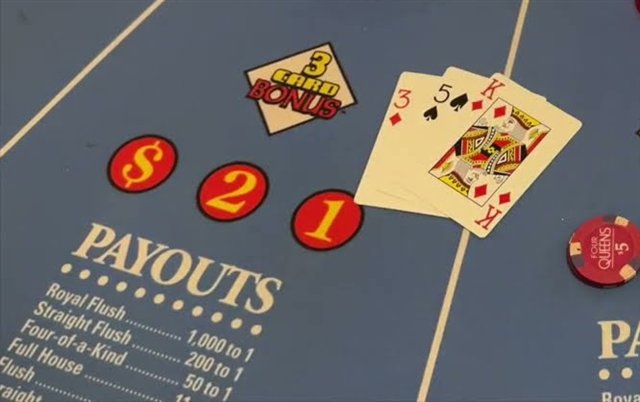
No dealer hand exists anywhere in the structure. The two community cards belong to the player and complete a five card hand against a fixed paytable.
The game was designed in the early nineteen nineties to sell shuffling machines to casinos. That commercial origin is why let it ride poker spread across North American floors so quickly.
Ontario lobbies carry it as a software title. Live dealer versions exist in very few studios.
The three betting circles are usually marked one, two and a dollar sign. That third circle is the bet a let it ride poker player can never withdraw.
Everything else on the felt is a paytable. Nothing marks a dealer position.
Table minimums online start around one dollar per circle. That makes three dollars the opening commitment on a let it ride poker hand.
Land based minimums run higher. Five dollars per circle is common.
How does a hand play out?
All three bets go down first. The player then sees their three cards and may withdraw the first bet, sees the first community card and may withdraw the second, and the third bet always rides to the end.
Two withdrawal decisions. No raising at any stage.
Committing three units before seeing a card is unusual and it is not as expensive as it sounds. Correct play recovers two of those units on the majority of hands dealt.
The third bet is locked from the start. Let it ride poker never allows a player to withdraw it under any circumstances.
The two community cards sit face down in front of the dealer from the start. They are turned one at a time, which is what creates the two decision points.
Nothing else is revealed. A let it ride poker player never sees another hand at the table.
Both withdrawal decisions are optional and independent. A let it ride poker player can pull the first bet and leave the second in play, or the reverse.
Neither decision affects the paytable. Only the number of units riding changes.
The dealer never receives cards at any point. A let it ride poker hand is settled entirely against the printed ladder.
Community cards are turned one at a time. That pacing creates both decisions.
Three equal bets is a rule rather than a choice. A let it ride poker table refuses unequal amounts in the three circles.
Why is it called let it ride?
Because leaving a bet in play is called letting it ride. A player who declines both withdrawals has three units at risk against the paytable, and a player who pulls both back has one.
The name describes the only choice on the felt.
The phrase is the instruction a player gives when declining a withdrawal. Saying it leaves the bet in play against the paytable for the rest of the hand.
Land based tables use a hand signal instead. A let it ride poker player scratches the felt to decline the withdrawal.
Declining a withdrawal is an active choice rather than a default. A let it ride poker client asks twice and a land based dealer waits for a signal each time.
Pulling a bet back is equally deliberate. Neither happens automatically.
The phrase entered casino vocabulary with the game itself. A let it ride poker dealer still says it aloud at a land based table.
Online the wording becomes a button. The meaning is unchanged.
The instruction is the only thing a player says at the table. A let it ride poker dealer waits for it at both decision points.
Online the button carries the same words.
What is the minimum paying hand?
A pair of tens or better. Anything below that loses every bet still in play, which is why most hands end with the player having withdrawn as much as the rules allow.
Roughly one hand in four reaches the paytable.
A pair of tens is a considerably higher bar than most table games use. Three card poker pays from a pair and Caribbean stud pays from a pair, and this one requires tens or better across five cards.
Roughly twenty four percent of hands reach it. Let it ride poker loses every bet still in play on the other seventy six.
Comparing the threshold across the table section shows how high it is. Three card poker pays from a pair and Caribbean stud pays from a pair, and let it ride poker demands tens or better.
That bar is what funds the paytable above it. Higher rungs pay considerably more than rival games offer.
Pairs below tens lose every bet in play. That is the rule a let it ride poker newcomer misreads most often.
Tens or better is printed on the felt. It sits directly above the paytable.
Nines and below pay nothing at all. A let it ride poker player holding a pair of nines loses every bet still in play.
The threshold is printed above the paytable. Nothing hides it.
The threshold explains the whole strategy. A let it ride poker player withdrawing early is responding to how far a pair of tens really is.
What does the paytable pay?
Even money on a pair of tens or better, two to one on two pair, three to one on trips, five to one on a straight and eight to one on a flush.
Above that the ladder climbs steeply. A full house pays eleven to one, quads pay fifty, a straight flush pays two hundred and a royal flush pays a thousand to one.
Every bet still in play is paid at that ladder.
Every bet left in play collects at the same ladder. A player who declined both withdrawals and made a flush collects eight to one three times over.
Paytables vary slightly between operators. The flush and full house rungs are where let it ride poker tables differ most often.
The thousand to one royal flush rung is the headline and contributes almost nothing. A royal appears roughly once in six hundred and fifty thousand hands.
Pairs and two pair carry the return. Those two rungs decide what a let it ride poker session actually pays.
Paytables are published before a hand is dealt. Comparing two let it ride poker tables takes one glance at each ladder.
Lower rungs rarely move. Operators differ on the flush and full house.
Each bet left in play is paid separately at the same rung. A let it ride poker flush with three bets riding collects eight to one three times.
That multiplication is why the rules matter so much.
Two pair and trips arrive often enough to matter across a session. Those rungs carry more of the let it ride poker return than the headline payouts above them.
When should you let the first bet ride?
With any paying hand already made, any three cards to a royal flush, any three suited cards to a straight flush with small gaps, and three to a straight flush with certain high card combinations.
Everything else comes back. Withdraw it.
The rule is narrow by design. A made paying hand, three to a royal, or three to a straight flush with the right gaps and high cards are the only holdings that qualify.
Everything else comes back to the stack. Let it ride poker rewards withdrawing on the vast majority of three card looks.
Three to a royal flush is the widest of the qualifying draws. Three suited cards with one gap and a high card also qualify, and everything narrower comes back.
Memorising the list takes one reading. Let it ride poker asks for nothing more at the first decision.
Made hands are the easy case. A let it ride poker player already holding a pair of tens leaves everything in play.
Draws are where the rule matters. Three to a royal is the strongest of them.
Three to a straight flush qualifies only with the right gaps. A let it ride poker chart lists the exact combinations.
Everything outside the list comes back to the stack.
When should you let the second bet ride?
With any paying hand already made, any four cards to a flush, any four to an outside straight with high cards, and four cards to a straight flush.
Four to an inside straight comes back unless it is high.
Four card draws widen the rule considerably. A four card flush, a four card open ended straight with high cards, or a four card straight flush all justify leaving the second bet in play.
Inside straights usually come back. Let it ride poker only rewards them when the cards are high enough to pair into a paying hand.
Four card flushes are the most common qualifying hand at this point. A let it ride poker player holding four to a flush has a genuine shot at eight to one on every bet left in play.
Four to an outside straight qualifies with high cards. Inside straights usually do not.
The fourth card widens the qualifying list considerably. A let it ride poker player with four to a flush has a real draw rather than a hope.
Everything narrower comes back. The rule is strict.
Four to a straight flush is the strongest four card draw. A let it ride poker hand holding it leaves both remaining bets in play.
Everything weaker follows the written rule.
Why is withdrawing correct so often?
Because the paytable starts at a pair of tens, which is a high bar with five cards. A hand that has not already made one and has no strong draw will miss far more often than the payouts justify.
Leaving bets out is the expensive instinct here.
The arithmetic is simple once the paytable is read. A hand needing two more cards to reach a pair of tens will miss far more often than the payout compensates for.
Instinct pulls the other way. Let it ride poker is designed around a player who feels that pulling money back is giving up.
Running the numbers once settles the instinct. A hand with no pair and no draw reaches a pair of tens on roughly one deal in five, and the paytable pays even money for it.
The arithmetic is decisive. Let it ride poker punishes optimism at both decision points.
The paytable threshold is the reason. A let it ride poker hand must reach tens or better, and most three card looks cannot.
Instinct resists it. The arithmetic does not.
Most three card looks are simply not close. A let it ride poker hand needs a pair of tens by the fifth card, and two cards rarely bridge that gap.
Withdrawing is the default rather than the exception.
Correct play recovers money on roughly three hands in four. That recovery is what keeps a let it ride poker session affordable.
What is the house edge?
Roughly 3.5 percent measured against a single bet unit. Because most hands end with only one bet in play, the cost per hand in dollars is lower than that figure suggests.
Against total money wagered it falls to about 2.8 percent.
The three and a half percent figure is quoted against one bet unit by industry convention. That basis makes the game look more expensive than it plays.
Average exposure sits near one and a half units. Let it ride poker costs less per hand in dollars than the headline figure suggests.
Both conventions appear in published sources and they describe the same game. Three and a half percent against one unit and two point eight percent against total action are the two figures.
Neither is wrong. Let it ride poker simply gets quoted on the harsher basis more often.
Quoting basis is everything in a comparison. A let it ride poker figure against one unit is not comparable with a slot figure against total stake.
Both numbers are published. Neither is misleading on its own terms.
Published sources quote both conventions. A let it ride poker figure is only comparable against another game quoted on the same basis.
Neither number changes how the game plays.
Why does the edge look high?
Because the convention measures against one unit rather than the three staked. A player following correct strategy withdraws so often that average exposure sits closer to one and a half units.
The quoted figure overstates the session cost.
Comparing quoted figures across table games only works when the basis matches. A percentage against one unit and a percentage against total money wagered are different measurements.
Both numbers describe the same game. Let it ride poker sits between three card poker and Caribbean stud on either basis.
Average exposure is the number worth knowing. Correct play leaves roughly one and a half units in play per hand rather than the three posted at the start.
That is why the dollar cost is modest. A let it ride poker session plays cheaper than the headline suggests.
Exposure falls as the hand progresses. A let it ride poker player following the rules risks far less than three units on average.
Dollar cost is what a session feels. The percentage overstates it.
Comparing dollar cost across a session is more useful than comparing percentages. A let it ride poker hour costs less than the quoted figure implies.
Hand volume is low by table standards.
Can you improve the edge?
Only by following the withdrawal rules exactly. There is no betting decision, no raise sizing and no dealer to read, so strategy consists entirely of when to pull money back.
Nothing else is available. That is the whole game.
No betting decision exists and no dealer behaviour can be read. Strategy is two withdrawal rules and nothing beyond them.
Following both exactly reaches the published figure. A let it ride poker player who leaves bets in play by instinct pays considerably more.
No staking system changes anything either. The three bets must be equal, so a let it ride poker player cannot weight one against another.
Table selection is the only other lever. Paytables vary slightly between operators.
Two rules cover every decision. Nothing else in let it ride poker can be optimised at all.
Table selection is the only other choice. Paytables differ slightly.
Paytable differences are small between operators. A let it ride poker player comparing two tables is choosing between close numbers.
The withdrawal rules matter far more.
Following both rules reaches the published figure exactly. Nothing else in let it ride poker is available to optimise.
What is the three card bonus?
An optional side bet paying on the player’s first three cards alone, starting at a pair and climbing to a mini royal. It resolves before any withdrawal decision is made.
House edges run from seven to fourteen percent.
The side bet uses the first three cards only and settles immediately. A player sees the result before making either withdrawal decision.
Ladders differ widely between operators. A let it ride poker bonus paying five to one on a pair is far better than one paying three.
The bet is settled before the first withdrawal decision, which makes it genuinely separate. A let it ride poker player can win the bonus and still lose every main bet on the same hand.
Ladders start at a pair on most versions. Mini royal pays the top rung.
It is a separate wager in its own circle. A let it ride poker player can back it without changing anything about the main hand.
Settlement is immediate. The result appears before the first withdrawal.
The circle sits beside the main bets and is clearly marked. A let it ride poker player leaving it empty plays the cheapest version of the table.
It never affects the main hand.
Is the bonus bet worth playing?
No. Even the best three card bonus paytable costs roughly twice the main game, and the worst versions cost four times as much.
Reading the ladder decides how bad it is.
Comparing the two figures settles it. Seven percent at best against three and a half on the main game is a poor trade for a wager that resolves on three cards.
Skipping it costs nothing. Let it ride poker works perfectly well as a three bet game with no side wager attached.
The best available ladder costs roughly seven percent and the worst costs fourteen. Both figures sit far above the main game.
Reading the ladder before backing it is the only useful step. A let it ride poker bonus circle is optional on every table.
Seven percent is the best case. That is twice the main game on a let it ride poker table.
Skipping it costs nothing at all.
Ladders differ enough to matter between operators. A let it ride poker bonus paying five to one on a pair is far better than one paying four.
Even the best version costs twice the main game.
What is the progressive side bet?
A linked wager paying on the player’s final five card hand, with a royal flush taking the pool. Fixed amounts pay for lower hands such as quads and full houses.
The edge usually sits above twenty percent.
Pools link across operators on some networks and stay local on others. The top prize pays on a royal flush in the player final five cards.
Fixed amounts sit beneath it. A let it ride poker progressive pays stated sums for quads and full houses regardless of the pool.
Pools link across operators on some networks and stay within one property on others. The top prize requires a royal flush in the player final five cards.
Break even needs an unusually large pool. A let it ride poker progressive rarely reaches it.
Pool size decides whether it is ever close to fair. A let it ride poker progressive needs an unusually large jackpot to approach break even.
Fixed rungs pay regardless of the pool.
Some versions pay a fixed amount for a royal rather than a pool. A let it ride poker table states which structure it uses.
Both cost far more than the main game.
How many players can play at once?
Up to six at a land based table, and unlimited on most software versions. Every seat plays its own three cards against the same two community cards.
Nobody competes with anybody else at the table.
Every seat receives its own three cards and shares the same two community cards. One player making a flush has no effect on another player at the same table.
Land based tables seat six. Let it ride poker online usually seats one player per table.
Seat count changes nothing about the odds. Every let it ride poker hand is settled against a fixed paytable rather than against another player.
Land based tables are sociable because the community cards are shared. Everybody reacts to the same reveal.
Shared community cards are what make a table sociable. A let it ride poker reveal affects every seat at once.
Results still settle independently.
Software tables usually seat one. A let it ride poker player online never waits for another seat to decide.
Land based tables seat six.
Does the dealer have a hand?
No. The dealer turns the two community cards and pays the paytable, which means no qualification rule exists and no dealer hand can beat a player.
That absence is unusual among table games.
The absence of a dealer hand removes an entire category of frustration. No qualification rule can reduce a payout and no dealer draw can beat a made hand.
The paytable is the only thing to satisfy. Let it ride poker pays on rank and nothing else.
The absence removes qualification rules entirely. No let it ride poker payout is ever reduced because the dealer failed to reach a threshold.
That makes the paytable the whole game. Nothing else can take a payout away.
No qualification rule can exist without one. That absence is a genuine structural advantage of let it ride poker.
The paytable is the only condition to satisfy.
Two community cards belong to every seat at once. A let it ride poker table has no dealer cards to compare against at all.
The paytable settles everything.
How fast does a hand play?
Slowly by table game standards. Two decision points, a three card look and two community reveals make a hand longer than blackjack or baccarat.
Pace suits a player who wants a long session.
Two decision points and three reveals make the game deliberate rather than quick. A land based table deals fewer hands per hour than blackjack or baccarat.
Slow pace lowers hourly cost. Let it ride poker suits a player budgeting by the evening rather than by the hand.
Counting hands per hour rather than minutes is the useful habit. A let it ride poker table deals fewer hands than blackjack, which lowers hourly cost at the same stake.
Software versions run faster than land based tables. The pace is still deliberate.
Two decisions and three reveals take time. A let it ride poker table deals fewer hands per hour than blackjack.
Slower play means lower hourly cost.
Counting hands rather than minutes is the useful habit. A let it ride poker session covers fewer hands per hour than blackjack at the same table.
Lower hand volume means lower hourly cost.
Where can Canadians play let it ride poker?
Registered Ontario operators carry software versions, the provincial platforms list it among novelty poker games, and land based floors from Niagara to the west deal it.
Live dealer versions are rare. Software dominates.
Provincial platforms list it among novelty poker games alongside three card poker. That placement puts let it ride poker within reach of players outside the private Ontario market.
Land based availability is broad. Floors from Niagara westward deal it with a bonus circle attached.
Provincial platforms list it among novelty poker titles. That placement puts let it ride poker within reach of players outside the private Ontario market.
Land based coverage is broad. Most large Canadian floors deal it.
Software versions dominate the online market. Live dealer let it ride poker tables are rare in Canadian lobbies.
Land based coverage is broader.
Search by name rather than browsing the table filter. Let it ride poker surfaces immediately where an operator carries it.
Provincial platforms list it as a novelty poker title.
Is let it ride poker certified in Ontario?
Yes. Every table on a registered Ontario lobby has passed independent laboratory testing of the shuffle, the paytable and the published return before deployment.
The tested build is the deployed build.
Testing covers the shuffle and the paytable together. A certified table pays exactly what its ladder prints and deals independently every hand.
The tested build is the deployed build. An operator changes nothing inside a certified let it ride poker table.
Certification covers the paytable and the shuffle together. A certified let it ride poker table pays exactly what its ladder prints on every hand.
Side bet ladders are tested in the same package.
Side bet ladders are tested alongside the main paytable. A certified let it ride poker table pays exactly what it prints.
Certification is per market as well as per title.
The regulator publishes its registered supplier list openly. Confirming a let it ride poker table is legal takes one search.
Testing covers every ladder on the felt.
Does let it ride poker count toward wagering?
Usually at a reduced rate or not at all. Table games clear a bonus requirement more cheaply than slots, so the contribution table restricts them.
Check the rate before claiming.
Contribution tables sit in the account area rather than in the game. Reading one before claiming an offer is the whole check.
Rates differ per operator. One Ontario site may count let it ride poker at ten percent and another may exclude it.
Excluded games sometimes void an entire bonus rather than contributing nothing. That clause matters more than the percentage beside let it ride poker in the table.
Rates differ per operator rather than per game.
Contribution tables sit in the account area. Reading one before claiming is the whole check.
Rates differ per operator.
Is let it ride poker good for a small bankroll?
Reasonably, provided the withdrawal rules are followed. Correct play leaves one bet in play on most hands, which keeps average exposure low despite three bets going down.
Adding side bets undoes that immediately.
Average exposure matters more than the three units posted. Correct play pulls two of them back on most hands, which keeps the real cost per hand modest.
Side bets break that pattern immediately. A let it ride poker player backing the bonus every hand raises exposure by a third.
Posting three units and recovering two on most hands is the pattern to expect. A let it ride poker bankroll needs to cover the three unit start rather than the average.
Deposit limits sit inside every registered Ontario account.
Three units go down every hand regardless. A let it ride poker bankroll has to cover that opening commitment.
Correct play recovers most of it.
Deposit limits sit inside every registered Ontario account. Setting one before the first let it ride poker hand is the practical step.
Skipping the side bets keeps exposure at three units.
How does it compare with three card poker?
Three card poker asks whether to add money and this one asks whether to take it back. The published edges are similar, and the psychology is reversed.
Both pay on rank rather than against a dealer hand.
The psychology is genuinely reversed between them. One game asks a player to commit more on a strong hand and this one asks them to retreat from a weak one.
Both settle against a paytable rather than a dealer on their side bets. Let it ride poker extends that idea to the entire game.
Hand frequency differs sharply. Three card poker pays from a pair and let it ride poker pays from a pair of tens, which is why one game feels active and the other feels sparse.
Both reach Ontario through the same regulated route.
One game adds money and the other removes it. That reversal is the whole difference between let it ride poker and its neighbours.
Edges land in a similar range.
Both games settle against a printed ladder rather than a dealer hand on their bonus wagers. Let it ride poker extends that structure to the whole table.
What does a Canadian check before playing let it ride poker?
Three things before the first hand. The main paytable, the side bet ladders if any are offered, and the bonus contribution rate in the terms.
Then withdraw unless the hand already pays or draws strongly.
All three sit in the client or the account area rather than in a review. The paytables appear in the rules screen before a hand is dealt.
Reading takes under a minute. That minute decides whether a let it ride poker table is worth sitting at.
A fourth check helps anyone new to the game. Reading both withdrawal rules before the first hand is worth more than any of the three table checks.
None of it requires a deposit. Let it ride poker publishes its paytables in the client.
The habit transfers to every table in the lobby. Let it ride poker is simply where the withdrawal rules make it urgent.
Nothing requires a deposit to read.
Everything sits inside the client before a deposit. A let it ride poker table publishes its ladders in the rules screen.
Reading takes under a minute.
Which game pages are worth reading next?
Four pages sit closest to this one. Each covers a game or a rule that touches the subject above, and each stands on its own.
Let it ride poker reverses the usual table game instinct and charges a player who cannot pull money back. Learn the two withdrawal rules and the rest of the game plays itself.