

Every other game in a Canadian lobby sets the house edge before you arrive. The mines casino game hands that dial to the player: pick three mines or pick twenty, and the odds, the payouts and the length of the round all change with the number you chose. For the wider market picture, start at our online casino Canada hub.
The table below sets out how the game behaves. Read it first, then work through the detail beneath.
| Trait | Detail |
|---|---|
| Format | A five by five grid revealed one tile at a time |
| Player control | The mine count is chosen before the round |
| Published return | Typically 97 percent |
| Round length | As long as the player keeps revealing |
| Cash out | Available after every safe tile |
| Canadian supply | Ontario registered operators and provincial platforms |
What is the mines casino game?
A twenty five tile grid hiding a number of mines that the player selects. Each safe tile raises the multiplier, each reveal is optional, and touching a mine ends the round with nothing.
There are no reels and no cards. Twenty five squares.
The layout borrows from a desktop puzzle that most Canadians already know, and the resemblance ends at the grid. There is no logic to deduce here and no numbers revealing which tiles sit next to a mine.
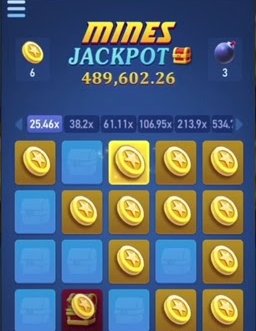
Every unrevealed square carries the same probability. The mines casino game is a sequence of independent gambles rather than a puzzle with a solution hiding inside it.
Canadians meet the format through a lobby category rather than a search. The instant or originals row sits beside the slot rows on a registered Ontario site, and the grid is usually one of the first tiles in it.
Nothing about the interface needs explaining. Twenty five squares, a stake box, a mine selector and a cash out button cover the entire screen.
Treating the grid as a puzzle is the first mistake a new player makes. Minesweeper rewards deduction and this format rewards nothing of the kind, because the only information on screen is what has already been revealed.
The resemblance is deliberate marketing. A Canadian who recognises the layout opens the mines casino game without needing a tutorial, and that familiarity is the whole reason the artwork borrows from it.
Stakes start at the lobby minimum on most Ontario builds. The mines casino game opens around twenty cents, which is low enough to learn the step sizes cheaply.
Grid size is fixed at twenty five tiles on almost every build. A handful of versions run larger boards, and the mines casino game paytable changes completely when they do.
Why does the player choose the mine count?
Because the choice is the whole game. Three mines make each reveal likely and each step small, and twenty mines make each reveal unlikely and each step enormous.
The published percentage holds at every setting. Only variance moves.
No other title in a Canadian lobby offers that control. A slot fixes its volatility rating in the certified build, a roulette wheel fixes its layout, and a blackjack table fixes its rules before anybody sits down.
The dial changes the distribution and nothing else. Setting twenty mines on the mines casino game does not buy a better deal, it buys a rarer and larger one.
The dial is also what makes the format readable. A player who understands that more mines means rarer survival and larger steps understands the whole game, and no further mechanic is hiding behind it.
Compare that with a slot rules screen. The mines casino game states its odds in a number the player set themselves rather than in a volatility rating somebody else assigned.
Operators present the selector as a difficulty setting and it is not one. Difficulty implies skill, and nothing a player does after choosing the number affects the outcome of a single tile.
Calling it a risk selector is more honest. The mines casino game asks how large a swing a player wants and charges the same edge for every answer.
Changing the number between rounds costs nothing. A mines casino game session can run three mines for twenty rounds and then ten for the next twenty.
Artwork differs enormously between builds while the rule stays fixed. One mines casino game hides bombs under gems and another hides them under coins, and the selector works identically in both.
How does a round work?
A stake is placed, the mine count is set, and the grid opens. Every tap reveals a tile, every safe tile raises the running multiplier, and the round continues until the player cashes out or hits a mine.
Nothing is timed. The grid waits indefinitely.
The pacing is entirely under player control, which separates it from every crash format. Nothing takes off, nothing departs, and no countdown removes the decision from the player hands.
That absence of pressure cuts both ways. A round on the mines casino game can run as long as a player wants, and the temptation to take one more tile is exactly what the design relies on.
Stakes are committed before the grid opens and cannot be changed mid round. A player who wants a larger stake finishes the current round first, which is worth knowing before the first tap.
Losing ends the round immediately with no partial return. Touching a mine on the mines casino game forfeits the whole stake regardless of how many safe tiles came before it.
Most builds allow a round to be abandoned only by cashing out. Closing the client mid round on a registered Ontario lobby returns the player to the same open grid when they come back.
That persistence protects the stake. A disconnection during a mines casino game round does not forfeit anything, and the position is restored exactly as it stood.
The stake is deducted when the grid opens rather than at the end. Nothing is returned on a mines casino game round that hits a mine.
Only one round runs at a time on a single client. The mines casino game does not allow a second grid to open while the first is still live.
Autoplay exists on a handful of builds and repeats a fixed tile count. A mines casino game running that way settles each round without asking anything.
How is the multiplier calculated?
From the odds of the reveal that just happened. With three mines on twenty five tiles the first safe tile is a modest step, and with twenty mines it is a large one, because the chance of survival was far lower.
Each step compounds on the last. The maths is transparent.
The arithmetic is published rather than hidden. With three mines the first reveal has a twenty two in twenty five chance of survival, so the step is small, and with twenty mines the chance is five in twenty five and the step is large.
Each subsequent tile improves the odds slightly because the grid shrinks. That is why the multiplier on the mines casino game accelerates as a round continues rather than climbing evenly.
The running figure is displayed continuously above the grid. A player never has to work anything out, and the next step is usually shown as well so the decision is made with both numbers visible.
The house edge is applied to each step rather than at the end. That is why the mines casino game returns slightly under the true odds at every point in a round.
The step from one safe tile to the next grows as the grid shrinks. Twenty four unrevealed tiles with three mines is a different proposition from six unrevealed tiles with three mines still hidden among them.
That acceleration is why deep rounds pay so steeply. The last few reveals on a mines casino game round carry odds close to the extreme settings.
The figure is rounded down rather than up at each step. That rounding is part of where the mines casino game edge sits.
The next step is shown before the tap on better builds. Reading both numbers turns a mines casino game decision into an informed one rather than a reflex.
What return does the mines casino game publish?
Typically ninety seven percent across Canadian deployments, which sits above almost every slot in the same lobby. The figure is certified and holds regardless of the mine count selected.
Setting more mines does not change the edge. It changes the shape.
Ninety seven percent is a strong figure for a Canadian lobby. Most slots on the same site publish between ninety four and ninety six, and the gap over a long session is real money rather than a rounding difference.
The figure is certified rather than advertised. An Ontario registered operator runs a tested build, and the mines casino game publishes the same percentage across every setting on the grid.
The percentage describes millions of rounds rather than an evening. A build certified at ninety seven percent can take a long run of stakes without returning anything, and the figure remains accurate throughout.
Comparing across categories is where the number helps. The mines casino game returns more than nearly every slot beside it in an Ontario lobby.
A ninety seven percent figure means three cents of every dollar staked is retained over the long run. On a fast format that adds up faster than the number suggests, because the stake turns over repeatedly.
Round count matters more than percentage. Two hundred rounds on the mines casino game cost more in total edge than twenty rounds at the same published figure.
The percentage appears in the rules screen of the running client. Reading it on a mines casino game takes one tap of the menu.
Two builds at different percentages can sit on the same Canadian lobby. Comparing them takes one look at each mines casino game rules screen before a stake is placed.
Is a higher mine count better value?
No. The house edge is identical at three mines and at twenty four, and the only thing that changes is how often a round survives and what it pays when it does.
The choice is about temperament. Value stays flat throughout.
The belief that it is may be the most common misunderstanding about the format. A payout of twenty four times looks generous until the probability behind it is read alongside it.
Both sides scale together. The mines casino game prices every mine count to the same edge, and the player is choosing a session shape rather than an advantage.
Working one example through settles it. Three mines with three safe tiles returns a small multiple reasonably often, and ten mines with three safe tiles returns a large multiple far more rarely.
Multiply the payout by the probability in either case and the answer matches. The mines casino game charges the same edge whichever route a player takes.
Operators sometimes promote the high settings with screenshots of large multipliers. Those screenshots are real and they are also the rare outcome, which is exactly what makes them worth promoting.
Nothing in the paytable favours them. The mines casino game applies an identical house edge whether a player sets three mines or twenty three.
The selector is a preference rather than an advantage. Nothing about a mines casino game rewards one setting over another.
What happens with twenty four mines?
One safe tile exists on the grid and finding it pays close to twenty four times the stake. The round is a single guess with roughly a one in twenty five chance of landing.
It is the extreme setting. Most players never use it.
The round becomes a single decision with no follow up. One tap either lands on the only safe tile or ends the round, and no cash out opportunity exists between those two outcomes.
It is the purest version of the format. Anything below that count turns the mines casino game back into a sequence of decisions rather than one.
Payout on that setting is close to twenty four times the stake rather than exactly twenty five. The gap is the house edge, and it is the clearest illustration of where the edge lives in this format.
Nothing else on the grid is hidden. The mines casino game states the payout for every mine count before a stake is committed.
Some builds cap the selector below that point. A version allowing a maximum of ten or fifteen mines simply does not offer the single tile round, and the paytable stops where the selector does.
Checking the range takes one look. The mines casino game selector shows its maximum before a stake is placed.
No cash out button appears on that round at all. The mines casino game settles it on the single tap.
When should you cash out?
Before the reveal that would hurt. The button is live after every safe tile, and the decision repeats for as long as the player keeps going, which is the part the format makes difficult.
No stopping rule improves the edge. It only shapes the session.
Deciding in advance is the only defence the format allows. A player who sets a target of four safe tiles and takes it every round has removed the decision from the moment it becomes hardest to make.
The button is always live and always tempting. That repetition is what separates the mines casino game from a format where the outcome resolves without asking anything.
The difficulty is psychological rather than mathematical. Each safe tile makes the next one slightly more likely, which is true and which encourages exactly the behaviour that ends rounds badly.
Improving odds do not mean improving value. The multiplier on the mines casino game rises to match them, and the edge never moves.
Writing the exit down before the session is a genuine technique rather than advice. A number decided in advance is a different thing from a number decided while a multiplier is climbing on screen.
The automatic setting enforces it. Among the controls on the mines casino game that is the one that actually changes player behaviour.
Three or four tiles at a low mine count is a common target. It keeps a mines casino game session moving without long empty runs.
The multiplier climbs fastest at the end of a deep round. That is exactly when a mines casino game player is least willing to stop, which is the design working.
Is there an auto cash out?
Most deployments carry an automatic setting that exits after a stated number of safe tiles. The round then closes itself at the multiplier that count produces.
Discipline is the whole benefit. The percentage is unchanged.
The setting sits beside the mine count on most builds. A player enters a number of safe tiles, switches the toggle on, and the round closes itself at that point without any further input.
It is the single most useful control available. Among the reasons a session on the mines casino game goes badly, hesitation at the cash out button accounts for most of them.
Setting it turns the format into something closer to a slot spin. A stake goes in, a result comes out, and no decision is asked for in between.
That is a trade rather than a loss. The mines casino game keeps its published percentage either way and the automatic route simply removes the temptation.
The toggle usually persists between rounds and sometimes between sessions. A player returning to the grid should check the field rather than assume it reset to nothing.
Manual play remains available alongside it. The mines casino game allows a player to override the automatic exit on any individual round.
Setting it removes the hardest decision in the format. That is the whole argument for using it on the mines casino game.
The field accepts a tile count rather than a multiplier. That is the one interface difference between this and the crash formats beside it.
Can you use a mines strategy?
No pattern exists to exploit. Mine positions are set when the round opens and every unrevealed tile carries the same probability, so a preferred grid shape is superstition rather than strategy.
Bankroll rules help. Tile selection does not.
Patterns feel meaningful and are not. Players favour corners, avoid the centre, or work in diagonals, and none of those habits changes the probability attached to any individual tile.
Mine positions are fixed when the round opens. Every unrevealed square on the mines casino game carries identical odds regardless of which order a player works through them.
Bankroll rules are the only thing that genuinely helps. Choosing a mine count, choosing an exit point and keeping both fixed across a session produces a predictable shape.
Tile order contributes nothing whatsoever. Every sequence through the mines casino game grid carries identical odds from the first tap to the last.
The most common belief is that spreading reveals across the grid is safer than clustering them. It is not, because mine placement is random and carries no relationship to the pattern a player chooses.
Fixed habits are harmless in themselves. They simply contribute nothing to a mines casino game result beyond making the session feel structured.
Bankroll discipline is the only lever available. Nothing about tile choice changes a mines casino game outcome.
Session rules are the useful kind. Choosing a mine count, an exit and a loss limit gives a mines casino game session a shape it otherwise lacks.
Do prediction tools work on the mines casino game?
No, and every application claiming otherwise is fraudulent. The grid is decided before the first reveal, and nothing outside the certified client can read it.
Tools demanding account credentials are worse. Avoid them entirely.
The market for these applications is large and entirely fraudulent. They sell a signal that cannot exist, because the grid is decided before a single tile is touched and nothing outside the client can read it.
A large share demand account credentials to run. Installing one alongside the mines casino game is a route to a drained balance rather than to a prediction.
The advertising follows a consistent pattern. Screenshots of large payouts, a subscription fee and a claim about reading the server appear in every one of these applications.
Operators warn against them openly. Running one alongside the mines casino game breaches most account terms as well as achieving nothing at all.
Some of these applications display a fake overlay on top of the real client. The overlay predicts nothing and exists to justify a subscription fee for as long as the user keeps paying it.
Nothing outside the certified build can see the grid. A mines casino game round is decided on the server before the first tile is touched.
Operators publish warnings about them in their help sections. No tool reads a mines casino game grid from outside the client.
Is the mines casino game a slot?
No. It carries no reels, no symbols and no free spins round, and Canadian lobbies file it under instant, arcade or originals rather than under slots.
Bonus terms often treat it separately. Read them before claiming.
Lobby categorisation reflects the difference clearly. Canadian operators file it under instant, arcade or originals, and the slot filter returns thousands of titles without ever returning this one.
The distinction matters for bonuses. Terms written for slots frequently exclude the mines casino game entirely or count it at a fraction of the rate.
The confusion is understandable because both pay a multiple of a stake and both sit in the same lobby. Everything else differs, starting with the fact that the player decides when the round ends.
Search filters make it visible. The slot category on an Ontario lobby returns thousands of titles and never returns the mines casino game.
Return figures differ as much as structure does. A ninety seven percent instant title sits above the ninety four to ninety six band most slots occupy on the same Canadian lobby.
That gap is why bonus terms separate them. Operators price the mines casino game differently because it costs them differently.
The lobby filter settles the question in one step. A slot search never returns the mines casino game.
Nothing about the format resembles a reel spin beyond paying a multiple. A mines casino game round ends when a player decides rather than when an animation finishes.
Who makes the mines casino game?
More than one supplier, because the format is not owned by anybody. Spribe, Hacksaw and a number of in house studios all ship a version, and the rules match closely across them.
Payout tables differ in detail. The structure does not.
The format is not protected by anybody, which is why versions appear across the market under slightly different names. Operators also build their own and label it as an original.
Telling them apart takes one look at the loading screen. The supplier name appears there, and the mines casino game from one studio can publish a different percentage from another.
An unowned format spreads quickly. Any studio can build a twenty five tile grid with a mine selector, and the result is a category rather than a single branded title.
Names differ slightly between builds. A player searching for the mines casino game on a Canadian lobby may find it filed under a studio specific title instead.
Supplier choice matters mainly for the published figure and the mine range. Beyond those two numbers the versions behave almost identically, which is unusual in a lobby full of differentiated products.
Brand recognition counts for little here. A Canadian choosing a mines casino game build should read the percentage rather than the studio name.
The supplier name sits on the loading screen. Checking it on a mines casino game takes a second before the grid opens.
Ontario registered lobbies usually stock one build rather than several. Choosing between mines casino game versions is rarely a decision a Canadian gets to make.
Do the versions differ?
In grid size, in the mine range offered and in the published percentage. A build capping at ten mines behaves differently from one allowing twenty four, and both call themselves the same thing.
The rules screen states the range. Check before the first stake.
Grid sizes vary beyond the standard twenty five tiles on a handful of builds. A larger grid changes every probability on the board and therefore every multiplier step attached to it.
Mine ranges vary more often. A version of the mines casino game allowing three to ten mines is a different product from one allowing three to twenty four.
Published percentages differ as well. A build at ninety seven percent and one at ninety five percent look identical on screen and cost meaningfully different amounts over a session.
The rules screen carries the figure. Checking it on any mines casino game takes one glance before the first stake is committed.
Interface details vary more than the mathematics. Some builds show the next multiplier before a tap and others show only the current one, which changes how easy the decision is to make.
Preview of the next step is worth having. A mines casino game showing both numbers lets a player weigh the reveal properly.
Reading the range and the percentage covers the difference. Everything else about a mines casino game build behaves the same way.
Minimum stakes differ between operators as well. The same mines casino game build can open at twenty cents on one Ontario site and a dollar on another.
Symbol sets change nothing mathematically. A mines casino game using diamonds and one using gold coins run the same probabilities behind completely different screens.
Can Canadians play the mines casino game legally?
Yes. Registered Ontario operators carry certified versions, and the provincial lottery platform runs its own build alongside its slots and table games.
Availability is unusually broad. Both channels stock it.
Ontario runs a competitive private licensing regime and registered operators carry certified versions under provincial oversight. The regulator publishes its registered supplier list openly.
The provincial lottery platform runs its own build as well. That dual presence gives the mines casino game a reach almost no other instant format has in Canada.
Provincial certification covers the deployed build exactly as it covers a slot. Testing verifies the mine placement, the payout table and the published percentage before anything reaches a lobby.
Offshore sites carry versions with no oversight at all. Playing the mines casino game on a registered Ontario operator is the difference between a regulated complaint route and none.
Ontario is the only province with a competitive private market, and registration there is published and checkable. Confirming a lobby is legal takes one search rather than a leap of faith.
The provincial platform route covers everybody else. A mines casino game on a crown catalogue is available across a far wider part of the country.
Provincial oversight is the practical difference from an offshore site. A mines casino game on a registered lobby has a complaint route behind it.
Do provincial platforms carry the mines casino game?
Yes, which separates it from most instant formats. The Ontario lottery platform publishes a version, and that placement gives the game a reach almost no crash style title manages.
Simplicity is why it crossed. The rules fit on one screen.
Crown procurement usually avoids formats that arrived recently and grew through streaming. This one crossed anyway, and the reason is that its rules fit on a single screen without any explanation.
A player outside Ontario can therefore still reach it. The mines casino game is one of the very rare instant titles where availability is not a provincial lottery.
That crossing matters more than it sounds. Crown catalogues reach players in provinces with no private market, and a format on those shelves is available to a far wider Canadian audience.
Selection there is narrow by design. A provincial mines casino game build is usually the operator own version rather than a licensed supplier one.
Crown catalogues usually move slowly and this format crossed unusually quickly. Simplicity is the reason: nothing about the rules requires a player to learn anything before starting.
Build selection there stays narrow. The mines casino game on a provincial shelf is one version rather than a choice of several.
That availability is unusual for an instant format. Most crash style titles never reach a crown shelf at all.
Is the mines casino game certified?
Every version on a registered Ontario lobby has passed independent laboratory testing of the generator, the mine placement and the published return percentage before deployment.
Placement is random per round. Testing confirms exactly that.
Testing covers the placement of the mines as well as the long run percentage. A laboratory confirms that positions are randomised per round and that no sequence carries from one round into the next.
Nothing about a losing run makes the next round safer. Certification on the mines casino game is a statement about independence rather than about outcomes.
Testing also covers the payout table against the stated probabilities. A laboratory confirms that the multiplier at each step matches the odds it claims to represent.
That check is the useful one here. The whole value proposition of the mines casino game rests on the payout ladder being honest about the risk.
Certification also covers independence between rounds. A run of early mines makes nothing about the next grid safer, and the testing confirms exactly that property.
Forum claims about hot and cold grids are wrong. Every mines casino game round begins from the same randomised starting point.
The certificate covers the exact deployed build. Two mines casino game versions are tested separately.
Testing is per market as well as per build. A mines casino game cleared elsewhere needs separate Ontario certification before deployment.
Does the mines casino game count toward wagering?
Often at a reduced rate or not at all. A ninety seven percent return is expensive for an operator to allow against a bonus, so the contribution table usually restricts it.
Rates vary by site. Read the table before depositing.
Exclusion is arithmetic rather than a judgement. A player clearing a requirement on a ninety seven percent title costs an operator far less than one clearing it on a ninety four percent slot.
The same logic restricts table games everywhere. Finding the mines casino game listed at zero percent contribution is ordinary rather than unusual.
Rates vary by site rather than by rule. One Ontario operator may count it at twenty percent and another may exclude it entirely from the same style of offer.
Reading the table before claiming is the whole check. A bonus that excludes the mines casino game is common rather than unusual.
Excluded games sometimes void an entire bonus rather than simply contributing nothing. That clause is worth reading carefully because the consequence is far larger than a zero contribution rate.
The terms sit in the account area. Checking where the mines casino game falls takes one look before a deposit is made.
Checking the clause before depositing is the whole step. A mines casino game excluded from a bonus is common.
Can you play the mines casino game for free?
Demo versions run the identical certified build with a play money balance on most Ontario registered operators, and the mine count works exactly as it does with real money.
Demo teaches the step sizes fast. Twenty rounds is enough.
Demo mode runs the identical certified build with a play money balance. Nothing about the mathematics is softened, and the difference between three mines and twenty shows itself within a handful of rounds.
That makes demo genuinely useful here. Twenty rounds on the mines casino game teach a player more about the step sizes than any written explanation manages.
Demo access also answers the mine count question directly. Running twenty rounds at three mines and twenty at ten shows the difference in a way no description manages.
Nothing is softened in demo mode. The identical certified build runs behind the mines casino game with a play money balance in front of it.
Demo mode carries one honest limitation. Play money removes the consequence entirely, so a player learns the step sizes without learning anything about their own exit discipline.
That discipline is the whole game. Demo rounds on the mines casino game teach the arithmetic and nothing about the temptation.
Demo builds run the identical certified mathematics. Nothing about a mines casino game demo is softened.
Demo availability varies by operator rather than by supplier. Some Ontario lobbies publish a mines casino game demo and others require an account first.
Is the mines casino game good for a small bankroll?
Better than most instant formats, provided the mine count stays low. Three mines and an early exit produce small regular returns that stretch a modest balance.
High mine counts do the opposite. Both sit on one screen.
The low mine settings behave like a gentle title. Three mines with an exit after three or four tiles produces small frequent returns that keep a modest balance alive for a long session.
The high settings behave like nothing else in the lobby. A modest balance on the mines casino game at twenty mines is a very short evening.
Stake size matters as much as mine count. A player at the lobby minimum with three mines and an automatic exit has built about the gentlest session the format allows.
Deposit limit tooling sits inside every registered Ontario account. Setting it before opening the mines casino game is worth more than any approach to the grid.
Round speed is the hidden cost. A player can complete far more rounds in an hour here than spins on a slot, and the edge applies to every one of them.
Counting rounds rather than minutes helps. An hour on the mines casino game covers more decisions than an hour anywhere else in the lobby.
Three mines and an automatic exit is the gentlest configuration. It makes a mines casino game session predictable.
A loss limit set in advance does more than any mine count. It ends a mines casino game session at a number the player chose rather than at zero.
How does the mines casino game compare with Plinko?
Both are instant games with a player set risk level and the control differs completely. Plinko fixes the risk before a ball drops and resolves in a second, and this grid keeps asking until somebody stops.
Percentages are close. The decision load is not.
Both hand the player a risk dial, which is rare in a Canadian lobby. One sets it with a risk level and a row count before dropping a ball, and the other sets it with a mine count before opening a grid.
Resolution is where they separate. Plinko finishes in a second and the mines casino game keeps asking until somebody decides to stop.
Both publish percentages above the slots around them and both sit outside most bonus terms for that reason. A Canadian choosing between them is choosing how much decision making they want.
One asks nothing after the drop. The mines casino game asks the same question after every single safe tile.
Both formats also sit outside most bonus terms for the same reason. High published percentages make either one expensive for an operator to allow against a wagering requirement.
Provincial availability differs. Plinko reaches crown platforms less reliably than the mines casino game does.
Both publish figures above the slots around them. Neither the mines casino game nor Plinko behaves like one.
What should a Canadian check before playing the mines casino game?
Three things before the first stake. The published return figure, the mine range the build allows, and the bonus contribution rate in the terms.
Then decide the exit in advance. That is the real control.
All three sit in the running client rather than in a review. The rules screen carries the percentage and the mine range, and the bonus terms sit in the account area of the lobby.
None of it requires a deposit. A demo round answers most of it, and the mines casino game publishes identical figures in demo and in the real money client.
A fourth check helps anyone new to the format. Running ten demo rounds at a high mine count shows how quickly a round can end, which no written description communicates properly.
Ten rounds take under two minutes. That is the cheapest education the mines casino game offers and it costs nothing at all.
The routine generalises past one title. Reading the percentage, the range and the bonus terms works on every game in an Ontario lobby.
The exit decision is the part unique to this format. Nothing else in the lobby asks a player to stop a round themselves the way the mines casino game does.
Everything sits in the client rather than in a review. The mines casino game states its own figures before any stake.
Which game pages are worth reading next?
Four pages sit closest to this one. Each covers a game or a rule that touches the subject above, and each stands on its own.
The mines casino game is the one title in a Canadian lobby where the player sets the shape of the risk and the house edge stays where it was. Decide the exit before the grid opens.