
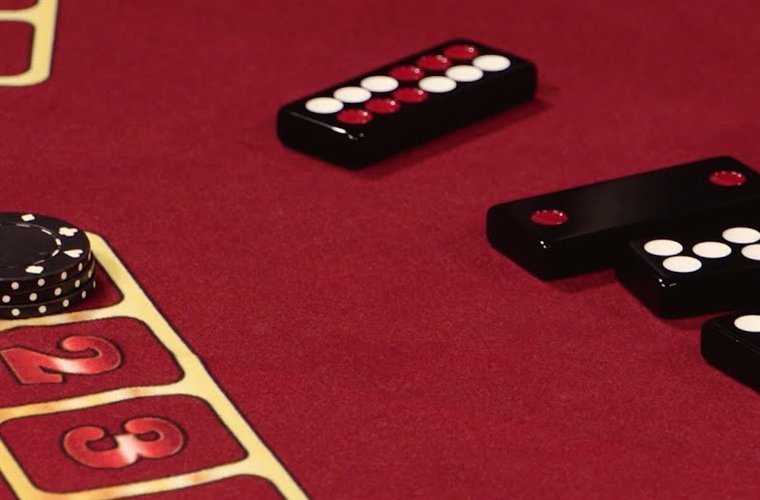
Pai gow tiles is the original pai gow, played with thirty two Chinese dominoes instead of cards. Each player sets four tiles into a high hand and a low hand, both must beat the banker to win, and a split result pushes. Most of the skill lies in the setting. The rest of the edge depends on one choice most players decline: taking the bank. For the wider market picture, start at our online casino Canada hub.
The table below sets out how the game behaves. Read it first, then work through the detail beneath.
| Trait | Detail |
|---|---|
| Equipment | 32 Chinese dominoes |
| Hand | Four tiles set into a high hand and a low hand |
| Win pays | Even money less a 5 percent commission |
| Split result | Push |
| Pushes | Roughly 41 percent of hands |
| Canadian supply | Edmonton and Calgary casinos, including PURE Casino Calgary |
What is pai gow tiles?
A Chinese banking game played with thirty two dominoes. Every player and the banker receive four tiles, split them into two hands of two tiles, and compare high hand against high hand and low hand against low hand.
Casinos call the game pai gow, pai gow tiles or tiles pai gow.
Pai gow tiles tables seat up to seven players plus the dealer, and every seat is compared against the banker alone.

Players never compete with each other directly.
The game rewards patience. A single hand takes longer than most card games, and long sessions stay calm.
Pai gow tiles remains one of the oldest banking games still dealt in North American casinos.
Where did pai gow tiles come from?
China. The earliest written description appears in a collection of Cantonese games published in Hong Kong in the late nineteenth century. The name means card nine, after the usual best point total.
Pai gow poker, the card game, was adapted from it far later.
The dominoes themselves are far older than the game. Pai gow tiles borrowed an existing set of Chinese tiles and built its ranking around them.
Chinese communities carried the game to North American card rooms and casinos.
The game later spread through Chinatown gambling halls before reaching regulated casinos.
How large is the tile set?
Thirty two Chinese dominoes. Unlike Western dominoes, the set includes duplicates of certain tiles and omits blank faces, and each tile is identified by its pip pattern.
The set forms sixteen ranked pairs.
Pai gow tiles players learn the set by pattern rather than by counting pips each time.
Red and white pips mark the faces on traditional sets.
Every tile has two halves. Each half shows between one and six pips.
Pai gow tiles sets use the same thirty two tiles in every casino, so rankings never change between tables.
How does a hand play out?
The dealer shuffles the tiles face down and builds a woodpile of eight stacks, four tiles each. Players bet, each seat receives one stack, and every player sets a high hand and a low hand before the banker reveals.
Dice traditionally decide which seat takes the first stack.
The woodpile lets every seat see how the tiles were stacked before the deal. Pai gow tiles players value that visible, hands on shuffle.
Setting happens privately, with tiles hidden until the reveal.
The banker reveals last. Every seat then compares its two hands in turn.
What are the high hand and low hand?
The two tile hand with the higher value is the high hand, also called the rear hand. The other is the low hand, or front hand. The player does not have to announce which is which.
The ranking makes the order obvious.
A pai gow tiles player who accidentally sets the low hand higher than the high hand is simply corrected, because the higher hand always counts as the high hand.
Setting a strong low hand often matters as much as setting a strong high hand.
How does a player win?
The high hand must beat the banker’s high hand and the low hand must beat the banker’s low hand. Winning both pays even money less a five percent commission.
Winning one and losing one is a push. Losing both loses the wager.
A pai gow tiles player who wins one hand and ties the other with a copy loses that copy to the banker, which turns the result into a push.
Ties never favour the player.
Winning both hands happens on roughly three hands in ten against a house way banker.
A pai gow tiles player who loses both hands forfeits the full wager with no commission charged.
How are hands ranked?
Pairs rank highest, in a fixed order of sixteen. Below pairs sit the Wong and the Gong, then point hands from nine down to zero.
Every two tile combination fits one of those categories.
Pai gow tiles rankings reward pairs far above any point hand. A low pair beats a nine point hand every time.
Learning the pair order is the first step for any new player.
Pairs, Wongs, Gongs and points cover every possible two tile hand in the set.
What are the sixteen pairs?
Matched tiles form most of the pairs, and a handful of mixed tiles with equal pip totals form the rest. The pairs follow a fixed traditional order rather than a simple pip count.
Reference charts show the order with a picture of each tile.
Pai gow tiles players memorise the top pairs first, because those hands appear in the most important setting decisions.
Mixed pairs of nines, eights, sevens and fives rank at the bottom of the pair list.
Matched pairs outnumber mixed pairs by a wide margin.
Pai gow tiles reference charts picture all sixteen pairs from Gee Joon down to the mixed fives.
What is Gee Joon?
The highest pair, formed by the one two tile and the two four tile. Individually those two tiles rank lowest of all when breaking ties, which makes them unusual.
Gee Joon is often called the supreme pair.
Pai gow tiles players who hold the Gee Joon pair usually keep it together as the high hand.
House ways decide the rare cases where splitting it is correct.
The pair appears rarely. When it does, it beats every other two tile hand.
Why are the Gee Joon tiles semi-wild?
Each Gee Joon tile can count as three or six points, whichever gives the higher total. Combined with a four point tile, a Gee Joon tile counts as three to make seven rather than six to make zero.
That flexibility makes Gee Joon tiles valuable even outside the pair.
A single Gee Joon tile in pai gow tiles turns a weak total into a strong one more often than any other tile.
Players treat it as a flexible asset.
The three or six choice applies separately in each hand where a Gee Joon tile sits.
What are Teen and Day?
Teen is the pair of twelve pip tiles and Day is the pair of two pip tiles. They rank directly below Gee Joon and anchor the Wong and Gong hands.
Their single tiles are the strongest high tiles for breaking ties.
The names come from Chinese words for heaven and earth. Pai gow tiles players use those names at the table rather than pip counts.
Teen outranks Day as a pair and as a single tile.
What is a Wong?
A Teen or Day tile combined with any nine point tile. The Wong ranks above every point hand and below every pair.
It is the strongest non pair hand in pai gow tiles.
A Teen tile with a nine point tile beats a Day tile with a nine point tile, because Teen ranks higher. Pai gow tiles uses the high tile to separate matching Wongs.
A Wong with Teen is the strongest non pair hand of all.
A pai gow tiles Wong made with Day still beats every nine point hand at the table.
What is a Gong?
A Teen or Day tile combined with any eight point tile. The Gong ranks below the Wong and above a nine point hand.
A Gong in the low hand is a strong result for any setting.
A Gong beats any nine point hand in pai gow tiles, even though its pip total is lower.
That rule surprises players arriving from baccarat.
Two Gongs with the same high tile tie, and ties go to the banker.
How are points counted?
Add the pips on both tiles and keep only the last digit. A ten tile and a nine tile make nine points, and a four tile and a seven tile make one point.
Baccarat uses the same last digit rule.
Pai gow tiles players count the last digit quickly after a session or two.
Ten, twenty and zero totals all count as zero points.
A nine point hand is the best point total, which gives the game its name.
Pai gow tiles players holding a Gee Joon tile check both the three and six count before setting.
How are ties broken?
When both hands hold the same Wong, Gong or point total, the hand with the higher ranked high tile wins. If the high tiles also match, the banker wins.
Gee Joon tiles never serve as the high tile for this purpose.
High tile comparisons follow the pair order in pai gow tiles, so a Teen tile outranks every other single tile for tie breaking.
Only the high tile of each hand matters.
The low tile never breaks a tie. Only the high tile counts.
Pai gow tiles copies, where both hands match exactly, always go to the banker.
Who wins a zero against zero?
The banker, always. A tie at zero points goes to the banker without comparing tiles, even when the player holds the higher ranked single tile.
That rule and the copy rule on ties give the banker its structural advantage.
Pai gow tiles players avoid setting a zero point hand wherever possible, because it cannot win on a tie.
Zero hands lose to every other point hand anyway.
The rule applies whether the player is banking or not, because it favours the banker position.
How often does a hand push?
Roughly forty one percent of hands push against a house way banker. The high hand and low hand split often because players arrange strength across both.
Pushes make pai gow tiles one of the slowest losing games in a casino.
A pai gow tiles session of one hundred hands typically includes around forty pushes, twenty nine wins and thirty losses for a player against a house way banker.
Push frequency changes little between strategies. Every approach produces roughly forty percent pushes.
What is the commission?
Five percent of every winning wager. A player who wins both hands on a one hundred dollar bet collects ninety five dollars.
Losses and pushes carry no commission.
The commission is what gives the banker its edge in pai gow tiles, along with ties and copies.
Commission is collected at the moment of payment.
Players track commission on winning hands only. Pushes cost nothing.
Pai gow tiles commission applies to the net win, never to the original stake returned with it.
Can the commission be prepaid?
At certain casinos. Betting one hundred and five dollars to win one hundred lowers the effective commission to about 4.76 percent, trimming the house edge by about seven hundredths of a percent.
Players always take the option where it exists.
A pai gow tiles player who prepays places the extra five percent with the bet before the deal.
The payout then arrives without deduction.
Prepaying adds five percent to every bet, losing ones included, yet the overall edge still falls slightly.
Who is the banker?
The bank usually rotates around the table, and the dealer banks when players decline. At certain casinos, such as Foxwoods, the bank alternates between the dealer and a player on every hand.
When a player banks, that player plays against every other seat and the dealer.
When a player banks, the dealer wagers the same amount that player bet the last time the dealer was banker.
Pai gow tiles rules on banking vary slightly between casinos.
Players may decline the bank every time it reaches them.
Pai gow tiles players who never bank play every hand against the dealer or another banker.
Why take the bank?
The banker wins ties and copies. Against the house way, the edge drops from about 2.44 percent when not banking to about 0.53 percent when banking.
Most players decline because banking requires covering every other bet at the table.
A pai gow tiles player who banks must have enough chips on the table to cover every wager placed against them.
That requirement keeps most pai gow tiles players from banking.
Banking multiplies the money at risk on a single hand. The lower edge comes with larger swings.
Pai gow tiles banking also changes which ties the player wins, because copies now fall in the player’s favour.
What is the house way?
The fixed set of rules the dealer uses to set tiles. Casinos that publish it post it at the table, and players can ask the dealer to set their hands the house way.
Following the house way avoids obvious setting mistakes, though it is not perfectly optimal.
The house way sets pai gow tiles hands the same way every time for a given four tile combination.
That consistency is why players trust it.
House ways differ slightly between casinos, so a strategy built for one table may not match another exactly.
Pai gow tiles dealers apply the house way to their own hand on every deal.
What is the house edge?
A player using the house way loses about 2.44 percent when not banking. Optimal setting trims that to about 1.66 percent, and optimal setting while banking turns it slightly in the player’s favour.
Those figures assume a five percent commission and the Foxwoods house way.
Inefficiencies in a typical casino house way cost the house about three quarters of a percent compared with optimal house setting.
Pai gow tiles players benefit from those inefficiencies without doing anything.
Setting tiles well matters more than bet size in controlling the cost of play.
Pai gow tiles players who prepay commission and bank when possible cut the edge to its lowest practical level.
Is there a published strategy?
Yes. Wizard of Odds publishes a basic strategy, the Wizard Way and two strategies developed by a contributor known as JB, along with optimal charts for banking and non banking play.
The simpler strategies come within a fraction of a percent of optimal.
A pai gow tiles strategy that fits on a single sheet, shared by a reader known as Charlie, combines parts of the other strategies into a near optimal guide.
Optimal charts cover single play and both banking positions.
Pai gow tiles strategies from Wizard of Odds come with charts for every possible four tile set.
How large is the set of possible hands?
There are 35,960 ways to choose four tiles from thirty two when every tile is distinct, and 3,620 distinct four tile sets when matching tiles are treated as identical.
Two tile hands number 136 distinct combinations.
The number of distinct pai gow tiles deals is small enough that complete strategy charts exist for every combination.
Card games rarely allow that.
The perfect hand pictured by Wizard of Odds carries odds of one in 35,960.
How does it compare with pai gow poker?
Pai gow poker uses fifty three cards, seven card hands and a five card and two card split. Pai gow tiles uses thirty two dominoes and splits four tiles into two equal hands.
Both pay even money less commission and push on split results.
Pai gow poker brought the two hand concept of pai gow tiles to players who already knew poker rankings.
The card version keeps the push rule as well.
Pai gow poker hands take less time to set because card rankings are familiar.
Pai gow tiles and pai gow poker both reward players who bank when the rules allow it.
How does it compare with baccarat?
Both games count points by the last digit of a total. Baccarat offers no decisions, while pai gow tiles asks the player to set every hand.
Baccarat plays far faster.
Pai gow tiles hands can also beat the banker through pairs, Wongs and Gongs, which baccarat has no equivalent for.
Baccarat tables handle far more hands per hour than tile tables.
How does it compare with sic bo?
Both are traditional Chinese games offered in North American casinos. Sic bo uses three dice and dozens of bet types, while pai gow tiles uses one wager and a hand setting decision.
Sic bo carries a wide range of house edges by bet.
Sic bo and pai gow tiles both draw players who enjoy traditional Chinese casino games.
Sic bo rounds finish quickly. Tile hands take longer to set and reveal.
Where can Canadians play pai gow tiles?
Alberta leads. Reference sources name Edmonton and Calgary among Canadian locations, and PURE Casino Calgary describes pai gow as an ancient Chinese game played with domino tiles on its table games page.
Tables are far less common elsewhere in the country.
At PURE Casino Calgary, pai gow tiles sits on the table game list beside baccarat, blackjack, roulette and ultimate texas holdem.
Players outside Alberta check their provincial casino operator for current listings.
Calling the casino before visiting confirms the table is open that day.
Pai gow tiles tables in Edmonton and Calgary are the most reliable places to find the game in Canada.
Can Canadians play pai gow tiles online?
Rarely. Regulated online lobbies carry pai gow poker far more often than tiles, and most online tiles experiences are practice apps rather than real money tables.
Land based floors remain the main route.
Practice apps for pai gow tiles appear on both the App Store and Google Play, and they suit learning the pair order before visiting a casino.
Pai gow poker is the closest real money option in most Canadian online lobbies.
Pai gow tiles practice apps suit learning the pair order at home before a casino visit.
Who regulates pai gow tiles in Alberta?
Alberta Gaming, Liquor and Cannabis oversees casino gaming in the province, which covers pai gow tiles tables on Alberta floors.
Each casino publishes its own table limits and house way details.
Pai gow tiles players with a rules question ask the pit supervisor first, since posted rules and house ways differ between casinos.
Posted table limits sit at every regulated table.
Is pai gow tiles good for beginners?
The ranking takes longer to learn than any card game, but beginners can ask the dealer to set tiles the house way. That removes every setting mistake immediately.
Learning the pairs comes with practice.
A beginner who lets the dealer set every pai gow tiles hand plays at the house way edge from the first bet.
That is a fair starting point.
Watching three or four rounds before sitting down helps. Dealers explain the reveal as it happens.
Pai gow tiles dealers set a beginner’s hand the house way on request without charge.
Is pai gow tiles good for a small bankroll?
High push rates stretch a bankroll further than the edge suggests. A player on a modest budget loses slowly because four hands in ten return the stake.
Checking the minimum first avoids surprises.
A pai gow tiles bankroll swings less than a baccarat bankroll of the same size at the same stake, because pushes return so often.
Small bets still pay commission on wins, so the percentage cost stays the same at any stake.
Pai gow tiles push rates keep a small bankroll steady across long sessions.
What does a Canadian check before playing pai gow tiles?
Four lines decide the table. The table minimum, the commission rule, whether prepaying is allowed and how the bank rotates all appear on the table card or can be confirmed with the dealer.
None of it requires a bet to learn.
The house way chart is worth a look as well. Pai gow tiles players who understand it know how their hands will be set.
Asking whether the dealer sets hands the house way on request takes a moment.
Pai gow tiles table cards list the minimum bet and commission rule in plain terms.
Which game pages are worth reading next?
Four pages sit closest to this one. Each covers a game or a rule that touches the subject above, and each stands on its own.
Pai gow tiles rewards patience more than any game in the pit. Learn the pairs, set tiles the house way when unsure, bank when the bankroll allows, and the edge shrinks to almost nothing.