
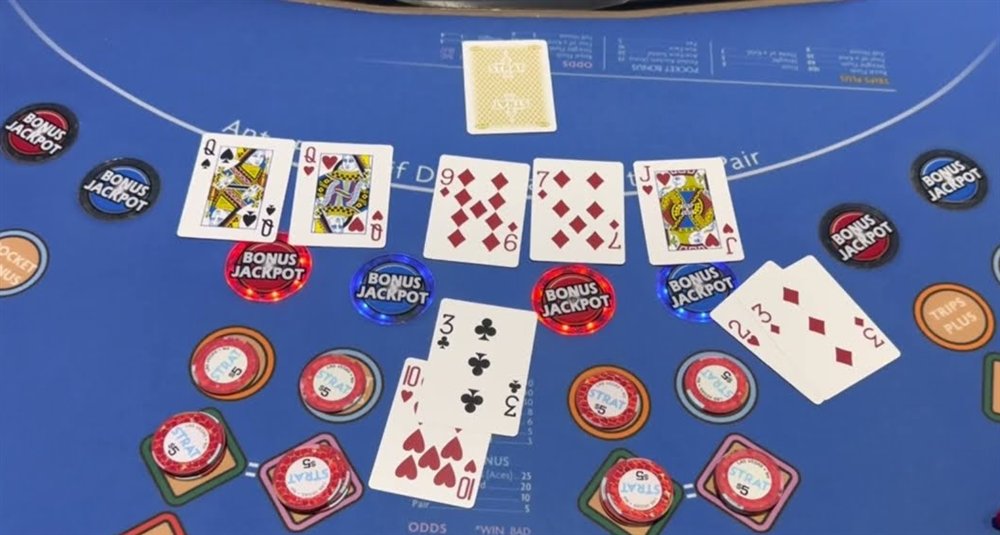
Heads up holdem looks like ultimate texas holdem until a strong hand loses. Then the Odds bet still pays. A straight that runs into a better dealer hand collects 5 to 1 on the best table, and a straight flush that loses collects 500 to 1. No other holdem game at the table pays a losing hand like that. For the wider market picture, start at our online casino Canada hub.
The table below sets out how the game behaves. Read it first, then work through the detail beneath.
| Trait | Detail |
|---|---|
| Owner | Galaxy Gaming |
| Required bets | Ante and Odds, equal in size |
| Play bet | 3x before the flop, 2x on the flop, 1x on the river |
| Dealer opens | With a pair or better |
| Odds bet | Pays on winning and losing straights or better |
| House edge | 2.36 percent on the Ante, 0.64 percent element of risk on the best table |
What is heads up holdem?
A house banked Texas holdem game where each player plays alone against the dealer. Both sides get two hole cards, share five community cards, and compare the best five card hands at showdown.
Galaxy Gaming owns the title and licenses it to casinos.
The name describes the format rather than a tournament. Heads up holdem puts every seat in a private duel with the dealer, even when six players share the felt.
No bluffing is possible, because the dealer never folds and never bets.
Rankings follow standard poker. A royal flush sits at the top and high card at the bottom.
Heads up holdem deals from a single fifty two card deck on every hand.
Heads up holdem suits players who want holdem decisions without facing other players across the felt.
How does a hand play out?
The player places equal Ante and Odds bets. Two hole cards arrive for the player and dealer. The player checks or bets three times the Ante, then the flop comes, then the turn and river together.
A player who checked twice must bet once more or fold at the river.
The turn and river arrive together in heads up holdem, so the third decision always sees the full board.
That structure mirrors ultimate texas holdem closely.
Side bets are placed with the Ante and Odds, before any card is dealt.
A full heads up holdem round takes under a minute on a software table.
How large is the Play bet?
Three times the Ante before the flop, two times the Ante after the flop, or exactly the Ante after all five community cards. The player makes only one Play bet per hand.
The earlier the bet, the larger it can be.
A heads up holdem player who bets 3x before the flop has no further decisions, and the remaining cards simply run out.
Smaller bets later in the hand buy information at a lower price.
A ten dollar Ante makes the 3x bet thirty dollars, the 2x bet twenty and the 1x bet ten.
The heads up holdem Play bet never exceeds three times the Ante.
Can the player check?
Yes, before the flop and again after the flop. At the river a player who has not yet bet must either bet one times the Ante or fold, losing the Ante and Odds bets.
Checking keeps the option open at a smaller size.
Checking before the flop in heads up holdem costs nothing immediately but gives up the right to the 3x bet for the rest of the hand.
Checking the flop gives up the 2x bet as well.
A check is a free action. It never costs chips at the moment it is made.
Heads up holdem never allows a check at the river once the board is complete.
When does the dealer open?
A pair or better. A dealer hand without a pair does not open, which changes how the Ante settles while the Play and Odds bets still play.
Open is the heads up holdem word for qualify.
Dealer hands with a pair appear on the large majority of heads up holdem deals, because seven cards make a pair easy.
Non opening dealer hands are high card hands only.
The dealer hand uses all seven cards available, exactly as the player hand does.
A heads up holdem dealer holding only ace high does not open.
What happens when the dealer opens and the player wins?
The Ante and Play bets both pay even money. The Odds bet pays from the winning hand table if the player holds a straight or better, and pushes otherwise.
This is the best outcome in heads up holdem.
A heads up holdem player who bet 3x and wins with a flush collects one unit on the Ante, three on the Play bet and one and a half on the Odds bet.
That is five and a half units of profit.
Winning with two pair pays the Ante and Play bets while the Odds bet pushes.
Heads up holdem pays the Ante only when the dealer opens.
What happens when the dealer does not open?
The Ante pushes. If the player wins, the Play bet pays even money and the Odds bet follows the winning table. If the dealer still wins, the Play and Odds bets lose.
A non opening dealer can still beat a weaker player hand.
The Ante push protects players who bet with a modest hand against a weak dealer. Heads up holdem still pays the Play bet in full when the player wins.
The dealer reveals the hole cards on every hand, opening or not.
Heads up holdem players still collect Odds payouts on straights and better in this case.
What happens when the dealer wins?
With an opening dealer, the Ante and Play bets lose. The Odds bet loses too, unless the player holds a straight or better, in which case the losing hand table pays.
That last rule is the signature of heads up holdem.
Losing a 3x heads up holdem hand with a pair costs five units: the Ante, the Odds bet and three on the Play bet.
A losing straight or better recovers part or all of that through the Odds bet.
A losing straight on the best table returns five units on the Odds bet, which more than covers a losing 1x hand.
A heads up holdem dealer holding a pair wins against any player high card hand.
What happens on a tie?
The Ante, Play and Odds bets all push. Ties happen when both hands play the same five cards or match rank for rank.
No wager wins or loses on a tie.
A heads up holdem board that holds a straight or flush on all five community cards often produces a tie.
Both hands then play the board.
Ties are uncommon at heads up holdem tables but more frequent than in stud games, because both hands share five cards.
Heads up holdem ties return every main wager to the player.
What does the Odds bet pay on a win?
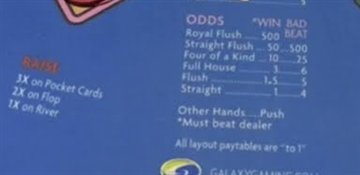
A royal flush pays 500 to 1, a straight flush 50 to 1, four of a kind 10 to 1, a full house 3 to 1, a flush 3 to 2 and a straight 1 to 1. Anything lower pushes.
The winning table is standard across heads up holdem builds.
Most heads up holdem wins come with a pair or two pair, so the Odds bet pushes on the majority of winning hands.
Straights and better turn it into profit.
A royal flush on a heads up holdem Odds bet pays five hundred times the stake.
The heads up holdem Odds bet always equals the Ante in size.
What does the Odds bet pay on a loss?
On the best table, a losing straight flush pays 500 to 1, four of a kind 50 to 1, a full house 10 to 1, a flush 8 to 1 and a straight 5 to 1. Any lower losing hand loses the Odds bet.
Losing strong hands pay more than winning ones.
A heads up holdem flush that loses to a full house collects 8 to 1 on the Odds bet under the best table.
The Ante and Play bets still lose.
A losing royal flush cannot happen, because nothing beats a royal flush.
A losing straight flush in heads up holdem needs a dealer holding a higher straight flush.
Why do losing hands pay more?
A strong hand that loses has run into an even stronger dealer hand, which is rare. Paying generously on those bad beats costs little over time and softens the sting of the result.
It is the most distinctive rule in heads up holdem.
Bad beats are what players remember. Heads up holdem turns those moments into payouts, which is why players enjoy the Odds bet.
The maths accounts for every one of them in the published edge.
The losing payouts are fixed. They do not change with the size of the Play bet.
Heads up holdem players rarely see the top losing payouts in a lifetime of play.
How do the losing Odds tables differ?
Galaxy Gaming offers four. Every table pays 500 to 1 on a losing straight flush. The rest vary: quads pay 50 or 25, full houses 10 or 6, flushes 8, 6 or 5, and straights 5 or 4.
Reading those rungs identifies the table.
Operators choose which losing Odds table a heads up holdem game uses.
The felt or rules screen prints the payouts in full.
The fourth table trims quads to 25 and full houses to 6, which costs the player most.
Heads up holdem players compare the flush rung first, because it varies most.
What is the house edge?
On the best losing Odds table the expected loss is 2.36 percent of the Ante. The other three tables cost 3.06, 3.73 and 4.55 percent.
Table choice nearly doubles the cost of heads up holdem from the best table to the worst.
The heads up holdem edge is measured against the Ante alone, while the Odds bet and Play bet add to the money wagered.
That is why the element of risk sits far lower.
Side bets are excluded from those figures. Each carries its own separate edge.
Poor strategy raises the heads up holdem edge quickly.
What is the element of risk?
The average hand risks about 3.67 units, so the element of risk is 0.64 percent on the best table. The other tables run 0.83, 1.02 and 1.24 percent.
Ultimate texas holdem sits at 0.53 percent for comparison.
A heads up holdem player betting five dollars on the Ante and Odds loses about twelve cents per hand on average under the best table.
The figure assumes correct strategy.
Heads up holdem sits just above ultimate texas holdem on this measure and well below most stud games.
Lower element of risk means a heads up holdem bankroll lasts longer per dollar wagered.
When does a player bet three times?
Bet 3x before the flop with any pair except deuces, and with the strong unpaired starting hands listed on published charts. Aggressive early betting is where the game rewards skill.
Pocket deuces wait for the flop.
A heads up holdem player who checks a premium pair before the flop gives away more value than any later mistake recovers.
Early aggression is the core skill.
Pocket aces and kings take the 3x bet without exception.
Heads up holdem strategy cards list the unpaired 3x hands in full.
When does a player bet two times?
After the flop, bet 2x with two pair or better, any hidden pair except pocket deuces, or four to a flush including a hidden ten or better of that suit.
A hidden pair uses at least one hole card.
A heads up holdem flush draw needs a hidden high card of the suit, because a board flush with a low hidden card often loses to a dealer holding a higher one.
Board pairs alone never justify a 2x bet at a heads up holdem table.
Heads up holdem players check the flop with everything else.
When does a player bet one time?
At the river, bet 1x with a hidden pair or better, or when fewer than twenty one dealer outs beat the player hand. Otherwise fold.
The medium and small raise rules match ultimate texas holdem.
Counting dealer outs means counting the cards that give the dealer a better hand. A heads up holdem player with fewer than twenty one such outs bets rather than folds.
Folding at the river costs two units, so the 1x bet only needs to win a modest share of the time.
Heads up holdem rewards careful river counting more than any other decision.
What does a hidden pair mean?
A pair that uses at least one of the player hole cards. A pair made only from community cards is shared with the dealer, so it adds no strength against the dealer hand.
The distinction appears on every strategy line.
A heads up holdem player holding a seven that pairs a seven on the board has a hidden pair. A pair of sevens on the board alone is not hidden.
Hidden pairs beat dealer hands that only play the board, which is why they carry weight.
Wizard of Odds marks hidden pairs with an asterisk in its heads up holdem strategy.
How often does the player fold?
Roughly one hand in five ends in a fold at the river under correct play. Every fold costs two units: the Ante and the Odds bet.
Folds are part of correct heads up holdem play, not a sign of weakness.
Folds happen only at the river in heads up holdem, because earlier decisions allow a check instead.
Every fold therefore sees all five community cards first.
The fold rate falls when the player bets strong hands early.
A heads up holdem fold rate far above one in five signals missed river bets.
What is the Trips Plus bet?
An optional side bet on the player’s final five card hand. Three of a kind or better wins from a fixed table, whatever the dealer holds.
The most common table pays 100 to 1 for a royal flush down to 3 to 1 for trips.
The Trips Plus bet in heads up holdem pays on the same seven cards the player uses for the main hand.
Its paytable sits beside the main betting circles.
Trips Plus limits on land based tables often differ from the main game limits.
Trips Plus is optional at every heads up holdem table.
What does Trips Plus pay?
The most common table pays 100 to 1 on a royal flush, 40 to 1 on a straight flush, 30 to 1 on quads, 8 to 1 on a full house, 7 to 1 on a flush, 4 to 1 on a straight and 3 to 1 on trips.
About fifteen hands in a hundred collect.
Three of a kind is the most frequent winning Trips Plus hand in heads up holdem, followed by straights and flushes.
A royal flush on the Trips Plus returns one hundred times the stake.
Heads up holdem Trips Plus pays the same whether the main hand wins or loses.
What is the Trips Plus house edge?
The most common table carries 3.34 percent. Four known tables run from 0.74 percent to 4.34 percent, depending on the full house, flush and straight payouts.
The best version costs about as little as the main game element of risk.
A heads up holdem table paying 9 to 1 on a full house and 7 to 1 on a flush carries the best Trips Plus table.
Tables paying 7 on a full house cost the most.
The table in use is printed on the felt beside the betting circle.
Heads up holdem tables paying 5 on a straight appear on two of the four Trips Plus tables.
What is the Pocket Bonus bet?
An optional side bet on the player’s two hole cards alone. Pocket aces pay 30 to 1 on the best table, ace and face card suited 20 to 1, ace and face unsuited 10 to 1, and any other pair 5 to 1.
It settles before a single community card appears.
The Pocket Bonus settles immediately in heads up holdem, before the player makes any Play bet decision.
Ace and face combinations include kings, queens and jacks.
A pair of kings pays the same 5 to 1 as a pair of twos.
Heads up holdem Pocket Bonus limits often sit below the main table limits.
What is the Pocket Bonus house edge?
About 4.5 percent on the best table, 6.8 percent when aces pay 25 to 1, and nearly 10 percent when pairs pay 4 to 1.
Roughly nine hands in ten lose the Pocket Bonus.
A heads up holdem player placing the Pocket Bonus on every hand spends about seven times more per dollar than on the main game.
A pair appears in the hole cards about once in every seventeen hands.
Heads up holdem players choosing the Pocket Bonus look for aces paying 30 to 1.
Are the side bets worth playing?
Both side bets cost more than the main game on common tables. They are optional, and skipping them keeps a heads up holdem session near its published element of risk.
The best Trips Plus table is the one exception worth considering.
Heads up holdem side bets suit players who want a separate chance at a large payout on each hand.
Budgeting them separately keeps their cost visible.
Leaving both circles empty costs nothing at a heads up holdem table.
Heads up holdem plays in full without either side bet.
Is there a progressive jackpot?
Some land based tables add one. Northwood Casino advertises its heads up holdem table as now with a progressive, alongside the Trips Plus and Pocket Bonus bets.
Progressive rules sit on their own table card.
Progressive heads up holdem wagers usually carry their own minimum stake and their own paytable.
Players read both before adding one.
Progressive meters display the current amount above the table.
Progressive heads up holdem wagers are optional wherever they appear.
How large is a heads up holdem table?
Up to six on a typical land based layout, each playing heads up against the same dealer hand. Players never compete with each other.
Every seat plays under the same rules and paytables.
Six seats keep a land based heads up holdem table moving at a steady pace. Every seat shares the same dealer hand and community cards.
Table minimums apply to each seat separately.
Heads up holdem seats never affect one another’s results.
How does it compare with ultimate texas holdem?
The betting structure is nearly identical: 3x, 2x or 1x Play bets and a dealer who opens with a pair. The difference is the Odds bet, which pays losing straights and better where the ultimate texas holdem Blind does not.
Ultimate texas holdem carries the slightly lower element of risk.
Heads up holdem calls the second required bet the Odds bet, while ultimate texas holdem calls it the Blind.
The Play bet sizes match exactly.
Players who know one of the two games play the other within minutes.
Heads up holdem trades a slightly higher edge for bad beat payouts.
Heads up holdem and ultimate texas holdem both reward the large preflop bet above every other decision.
How does it compare with texas holdem bonus poker?
Texas holdem bonus poker demands a Flop bet before the flop and allows two more optional raises. Heads up holdem lets the player check twice and makes one Play bet at most.
Both deal from a single deck.
Texas holdem bonus poker pays the Ante only on straights and better. Heads up holdem pays the Ante on any win against an opening dealer.
Heads up holdem also opens the dealer on a pair, which texas holdem bonus poker never does.
Heads up holdem pays more on strong losing hands than texas holdem bonus poker ever does.
How does it compare with casino holdem?
Casino holdem forces a decision on the flop at a fixed 2x call and needs the dealer to qualify with fours or better. Heads up holdem allows a 3x bet before the flop and opens on any pair.
Casino holdem folds far more often.
Casino holdem pays an Ante bonus on strong hands. Heads up holdem pays strong hands through the Odds bet, winning or losing.
Both games deal from a single deck and use two hole cards.
Heads up holdem gives the player more control over bet sizing.
Is heads up holdem good for beginners?
A beginner who already knows holdem hand rankings learns it within a handful of hands. The raise strategy takes longer, but the 2x and 1x rules fit on a single card.
The 3x chart is the part to study.
Beginners who start with the 2x and 1x rules play heads up holdem reasonably well from the first session.
The 3x chart adds the rest.
Demo tables are the easiest place to try the raise rules without risk.
Heads up holdem suits players who already enjoy ultimate texas holdem.
What mistakes cost the most?
Checking strong pairs before the flop is the costliest, because the 3x bet carries most of the value. Folding hidden pairs at the river is the second.
Playing the worst Odds table is the third.
Betting 1x at the river on a board pair without a hidden card is another common heads up holdem error.
That hand usually loses to any dealer pair.
Choosing the fourth losing Odds table nearly doubles the cost of every heads up holdem hand.
Heads up holdem punishes passive preflop play more than any other habit.
Where can Canadians play heads up holdem?
Availability in Canada is limited compared with ultimate texas holdem. Ontario registered operators with deep table catalogues and land based floors carrying the Galaxy Gaming line are the places to look.
Searching by name is faster than browsing a lobby.
Galaxy Gaming has offered a free demo of heads up holdem on its own web site, which suits practice before playing for money.
Players outside Ontario check their provincial platform first.
Heads up holdem appears most often in Galaxy Gaming table catalogues.
Heads up holdem availability changes as operators update their table catalogues, so a lobby search is worth repeating.
Is heads up holdem certified in Ontario?
Registered operators run builds tested by an approved laboratory. The deck, the opening rule and every paytable are fixed at certification and cannot change afterwards.
Operators display their registration number in the site footer.
Certification is granted per market as well as per title. A heads up holdem build approved elsewhere is retested before an Ontario release.
Testing covers the shuffle, the opening rule and every paytable together.
An operator offering heads up holdem displays its registration number in the site footer.
Does heads up holdem count toward wagering?
Table games usually contribute at a reduced rate, and certain bonus terms exclude them outright. The contribution clause matters more than the headline bonus figure.
Rates differ between operators.
An excluded game can void a bonus rather than simply contributing nothing. That clause matters more than the rate beside heads up holdem.
Contribution rates for table games run from zero to twenty percent.
Cash play at a heads up holdem table carries no such restrictions.
Is heads up holdem good for a small bankroll?
Every hand starts at two units and a 3x bet lifts it to five. Northwood Casino lists table limits of three to one hundred dollars, which gives a sense of land based stakes.
Side bet limits there run three to twenty five dollars.
A heads up holdem bankroll sized for fifty hands at five units each absorbs normal swings comfortably.
Deposit limits sit inside every registered Ontario account.
The 1x river bet keeps exposure low on marginal hands.
Heads up holdem tables with low minimums suit a modest deposit.
What does a Canadian check before playing heads up holdem?
Four lines decide the table. The losing Odds table, the Trips Plus table, the table minimum and the operator registration status all appear before any money moves.
None of it requires a deposit to read.
The losing Odds table matters most, because it moves the heads up holdem edge more than any other line.
Reading it takes seconds.
Checking the Pocket Bonus table as well adds one more line to read.
Heads up holdem publishes every relevant number before the first hand.
Which game pages are worth reading next?
Four pages sit closest to this one. Each covers a game or a rule that touches the subject above, and each stands on its own.
Heads up holdem pays strong hands whether they win or lose. Bet early with pairs, bet the flop with hidden pairs and flush draws, pick the best Odds table, and the game plays close to its published edge.