
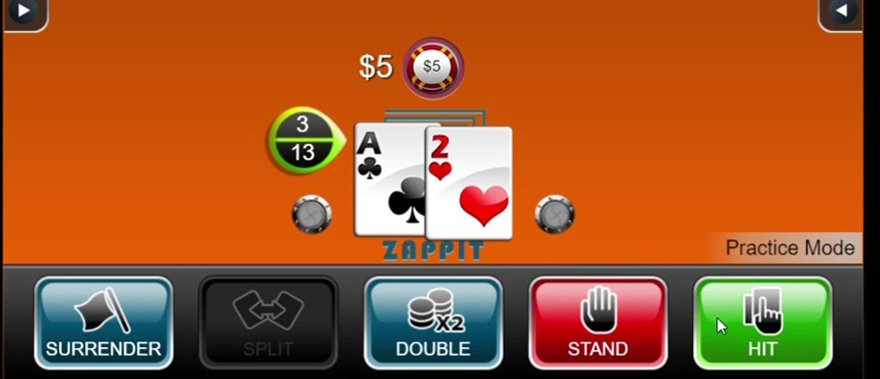
Zappit blackjack lets the player throw away a bad starting hand and take two fresh cards. A two card fifteen, sixteen or seventeen can be zapped, replaced in one click, and played again from the new total. The price is the dealer twenty two rule: when the dealer finishes on twenty two, every live hand pushes. For the wider market picture, start at our online casino Canada hub.
The table below sets out how the game behaves. Read it first, then work through the detail beneath.
| Trait | Detail |
|---|---|
| Inventor | Geoff Hall, creator of blackjack switch |
| Decks | Six, reshuffled every round online |
| The zap | Replace a two card 15, 16 or 17 with two new cards |
| Dealer 22 | Pushes against every live player hand |
| Blackjack pays | 3 to 2 online before a zap |
| House edge | About 1.15 percent online |
What is zappit blackjack?
A blackjack variant that adds one new move: the zap. A player holding a two card total of fifteen, sixteen or seventeen may discard both cards and receive two new ones instead of hitting or standing.
Everything else follows standard blackjack, with the dealer twenty two push paying for the zap.
The zap is the only rule that changes the rhythm of the game. A zappit blackjack round looks exactly like a standard round until a stiff total appears.

Then the Zap button lights up beside Hit and Stand.
Card values never change. Tens and face cards count ten, aces count one or eleven, and every other card counts at face value.
Zappit blackjack tables look identical to standard blackjack tables apart from the Zap button and the push rule line.
The name comes from the zap itself, and the game has kept the same core rule since its release. Players recognise it instantly by the Zap button on the action bar.
Who invented zappit blackjack?
Geoff Hall, the designer behind blackjack switch and free bet blackjack. Scientific Games, now Light and Wonder, took over distribution, and the game appears online and on North American casino floors.
The push twenty two rule runs through most of his designs.
Geoff Hall built zappit blackjack around the same idea as his earlier games: give the player something visible and valuable, then recover the cost quietly through the dealer twenty two push.
Hall’s designs share a habit of giving the player a new decision rather than a new side bet.
The zap is the simplest example.
Zappit blackjack joined the Light and Wonder table catalogue through its Scientific Games heritage.
How does the zap work?
After the first two cards, a Zap button appears on eligible hands. Pressing it discards the hand and deals two fresh cards to the same box. Play then continues from the new total as a normal hand.
The original wager stays in place. Nothing extra is staked.
A zapped hand keeps its seat and its stake. Zappit blackjack treats the two new cards as a brand new starting hand for every purpose except the natural blackjack payout.
Surrender, doubling and splitting all remain open where the rules allow.
The new cards arrive face up, exactly like the original deal.
The player then acts on the new total straight away.
A zappit blackjack zap never changes the bet size or the seat.
Players who change their mind cannot undo a zap. Once the new cards land, the original hand is gone for the rest of the round.
Zappit blackjack shows the new total beside the cards as soon as the replacement pair lands.
Which hands can be zapped?
Online, two card totals of fifteen, sixteen and seventeen. Certain land based versions also allow a two card eighteen to be zapped, which changes strategy and cost.
Hands of three or more cards can never be zapped.
A zappit blackjack pair that totals sixteen, such as two eights, qualifies for the zap as well as for a split.
The player chooses one action or the other.
Two card hands totalling fourteen or less never qualify, because hitting them carries little risk of busting.
Zappit blackjack shows the Zap button only on qualifying two card totals.
Can a hand be zapped twice?
No. The zap is available once per round. If the new two cards also total fifteen through seventeen, the player hits, stands, doubles or surrenders like any other hand.
A second zap button never appears.
Zappit blackjack limits the zap to one use because a second zap would hand the player too much value.
The dealer twenty two push is calibrated for a single zap per round.
Split hands cannot be zapped, because a split happens after the first action and the zap must come first.
Zappit blackjack treats the second deal as final for zapping purposes.
What happens if the zap deals a blackjack?
An ace and a ten value card after a zap do not count as a natural. The hand is treated as twenty one, which wins even money online rather than three to two.
Natural blackjacks exist only on the original deal.
A zappit blackjack twenty one made from a zap still pushes against a dealer twenty one and pushes against a dealer twenty two.
Only an original natural beats the push rule.
The interface labels a zapped twenty one plainly. No three to two payout appears on it.
That rule prevents players from zapping in search of a three to two payout. The zap is a rescue, not a bonus.
Why does dealer 22 push?
The zap removes the worst starting hands in blackjack, which is worth a great deal to the player. Pushing every live hand when the dealer finishes on twenty two takes that value back.
Dealer busts on twenty three or more still pay.
Every zappit blackjack table prints the push rule beside the blackjack payout line.
The rule applies to doubled and split hands as well.
Twenty three and above remain ordinary busts that pay every live hand.
Zappit blackjack players see the push roughly once every fourteen rounds.
Does dealer 22 beat a player blackjack?
No. An original blackjack keeps its win when the dealer reaches twenty two. Players who busted earlier in the round still lose, because their hands were already settled.
Only live hands push.
Settled hands stay settled. A zappit blackjack player who busted before the dealer drew loses that wager whatever the dealer total becomes.
Surrendered hands also stay settled. Half the stake is returned before the dealer draws.
How often does the dealer finish on 22?
Roughly seven dealer hands in a hundred end on exactly twenty two. That frequency is the same across every push twenty two game, because the dealer drawing rules do not change.
It shows up about once every fourteen rounds.
Dealer hits on soft seventeen raise the twenty two frequency slightly. Zappit blackjack uses that rule on its standard online build.
Dealer upcards of ten or ace reach twenty two less often than middle upcards such as six.
Across a long session the push rule costs more than any single decision. It is the steady price for every zap offered.
What does blackjack pay?
Three to two on online tables before any zap. Land based versions can pay six to five, which raises the house edge well above the online figure.
The payout line sits on the rules screen or printed felt.
Players choosing a land based zappit blackjack table check the payout line first, because six to five costs far more than the extra zappable total gives back.
A ten dollar natural returns fifteen dollars profit at three to two. At six to five it returns twelve.
Zappit blackjack online keeps the full three to two payout on original naturals.
What are the standard online rules?
Six decks shuffled after every round, dealer hits soft seventeen and stands on hard seventeen, doubling on the first two cards, one split with no resplits, and late surrender, including after a zap.
Insurance pays two to one.
Every line in that list appears on the zappit blackjack rules screen before the first wager.
Reading them takes under a minute.
Rules screens also show table limits and whether surrender is enabled.
Zappit blackjack online uses the same rule set on every certified build.
How does splitting work?
Splitting is allowed only as the first action on a pair. Resplitting is not allowed, and split aces receive one card each with no further action.
Doubling after a split is allowed.
A zappit blackjack player holding two eights chooses between splitting and zapping, because both are first actions and only one can happen.
The chart settles which is better against each upcard.
Splitting aces ends the action on both new hands after one card each.
Zappit blackjack never allows a split pair to be resplit, whatever the rank.
How does doubling work?
Doubling is allowed on the first two cards of a hand, including a zapped hand’s new two cards. The doubled hand receives one card only.
Split hands may double as well.
Doubling a zapped eleven against a weak upcard is one of the stronger plays in zappit blackjack.
The new cards give the double the same value as a natural eleven.
Doubling commits a second unit, so the double needs a strong total to justify it.
Zappit blackjack doubles pay even money on the doubled stake.
Can a player surrender?
Online zappit blackjack allows surrender, returning half the wager. It is available as a first action on the original hand and again on the new cards after a zap.
That combination gives the player two separate escapes from a weak total.
Surrender costs half the stake and ends the hand at once.
Zappit blackjack surrender suits stiff totals facing a dealer ten or ace.
What is the house edge?
About 1.15 percent on the standard online rules with correct play. Land based versions paying six to five on blackjack cost more, even with the option to zap eighteen.
Zappit blackjack sits above a good standard table and below most side bets.
Poor zap decisions raise the zappit blackjack edge quickly. Zapping good hands or keeping bad ones gives back more than the table takes.
Operators cannot change the zap rule or the push rule after certification.
The zappit blackjack edge rises sharply when the zap is used without a chart.
The online figure of about 1.15 percent assumes the player follows a published chart on every zap, double, split and surrender decision.
Is zappit blackjack better than standard blackjack?
No, on cost alone. A standard six deck table paying three to two costs roughly half a percent less. Zappit blackjack trades that difference for the chance to escape stiff hands.
Players choose it for the decision, not the edge.
Zappit blackjack suits players who hate sitting on a sixteen against a ten.
Standard blackjack suits players chasing the lowest possible cost.
The difference in cost is small at low stakes and grows with bet size.
Players who enjoy an extra decision on stiff hands find the half percent worth paying. Players focused only on cost prefer a standard table.
When is zapping correct?
A two card fifteen or sixteen facing a dealer seven or higher is the classic zap spot, because standard strategy already expects those hands to lose often against strong upcards.
Published zappit strategy charts cover every total and upcard.
Zappit blackjack players who zap every stiff total without looking at the upcard lose value against weak dealer cards.
Charts show the zap as its own action in each qualifying cell.
Zappit blackjack rewards zaps against strong dealer upcards most.
When does a player keep a stiff hand?
Against a dealer two through six, stiff totals often stay put, because the dealer busts frequently from those upcards. The push twenty two rule trims that benefit, so the line sits close.
Charts settle each borderline case.
A zappit blackjack sixteen against a dealer six keeps its chance of a dealer bust, and a fresh deal can easily land worse.
The upcard decides.
Keeping a stiff hand often means standing, because the dealer busts from weak upcards.
Zappit blackjack players keep stiff totals most often against a dealer five or six.
Is zapping seventeen correct?
Seventeen is the strongest zappable total and holds up against weak upcards. Any case for zapping it rests on strong dealer upcards such as a ten or an ace.
Charts treat seventeen as the most selective zap.
Seventeen already stands on every standard chart. Zappit blackjack gives that hand one more option, and it rarely beats standing against a weak dealer.
Seventeen is the zappable total that wins most often without any change.
Does basic strategy still apply?
After a zap, or on any hand that is not zapped, a strategy chart for six deck blackjack with the dealer hitting soft seventeen works well. The zap decision sits on top of it.
Treating the zap like a hit on a poor total is a common shortcut.
Zappit blackjack charts published for the online build combine the zap and the standard decisions in one table.
Printing one takes a minute.
The chart for the new cards is the same chart used for any starting hand.
Zappit blackjack charts assume six decks and a dealer who hits soft seventeen.
Can you count cards in zappit blackjack?
Not online. The software reshuffles all six decks after every round, so no information carries from one hand to the next.
Land based shoes follow their own cut card rules.
Continuous reshuffling also means every zappit blackjack round starts with identical odds.
Session results depend on decisions, not deck position.
Land based tables with a shoe allow counting in principle, though the push rule reduces its value.
Software shoes make every round independent, which also removes any benefit from tracking zapped cards during a session.
Zappit blackjack software keeps no memory of earlier rounds, so every deal is independent.
How does it compare with blackjack switch?
Both come from Geoff Hall and both push dealer twenty two. Blackjack switch swaps cards between two hands and pays naturals even money. Zappit blackjack replaces one bad hand and keeps three to two online.
Blackjack switch carries the lower edge on good rules.
A zappit blackjack player manages one hand. A blackjack switch player manages two at once and must match both stakes.
Blackjack switch requires two equal stakes on every round. Zappit blackjack needs one.
Zappit blackjack and blackjack switch both reward learning a dedicated chart.
How does it compare with free bet blackjack?
Both push dealer twenty two. Free bet blackjack hands out free doubles and splits, while zappit blackjack hands out a fresh start on stiff totals.
Their house edges sit close, near one percent.
Free bet blackjack rewards strong starting hands with free doubles. Zappit blackjack rescues weak starting hands with a fresh deal.
Both games are built around the same dealer twenty two push.
Zappit blackjack and free bet blackjack often appear in the same blackjack variant sections of Canadian lobbies.
How does it compare with super fun 21?
Super fun 21 offers doubles on any cards, surrender at any point and bonus hands, then pays most blackjacks even money. Zappit blackjack keeps standard options and adds a single new move.
Both land slightly above one percent.
Super fun 21 changes a long list of rules. Zappit blackjack changes one rule and the dealer twenty two outcome.
Super fun 21 pays most naturals even money. Zappit blackjack pays original naturals three to two online.
Both games suit players who want more control over weak hands than standard blackjack offers.
Is there a live dealer version?
Zappit blackjack is best known as a software game. Land based tables in North America use a live version with slightly different rules, including zapping eighteen at certain venues.
Canadian players meet it mostly online.
Land based zappit blackjack tables often pay six to five on blackjack, which makes the online version the cheaper choice for Canadian players.
Live studio versions are rare. Software carries the game in most Canadian lobbies.
Zappit blackjack software builds deal every hand on demand at any hour.
Where can Canadians play zappit blackjack?
OLG lists zappit blackjack in its online casino, and Ontario registered operators carrying the Light and Wonder table catalogue stock it too. Provincial platforms elsewhere list it less consistently.
Searching by name is faster than browsing.
OLG carries zappit blackjack among its online blackjack variants, alongside standard blackjack.
Players outside Ontario check their provincial platform first.
Zappit blackjack appears under blackjack variants in most Ontario lobbies that carry it.
Checking the rules screen confirms whether a given Canadian table allows zapping fifteen, sixteen and seventeen.
Is zappit blackjack certified in Ontario?
Registered operators run builds tested by an approved laboratory. The zap rule, the dealer twenty two push and the payouts are fixed at certification and cannot change afterwards.
Operators display their registration number in the site footer.
Certification is granted per market as well as per title. A zappit blackjack build approved elsewhere is retested before an Ontario release.
Testing covers the shuffle, the zap rule and every payout together.
Players can confirm an operator registration through the regulator public register in a minute.
Does zappit blackjack count toward wagering?
Blackjack variants usually contribute at a reduced rate, and certain bonus terms exclude them outright. The contribution clause matters more than the headline bonus.
Rates differ between operators.
An excluded game can void a bonus rather than simply contributing nothing. That clause matters more than the rate beside zappit blackjack.
Contribution rates for table games run from zero to twenty percent.
Is zappit blackjack good for a small bankroll?
The zap costs nothing extra, so exposure per round stays at one unit unless the player doubles or splits. A one dollar table suits a modest deposit.
Fast software rounds raise hourly cost, so pace matters.
Deposit limits sit inside every registered Ontario account. Setting one before a zappit blackjack session takes a minute.
A bankroll sized for fifty rounds at the chosen stake absorbs normal swings.
Zappit blackjack minimums start low on software tables.
Zappit blackjack sessions at the table minimum keep exposure low while the zap rules become familiar.
What does a Canadian check before playing zappit blackjack?
Four lines decide the table. The zappable totals, the blackjack payout, the surrender rule and the operator registration status all appear before any money moves.
None of it requires a deposit to read.
The habit transfers to every blackjack variant in the lobby. Zappit blackjack simply adds the zap line to the list.
Reading the rules screen takes under a minute.
Does zapping change the dealer hand?
No. The dealer upcard and hole card stay exactly as dealt. The zap only replaces the player’s two cards, so the dealer hand plays out under the same rules whatever the player chooses.
Zappit blackjack keeps the dealer side of the table untouched. The player decision affects one box only, and the dealer still draws to sixteen and hits soft seventeen.
The dealer hole card is revealed only after every player finishes acting.
Zappit blackjack dealers never zap, and dealer hands follow fixed drawing rules.
The dealer upcard is visible before the zap decision, which is why every zap chart reads the upcard first.
Where do zapped cards go?
They leave play for the rest of the round. Online, the six deck shoe reshuffles after every round, so the discarded cards return before the next deal and never affect later hands.
Zappit blackjack players therefore gain nothing by remembering which cards were zapped. Each round starts from a complete shoe.
Land based tables place zapped cards in the discard tray.
On software tables the discarded cards simply disappear from the screen once the new hand is dealt.
How does insurance work?
Insurance appears when the dealer shows an ace and pays two to one if the dealer holds blackjack. It works exactly as in standard blackjack and costs half the original wager.
Zappit blackjack strategy skips insurance, as standard blackjack strategy does. The bet carries a higher edge than the main game.
Insurance settles before the player makes any zap decision.
Zappit blackjack insurance pays only when the dealer holds a natural.
What happens on a tie?
Equal totals push, returning the stake. A zapped twenty against a dealer twenty pushes, and every live hand pushes when the dealer finishes on twenty two.
Pushes are more common at a zappit blackjack table than at a standard one, because the dealer twenty two outcome adds to ordinary ties.
Ties never cost the player anything beyond the time spent on the hand.
Zappit blackjack ties return the full stake immediately.
What happens when the player busts?
The wager loses immediately. A player who hits a zapped sixteen and busts loses that hand before the dealer acts, and a later dealer twenty two cannot rescue it.
Zappit blackjack settles busted hands at the moment they bust, exactly like standard blackjack.
Busting is more likely after hitting a zapped stiff total than after standing.
Busted chips are collected at once, and the dealer continues with the remaining live hands.
Why is the zap limited to fifteen through seventeen?
Those are the stiff totals that standard strategy handles worst. Lower totals already hit with little risk, and eighteen and above win often enough that zapping them would give away value only on land based tables that allow it.
Zappit blackjack aims the zap exactly where players feel stuck.
Limiting the zap keeps the house edge close to one percent on the online build.
Zappit blackjack land based tables adding eighteen offset the extra value through a lower blackjack payout.
What mistakes cost the most?
Zapping every stiff total without checking the upcard is the costliest. Ignoring surrender after a poor zap is the second, and choosing a land based table paying six to five on blackjack is the third.
Each error is avoidable with a published zappit blackjack chart and a glance at the rules screen.
Doubling weak zapped totals is another common error.
Zappit blackjack mistakes compound quickly on fast software tables.
Playing without a chart turns the zap from an advantage into a cost.
Is zappit blackjack good for beginners?
Yes. A beginner who already knows blackjack learns the zap in one round, and the extra button makes stiff hands less stressful. The strategy chart adds one column of decisions.
Demo tables let a beginner try zappit blackjack without risking money.
The zap button appears only when the hand qualifies, so beginners never zap by mistake on an ineligible total.
Zappit blackjack demo play mirrors the real game exactly.
Most beginners find the zap easier to learn than doubling and splitting rules.
How fast does a round play?
Software rounds finish in seconds, even with a zap. The reshuffle after every round happens instantly, so there is no pause between hands.
Faster zappit blackjack rounds raise the hourly cost at the same stake, so players on a budget slow down between hands.
Land based tables run slower because of dealing and chip handling.
Zappit blackjack sessions stay predictable when players set a round limit before starting.
A comfortable pace keeps decisions accurate across a long session.
Which game pages are worth reading next?
Four pages sit closest to this one. Each covers a game or a rule that touches the subject above, and each stands on its own.
Zappit blackjack gives every player a second chance at a bad start and collects the cost one twenty two at a time. Zap stiff hands against strong upcards, keep them against weak ones, and the table plays close to its published edge.