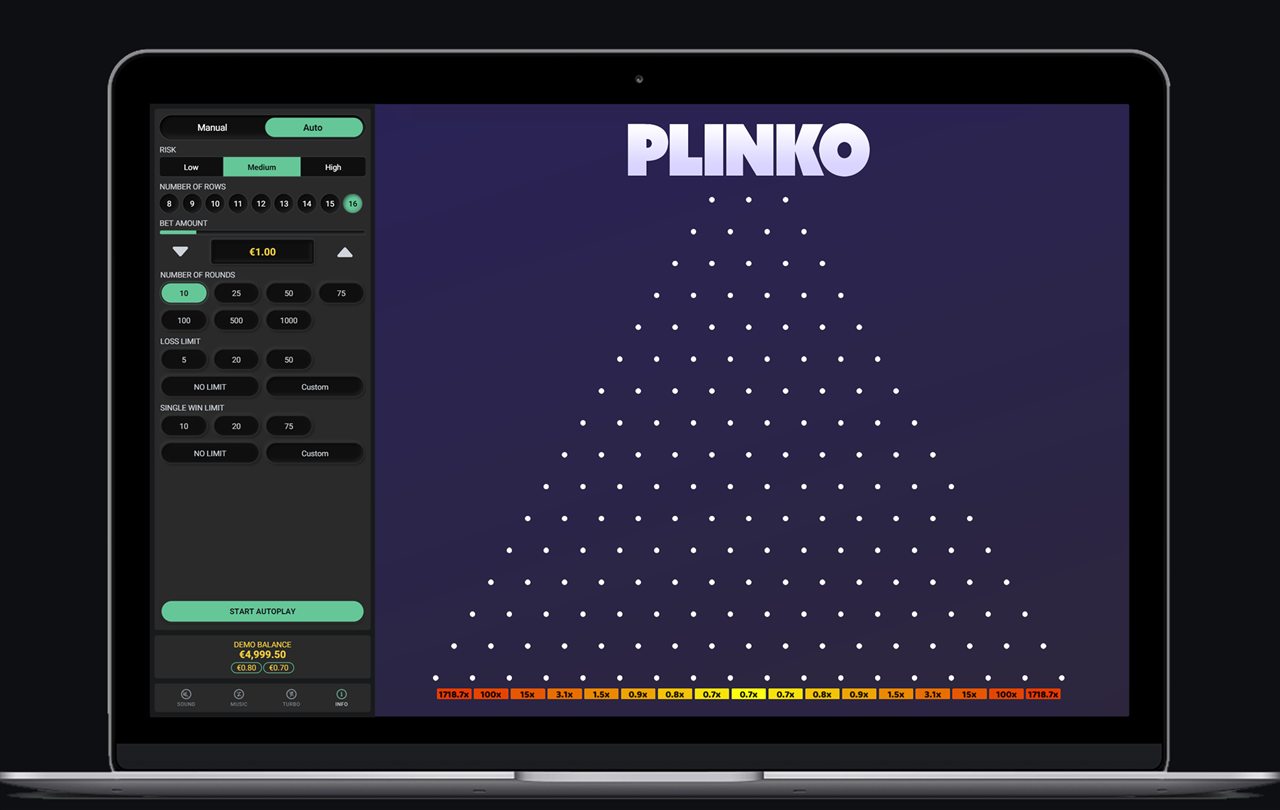
Plinko is a casino game where a ball drops through a pyramid of pegs and lands in a payout slot at the bottom, with the multiplier decided by which slot catches it. Canadian players meet three different products under that name, and only one of them is a real money casino game. This page separates them and covers what the casino version actually returns. For the wider market picture, start at our online Canada casinos hub.
The table below sets out what Plinko is and where a Canadian can play it. Read it first, then work through the detail beneath.
| Question | Short answer |
|---|---|
| Game type | Instant win, not a slot or a table game |
| Typical return | Around 99 percent on the casino version |
| Risk control | Player chooses risk level and row count |
| Licensed routes | Ontario registered operators, patchy on crown sites |
| Lottery version | A separate OLG product, unrelated to the casino game |
| Best use | Low edge play with fast, fully controllable variance |
What is Plinko?
Plinko is an instant win casino game built around a triangular field of pegs. A ball drops from the top, bounces left or right at each peg, and settles in one of the payout slots along the bottom row, where a multiplier is applied to the stake.
No reels, paylines or dealer are involved. The result comes from a certified random number generator exactly as a slot outcome does.
The format came from a television game show before any casino built it.
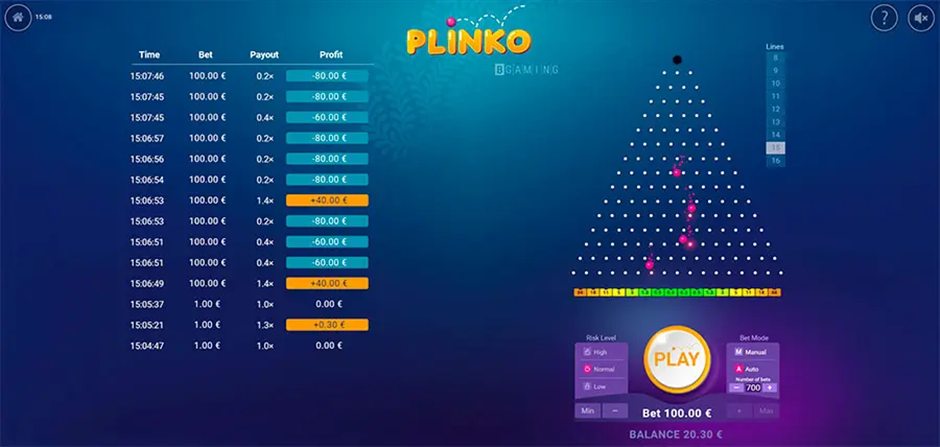
Studios kept the pyramid and the falling ball and replaced the physical board with a certified generator.
Plinko therefore looks like a game of physics and behaves like every other certified casino product.
The ball path is drawn after the slot has already been chosen.
Which Plinko do Canadians actually mean?
Three products share the Plinko name. The casino game from studios such as Hacksaw and BGaming, an Ontario lottery scratch product operated by the provincial corporation, and the physical board game sold in retail stores.
Only the first accepts real money bets at an online casino. The other two appear constantly in the same search results.
Search results mix all three constantly, which is why the distinction matters before anything else.
Retail listings and television wiki pages outrank casino pages on the plain term.
A Canadian looking for the real money game reaches it through an operator lobby rather than through a general search.
The lottery product sits on the provincial corporation site.
Who makes the casino version of Plinko?
Hacksaw Gaming and BGaming supply the versions most Canadian lobbies carry. Both certify with named testing laboratories and both publish a return figure inside the game alongside the risk controls.
Crypto casinos popularised the format before regulated studios adopted it. The certified versions behave identically and answer to a regulator.
Studio choice changes the payout table more than it changes the concept.
Hacksaw ships a version with adjustable rows and three risk settings.
BGaming ships a comparable product with its own multiplier spread.
Both publish the figure inside the game, so comparing two builds of Plinko takes one look at each information panel.
What return does Plinko pay?
Plinko returns around ninety-nine percent on the main certified versions. That figure sits far above the video slot average near ninety-six percent and above most table games, which makes it one of the lowest edge products in any Canadian lobby.
The figure holds across risk settings. Changing the risk level moves the variance rather than the return.
Putting the figure against an hour of play shows what it buys.
Six hundred drops at one dollar is six hundred dollars of turnover, and at ninety-nine percent the expected loss is six dollars.
The same turnover on a ninety-six percent slot costs twenty-four.
That gap is the whole commercial argument for Plinko.
How do the risk levels work?
Low, medium and high settings reshape the Plinko payout table. Low risk pays small multipliers across most slots with rare losses, while high risk pays almost nothing in the centre and enormous multipliers at the outer edges.
The published return stays the same at every setting. Only the shape of the outcome distribution changes.
Choosing a setting is choosing a session shape rather than a better deal.
Low risk produces a long grind with small movements in either direction.
High risk produces long stretches of near total loss punctuated by a large multiplier.
Bankroll decides which of the two a player can actually sit through.
Does the row count change anything?
Row count changes the spread of Plinko outcomes. Adding rows deepens the pyramid, widens the range of possible multipliers and pushes the extremes further out at both ends of the payout table.
Fewer rows produce a flatter, tamer distribution. The return figure holds regardless.
Row count and risk level interact rather than duplicate each other.
Maximum rows at high risk produces the widest spread the game offers, with the outer slots paying enormous multiples and the centre paying almost nothing.
Minimum rows at low risk produces the tamest version of Plinko available.
Every combination in between exists.
Can you play Plinko in Canada legally?
Yes, at Ontario registered operators. The private Ontario market licenses the studios that build it, so the certified casino version appears in those lobbies alongside slots and table games.
Provincial crown sites carry it inconsistently. Curated catalogues favour familiar formats over newer ones.
Route decides availability more than province does.
Ontario registered operators license the studios that build it, so the game appears there routinely.
Crown corporation catalogues favour established formats and stock it inconsistently.
Offshore sites carry Plinko everywhere and attach no Canadian complaints route to the account.
Is the OLG Plinko game the same thing?
No, it is a separate lottery product. The provincial corporation runs a scratch and instant ticket game under the same name, with fixed prize structures set by lottery rules rather than by a casino return figure.
The two have nothing in common beyond the peg board imagery. Search results mix them freely.
The two products differ in every way that matters to a player.
A lottery ticket has a fixed prize table set in advance and a single outcome per purchase.
The casino version has a published return figure, adjustable risk and unlimited repeat play.
Confusing them leads a player to the wrong site entirely.
Is Plinko a slot?
No, it sits in the instant win category. There are no reels, no paylines and no free spins feature, and the outcome resolves in a single drop rather than through a spin cycle.
Lobbies file it under instant games, arcade or originals. The certification process is identical to a slot.
The distinction has a practical consequence for bonuses.
Operators weight slot play at full value toward wagering requirements and frequently weight instant win games lower.
Plinko sits in the second group at most Canadian operators.
Checking the weighting table before accepting an offer is what avoids the surprise.
Is Plinko fair?
The certified versions are independently tested. Laboratories examine the random number generator and the payout table before the game reaches a licensed operator, and the regulator audits compliance afterwards.
The bouncing ball is animation played back from a fixed result. Nothing about the physics on screen decides the outcome.
Certification covers the parts that decide money and stops at the visuals.
Laboratories test the generator and the payout table, and the animation layer sits outside that boundary because it cannot influence a result.
A licensed Canadian operator names its testing laboratory in the footer.
An unlicensed site naming nothing carries no such assurance.
Can you use a Plinko strategy?
On Plinko, selection and stake size are the only levers. No sequence of drops, risk changes or bet patterns alters the expected return, because each drop draws independently from the generator.
Choosing a high return version and sizing the stake sensibly is the whole method. Everything after the drop button is presentation.
Two beliefs are worth dismissing directly.
Dropping into the same column repeatedly changes nothing, because the entry point is fixed and the path is generated.
Raising the stake after a losing run recovers nothing, because the edge applies identically at every bet size.
Loss limits at a licensed operator cap the damage either belief can do.
Does Plinko count toward wagering requirements?
Plinko counts at reduced weighting or not at all. Operators discount or exclude very high return games from bonus play, and a ninety-nine percent product is the first candidate for that treatment.
The weighting table states the position. Reading it before depositing prevents a wasted bonus.
The reason for the discount is arithmetic rather than policy.
A ninety-nine percent game costs an operator almost nothing to clear, so counting it fully would make bonuses trivially profitable for players.
Excluding or discounting Plinko is how operators price that risk.
The terms page states the exact weighting.
Who should play Plinko?
Players who want the lowest available house edge with variance they control. The return beats almost everything else in a Canadian lobby and the risk selector lets a player set how wild the session gets.
Players who want features, themes and story get nothing here. The game is a payout table and a bouncing ball.
One group is worth naming specifically.
Players who dislike waiting through feature animations get an outcome per second with no cutscenes at all.
That speed raises turnover per hour, which offsets part of the low edge advantage.
Setting a session limit before opening Plinko is the correct response to a game this fast.
What should you check before playing Plinko?
Four things settle any Plinko version. The return figure inside the game, the risk level, the row count and whether the operator holds provincial registration, since an unlicensed site leaves no complaints route.
All four take under a minute. Demo mode at a licensed operator answers the rest for free.
Recording the answers makes the checks permanent.
A short note per version listing the return figure, the available risk levels, the row range and the bonus weighting covers everything.
Only the operator weighting changes between sites.
Two minutes settles Plinko for good at any Canadian lobby.
Which game pages are worth reading next?
Plinko sits in the instant win corner of a Canadian lobby that also holds slots, table games and live dealer tables. The pages below cover the neighbouring choices.
- Every game category a Canadian lobby carries
- Slots with the strongest published return figures
- How to judge any slot on three measures
- The licensed Ontario market and what it carries
- Keno, bingo and scratch card play in Canada
Plinko is the rare Canadian casino game where the published return is the headline rather than the fine print. Read the figure, pick a risk level and the rest is a ball falling through pegs.
3 thoughts on “Plinko Canada: The Casino Game, the Lottery Ticket and the Board”