
The Hollandish betting system Canada roulette players read about is a slow negative progression for even-money bets. You play in blocks of three spins at one stake, then raise the stake by two units after a losing block or reset it after a winning one. For licensed tables, see our list of online casinos for Canadian players.
We explain the rules, the two versions in circulation, and the results of our own one-million-session test on European and American wheels.
| Point | Hollandish system |
|---|---|
| Type | Negative progression |
| Bets | Even-money roulette bets such as red/black, odd/even, high/low |
| Unit of play | Blocks of three spins at the same stake |
| Stake ladder | 1, 3, 5, 7, 9, 11 units and up |
| Reset rule | Back to 1 unit after a block with two or three wins |
| House edge | Unchanged: 2.70% European, 5.26% American |
What does the Hollandish betting system involve?
The Hollandish system is a staking plan for even-money bets that changes the stake every three spins instead of every spin. The Hollandish betting system Canada players try raises the stake by two units after a losing block and resets after a winning one.
888casino’s Ioannis Kavouras groups it with negative progressions such as the Martingale and the Labouchere.
He calls it less aggressive than both, because the stake moves only once per block.
Roulette77 says it is one of the easiest roulette tactics to put into practice.
How does the Hollandish system work step by step?
Pick an even-money bet and a base unit. Bet one unit on three spins. If you win two or three, stay at one unit. If you win one or none, bet three units on the next three spins. The Hollandish betting system Canada players follow repeats that rule every block.
- Choose red, black, odd, even, high or low.
- Set the base unit, such as 1 or 5 dollars.
- Play three spins at the current stake.
- Count wins: two or three means reset, one or zero means step up.
- Move two units up the ladder after each losing block.
Betway multiplies every step by the base, so a base of 5 runs 5, 15, 25 and so on.
What is the Hollandish stake sequence?
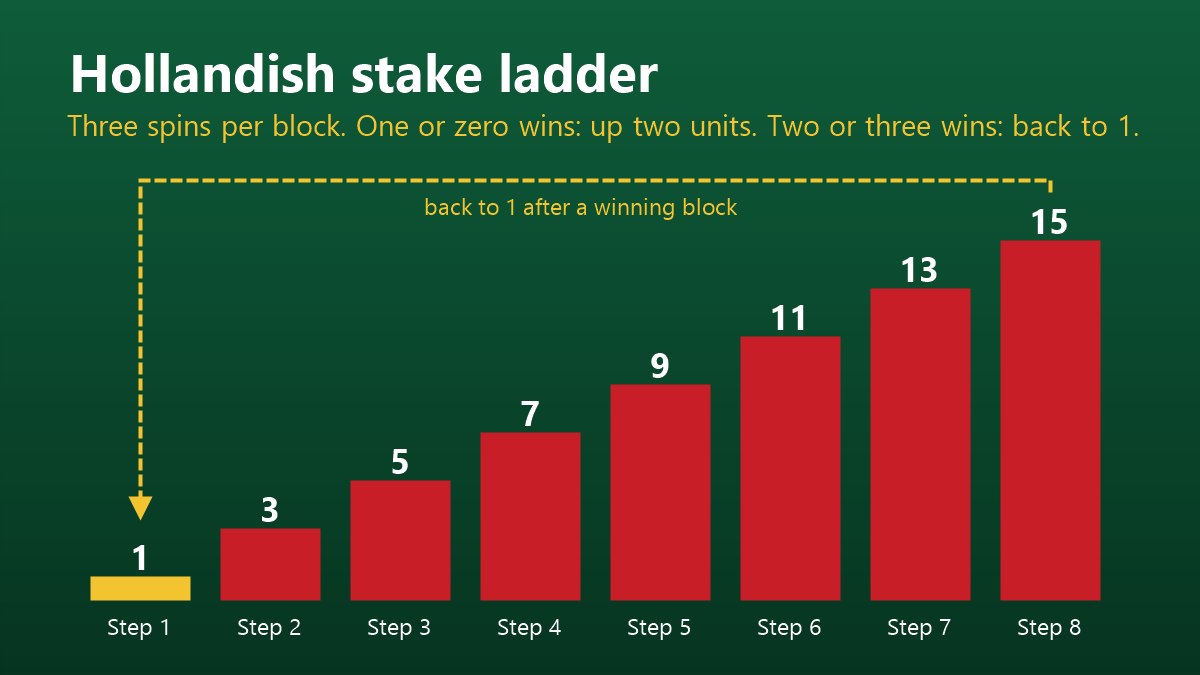
The stakes run 1, 3, 5, 7, 9, 11 units and up, adding two base units each time. Roulette77 gives the formula as the first stake plus twice the base at each step. With a base of 2, the Hollandish betting system Canada players use runs 2, 6, 10, 14, 18.
Every stake on the ladder is an odd multiple of the base unit.
The ladder climbs in a straight line, unlike the doubling of the Martingale.
After n losing blocks in a row, you sit on step 2n + 1.
When do you raise or reset the stake?
Betway and Roulette77 agree: a block with two or three wins resets you to one unit, and a block with one or zero wins moves you up a step. On the Hollandish betting system Canada players test, the block result is all that counts.
Two wins and one loss leave you one stake ahead for the block.
One win and two losses leave you one stake behind.
Single spins inside a block never change the stake on the Hollandish betting system Canada players use.
What can happen in a three-spin block?
There are four results. On a European wheel, three wins come up about 11.5% of the time, two wins 36.5%, one win 38.5% and no wins 13.5%. The Hollandish betting system Canada players use resets on the first two and steps up on the last two.
| Block result | Net at stake s | European chance | Next stake |
|---|---|---|---|
| 3 wins | +3s | 11.5% | Reset to 1 |
| 2 wins | +1s | 36.5% | Reset to 1 |
| 1 win | -1s | 38.5% | Up two units |
| 0 wins | -3s | 13.5% | Up two units |
Each even-money spin wins 18 times in 37 on a European wheel, because of the single zero.
How often does a block reset?
On a European wheel, a block resets 47.97% of the time, and on an American wheel 46.06%. Betway calls it a two-out-of-three chance to win your rounds, but the maths of the Hollandish betting system Canada players use says a block wins less than half the time.
You need two wins from three spins, and each spin wins less than half the time.
Our one-million-session test matched the 47.97% figure to two decimals.
So over time, more blocks step up than reset.
What does a worked example look like?
Start at 1 unit and lose all three spins: down 3, step to 3 units. Win one of three: down another 3, step to 5 units. Win two of three: up 5, reset to 1. The Hollandish betting system Canada players run here ends the cycle one unit down.
The reset block recovered most of the losses, but not all of them.
Betway’s own table shows a small profit of 24 units after 10 rounds, six of them losing.
Results depend on the order of wins and losses, not just the count.
How does the 888casino version differ?
The 888casino version is a recovery plan. You stay on a step until it wins back the losses from the step before, then move down. Kavouras says losing three bets at one level means winning three before that progression ends. It is a stricter form of the Hollandish betting system Canada players see online.
In his example, a loss during the 3-unit stage sends you to 5 units until that loss is covered.
Once the losses are fully recovered, you drop back to one unit.
He warns that stakes can climb even when you win more spins than you lose.
Can the stake steps be made steeper?
Yes. Kavouras suggests a steeper ladder such as 1, 3, 5, 8, 12, 16. The steeper Hollandish betting system Canada players can try ends a losing run sooner with fewer wins, but the bets get bigger faster.
He calls the choice a trade-off.
A steeper ladder raises the risk of hitting a table limit.
The house edge on each spin stays the same either way.
How fast do stakes climb after losing blocks?
After n losing blocks in a row, you have staked 3n squared units in total. Five losing blocks mean 75 units staked, and eight mean 192. On the Hollandish betting system Canada players follow, a run of nine losing blocks needs 243 units.
The worst case is losing every spin, which costs the full amount staked.
Most losing blocks are one win and two losses, which cost one stake rather than three.
A 200-unit bankroll runs dry before the ninth losing block in the worst case.
What does a losing climb cost at each step?
Each losing block adds three bets at a stake two units higher. The table shows the stake and the total staked after each straight loss on the Hollandish betting system Canada players use, with a 1-unit base.
| Losing blocks in a row | Next stake | Total staked so far |
|---|---|---|
| 1 | 3 | 3 |
| 2 | 5 | 12 |
| 3 | 7 | 27 |
| 4 | 9 | 48 |
| 5 | 11 | 75 |
| 6 | 13 | 108 |
| 7 | 15 | 147 |
| 8 | 17 | 192 |
Seven losing blocks in a row happen about once in 97 tries on a European wheel.
What did our one-million-session test show?
We ran one million sessions of 300 spins on a European wheel, with a 200-unit bankroll and a 1-unit base. Players of the Hollandish betting system Canada sim lost 23.97 units on average, finished ahead 41.5% of the time and went bust 10.2% of the time.
Average total staked per session of the Hollandish betting system Canada test was 888 units.
The loss per unit staked came out at 2.70%, the exact European house edge.
The best session won 198 units, and the worst lost the full 200.
How does Hollandish compare with flat betting?
Flat betting 1 unit for the same 300 spins lost 8.10 units on average and finished ahead 29.9% of the time. The Hollandish betting system Canada players use won more sessions but lost about three times more on average, because it staked 888 units instead of 300.
Flat betting never went bust with a 200-unit bankroll in our test.
The Hollandish plan trades frequent small wins for rare large losses.
Our page on flat betting covers the plain one-stake approach.
Why do more sessions win but lose more on average?
Resets lock in small profits, so a large share of sessions end ahead. The losses come from rare long climbs up the ladder. On the Hollandish betting system Canada players test, those climbs cost far more than the small wins return.
The house edge applies to every unit staked.
Staking three times more means losing about three times more over time.
Win rate per session tells you nothing about the average result.
What does the American wheel do to the system?
The double zero nearly doubles the damage. On an American wheel, our test of the Hollandish betting system Canada players use lost 47.86 units on average, ended ahead only 28.7% of the time and went bust 16.3% of the time.
The house edge on even-money bets rises from 2.70% to 5.26%.
Blocks reset 46.06% of the time instead of 47.97%.
Pick a single-zero table for the Hollandish betting system Canada players use whenever one is offered.
How big a bankroll does the system need?
With a 50-unit bankroll, 76.7% of our test sessions went bust within 300 spins. At 200 units, 10.2% did. The Hollandish betting system Canada players run needs a bankroll far larger than the base unit.
Roulette77 suggests a bankroll of 200 or more.
A small bankroll cannot fund the 5th or 6th step of the ladder for long.
Our page on managing a casino bankroll covers budgeting for any system.
What did Roulette77’s test find?
Roulette77 ran three players for 501 spins each with a 1,000 bankroll. They finished at 1,021, 994 and 1,327, and the site called the risk to the bankroll low. Our million-session repeat of that Hollandish betting system Canada setup ended ahead only 37.1% of the time.
Our version with a 1-unit base lost 42.55 on average.
Three runs are too small a sample to judge a system.
Roulette77 also found the progression negative over time, which matches our result.
Does a bigger base unit change the odds?
No. In our 501-spin test with a 1,000 bankroll, a 3-unit base lost 125.38 on average, about three times the 42.55 lost with a 1-unit base. Both versions of the Hollandish betting system Canada sim ended ahead 37.1% of the time.
The bigger base also went bust 3.7% of the time, against none at the 1-unit base.
Raising the base scales both wins and losses.
The house edge per unit staked stayed at 2.70%.
How high can stakes go?
In our 300-spin test, 37.6% of sessions reached a 15-unit stake and 2.5% reached 21 units. With Roulette77’s longer 501-spin setup, 10.5% of Hollandish betting system Canada sessions hit 21 units or more.
Longer sessions give the ladder more chances to climb.
Check the table maximum before you start.
A higher base unit reaches the table limit sooner.
What are the strengths of the Hollandish system?
It climbs slowly, and a block with one win still returns part of the stake, Betway notes. Kavouras says early losses do not turn into high stakes too soon. The Hollandish betting system Canada players use is gentler than doubling plans.
Grouping spins in threes makes the stake easy to track.
Roulette77 describes the system as low in volatility.
It suits patient players who prefer small swings.
What are its main weaknesses?
Stakes only drop after a winning block, so a losing run keeps raising them. Kavouras adds that bets can rise even when you win more spins than you lose. No version of the Hollandish betting system Canada players use changes the house edge.
Roulette77 calls the system noticeably slow.
Long sessions bring longer climbs and bigger stakes.
The reset block often fails to recover every loss from the climb.
Where do Hollandish guides disagree?
Betway calls a block a two-out-of-three chance, but the true figure is 47.97%. Roulette77 expects a moderate gain with a 200 bankroll, but our test lost money on average. 888casino uses a stricter recovery rule. Check which Hollandish betting system Canada guide you follow.
Roulette77 and Betway use the simple reset rule.
Kavouras’s version stays on a step until it recovers earlier losses.
All three agree the system cannot remove the risk of a long losing run.
Is the Hollandish system allowed at Canadian casinos?
Yes. A staking plan only sets your bet size, so licensed casinos accept it like any other bets. The Hollandish betting system Canada players use still has to fit inside each table’s minimum and maximum.
Table limits are the main practical barrier to any progression.
Online tables show their limits in the game info panel.
Read the table limits before you start the first block.
How does it compare with Martingale and d’Alembert?
Martingale doubles after every loss, and d’Alembert adds one unit per loss. The Hollandish betting system Canada players use adds two units per losing block of three spins, so it climbs slower than Martingale and moves less often than d’Alembert.
Betway suggests Hollandish to players who dislike the risks of Martingale and d’Alembert.
All three are negative progressions with the same house edge.
Our page on the d’Alembert betting system covers its rules and risks.
How does it compare with Fibonacci and 1-3-2-6?
Fibonacci raises stakes along its number sequence after each loss, and 1-3-2-6 raises after wins. Roulette77 notes that Fibonacci reacts to every bet, while the Hollandish betting system Canada players use waits for three.
1-3-2-6 is a positive progression, the opposite approach.
See our Fibonacci betting system page for its stake ladder.
Our 1-3-2-6 betting system page covers the win-based plan.
Can any betting system beat the house edge?
No. Every spin keeps the same odds whatever you bet before it. Our test of the Hollandish betting system Canada players use lost exactly 2.70% of all money staked, the European house edge.
Systems change the size and timing of bets, not the odds.
A system that stakes more loses more over time.
Our page on roulette strategies compares other approaches.
Which games suit the Hollandish system?
All three sources build it on even-money roulette bets: red or black, odd or even, high or low. The Hollandish betting system Canada players use works the same way on any bet that pays one to one.
Single-zero roulette gives the lowest house edge for these bets.
Try it on free roulette first to learn the block rules.
Our free roulette page lists demo tables.
How do you set limits when using the system?
Set a loss limit before the first spin, cap the highest step you will play, and stop when you hit either. Ontario players of the Hollandish betting system Canada tables offer can also use deposit limits at every regulated site.
Decide in advance whether you will stop at step 5, 7 or 9.
Write down your start balance and check it after each block.
Ontario’s ConnexOntario line, 1-866-531-2600, is free for anyone worried about their play.
Is the Hollandish betting system worth using?
Use it for structure, not profit. It keeps stakes in steady blocks and climbs slower than Martingale. But our million-session test of the Hollandish betting system Canada players use lost the full house edge on every unit staked.
Flat betting lost less in the same test.
Pick a European wheel and a small base unit.
Stop at your limit, win or lose.
1 thought on “Hollandish Betting System Canada: Rules, Stake Ladder and Simulation Results”