
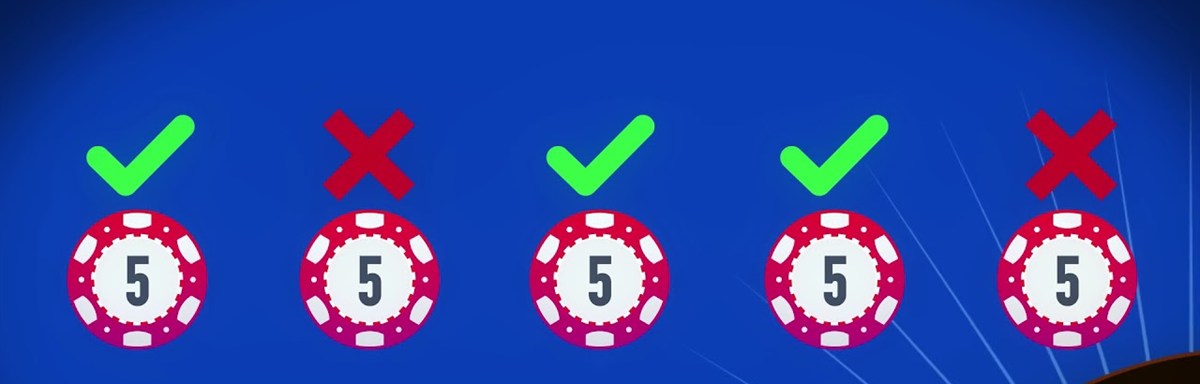
Flat betting Canada players use at casinos and sportsbooks is the simplest staking plan there is: you bet the same amount every time, win or lose, usually 1% to 5% of your bankroll. It cannot beat the house edge, but it keeps losing streaks cheap, makes results easy to track and lets a real betting edge grow without blowing up the bankroll. Our list of online casinos rated for Canadians shows where we have tested table games.
The table sums up the flat betting Canada facts, with our own calculations for roulette and -110 sports lines. The video on this page explains the approach.
| Item | Value |
|---|---|
| Rule | Same stake on every bet |
| Typical unit | 1% to 5% of the bankroll |
| Cost of 10 straight losses | 10 units |
| 100 European roulette spins at 1 unit | Average loss 2.70 units; 35.48% of sessions ahead in our test |
| Break-even win rate at -110 | 52.38% |
| Profit at a 55% win rate, -110 | 0.05 units per bet |
| House edge | Unchanged by any staking plan |
What is flat betting?
Flat betting means staking the same amount on every bet, regardless of earlier wins or losses. If your unit is $10, every roulette spin, baccarat hand or sports bet is $10 until you deliberately change the unit.
Betway sums it up for baccarat: lose and the stake stays the same, win and it stays the same.
That consistency is the whole idea behind flat betting Canada players adopt.
How does flat betting differ from progressive staking?
Progressive plans change the stake after each result: the Martingale doubles after losses, the Fibonacci betting system climbs a sequence and positive plans press winning streaks. Flat betting never reacts to the last result.
Danny.bet calls progressive staking risk disguised as strategy for most players.
No reaction to results is what defines flat betting Canada style.

What does a short flat betting run look like?
Here are ten even-money bets at 1 unit each. With five wins and five losses the result is exactly zero, and the worst point in the run is only 3 units down.
| Bet | Stake | Result | Balance |
|---|---|---|---|
| 1 | 1 | Loss | -1 |
| 2 | 1 | Loss | -2 |
| 3 | 1 | Loss | -3 |
| 4 | 1 | Win | -2 |
| 5 | 1 | Win | -1 |
| 6 | 1 | Loss | -2 |
| 7 | 1 | Win | -1 |
| 8 | 1 | Win | 0 |
| 9 | 1 | Loss | -1 |
| 10 | 1 | Win | 0 |
The balance simply equals wins minus losses.
Plain arithmetic keeps flat betting Canada sessions easy to follow.
How do you pick a flat stake?
Base it on your bankroll. Legalbet describes flat staking as keeping each bet within 1% to 5% of the account, and the Miller strategy uses 1%. A $500 bankroll at 2% gives a $10 unit.
Smaller units survive longer losing runs.
The unit is the one decision that shapes every flat betting Canada session.
How do you choose between 1% and 5%?
Choose by the size of swing you can live with. A 1% unit survives 100 straight losses before the bankroll is gone, while a 5% unit survives 20. Smaller units also make each loss feel minor, which helps discipline.
Beginners do best at the low end.
Unit size sets the risk level of flat betting Canada players choose.
What counts as one unit in a flat plan?
A unit is your standard stake, expressed as a share of your bankroll. Talking in units lets bettors compare results without revealing dollar amounts, and it makes a flat plan easy to follow.
One unit per bet is the classic flat rule.
Units are the language of flat betting Canada sports bettors share.
What types of flat staking exist?
Legalbet lists four: academic flat, at 1% to 2% depending on confidence; static flat, a fixed 1% on every bet; chaotic flat, 5% bets spread across long-shot wagers; and aggressive flat, 5% on a single sport for experienced bettors.
Static flat is the purest version.
Most flat betting Canada beginners start with the static 1% rule.
Is flat betting the same as a fixed-percentage plan?
Not quite. A fixed-percentage plan recalculates the stake as a share of the current bankroll before every bet, so stakes shrink after losses and grow after wins. Flat betting holds the unit steady until a planned resize.
Both avoid chasing losses.
Fixed units keep flat betting Canada records simpler than percentage plans.
What is the Miller strategy?
Sports Betting Dime describes the Miller strategy, named after John R. Miller, author of Professional Gambler. It limits bets to odds between 1.85 (-118) and 1.91 (-110) and stakes 1% of the bankroll on each one.
Near-even odds keep each bet close to a coin flip.
Miller’s plan is the best-known structured form of flat betting Canada bettors read about.
How does the Miller strategy resize the stake?
The stake stays at 1% of the starting bankroll until the bankroll grows by 25%. Starting with $1,000, you bet $10 a game; once the bankroll reaches $1,250, the stake rises to $12.50.
Resizing happens only after a clear gain, never after a loss.
Step-ups based on growth keep flat betting Canada plans disciplined.
What win rate does flat betting need at sportsbooks?
At -110, you must win 52.38% of bets to break even, because each win returns about 0.91 units. At -105 the break-even rate drops to 51.22%, and at -118 it rises to 54.13%.
Better prices lower the bar.
Shopping for prices is the quiet engine of flat betting Canada sports bettors use.
What does a 55% bettor earn with flat stakes?
At -110, a bettor who wins 55% of flat 1-unit bets earns about 0.05 units per bet: 0.55 times 0.91 units won, minus 0.45 units lost. Over 500 bets that is about 25 units.
Results swing widely around that average over short stretches.
Small edges add up slowly in flat betting Canada sports plans.
How does flat betting compare with the Kelly criterion?
The Kelly criterion sizes each bet by your estimated edge. At -110 with a true 55% win chance, Kelly suggests about 5.5% of the bankroll, and half-Kelly is a common choice. Flat betting skips the estimate and bets the same unit.
Kelly grows faster when edges are measured well and shrinks faster when they are not.
Flat betting Canada bettors use is the safer choice when edges are uncertain.
Why do serious bettors favour flat stakes?
Danny.bet says flat betting lets a real edge compound safely over hundreds of bets and turns betting into a repeatable process. Sports Betting Dime adds that a strict plan for what and how to bet is what sets sharp bettors apart.
Consistency makes performance measurable.
Measurable results are why professionals trust flat betting Canada style.
What losing runs can a winning bettor expect?
Even a 55% bettor loses 45% of the time. Our calculation shows a run of eight or more straight losses in about 60% of 1,000-bet stretches, and ten or more in about 17%.
Flat stakes turn those runs into 8 or 10 units lost, nothing worse.
Expect cold runs in any flat betting Canada sports record.
Why does flat betting protect a bankroll?
Losses grow in a straight line. Each loss costs one unit, so a run of bad results never forces a huge recovery bet. Danny.bet notes that one bad result never threatens the whole bankroll.
It also removes the urge to chase.
Protection, not profit, is the main job of flat betting Canada players adopt.
What does a losing streak cost with flat stakes?
Ten straight losses cost exactly 10 units with flat betting, against 55 with the D’Alembert, 143 with the Fibonacci and 1,023 with the Martingale, all starting from 1 unit.
Our page on the D’Alembert betting system compares the slower progression.
Linear losses are the safety net of flat betting Canada players rely on.
How did flat betting do in our roulette simulation?
In one million simulated 100-spin sessions on European red at 1 unit, flat betting finished ahead in 35.48% of sessions, lost 2.70 units on average and had a worst session of minus 52.
| Method | Sessions ahead | Average result | Worst session |
|---|---|---|---|
| Flat 1 unit | 35.48% | -2.70 | -52 |
| D’Alembert | 58.83% | -17.61 | -1,354 |
| Fibonacci, 500-unit cap | 90.75% | -12.91 | -18,486 |
| Martingale, 500-unit cap | 92.77% | -15.63 | -11,478 |
Flat betting lost the least by far, with the smallest worst case.
The numbers show what flat betting Canada players gain: low cost and no disasters.
Why do progressions win more sessions but cost more?
Progressions raise stakes to win back losses, which turns most sessions into small wins and a small share into huge losses. They also stake far more units in total, and the house edge applies to every unit.
Flat betting accepts more losing nights in exchange for a lower bill.
Lower total stakes are the real advantage of flat betting Canada style.
What happens over a long session?
Over 1,000 European roulette spins at 1 unit, our simulation showed flat betting ahead in 18.85% of sessions, with an average loss of 27.01 units and a worst session of minus 158.
The longer you play, the closer results move to the house edge.
Long sessions reveal the true cost of flat betting Canada roulette players accept.
How long does a roulette bankroll last with flat bets?
On average, a 100-unit bankroll staked one unit per European spin loses about 2.7 units per 100 spins, so it lasts roughly 3,700 spins before the house edge alone uses it up. Swings make real sessions shorter or longer.
Progressions burn through the same bankroll far faster.
Long playing time per dollar is the comfort of flat betting Canada roulette players enjoy.
How large are the swings with flat bets?
For even-money bets, one standard deviation over a session is about the square root of the number of bets in units. Over 100 spins that is about 10 units, which is why results range widely around the 2.70-unit average loss.
Swings grow slower than the number of bets.
Predictable swings make flat betting Canada budgets easier to plan.
What does flat betting cost per hour at roulette?
Expected loss is spins times stake times the house edge. If you play 40 European spins an hour at $5, you stake $200 and lose about $5.40 an hour on average.
Faster tables and bigger stakes raise that figure.
Hourly cost is the simplest way to budget flat betting Canada sessions.
Why does flat betting suit baccarat?
Baccarat’s main bets carry low house edges, about 1.06% on banker and 1.24% on player. Betway notes that banker pays 19 to 20 after commission, player pays even money and tie pays 8 to 1, and recommends flat betting on banker.
Flat stakes ride out baccarat’s swings without escalating.
Low edges make baccarat a natural fit for flat betting Canada players enjoy.
Is flat betting a good fit for blackjack?
Yes, for players using basic strategy, where the house edge is around 0.5% on good rules. Card counters vary their bets with the count, so flat betting gives up that one legal advantage.
Our page on blackjack strategies covers basic strategy.
Basic strategy plus flat stakes is the cleanest form of flat betting Canada blackjack players use.
Can you keep flat stakes at a live dealer table?
Yes, in the same way as anywhere else: one unit on every round. The table minimum sets the smallest unit you can use, so pick a table whose minimum fits 1% to 2% of your session bankroll.
Live tables run slower than RNG games, which lowers the hourly cost and gives time to note each result.
Live play suits flat betting Canada players who like a steady pace.
Is slot play a form of flat betting?
Usually, yes. Most players keep the same stake from spin to spin, which is flat betting by default. The return then depends on the slot’s RTP and volatility.
Raising the stake after losses breaks the flat rule.
Steady stakes keep slot sessions in line with flat betting Canada principles.
How do you flat bet on sports in Canada?
Single-game sports betting is legal across Canada, through provincial sites and, in Ontario, private sportsbooks registered with iGaming Ontario. Pick near-even markets such as spreads and totals at about -110, and stake one unit on each.
Record every bet.
Near-even markets suit flat betting Canada bettors run.
Does flat betting suit parlays?
Poorly. Parlays combine two or more legs, so each one carries the bookmaker’s margin and wins come rarely. Flat stakes on parlays still produce long losing runs and little control.
Single bets near even money fit the method best.
Keep parlays out of flat betting Canada plans aimed at steady results.
What is to-risk versus to-win flat betting?
To-risk flat betting stakes the same amount every time. To-win flat betting stakes whatever is needed to win the same amount, so a heavy favourite takes a bigger stake and an underdog a smaller one.
To-win suits bettors who often back favourites.
Both versions fit flat betting Canada sports plans, as long as you pick one and keep it.
When do you recalculate the unit?
Danny.bet advises recalculating only after a genuine change in bankroll, such as once a month, and never mid-session in reaction to a win or loss. Miller’s rule waits for a 25% gain.
Scheduled updates keep emotion out of sizing.
Planned resizing keeps flat betting Canada plans honest.
Can steady stakes shrink the house edge?
No. The edge comes from the game or the bookmaker’s margin, not from stake sizes. Flat betting simply exposes you to it at a steady rate instead of in bursts.
Only a real edge, such as better information or prices, can make betting profitable. Staking plans decide only the pace at which the edge reaches your money.
Flat betting Canada players use manages risk; it does not create profit.
Where does flat staking fall short?
Growth is slow, a large bankroll is needed for meaningful profits and the plan feels dull. Sports Betting Dime adds that strict rules, such as Miller’s odds range, can rule out bets you like.
Legalbet also notes the slow pace of capital growth.
Patience is the cost of flat betting Canada bettors pay.
How do you track flat bets?
Keep a simple log of the date, event or game, stake, odds and result. Total the units won or lost each week and compare them with the number of bets.
Online accounts keep a bet history you can export or copy. A spreadsheet with one row per bet is enough, and a weekly total shows whether the plan is working.
Records turn flat betting Canada play into something you can measure.
How do you measure return on investment?
Return on investment is profit divided by total staked. A bettor who stakes 500 units and finishes 25 units up has an ROI of 5%. Flat stakes make the figure easy to compute.
Small samples can mislead, so judge over hundreds of bets.
ROI is the scorecard for flat betting Canada sports bettors keep.
What does flat betting teach new players?
It teaches three habits that matter more than any system: decide your stake before you play, record every result and judge yourself over hundreds of bets rather than one night. It also shows plainly how the house edge works.
Those habits carry over to every game.
Good habits are the lasting benefit of flat betting Canada beginners learn.
Which mistakes break a flat plan?
Common errors are raising the stake after losses, betting extra on a “sure thing”, changing the unit mid-session and skipping the log. Each one turns a flat plan into a disguised progression.
Stick to the unit you set.
Discipline is the only skill flat betting Canada plans need.
Is flat betting allowed with casino bonuses?
Yes. Flat stakes rarely break bonus rules, since they stay below maximum-bet limits. Table games often count for little toward wagering, so check the terms.
See our page on wagering requirements for how each game counts.
Steady stakes make flat betting Canada players use bonus-friendly.
How does flat betting fit a bankroll plan?
Flat betting is the staking half of bankroll management: you set a session budget, divide it into units and stop when it is gone. Our page on managing a casino bankroll covers the budgeting half.
Separate gambling money from everyday money.
Budgets and units together complete flat betting Canada planning.
How do you keep flat betting within limits?
Set deposit, loss and time limits in your account, and decide in advance the number of units a session can use. The account tools are set out in our page on gambling limit settings.
You must be 19, or 18 in Alberta, Manitoba and Quebec, to gamble.
For support in Ontario, ConnexOntario offers free, confidential help around the clock.
Who is flat betting Canada players use best for?
It suits casino players who want low, predictable costs and sports bettors who believe they have an edge and want it to grow safely. It does not suit anyone hoping a staking plan will beat the house.
Keep the unit small and the log up to date.
Bet steadily and stay within your limits.