
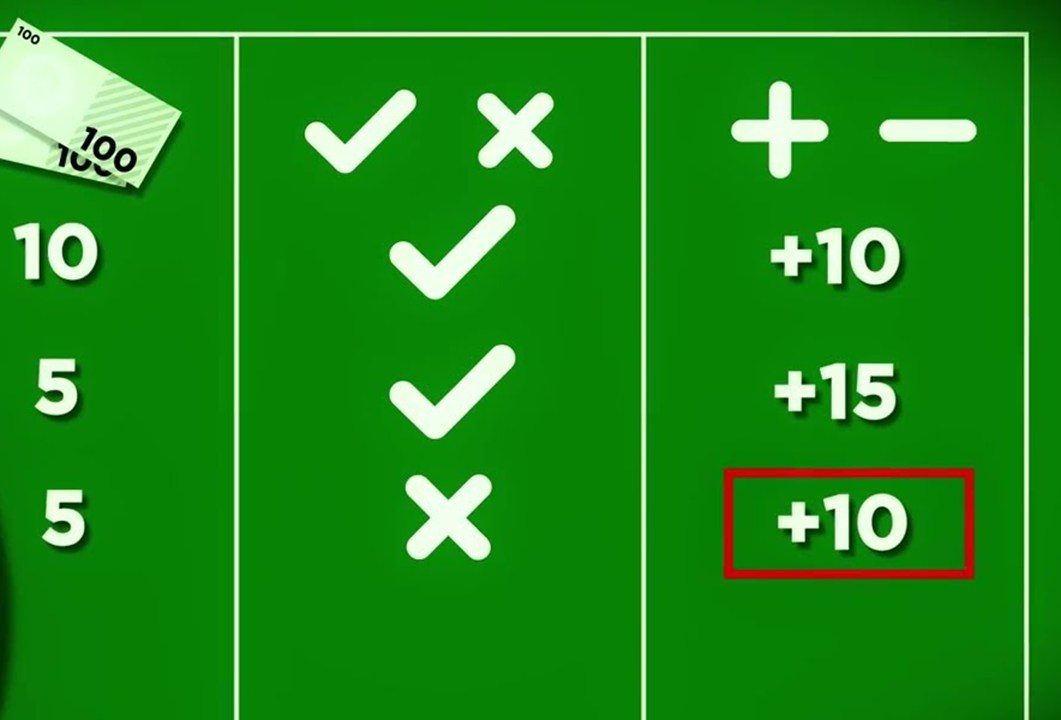
The D’Alembert betting system Canada players use at roulette, baccarat, blackjack and craps tables is a gentle negative progression: you add one unit to your stake after a loss and take one unit off after a win. It changes the size of each bet, never the odds of the game. Our list of top-rated online casinos in Canada shows the sites we have reviewed.
The table sets out the D’Alembert betting system Canada facts in units, with the odds worked out for European roulette. The Wizard of Odds video on this page explains how to use it at the table.
| Item | Value |
|---|---|
| Type | Negative progression |
| After a loss | Add 1 unit to the next stake |
| After a win | Remove 1 unit, never below 1 unit |
| Suited bets | Even-money bets |
| Stake after 10 straight losses | 11 units |
| Total lost in 10 straight losses | 55 units |
| Chance of 10 straight losses on red or black | About 1 in 784 on a European wheel |
| House edge | Unchanged: 2.70% European roulette, 5.26% American |
| Reverse version | Add 1 unit after a win, remove 1 after a loss |
What is the D’Alembert betting system?
It is a one-unit staking method built for even-money wagers. You pick a base unit, bet one unit, add one unit after every loss and remove one unit after every win, never dropping below one unit.
The plan tells you what to stake, not what to bet on. Red or black, banker or player, pass or don’t pass: the choice stays yours.
That simplicity explains why the D’Alembert betting system Canada beginners pick up is usually the first progression they try.
How does the D’Alembert work, step by step?
Choose a unit, such as $1 or $5, and place one unit on an even-money bet. After a loss, raise the next bet by one unit. After a win, lower it by one unit. At one unit, a win leaves the stake at one unit.
The steps never change, whatever the game. A loss always means plus one, and a win always means minus one.
Every D’Alembert betting system Canada session follows those two moves until you decide to stop.

Is the D’Alembert a negative or positive progression?
The standard D’Alembert is a negative progression, because the stake rises after losses. The reverse D’Alembert is the positive version, because the stake rises after wins.
Negative progressions win often and lose big. Positive ones do the opposite.
Knowing the type helps you judge the risk in any D’Alembert betting system Canada page you read.
Who was Jean le Rond d’Alembert?
Jean le Rond d’Alembert was an 18th-century French mathematician, physicist and philosopher, born in Paris. He co-edited the Encyclopédie with Denis Diderot, wrote over a thousand articles for it and gave physics the wave equation.
His mother left him on the steps of the Saint-Jean-le-Rond church in Paris days after his birth, which is where his first name came from.
Most players know only his surname, which lives on through the D’Alembert betting system Canada players follow.
Why is the system named after him?
In an Encyclopédie article called Croix ou Pile, French for heads or tails, d’Alembert argued that the chance of heads grew each time a coin came up tails. Betting more after a loss follows the same reasoning.
The argument was wrong. A fair coin has no memory, and each toss stays at one chance in two.
The name stuck anyway, so the D’Alembert betting system Canada players follow honours a famous mistake.
What does montant et démontant mean?
Montant et démontant is French for upward and downward, and 888casino gives it as another name for the D’Alembert. The phrase describes the stake climbing after losses and stepping back down after wins.
The older name is rare at Canadian tables, where players simply say D’Alembert.
Either name points to the same D’Alembert betting system Canada players use online and in casinos.
What is the equilibrium idea behind the system?
The idea is that wins and losses on a near 50/50 bet will even out over time. If they do, the stakes you raised after losses get repaid by wins, and you finish ahead.
Players often call this the law of equilibrium.
Every promise the D’Alembert betting system Canada players hear rests on that single assumption.
Why is the equilibrium idea wrong?
Spins, hands and rolls are independent events. A roulette wheel or a random number generator keeps no record of past results, so red stays at 18 in 37 on a European wheel after any run of black.
Results balance as a percentage over huge samples, but the raw gap between wins and losses does not shrink back to zero.
That gap is the hole in the D’Alembert betting system Canada players have to understand before they bet.
What happened when black kept landing at Monte Carlo?
On one famous night at the Monte Carlo Casino, the ball landed on black 26 times in a row. Gamblers lost millions of francs betting on red, sure that the streak had to break.
Wikipedia puts the chance of 26 reds or blacks in a row on a single-zero wheel at about 1 in 68.4 million.
The story is the classic warning for anyone running the D’Alembert betting system Canada tables see today.
What does a short D’Alembert run look like?
Here are ten spins on European red with a 1-unit start. The run ends with five wins and five losses, and the balance finishes 5 units ahead after 23 units staked.
| Spin | Stake | Result | Balance |
|---|---|---|---|
| 1 | 1 | Loss | -1 |
| 2 | 2 | Win | +1 |
| 3 | 1 | Loss | 0 |
| 4 | 2 | Loss | -2 |
| 5 | 3 | Loss | -5 |
| 6 | 4 | Win | -1 |
| 7 | 3 | Win | +2 |
| 8 | 2 | Loss | 0 |
| 9 | 3 | Win | +3 |
| 10 | 2 | Win | +5 |
The three straight losses at spins 3 to 5 pushed the stake to 4 units, and the wins that followed paid them back.
This is the D’Alembert betting system Canada players hope to see: a gentle climb and a steady recovery.
What happens after a win at one unit?
Nothing changes. One unit is the floor, so a win at one unit leaves the next bet at one unit. The stake only climbs again after a loss.
This floor keeps the plan simple but breaks the plus-one-per-win balance on runs of wins.
Every D’Alembert betting system Canada session spends a good part of its time at the floor.
What happens when wins and losses come out level?
When wins and losses are equal and the stake never hits the one-unit floor, you finish one unit ahead for every win. Ten wins and ten losses leave you 10 units up.
888casino states the same rule, and the ten-spin run above shows it: five wins, five losses, plus 5 units.
That neat result is the whole sales pitch of the D’Alembert betting system Canada forums repeat.
Is there a formula for D’Alembert results?
Yes. While the stake stays above the floor, your result equals the starting stake times wins minus losses, plus half of the total bets minus the square of the gap between losses and wins.
With a 1-unit start, ten bets and a gap of zero, the formula gives 5 units, which matches the run above. Three straight losses give minus 3, plus half of 3 minus 9, for a total of minus 6.
The square term explains why a large gap hurts the D’Alembert betting system Canada players run so badly.
Why does the house edge stop wins and losses from levelling?
The zero pocket makes losses slightly more likely than wins. Over 370 spins on European red, the average result is 180 wins and 190 losses, so the gap grows rather than closing.
On an American wheel with two zeros, the expected gap is nearly twice as wide.
The edge works against every D’Alembert betting system Canada session, one spin at a time.
How does a zero affect the count?
On a standard European or American wheel, a zero loses every outside bet, so it counts as a loss and the stake rises by one unit. The zero is the house edge in action.
On an American wheel, the double zero adds a second losing pocket.
Zeros are the main reason the D’Alembert betting system Canada players run drifts below even.
What does a losing streak cost?
With a 1-unit start, a streak of losses costs 1 plus 2 plus 3 and onwards. Ten straight losses cost 55 units and leave your next stake at 11 units.
| Straight losses | Last stake | Total lost: D’Alembert | Total lost: Martingale |
|---|---|---|---|
| 3 | 3 | 6 | 7 |
| 5 | 5 | 15 | 31 |
| 8 | 8 | 36 | 255 |
| 10 | 10 | 55 | 1,023 |
| 15 | 15 | 120 | 32,767 |
| 20 | 20 | 210 | 1,048,575 |
The totals grow slowly next to the Martingale, which doubles after each loss.
That slow growth is the real strength of the D’Alembert betting system Canada players choose over doubling plans.
How fast do D’Alembert stakes grow?
They grow in a straight line: one unit per net loss. After 20 more losses than wins, the stake is 21 units. A doubling system grows in a curve and reaches 1,024 units on the eleventh bet of a losing run.
Straight-line growth is easier on the nerves and the bankroll.
That steady line is the signature of the D’Alembert betting system Canada players prefer.
How likely is a long losing streak on red?
On a European wheel, the chance of losing a red or black bet is 19 in 37. Five losses in a row from a given spin happen about 1 in 28 times, eight about 1 in 207, and ten about 1 in 784.
Those odds look long, but a session gives a streak plenty of chances to start. Our calculation shows a run of eight or more losses turns up in about 51% of 300-spin sessions and 70% of 500-spin sessions.
Long sessions make streaks a normal part of the D’Alembert betting system Canada players run.
What does it take to recover from ten losses?
After ten straight losses from 1 unit, you are 55 units down and betting 11. Winning at 11, 10, 9, 8, 7, 6 and 5 units takes seven straight wins to get back ahead, by a single unit.
Seven wins in a row on European red happen about 1 in 155 times, so most recoveries take far longer and include more losses along the way.
Slow recovery is the price of the gentle steps in the D’Alembert betting system Canada players use.
What did our simulation of one million sessions show?
We simulated one million sessions of 100 spins on European red, starting at 1 unit with no table limit. The D’Alembert finished ahead in 58.81% of sessions, yet the average session lost 17.70 units.
| Method | Sessions ahead | Average result | Average units staked | Worst session |
|---|---|---|---|---|
| Flat 1 unit | 35.50% | -2.71 | 100 | -48 |
| D’Alembert | 58.81% | -17.70 | 653 | -1,249 |
| Reverse D’Alembert | 23.81% | -14.07 | 519 | -74 |
| Martingale, 500-unit cap | 92.75% | -15.63 | 586 | -9,003 |
Every method lost money on average, and the loss per unit staked sat close to the 2.7% house edge in each case.
The test shows what the D’Alembert betting system Canada players use really does: it moves risk around without removing it.
Why do most sessions win while the average loses?
Winning sessions are small and losing sessions can be large. The median D’Alembert session finished 13 units ahead and the best reached 71 units, but the worst 5% lost 191 units or more.
Small frequent wins and rare heavy losses add up to a negative average.
That shape is the trap in the D’Alembert betting system Canada players tend to miss in a single evening.
What happens over longer sessions?
Over 1,000 spins, the picture darkens. In 200,000 simulated sessions, the D’Alembert finished ahead only 37.48% of the time, with a median result of minus 292 units and an average of minus 685.
The stakes also climbed: those sessions put 25,291 units into action on average, against 1,000 for flat betting.
The longer you play, the more the D’Alembert betting system Canada players run drifts toward big stakes and big losses.
Does the D’Alembert change the house edge?
No. The edge is fixed by the game: 2.70% on European roulette, 5.26% on American and 1.35% on even-money bets at French roulette with la partage. No pattern of stakes moves those figures.
In our simulation, the D’Alembert lost 2.71% of every unit staked, the same as flat betting.
No D’Alembert betting system Canada session can turn a negative game into a positive one.
Why does the D’Alembert raise expected losses?
Expected loss equals total stakes times the house edge. The D’Alembert put 653 units into play across 100 spins, against 100 for flat betting, so its average loss was over six times larger.
The edge per unit stays the same, but the units multiply.
Bigger stakes are the hidden cost of the D’Alembert betting system Canada players tend to overlook.
Is flat betting better than the D’Alembert?
Flat betting loses less on average because it stakes less. In our test it lost 2.71 units per 100-spin session, but it finished ahead only 35.50% of the time, against 58.81% for the D’Alembert.
The D’Alembert trades a lower average for more frequent small wins.
Which one suits you depends on whether you value cheap play or the winning sessions the D’Alembert betting system Canada players chase.
Is the D’Alembert safer than the Martingale?
Yes, in terms of stake growth. After ten losses, the Martingale asks for 1,024 units on the next bet, while the D’Alembert asks for 11. Our capped Martingale won 92.75% of sessions but had a worst session of minus 9,003 units.
Both chase losses, but the D’Alembert does it in single steps.
That makes the D’Alembert betting system Canada players use the calmer of the two negative progressions.
Is the D’Alembert gentler than the Fibonacci?
Yes. The Fibonacci adds the two previous stakes after each loss, so ten straight losses cost 143 units against 55 for the D’Alembert, and the stakes keep accelerating after that.
The Fibonacci sits between the D’Alembert and the Martingale for risk.
Players who find the Fibonacci too steep often switch to the D’Alembert betting system Canada players call the gentle one.
Where does the Labouchère fit beside the D’Alembert?
The Labouchère uses a written line of numbers. You bet the first plus the last, cross both off after a win and add the lost stake to the end after a loss, so stakes can rise faster than in the D’Alembert.
It takes more bookkeeping at the table.
The D’Alembert betting system Canada players prefer asks for only one number in your head: the current stake.
Which is gentler: the D’Alembert or the 1-3-2-6?
The 1-3-2-6 is gentler on losses. It holds the stake at one unit after any loss and caps each cycle’s loss at 2 units, while the D’Alembert keeps adding a unit through a losing run.
Our page on the 1-3-2-6 betting system explains its four-step cycle.
The two plans suit opposite moods: the 1-3-2-6 rides wins, while the D’Alembert betting system Canada players run chases losses.
How does the D’Alembert compare with Oscar’s Grind?
Oscar’s Grind raises the stake by one unit after a win, keeps it the same after a loss and ends each series once it is one unit ahead. The D’Alembert raises after losses instead.
Both use one-unit steps, so both grow slowly.
Oscar’s Grind is the patient cousin of the D’Alembert betting system Canada players know best.
What is the reverse D’Alembert?
The reverse D’Alembert flips the rules: you add one unit after a win and remove one unit after a loss. It is a positive progression, so the stake grows with your winnings rather than your losses.
It never asks you to chase a loss.
The reverse D’Alembert betting system Canada players use suits those who prefer to press a hot run.
How does a reverse D’Alembert run look?
Here are ten spins with the reverse rules and a 1-unit start. The results are five wins and five losses again, but this time the balance ends 5 units down after 19 units staked.
| Spin | Stake | Result | Balance |
|---|---|---|---|
| 1 | 1 | Win | +1 |
| 2 | 2 | Win | +3 |
| 3 | 3 | Loss | 0 |
| 4 | 2 | Win | +2 |
| 5 | 3 | Loss | -1 |
| 6 | 2 | Loss | -3 |
| 7 | 1 | Win | -2 |
| 8 | 2 | Loss | -4 |
| 9 | 1 | Win | -3 |
| 10 | 2 | Loss | -5 |
Wins came scattered rather than bunched, so the bigger stakes kept landing on losses.
Level results are bad news for the reverse D’Alembert betting system Canada players try, because it pays only on streaks.
When does the reverse D’Alembert pay off?
It pays when wins arrive in runs. In our simulation it finished ahead in only 23.81% of 100-spin sessions, but its best session reached plus 917 units and its worst lost just 74.
The median reverse session lost 37 units, so the typical night ends down.
The reverse D’Alembert betting system Canada players use has a lottery-style shape: small regular losses, rare big wins.
When do players reset the reverse D’Alembert?
Players often reset to one unit once the stake reaches a set level, such as 5 or 6 units, to lock in a run’s profit. Without a reset, one loss at the top of a run gives back the largest stake.
A reset point turns a streak into banked units.
Pick the reset level before the session, like every other rule of the reverse D’Alembert betting system Canada players follow.
Is the Paroli the same as the reverse D’Alembert?
No. The Paroli doubles the stake after each win and resets after three wins or any loss. The reverse D’Alembert adds only one unit after a win and drops one after a loss.
The Paroli is faster and more aggressive on streaks.
The reverse D’Alembert betting system Canada players use is the gentler way to ride wins.
Which version suits which player?
The standard version suits players who want frequent small winning sessions and accept a rare deep loss. The reverse version suits players who accept frequent small losses for the chance of a big run.
Neither version changes the expected loss per unit staked.
Choose by temperament, since the maths behind each D’Alembert betting system Canada variant is the same.
Which bets suit the D’Alembert betting system Canada players use?
Even-money bets with close to a 50% chance suit it best: red or black, odd or even and 1-18 or 19-36 at roulette, banker or player at baccarat, the main hand at blackjack and pass or don’t pass at craps.
The one-unit steps assume a win pays the same as a loss costs.
Bets with long odds break the logic of the D’Alembert betting system Canada players rely on.
How do you use the D’Alembert at European roulette?
Pick one outside bet, such as red, and stay on it. Bet one unit, add a unit after each loss and drop a unit after each win. A zero counts as a loss on a European wheel.
Our page on roulette strategies for Canadian players compares the main staking systems side by side.
European roulette is the natural home of the D’Alembert betting system Canada players run online.
Why avoid American roulette with this system?
The extra double zero raises the house edge to 5.26%. In our American wheel test, the D’Alembert finished ahead in 49.60% of 100-spin sessions, and the average session lost 38.27 units.
That average loss is more than twice the European figure of 17.70 units.
Always check the wheel before you start any D’Alembert betting system Canada session.
Does French roulette help the D’Alembert?
Yes. With la partage, you get half of an even-money stake back when the ball lands on zero, which cuts the house edge on those bets to 1.35%. That halves the expected loss on every unit you stake.
Decide in advance how to count a la partage zero. Counting it as a loss keeps the rule simple.
French tables are the best home for the D’Alembert betting system Canada casinos offer.
Does en prison help the D’Alembert?
Yes. Under en prison, an even-money bet that meets a zero is held for the next spin instead of lost, which also cuts the edge on those bets to 1.35%. The rule appears on French roulette tables.
Count a held bet that is later returned as a push.
En prison and la partage give the D’Alembert betting system Canada players use the best roulette odds available.
Can you use the D’Alembert on dozens and columns?
You can, but it was not built for them. A dozen or column bet wins 12 times in 37 on a European wheel, about 32.43%, and pays 2 to 1, so losing runs come far more often.
Betting two dozens at once wins 64.86% of the time, but each win returns only half your combined stake as profit.
Most players keep the D’Alembert betting system Canada tables offer for even-money bets only.
How does the D’Alembert work at live roulette?
Live dealer roulette streams a real wheel from a studio, so spins come slower than in RNG roulette. Each table shows its minimum and maximum bets, so match your unit to the minimum before you start.
Our live roulette page covers the live tables Canadians can join.
A slower pace makes the D’Alembert betting system Canada players use easier to track at a live table.
How do you use the D’Alembert at blackjack?
Treat each hand as a win or a loss on your main bet. Add a unit after a losing hand, take one off after a winning hand and keep the stake the same after a push.
Blackjack has a house edge around 0.5% with basic strategy on good rules, lower than any roulette wheel. Our page on blackjack strategy covers the plays.
Basic strategy first, staking second: that order keeps the D’Alembert betting system Canada players use at blackjack on solid ground.
How do doubles, splits and blackjacks fit the count?
ReadWrite suggests moving two units after a lost or won double, two units after two lost or two won split hands, and no change when a split ends with one win and one loss.
Count a natural blackjack, which pays 3 to 2, as a single win.
Never skip a correct double or split to keep the count tidy. That raises the house edge, and the D’Alembert betting system Canada players use cannot win it back.
How does the D’Alembert work at baccarat?
Bet banker or player and follow the usual steps. Banker carries a house edge of about 1.06% and player about 1.24%, and a tie returns your banker or player bet, so leave the stake unchanged after one.
Skip the tie bet, which pays well but carries a far higher edge. Our page on baccarat card counting covers another idea players try at the same tables.
Low edges make baccarat a good fit for the D’Alembert betting system Canada players take to the tables.
Does the banker commission upset the D’Alembert?
Slightly. A banker win pays 0.95 units per unit after the 5% commission, so level wins and losses no longer return a full unit per win. Our ten-spin run would finish at plus 4.3 units instead of plus 5.
Player bets pay even money with no commission.
Both sides work with the D’Alembert betting system Canada baccarat players follow, as long as the count stays honest.
How does the D’Alembert work at craps?
Use the pass line or don’t pass. Pass carries an edge of about 1.41% and don’t pass about 1.36%, and both pay even money, so the one-unit steps fit them well.
A don’t pass bet pushes on a 12 on the come-out roll, so keep the stake the same after a push.
Avoid proposition bets such as any seven or hardways, which do not suit the D’Alembert betting system Canada craps players use.
Can you use the D’Alembert at sic bo?
Yes, on the big and small bets, which pay even money. Both lose on any triple, which gives them a house edge of about 2.78%, close to European roulette.
Other sic bo bets pay at long odds and do not suit one-unit steps.
Big and small are the only sic bo bets for the D’Alembert betting system Canada players use.
Can you use the D’Alembert at slots?
No. Slots have no even-money outcome. Each spin pays anything from nothing to a jackpot, so a one-unit step after a loss has no link to what a win returns.
Slot results come from a certified random number generator, and the return to player only shows over a very large number of spins.
Keep the D’Alembert betting system Canada players know for table games with two clear outcomes.
Can you use the D’Alembert for sports betting in Canada?
Yes, on bets priced close to even money. Single-game sports betting is legal across Canada, and spreads and totals at -110, or 1.91 in decimal odds, are the closest common prices.
At -110, you have to win 52.38% of bets to break even.
That break-even line makes sports a tough test for the D’Alembert betting system Canada bettors try.
What does the bookmaker’s margin do to the system?
At -110, a win returns about 0.91 units per unit staked, so level wins and losses no longer pay a full unit per win. Our ten-result run would finish at plus 3.73 units instead of plus 5.
Sports results are also not coin flips, and the system ignores form, injuries and prices.
Line shopping matters more than staking for the D’Alembert betting system Canada sports bettors run.
Which sports bets fit the D’Alembert?
Point spreads and totals priced near -110 fit best, along with moneylines on evenly matched games. Avoid parlays and long-shot futures, where a win pays far more than a single unit.
Odds that drift far from even money break the one-unit logic.
The closer the price is to even, the better the D’Alembert betting system Canada bettors use holds its shape.
How do you size a D’Alembert unit?
A common rule is 1% to 2% of the money you set aside for the session. With a $200 bankroll, that gives a unit of $2 to $4, enough to survive a long losing streak.
Casinos.com mentions players choosing anywhere from 0.33% to 5% of the bankroll, and the smaller figures last far longer.
A small unit is the best protection the D’Alembert betting system Canada players use can offer.
What bankroll does a D’Alembert session take?
Your bankroll in units sets the longest losing streak you can survive from a 1-unit start. The running totals go 1, 3, 6, 10, 15 and onwards.
| Bankroll | Unit as a share | Straight losses covered |
|---|---|---|
| 50 units | 2% | 9 (45 units) |
| 100 units | 1% | 13 (91 units) |
| 200 units | 0.5% | 19 (190 units) |
| 500 units | 0.2% | 31 (496 units) |
Deeper streaks happen, but they are rare: 13 straight losses on European red come about 1 in 5,800 times from a given spin.
Match the bankroll to the session length before you start any D’Alembert betting system Canada play.
Does unit size change the results?
Only the scale. A $5 unit produces five times the swings of a $1 unit, with the same chance of a winning session and the same edge per dollar staked.
Larger units also reach table limits sooner.
Choose a unit that keeps a D’Alembert betting system Canada session affordable at its worst.
What stop-win and stop-loss rules work?
ReadWrite’s casino editor suggests a stop-win around five times your unit and a stop when the stake reaches 8 to 10 units. Both rules end the session before a streak can do serious damage.
Write both numbers down before the first spin.
Fixed exits turn the D’Alembert betting system Canada players use into a planned session instead of an open-ended chase.
What did our goal test show?
We ran one million sessions with a goal of plus 10 units and a 100-unit bankroll, capped at 1,000 spins. The D’Alembert reached the goal 85.47% of the time and failed to cover the next stake 14.53% of the time.
| Method | Reached +10 | Ran out of bankroll | Average result | Average spins |
|---|---|---|---|---|
| Flat | 53.14% | 1.50% | -15.51 | 574 |
| D’Alembert | 85.47% | 14.53% | -4.22 | 30 |
| Reverse D’Alembert | 82.02% | 17.98% | -7.12 | 71 |
The goal arrives quickly with the D’Alembert, but each failure costs about 90 units, so the average still lands below zero. Flat betting reached the goal less often but rarely went broke.
The test captures the trade-off in every D’Alembert betting system Canada session: quick small wins, occasional deep losses.
How does the D’Alembert affect session length?
With a small win goal, sessions end fast. In our goal test, D’Alembert sessions lasted about 30 spins on average, against 574 for flat betting, which kept playing until it hit the goal or the spin cap.
Short sessions mean fewer spins at risk.
Fast exits are a hidden benefit of the D’Alembert betting system Canada players use with a firm goal.
Why cap the stake at a set level?
A stake cap stops one bad run from swallowing the bankroll. If you cap at 10 units, a losing streak stops raising your bet, and you either keep betting 10 or end the session.
The cap also keeps you far from table maximums.
A cap is the simplest safety rail for the D’Alembert betting system Canada players run.
What is the stretched D’Alembert?
The stretched version repeats each stake level three times before moving, for example 1, 1, 1, 2, 2, 2, 3, 3, 3. Casinos.com mentions it in its baccarat section as a slower way to play.
Stakes climb even more slowly, so losing streaks bite later and recoveries take longer.
It is the slowest form of the D’Alembert betting system Canada players can choose.
What other variations do players use?
Common variations include steps of two units instead of one, a reset to one unit whenever the session shows a profit, and a starting stake above one unit, such as 5 units.
Bigger steps raise the risk, while profit resets lock in small wins.
Each tweak changes the feel of the D’Alembert betting system Canada players use, never the house edge.
Why start above one unit?
At one unit, a win cannot lower the stake, so the floor breaks the plus-one-per-win balance. Starting at 5 units gives the stake room to fall after wins and keeps the formula working longer.
The trade-off is a higher average stake from the first spin.
A higher start suits players who want the clean maths of the D’Alembert betting system Canada sites describe.
Can you combine the D’Alembert with other systems?
You can mix it with a stop-win, a stake cap or a profit reset, but stacking progressions adds complexity without improving the odds. Every combination still loses the house edge on each unit.
Simple rules are easier to follow under pressure.
The plain D’Alembert betting system Canada players start with is usually the best version.
Do table limits stop the D’Alembert?
Rarely. Table maximums sit far above the minimum at most tables, and the D’Alembert reaches only 11 units after ten straight losses, while a Martingale from the same start needs 1,024.
Limits matter only on very long sessions or with a large unit.
Table caps are a minor concern for the D’Alembert betting system Canada players run with small units.
How does the D’Alembert handle a winning streak?
Badly for profit. Each win lowers the stake, so a long winning run quickly drops you to one unit, and the rest of the streak wins one unit at a time.
The reverse version is built to cash in on those runs instead.
Streaks are where the D’Alembert betting system Canada players use leaves money on the table.
Do you carry the stake into the next session?
It is safer to start each session fresh at one unit. Carrying a high stake forward turns separate sessions into one long chase, which is where losses grow.
Close the session, note the result and reset.
A fresh start keeps each D’Alembert betting system Canada session self-contained.
How do you track stakes during play?
Keep a running note of the current stake and your session result, on paper or in a phone note. Online, the bet history in your casino account also shows each stake and result.
One number to track makes errors rare.
A clear record keeps the D’Alembert betting system Canada players use honest from spin to spin.
Does the D’Alembert work on mobile?
Yes. Roulette, blackjack and baccarat run in mobile browsers and apps at Canadian casinos, and the stake steps are the same on any screen. A notes app tracks the stake.
Smaller screens make a clear bet history even more useful.
The D’Alembert betting system Canada players use travels well to phones.
Can you practise the D’Alembert for free?
Yes. Demo roulette, blackjack and baccarat games at Canadian casinos use play money, so you can run hundreds of D’Alembert bets and watch stakes rise and fall without risk.
Our free roulette page covers where to try it.
Practice is the cheapest way to see a losing streak in the D’Alembert betting system Canada players use.
Can you use the D’Alembert with a casino bonus?
Check the terms first. Bonuses usually set a maximum bet while wagering, and table games often count for a small share of the wagering requirement or none at all.
A climbing stake can break a maximum-bet rule and void the bonus. Our page on wagering requirements explains the terms.
Cash play is the cleaner fit for the D’Alembert betting system Canada sites allow.
Do casinos ban betting systems?
No. Casinos let you stake as you like within table limits, because a staking pattern does not change the house edge. Bonus terms are the exception, where irregular betting can lead to lost bonus funds.
Read the bonus rules on irregular play before you start.
Outside bonus play, the D’Alembert betting system Canada casinos see every day breaks no rule.
Is the D’Alembert legal in Canada?
Yes. Canadian gambling law regulates who may run games, not how players size their bets. The Criminal Code lets provinces conduct and manage gaming, and choosing your stakes is up to you.
Play only at a site licensed for your province.
The D’Alembert betting system Canada players use is a personal choice, like flat betting or a Martingale.
Where can Canadians play even-money games legally?
Ontario players can use private casinos registered with iGaming Ontario and regulated by the AGCO. Other provinces run their own sites, such as PlayNow, PlayAlberta and Loto-Québec’s online casino.
Each provincial site serves only its own residents.
Licensed sites give the D’Alembert betting system Canada players run fair, audited games.
Can past spins tell you what comes next?
No. Each RNG or live spin is independent, so a run of reds tells you nothing about the next spin. Testing labs check that results match the expected odds over large samples.
Results boards on live tables are for show, not prediction.
No pattern reading can help the D’Alembert betting system Canada players use.
Why does the D’Alembert feel like it works?
It wins small sums often. In our test, 58.81% of 100-spin sessions ended ahead, so a player who tries it a handful of times will usually walk away pleased.
The rare heavy loss is easy to blame on bad luck rather than the system.
Good nights stick in memory, which keeps the D’Alembert betting system Canada players love in fashion.
What are the main advantages of the D’Alembert?
It is easy to learn, the stakes climb slowly, table limits rarely come into play and a modest bankroll lasts a long time. It also wins more short sessions than flat betting.
Those strengths make it a popular first system.
Simplicity is the best feature of the D’Alembert betting system Canada beginners pick up.
What are the main drawbacks of the D’Alembert?
It chases losses, recovers slowly after a long streak and raises total stakes, which raises the expected loss. It also rests on the equilibrium idea, which is false for independent bets.
Its small wins can hide a growing risk.
Know these limits before you trust the D’Alembert betting system Canada players discuss online.
What mistakes do players make with the D’Alembert?
Common mistakes are switching between bets mid-session, skipping a step after a painful loss, raising the unit to win back losses faster and playing on an American wheel.
Each one adds risk without changing the odds.
Stick to one bet and one unit to keep the D’Alembert betting system Canada players run on track.
Are D’Alembert winnings taxed in Canada?
For recreational players, gambling winnings are generally not taxable in Canada, whatever staking system you use. The Canada Revenue Agency treats casual gambling wins as windfalls rather than income.
Professional gamblers who run gambling as a business face different rules.
Taxes rarely touch the D’Alembert betting system Canada hobby players enjoy.
How old must you be to play D’Alembert tables online?
You must be 19 in most provinces, or 18 in Alberta, Manitoba and Quebec, to gamble online. Licensed sites verify age and identity, usually before your first withdrawal.
Our page on the gambling age in each province sets out the rules.
Age checks apply to every D’Alembert betting system Canada player at a licensed site.
How do you manage a bankroll for D’Alembert play?
Keep the session bankroll separate from everyday money, size the unit from it and stop when it is gone. Never top up mid-session to keep a progression alive.
Our page on managing a casino bankroll covers budgets in more detail.
Discipline with money matters more than any D’Alembert betting system Canada rule.
How do you keep D’Alembert play under control?
Set deposit, loss and time limits in your casino account before you start, and decide your stop-win, stop-loss and stake cap in advance. A progression makes limits more important, not less.
The account tools are covered in our page on limits for online gambling.
Free, confidential help is available around the clock through ConnexOntario for Ontario residents, and through provincial helplines elsewhere.
What does a full D’Alembert session plan look like?
A sound plan has six parts: a European or French wheel, one even-money bet, a unit of 1% of the session bankroll, a stake cap of 10 units, a stop-win of 10 units and a stop-loss equal to the bankroll.
Write the plan down, then follow it spin by spin.
A written plan is the best way to run the D’Alembert betting system Canada players use.
Who is the D’Alembert betting system Canada players use best for?
It suits players who enjoy steady even-money betting, want more winning sessions than flat betting gives and accept that the average result stays negative.
It does not suit anyone hoping to beat the house.
Play it for structure and fun, with limits in place, and treat any profit as a bonus.