
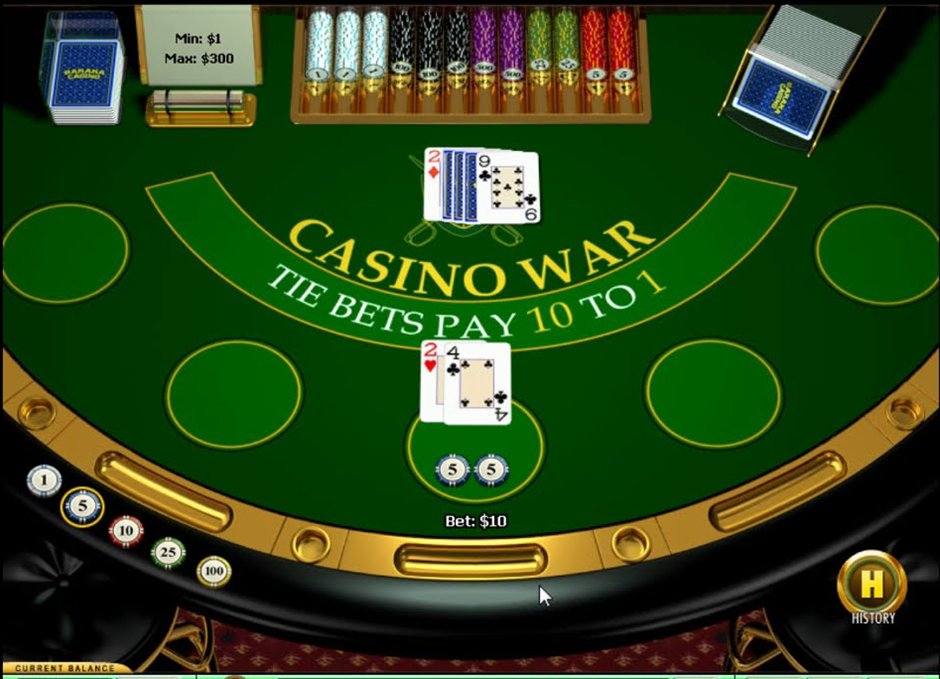
Casino war is the only game on a Canadian floor a six year old could play, and the only one where the simplest move is the wrong one. High card wins. When the cards tie you either surrender half your stake or go to war, and the surrender is the expensive option. For the wider market picture, start at our online casino Canada hub.
The table below sets out how the game behaves. Read it first, then work through the detail beneath.
| Trait | Detail |
|---|---|
| Cards | One to the player, one to the dealer, from six decks |
| Win condition | The higher card wins, suits are ignored |
| Tie options | Surrender half the stake or go to war |
| House edge | Roughly 2.9 percent going to war, 3.7 percent surrendering |
| Tie side bet | Around 18 percent house edge |
| Canadian supply | Ontario lobbies, provincial platforms, land based floors |
What is casino war?
A one card game where the player and the dealer each receive a single card and the higher one wins. Aces are high, suits do not matter, and no decision is required unless the two cards tie.
Even money on a win. Nothing else to learn.
The game is adapted from the children’s card game of the same name. Casino war keeps the high card rule exactly and adds a tie procedure that carries the entire house edge.

A Canadian meeting it online usually finds it filed under novelty or specialty games rather than table games. Casino war sits away from blackjack in most lobby filters despite being a card game.
Aces rank above kings and no suit ever breaks a tie. Casino war compares one number against one number and nothing else.
What happens on a tie?
The player chooses between surrendering and going to war. Surrendering forfeits half the stake immediately, and going to war requires a second bet equal to the first before the cards are dealt again.
Going to war is correct every time. Surrender costs more.
Ties occur on roughly one hand in fourteen. That frequency is high enough for the choice to decide what a casino war session actually costs.
The choice appears as two buttons on screen. A casino war client will not deal the next card until one of them is pressed.
Ties arrive roughly every fourteen hands on a six deck shoe. A casino war session of one hundred hands meets the decision seven times.
How does going to war work?
Three cards are burned, then one new card goes to each side. If the player wins or ties this second round, the war bet pays even money and the original stake pushes rather than paying.
Winning a war pays one unit on two at risk.
Losing the war loses both bets. That asymmetry is where casino war takes its margin, and it is printed on the felt in plain language.
Burning three cards before the second deal is a hold over from the land based procedure. Nothing about it changes the odds of a casino war round.
A tie on the second deal counts as a player win. Casino war pays the war bet on that outcome rather than repeating the procedure.
Why does the original bet only push?
Because the house needs a return from a game that is otherwise an even proposition. Paying the war bet alone while pushing the original stake converts a fair contest into a 2.88 percent edge.
Two units at risk, one unit paid. That is the rule.
Nothing else in casino war generates an edge. The single card comparison is genuinely even, ties excepted.
Reading the payout line once removes the surprise. A casino war felt states that the original wager pushes on a won war.
Why is surrendering worse?
Because half a unit lost with certainty is worse than the expected cost of a war. Going to war wins often enough that the average loss is smaller than the guaranteed half stake.
Surrender raises the edge to about 3.7 percent.
Players surrender because it feels safer. Casino war is built on that instinct, and the whole difference between a cheap session and an expensive one sits in refusing it.
Certain tables pay a bonus on a won war, which widens the gap further. Surrendering on those casino war tables is worse again.
The instinct to cut a loss is what the rule is priced against. Casino war charges almost a full extra point to anybody who follows it.
What is the tie bet?
An optional side wager that the first two cards will tie, paying ten to one. The true odds are closer to thirteen to one, which leaves a house edge around eighteen percent.
The main game costs three percent. This costs eighteen.
Skipping it is the single easiest saving available. No version of casino war prices the tie bet competitively.
A handful of versions pay twelve to one rather than ten. Even the generous casino war tie bet costs many times the main game.
It sits beside the main betting box on screen. Leaving the casino war tie circle empty costs nothing and saves the most.
Twelve to one is the best price on offer anywhere. Even that leaves the casino war tie bet costing four times the main game.
How many decks are used?
Six decks is the standard shoe on both land based and online tables. More decks slightly reduce the tie frequency, which marginally lowers the cost of the game for a player going to war.
Deck count is printed in the rules screen. Six is normal.
Single deck versions exist and are rare. A casino war shoe of one deck ties more often and costs the player slightly more.
What is the house edge?
Roughly 2.88 percent when a player always goes to war, rising to about 3.7 percent for a player who always surrenders. Both figures assume no tie side bet.
Adding the tie bet pushes the combined cost far higher.
That places casino war between roulette and the weaker table games. It is cheaper than most slots and dearer than blackjack.
The figure assumes no side bet and correct tie handling. A casino war player doing both things pays under three percent.
Comparing per hand rather than per hour is the fair basis here. Casino war deals quickly, so hourly cost runs higher than the percentage suggests.
Can you use a strategy?
Only one rule exists and it never changes. Always go to war on a tie and never buy the tie side bet, and the game is being played correctly from the first hand.
Card counting gains nothing meaningful here.
No other decision exists. Casino war has one lever, and pulling it correctly takes no practice at all.
No betting system changes the cost of a hand. Casino war applies the same edge to every stake regardless of sequence.
One rule covers the whole game. Casino war needs nothing else committed to memory.
Where can Canadians play casino war?
Registered Ontario operators carry software versions, the provincial platforms list it among novelty games, and a number of land based floors deal it as a low minimum table.
Live dealer versions are rare. Software is the usual route.
Table minimums run low on both channels. A casino war seat is usually among the cheapest on a Canadian floor.
Is casino war certified in Ontario?
Yes. Every table on a registered Ontario lobby has passed independent laboratory testing of the shuffle, the paytable and the published return before deployment.
The tested build is the deployed build.
Certification covers the shuffle and the payout rules together. An operator changes nothing inside a certified casino war table.
Does casino war count toward wagering?
Usually at a reduced rate or not at all. A three percent table game clears a bonus requirement cheaply, so the contribution table restricts it.
Check the rate before claiming.
Rates differ per operator rather than per game. One Ontario site may count casino war at ten percent and another may exclude it.
Is casino war good for a small bankroll?
Reasonably, provided the tie bet stays untouched. A war doubles the exposure on roughly one hand in fourteen, which is a manageable pattern at a low table minimum.
Session length is average. Stakes are usually low.
Budgeting for the war is the practical step. A casino war bankroll needs headroom for a doubled stake on one hand in fourteen.
How does it compare with baccarat?
Baccarat carries a lower edge and asks nothing of the player either. This game is simpler still and costs about two points more for that simplicity.
Both are pure chance. One is cheaper.
Both resolve without any player skill. Casino war is quicker to learn and costs about two points more per hand.
What does a Canadian check before playing casino war?
Three things before the first hand. Whether the table pays a bonus on a won war, the tie bet payout, and the bonus contribution rate in the terms.
Then go to war on every tie.
None of it requires a deposit. Casino war publishes its payout rules in the client before any money moves.
Which game pages are worth reading next?
Four pages sit closest to this one. Each covers a game or a rule that touches the subject above, and each stands on its own.
Casino war hides its entire house edge in one decision most players get wrong out of caution. Go to war, skip the tie bet, and the game is as cheap as it gets.
1 thought on “Casino War Canada: One Card, One Decision, One Costly Instinct”