
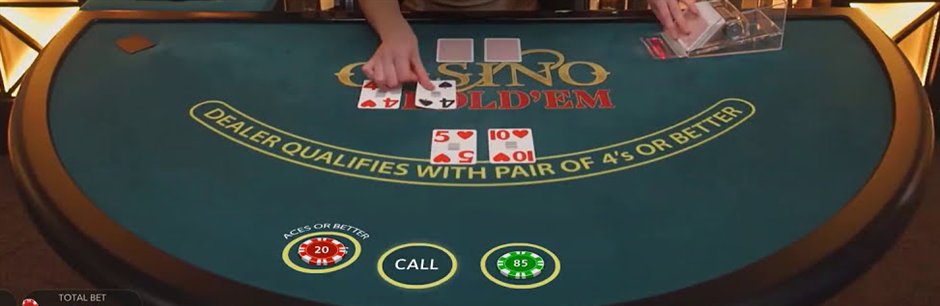
Casino holdem is the live dealer table where folding is almost always wrong. The Ante is lost outright on a fold, the Call is only twice the Ante, and correct play sends roughly eighty two percent of hands to a showdown. For the wider market picture, start at our online casino Canada hub.
The table below sets out how the game behaves. Read it first, then work through the detail beneath.
| Trait | Detail |
|---|---|
| Cards | Two to the player, two to the dealer, five community |
| Bets | Ante, a Call of twice the Ante, optional AA side bet |
| Dealer qualification | A pair of fours or better |
| Fold rate | Roughly 18 percent of hands with correct play |
| House edge | Roughly 2.2 percent against the Ante |
| Canadian supply | Ontario live lobbies, provincial platforms, land based floors |
What is casino holdem?
A house banked poker variant where the player and the dealer each receive two cards and share five community cards. The player decides once whether to fold or to call, and the best five card hand wins.
The dealer is the only opponent. Nobody else matters.
The game was designed in the late twentieth century and spread through live dealer studios. Casino holdem now sits on almost every Ontario live lobby beside blackjack and baccarat.
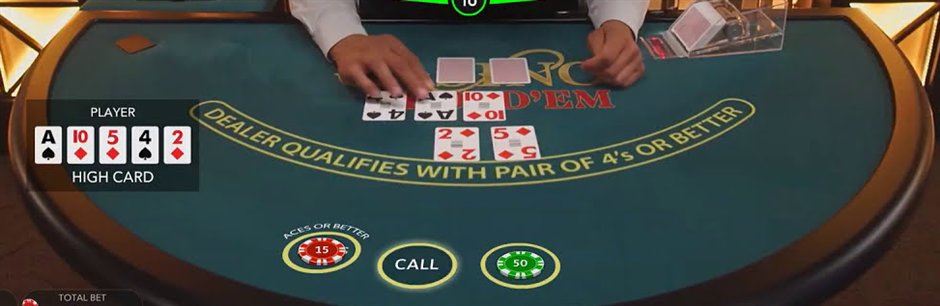
A Canadian meeting it for the first time usually arrives through the live dealer filter. The table looks like a poker room and behaves nothing like one, because casino holdem banks every hand through the house.
Nothing about it requires poker experience beyond hand rankings. A player who knows a flush beats a straight has everything the game asks for.
The table seats unlimited players in a live studio. Every casino holdem seat receives its own two cards and shares the same five community cards with everybody else.
Nothing one player does affects another. The dealer hand is the only common opponent.
The name varies slightly between studios. Casino holdem, Casino Hold Em and Casino Poker all describe the same rules on a Canadian lobby.
Reading the rules screen confirms it in one glance. The Ante, the Call and the qualification threshold are identical.
Chat panels and statistics displays sit beside a live table. Neither carries information that changes a casino holdem decision.
The felt itself states the qualification rule. That is the only text at the table worth reading.
The game reached Canadian lobbies through live studios rather than land based floors. Casino holdem is an online first table game in this market.
Two hand versions exist on some studios, letting one player back two separate holdings against the same board. The casino holdem rules are otherwise unchanged.
How does a hand play out?
The player posts an Ante and receives two cards, and three community cards are dealt face up. The player then folds and loses the Ante, or calls with twice the Ante to see the last two community cards.
One decision, taken on the flop. Nothing follows it.
The dealer reveals their two cards after the call. Casino holdem then compares the two best five card hands and settles every wager at once.
Seeing three community cards before deciding is unusually generous. Most house banked poker variants ask for a commitment on less information than casino holdem provides.
The last two community cards arrive after the call. Nothing further is asked of the player at that point.
Betting windows on a live table are short. A casino holdem dealer moves the hand along whether every seat has decided or not, and an undecided seat folds by default.
Software versions wait indefinitely. That makes them the better place to learn the calling rule.
The Ante is committed before any card is seen. That single unit is the cost of entry on every casino holdem hand dealt.
Calling doubles the exposure. Folding forfeits the Ante and ends the hand immediately.
Three community cards before the decision is the structural gift. Casino holdem asks for a commitment on more information than its rivals do.
How is it different from Texas Holdem poker?
The casino banks every hand rather than taking a rake from a pot. There is no raising, no bluffing, no reading opponents, and the bet sizes are fixed by the rules rather than chosen.
Hand rankings carry over. Everything else does not.
A player never competes with another seat. Casino holdem seats resolve independently against the same dealer hand.
No rake exists anywhere in the structure. Casino holdem takes its margin from the Ante paytable and the qualification rule instead of a percentage of a pot.
Variance behaves differently too. A poker session swings on decisions and this one swings on cards, because the correct decision is fixed.
Bankroll behaviour differs sharply as well. A poker player can fold cheaply for hours, and every casino holdem hand costs at least one unit whether the cards are worth playing or not.
Position means nothing here. The dealer acts last on every hand by definition.
Nothing carries over except hand rankings. Casino holdem removes every skill element poker rewards.
What is the dealer qualification rule?
The dealer needs a pair of fours or better to qualify. The threshold is low, and with five community cards shared it is met on roughly four hands in five.
A low bar compared with other table poker games.
Failure returns money rather than withholding it. Casino holdem pays the Ante and pushes the Call when the dealer misses the threshold.
A pair of fours is a low threshold by any standard. Casino holdem sets it there deliberately, because a shared five card board would otherwise leave the dealer qualifying almost every hand.
Roughly one hand in five fails it. That frequency is worth knowing before the first call.
Comparing thresholds across the table section is instructive. Three card poker needs Queen high, Caribbean stud needs Ace King, Ultimate Texas Holdem needs a pair, and casino holdem needs a pair of fours.
Lower thresholds favour the player. This one is among the lowest in the section.
The rule protects the house from a structure that would otherwise favour the player heavily. Casino holdem shows three community cards before asking for a decision, which is a genuine information advantage.
Qualification is checked before the hands are compared.
The threshold is printed on the felt in full. A casino holdem table never hides the condition.
Every version uses the same threshold. No casino holdem table on a Canadian lobby raises or lowers it.
What happens when the dealer fails to qualify?
The Ante pays according to the Ante paytable and the Call is returned. A player holding a strong hand still collects the Ante bonus, which is unusual among qualification rules.
The Call pushes. The Ante still pays its ladder.
That structure is gentler than the Caribbean stud version. Casino holdem does not flatten a straight flush into an even money payout.
The outcome is a partial win rather than a disappointment. Casino holdem returns the Call intact and pays the Ante ladder on whatever the player holds.
A strong hand still collects its bonus. That is the key structural difference from other qualification rules.
The Ante ladder paying on an unqualified dealer is genuinely unusual. Most house banked poker games flatten the payout in that situation rather than honouring the bonus.
That single rule is why casino holdem publishes a lower edge than Caribbean stud on similar structure.
Roughly one hand in five ends this way. A casino holdem player meets the outcome several times in an ordinary session.
Nothing is lost on it. The Ante pays and the Call returns.
The Ante ladder still pays in full. That is what separates casino holdem from the harsher qualification rules.
What does the Ante pay?
Even money up to a straight, two to one on a flush, three to one on a full house, ten to one on four of a kind, twenty to one on a straight flush and one hundred to one on a royal flush.
The ladder applies whether the dealer qualifies or not.
Lower rungs carry most of the value. Casino holdem Ante bonuses on a full house or better are rare enough to contribute little across a session.
Ladders vary between studios and the differences matter. A casino holdem table paying two to one on a flush is worth finding over one paying even money.
The straight rung rarely moves. Flush and full house are where tables separate.
Reading the ladder before sitting is the whole check. Two casino holdem tables in the same Ontario lobby can differ by a full rung on the flush.
Royal flush at one hundred to one is decorative. It appears too rarely to affect the published figure.
Even money covers everything up to a straight, which is the vast majority of winning hands. The casino holdem ladder only starts climbing at a flush.
That shape keeps the published edge low without expensive top rungs.
A straight and below pays even money on every version. The casino holdem ladder above that point is where operators compete.
Comparing two tables means comparing four rungs.
Four rungs decide table quality. A casino holdem ladder is worth two minutes of comparison before sitting.
The royal flush rung is effectively decorative. It appears too rarely to move a casino holdem return figure.
What does the Call pay?
Even money whenever the dealer qualifies and the player wins the showdown. The Call carries no bonus ladder of its own and never pays more than one to one.
Two units staked, two units returned on a win.
That flat payout is why the Ante ladder exists. Casino holdem splits the reward between a fixed call and a scaling ante.
Flat even money keeps the game simple. A casino holdem player never has to work out what a winning showdown is worth beyond doubling the Call.
Losing the showdown loses both bets. There is no partial settlement.
The flat payout keeps the arithmetic simple at the table. A winning casino holdem showdown returns the Call at even money plus whatever the Ante ladder owes.
Nothing scales with hand strength on the Call. That reward sits entirely on the Ante.
Even money and nothing more. The casino holdem Call never scales with hand strength.
When should you fold?
Almost never. Correct strategy folds roughly eighteen percent of hands, and the folds are limited to weak holdings that miss the flop entirely with no draw attached.
Any pair calls. Any two overcards call.
The Ante is lost on a fold with no showdown. Casino holdem therefore punishes caution the way most house banked poker variants do.
Folding eighteen percent of hands sounds high until the alternative is considered. Every casino holdem fold forfeits one unit with no chance attached.
The correct folds are genuinely hopeless holdings. Nothing marginal belongs in that group.
The eighteen percent figure is the output of a solved game rather than a preference. Folding more than that on casino holdem raises the cost of every session measurably.
Folding less costs money too. The hopeless hands are genuinely hopeless.
Unpaired low cards missing the flop entirely are the only genuine folds. Everything else on a casino holdem flop has enough equity to justify the Call.
Caution costs more than the occasional bad call here.
Board texture matters less than the three tests. A casino holdem player checking for a pair, overcards or a draw is playing close to optimally.
Everything else is noise at this table.
Eighteen percent is the target fold rate. Casino holdem players folding more than that pay for the caution.
Folding is a button rather than an automatic action. A casino holdem player has to choose it deliberately.
What is the simple calling rule?
Call with any pair, any two cards higher than the board, any flush draw and any open ended straight draw. Fold unpaired low cards that match nothing on the flop.
That covers almost every hand correctly.
Perfect play refines the marginal cases. A Canadian using the simple casino holdem rule gives up a small fraction of a percentage point.
Memorising it takes one reading. Casino holdem asks for a pair, two overcards or a draw, and folds everything that misses all three tests.
Board pairs complicate marginal hands slightly. The simple rule still holds in almost every case.
Writing the rule on a note beside the screen is entirely legitimate. Nothing in the casino holdem rules prevents a player from consulting a chart mid hand.
Live tables allow it at most studios as well. The dealer has no interest in how a player decides.
Three tests cover it. A pair, two cards above the board, or a draw to a flush or an open ended straight all call on casino holdem.
Missing all three is the fold. Nothing else is needed.
Pair, overcards or draw calls. Everything else folds on casino holdem.
What is the house edge?
Roughly 2.16 percent against the Ante with correct play. Measured against total money wagered across a hand the figure falls to about 0.8 percent.
That places it among the cheaper table games online.
Both figures describe the same game. Casino holdem competes with blackjack once the basis is matched properly.
Element of risk is the fairer comparison figure. Casino holdem near 0.8 percent on that basis sits beside blackjack rather than behind it.
Published figures assume correct play. A player folding too often faces a considerably more expensive game.
Comparing published figures across games only works when the basis matches. A percentage quoted against the Ante and a slot figure quoted against total stake are not the same measurement.
Casino holdem at roughly 0.8 percent element of risk is among the cheapest wagers in a Canadian live lobby.
The figure assumes the simple calling rule is followed. A casino holdem player folding by instinct rather than by rule pays considerably more than the published number.
Nothing about the edge is a guarantee for a single session.
Element of risk is the honest figure. Casino holdem sits under one percent on that basis.
Correct play is the condition attached. A casino holdem figure assumes the calling rule is followed every hand.
What is the AA side bet?
An optional wager paying when the player’s two cards and the three flop cards together contain a pair of aces or better. Payouts climb from seven to one up to one hundred to one on a royal flush.
It settles on the flop, before the call decision.
The house edge sits around six percent. Casino holdem players treating the AA bonus as a main wager pay roughly three times the cost of the base game.
It resolves before the main decision, which makes it feel separate from the hand. A casino holdem AA bonus pays or loses on the flop regardless of what follows.
Qualifying hands are aces or better across five cards. That happens often enough to keep the bet active.
Qualifying combinations appear on roughly six percent of flops. That frequency is what keeps the wager feeling live without making it good value.
Paytables vary by studio. A casino holdem AA ladder paying twenty five to one on a straight is better than one paying twenty.
It uses the player two cards and the three flop cards together. A casino holdem AA bonus therefore resolves on five cards rather than on the full seven.
The main hand is unaffected by it either way.
It is settled and paid before the call decision on most interfaces. A casino holdem AA result therefore never influences whether a player calls.
Treating the two wagers separately is the correct framing.
It resolves on five cards rather than seven. A casino holdem AA bonus is settled before the call.
Is the AA side bet worth playing?
Not on value. Six percent is a heavy price beside a main game costing two, and the qualifying hands appear often enough to feel close without being generous.
Paytables vary between studios. Read before backing it.
The honest position is that it is entertainment. A casino holdem player backing it every hand is paying roughly three times the base game cost for the extra action.
Skipping it is the single cheapest improvement available at the table.
Backing it every hand raises the per hand exposure by a third. A casino holdem player doing that is paying the base edge and the side bet edge together.
Skipping it is the single cheapest improvement at the table.
Six percent against two is the comparison. Skipping it is the cheapest casino holdem improvement available.
Backing it occasionally costs little. Backing it every hand triples the casino holdem edge a player actually pays.
Does the Ante paytable vary?
Yes, and it matters. Some tables pay two to one on a flush and others pay one to one, which moves the house edge by well over a percentage point.
The flush rung is the one that moves most often.
Comparing two Ontario tables takes one glance. Casino holdem publishes its full ladder in the rules screen on every version.
Comparing two Ontario operators takes two minutes. Casino holdem publishes its ladder in the rules screen on both live and software versions.
Nothing else about the game changes between tables. Only the paytable moves.
Operators rarely advertise the ladder outside the game. The information sits in the rules screen because regulation requires it there, and a casino holdem player who never opens it never knows.
Comparing two tables takes two minutes. The difference is worth more than a point.
The flush rung is the one worth checking first. A casino holdem table paying two to one there rather than even money is worth more than a percentage point over a session.
Everything below a flush pays even money everywhere.
The flush rung moves most often. Reading it takes one glance at the casino holdem rules screen.
What is the progressive version?
A handful of studios attach a jackpot side bet paying on the player’s five card hand. Pools link across operators and pay the full amount on a royal flush.
Edges on those side bets run above twenty percent.
The main game is unchanged beneath it. A progressive casino holdem table plays identically once the side bet is skipped.
Pool sizes are displayed above the table on most interfaces. A casino holdem player sees the current figure before deciding whether to buy in.
Fixed payouts sit beneath the top prize. A flush or a full house pays a stated amount.
Jackpot side bets link across operators on some networks. A casino holdem pool can therefore climb faster than a single site could ever fund on its own.
The edge on those wagers is heavy. Treating them as entertainment is the honest framing.
Pools link across operators on some networks. The casino holdem main game is unchanged beneath the side bet.
Why is it mostly a live dealer game?
Because the format suits a studio. One dealer serves unlimited seats, the community cards are shared, and the pace matches what a live audience expects from a poker table.
Software versions exist and attract less traffic.
Ontario lobbies list it under live casino rather than table games. Finding casino holdem usually means opening the live dealer filter.
Shared community cards are what make the format scale. One casino holdem dealer can serve hundreds of seats because every player uses the same five cards.
That efficiency is why studios favour it. A blackjack table cannot work the same way.
Studios also favour formats that need one dealer and no per seat equipment. A casino holdem table needs a shoe and a felt, and everything else is software.
That economy is why almost every major studio runs one.
Community cards shared across every seat are what make the format scale. One casino holdem deal serves an unlimited audience at once.
Software versions replicate the rules and lose the atmosphere.
Shared community cards let one dealer serve every seat. That is why casino holdem scales as a studio product.
Software versions carry the same certified mathematics. Live casino holdem simply attracts most of the traffic.
How many seats can play?
Unlimited on a live table. Every seat plays its own two cards against the same dealer hand and the same community cards, which is why a studio can serve hundreds at once.
One player’s decision never affects another.
Live tables show other players decisions on screen. Nothing about them affects a casino holdem result, and the information is presentation rather than data.
Software versions seat one player. The mathematics are identical either way.
Unlimited seating changes nothing about the odds. A casino holdem hand played alone and the same hand played alongside five hundred others resolves identically.
Crowded tables simply deal on the same schedule.
Unlimited seating changes no odds. Every casino holdem seat plays the same dealer hand independently.
What stakes does casino holdem accept?
Live tables typically open around one dollar for the Ante, which means three dollars committed on a called hand. Higher limit tables run alongside for larger stakes.
Three units per called hand is the working figure.
Adding the AA bonus makes four. Casino holdem exposure scales directly with the Ante chosen.
High limit tables run alongside the standard ones in most studios. A casino holdem player choosing a table is choosing an exposure level rather than a different game.
The Ante sets everything. Call and side bet scale from it.
Choosing the table minimum is the main bankroll decision. Casino holdem exposure scales directly with the Ante, and the Call doubles it on every hand played to showdown.
High limit tables run alongside the standard ones. The mathematics are identical.
Minimums sit lower online than on a land based floor. A casino holdem table opening at one dollar is common in an Ontario live lobby.
Three units per called hand is the working exposure figure.
Live studios run parallel tables at different limits. A casino holdem player moving up is changing exposure rather than rules.
The Ante drives everything else on the layout.
One dollar Antes are common online. Three units per called hand is the casino holdem working figure.
Table limits are shown before a seat is taken. A casino holdem lobby lists the minimum beside every table.
Where can Canadians play casino holdem?
Registered Ontario operators carry live dealer versions from the major studios, the provincial platforms list it, and a number of land based floors deal it in person.
Live studio coverage decides online availability.
Searching by name is quicker than browsing. Casino holdem surfaces immediately in the live dealer filter where it exists.
Studio coverage decides availability more than operator choice. A registered Ontario site carrying a major live studio usually carries casino holdem, and one without it carries nothing.
Land based floors deal it less often than blackjack. Online is the practical route.
Provincial platforms list live versions alongside blackjack and roulette. That availability puts casino holdem within reach of players outside the private Ontario market.
Land based floors deal it less often. Online is the practical route in most provinces.
Search by name rather than browsing the whole live section. Casino holdem surfaces immediately on any Ontario lobby that carries it.
Availability follows studio agreements rather than operator preference.
Studio agreements decide availability. Casino holdem appears wherever a major live supplier is carried.
Is casino holdem certified in Ontario?
Yes. Every table on a registered Ontario lobby has passed independent testing of the shuffle, the paytables and the published return before deployment.
Live studios are audited separately for equipment and procedure.
The regulator publishes its registered supplier list openly. Confirming that a lobby dealing casino holdem operates legally takes one search rather than trust in a claim.
The tested build is the deployed build.
Testing covers spin and shuffle independence as well as the published figures. No sequence of hands makes the next one more likely on a certified casino holdem table.
Live equipment is audited separately from the software layer.
Certification is per market as well as per table. A casino holdem table cleared elsewhere needs separate Ontario testing before deployment.
The regulator publishes its registered supplier list openly.
Testing covers shuffle and paytables together. The deployed casino holdem table is the tested one.
Does casino holdem count toward wagering?
Usually at a reduced rate or not at all. A table game costing under one percent of money wagered clears a bonus requirement far too cheaply for an operator to allow at full rate.
Check the contribution table before claiming.
Excluded games sometimes void an entire bonus rather than contributing nothing. That clause matters more than the percentage beside casino holdem in the table.
Rates differ per operator rather than per game.
Element of risk is why operators restrict table games so heavily. A game costing under one percent of money wagered clears a requirement at a fraction of a slot cost.
Rates differ per operator rather than per game.
Reading the clause matters more than the rate. A bonus excluding casino holdem is common.
Is casino holdem good for a small bankroll?
Yes, with the side bet skipped. Three units per called hand at a one dollar Ante is predictable, and the low house edge keeps a modest balance alive across a long session.
Folding correctly matters less than skipping the AA bonus.
Setting a hand count before sitting works better than setting a time. Fifty casino holdem hands at the table minimum is a measurable session with a known worst case.
Deposit limits sit inside every registered Ontario account.
Three units per called hand is the working figure at a one dollar Ante. A casino holdem session of fifty hands therefore has a known worst case before it starts.
Deposit limits sit inside every registered Ontario account.
The low published edge helps a modest balance more than any decision at the table. Casino holdem returns more per dollar wagered than almost anything else in a Canadian live lobby.
Skipping the side bet keeps it that way.
A low edge protects a modest balance more than any single decision. Casino holdem returns more per dollar staked than most of a Canadian live lobby.
The AA bonus undoes that advantage quickly.
The low edge does the work. Casino holdem stretches a modest balance further than most tables.
How does it compare with Ultimate Texas Holdem?
Both are community card games with a dealer qualification rule and similar published edges. This one asks for a single decision on the flop, and the other asks for three with a shrinking raise attached.
Simplicity is the trade. The cost is almost identical.
Both reach Ontario through the same registration and testing route. Choosing between casino holdem and the other game is a choice about decision load rather than oversight.
Side bets differ in structure. One resolves on the flop and the other on seven cards.
Ultimate Texas Holdem lets a strong hand commit four times the Ante before the flop. Casino holdem fixes the Call at twice and pays the difference back through its Ante ladder.
Both published edges land near two percent against the Ante.
Fold rates differ sharply between them. Casino holdem folds roughly eighteen percent of hands and Ultimate Texas Holdem folds almost none.
Both reward calling more than instinct suggests.
Both publish similar edges against the Ante. Casino holdem asks for one decision rather than three.
What does a Canadian check before playing casino holdem?
Three things before the first hand. The Ante paytable and its flush rung, the AA bonus ladder if it is offered, and the bonus contribution rate in the terms.
Then call with any pair, any overcards and any draw.
None of the three requires a deposit. Casino holdem publishes its paytables in the client, and the contribution rate sits in the account area.
Reading takes under a minute.
The routine generalises past one game. Reading the paytables, the table minimum and the bonus terms works on every table in an Ontario lobby.
The calling threshold is the part unique to casino holdem. Nothing else in the section rewards calling this widely.
A fourth check helps anyone on a modest balance. The table minimum decides the size of the three unit commitment a called hand requires.
None of the four requires a deposit to read.
Everything sits inside the client. Casino holdem publishes its own figures before a deposit.
Which game pages are worth reading next?
Four pages sit closest to this one. Each covers a game or a rule that touches the subject above, and each stands on its own.
Casino holdem offers one of the cheapest edges in a Canadian live lobby and hands most of it back to players who fold too often or back the side bet every hand. Call more than instinct suggests.
2 thoughts on “Casino Holdem Canada: Why Folding Is Almost Always Wrong”