
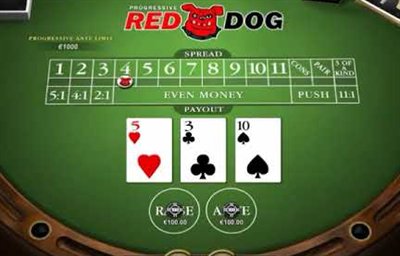
Red dog poker is not poker at all. Two cards land face up, and the player bets that a third card will fall between them. The narrower the gap, the bigger the payout, and the one real decision is whether to double the bet once the gap is known. For the wider market picture, start at our online casino Canada hub.
The table below sets out how the game behaves. Read it first, then work through the detail beneath.
| Trait | Detail |
|---|---|
| Also known as | Acey deucey, in between |
| Decks | One to eight, six is common |
| Card order | Poker rank, aces high, suits ignored |
| Top payout | 11 to 1 on three of a kind |
| Best decision | Raise only on a spread of seven or more |
| House edge | About 2.8 percent with six decks |
What is red dog poker?
A card game played against the house where two cards are dealt face up and the player wins if a third card lands strictly between them in rank. The payout depends on how close the first two cards are.
Despite the name, no poker hands are formed. Red dog poker borrows only the poker card order.
The whole game runs on one question: how likely is the next card to land inside the gap. Red dog poker answers it with a fixed paytable and a single raise.

No other decision exists at the table.
Every wager settles on a single third card, which keeps the game easy to follow from the first hand.
Red dog poker tables accept a single wager per seat before the first two cards appear.
Red dog poker rewards players who understand probability, because every payout reflects how many ranks can still land between the first two cards on the table.
Why is it called poker?
Casinos grouped it with card games that use poker rankings and marketed it under that heading. The game itself shares more with the old acey deucey card game than with any poker variant.
Online lobbies list it as red dog, red dog poker or in between.
The red dog poker name stuck in casino marketing even though the game has no hands to rank.
The rules screen explains the real game in two short lines.
Players expecting poker hands find a much simpler game once the first two cards land.
How does a hand play out?
The player places a wager. The dealer turns two cards face up. Depending on those cards, the hand pushes, goes to a third card for a three of a kind check, or announces a spread and offers a raise before the third card.
Each hand takes seconds.
A red dog poker round never needs more than three cards. Two open cards set the question, and the third card answers it.
Software tables animate each card as it lands.
The wager is placed before any card appears, and nothing changes it except the optional raise.
Red dog poker never deals a hand to the player, only shared cards that decide the result.
How are cards ranked?
Twos are lowest and aces are highest, exactly as in poker. Suits never matter, so a seven of hearts and a seven of clubs count as the same rank.
Aces never play low in red dog poker.
Face cards follow the usual order: jack above ten, queen above jack and king above queen. Red dog poker places the ace above the king in the casino version.
Kings rank directly below aces, and twos rank below threes, with no exceptions.
What is the spread?
The number of ranks strictly between the first two cards. A five and a ten have a spread of four, because six, seven, eight and nine sit between them.
The dealer announces the spread before the raise decision.
A red dog poker spread counts ranks, not cards. A four and an eight have a spread of three whatever suits appear, and a jack and an ace have a spread of two.
A spread of zero means consecutive cards. A pair has no spread at all.
Red dog poker dealers announce the spread aloud on live tables and on screen online.
What happens when the first two cards are consecutive?
The hand pushes. No rank can fall between two consecutive cards, such as a six and a seven, so the wager returns without a third card being dealt.
Consecutive cards are one of the two push outcomes.
Consecutive cards arrive often enough to matter. A red dog poker session includes a steady run of these instant pushes.
They cost nothing and move the game along.
No third card is dealt, and the next hand starts straight away.
What happens when the first two cards are a pair?
A third card is dealt. If it matches the pair to make three of a kind, the wager pays 11 to 1. Any other third card pushes.
Pairs never lose in red dog poker.
The pair outcome gives every red dog poker hand a small chance at the largest payout in the game.
The raise is not offered on a pair.
A pair that misses three of a kind returns the stake in full.
What does each spread pay?
A spread of one pays 5 to 1, a spread of two pays 4 to 1, a spread of three pays 2 to 1, and a spread of four or more pays even money.
Wider spreads win more often, so they pay less.
The paytable rewards precision. A red dog poker spread of one needs exactly one rank to land, which is why it pays five times the stake.
Payouts apply to both the original wager and any raise on that hand.
Red dog poker paytables print the four spread payouts in a single short column.
When does the player lose?
When the third card matches either of the first two cards or falls outside them. A third card equal to the high or low card counts as outside.
That rule makes wide spreads less generous than they look.
A red dog poker player holding a four and a jack loses to any four or jack, and to anything below four or above jack.
Only the six ranks between them win.
A loss takes both the original wager and any raise placed on that hand.
What is the raise?
After the spread is announced, the player may add a second wager up to the size of the original. The raise wins or loses on the same third card at the same payout.
Raising is optional on every spread.
The raise can match the original wager or stay below it. Red dog poker tables accept any raise amount up to that limit.
The raise pays at the same rate as the original wager.
Raising never changes the payout rate, only the amount at risk.
Red dog poker raises settle at the same moment as the original wager.
When does a player raise?
Only on a spread of seven or more. Those spreads win more often than they lose at even money, while every narrower spread loses money on the extra wager.
The rule holds whatever the number of decks.
Red dog poker players who follow that rule lift their return on every favourable spread and lose nothing on unfavourable ones.
Spreads of one through six never justify a raise, whatever the payout looks like.
Red dog poker charts reduce to one line: raise on seven, eight, nine, ten or eleven.
Red dog poker players who raise on every spread of seven or more and on nothing narrower reach the published house edge on every session.
Why raise only on spreads of seven or more?
With six decks, a spread of seven wins about 54 percent of the time at even money, giving the player an edge on the raise. A spread of six wins about 46 percent and costs money.
The crossover sits exactly between six and seven.
A red dog poker spread of eight wins about 62 percent of the time, and a spread of ten about 77 percent, so the raise grows more valuable as the gap widens.
The break even point for an even money bet is fifty percent, and spread seven is the first to clear it.
Red dog poker players who raise on six give away about seven percent of the raise on average.
Is raising on a spread of one tempting?
It looks tempting because it pays 5 to 1, but it wins less than 8 percent of the time. The raise on a spread of one loses more than half its value on average.
Big payouts on narrow spreads are priced to favour the house.
Spreads of two and three are traps as well. A red dog poker raise on either loses between a fifth and a third of its value on average.
The house prices the 5 to 1 payout well below the true odds of roughly 12 to 1.
How often does each spread win?
With six decks, a spread of one wins about 7.7 percent of the time, a spread of four about 31 percent, a spread of seven about 54 percent and a spread of eleven about 85 percent.
Each step adds roughly 7.7 points.
Red dog poker probabilities rise in near equal steps because each extra rank adds the same share of the remaining deck.
Figures shift slightly with fewer decks, but the pattern stays the same.
Red dog poker spreads of five and six sit just below the even money break even point, which is why they never justify a raise.
What is the widest possible spread?
Eleven, from a two and an ace. Every rank from three through king sits between them, so only another two or another ace loses.
That hand wins about 85 percent of the time with six decks.
A red dog poker spread of eleven is the strongest raise opportunity in the game.
Correct strategy takes the full raise on it.
A two and an ace appear together rarely, so the best raise opportunity is also uncommon.
What is the house edge?
With six decks and correct raising, about 2.8 percent. A single deck game runs about 3.16 percent, and an eight deck game about 2.75 percent.
More decks help the player slightly in red dog poker.
The red dog poker figures assume the player raises on spreads of seven or more and never on narrower spreads.
Any other raising pattern costs more.
Operators choose the deck count, and the rules screen states it.
Red dog poker edges stay close to three percent across every common deck count.
What is the element of risk?
Because correct raising adds money only on favourable spreads, the element of risk sits lower than the house edge: about 2.38 percent with six decks.
That figure is the fairer comparison with other games.
Red dog poker charges its edge mostly on the original wager, because raises go only where the player holds an advantage.
Element of risk rewards games where extra money goes in only on good spots.
Why do more decks lower the edge?
With more decks, removing the first two cards changes the remaining deck less. A matching third card becomes relatively more likely on pairs, and spread probabilities move slightly in the player’s favour.
The difference between one and eight decks is about four tenths of a percent.
Players rarely choose a red dog poker table by deck count, yet an eight deck game is the cheapest version available.
The effect is small enough that other factors, such as table limits, matter more to most players.
How often does a hand push?
About 21 percent of hands push with six decks. Consecutive first cards and pairs that miss three of a kind account for every push.
Pushes return the full wager.
Red dog poker pushes arrive without any decision, which keeps the pace steady and the bankroll calm.
Pushes cost nothing and require no decision.
Red dog poker pushes make the game gentler on a bankroll than its edge alone suggests.
How often does three of a kind hit?
About half a percent of all hands end in three of a kind at 11 to 1 with six decks. The payout is the largest in the game but contributes only a small share of the return.
Pairs appear far more often than they convert.
A red dog poker player sees three of a kind roughly once every two hundred hands with six decks.
The 11 to 1 payout feels large because the event is rare.
How often does the player lose?
About 46 percent of hands lose the original wager, and about 6 percent lose a raised wager as well. Losing raises happen on wide spreads that still miss.
Wins and pushes cover the remaining hands.
Losing hands outnumber winning hands in red dog poker, but even money raises on wide spreads balance part of that gap.
Losses come mostly from spreads of four or more that miss.
How volatile is red dog poker?
The standard deviation is about 1.6 units per hand with six decks. That is higher than even money games because of the 5 to 1 and 11 to 1 payouts and the raise.
Swings stay modest compared with side bets.
A red dog poker bankroll of fifty units comfortably covers normal swings at a steady stake.
Raising only on favourable spreads keeps swings lower than raising at random.
Red dog poker swings rise when players chase narrow spread payouts.
Is there any strategy beyond the raise?
No. The player never chooses cards, never hits and never folds. The raise on spreads of seven or more is the only decision that changes the return.
Bet sizing affects variance but not the edge.
Red dog poker players who remember a single number, seven, play the game perfectly.
No betting system changes the house edge on any spread.
Can card counting help?
Online games reshuffle digitally every hand, which removes any counting value. Live multi deck shoes change probabilities too little from hand to hand to matter.
Red dog poker is not a counting game.
A red dog poker player tracking cards gains nothing meaningful, because the raise rule already captures the value available.
Shuffling machines on live tables remove the question entirely.
What is acey deucey?
A traditional card game with the same core idea: bet that the next card falls between two cards. Home versions vary widely, while the casino form fixes the payouts and the raise.
Red dog poker is the casino version.
Acey deucey often allows players to bet the pot in home games, while red dog poker limits every wager to the table maximum.
Home games usually play from a shared pot that grows from hand to hand.
Is in between the same game?
In between is another common name for the same concept. Online lobbies use in between, red dog and red dog poker interchangeably for games with near identical rules.
Payout tables confirm which version a table uses.
Red dog poker rules screens clarify whether consecutive cards push and whether pairs draw for three of a kind.
Payout ladders on in between titles sometimes differ from the classic red dog table.
Who makes online red dog poker?
Real Time Gaming offers a red dog title that appears in game catalogues, and other studios release in between style games. Paytables and deck counts vary by supplier.
The rules screen names the supplier.
Red dog poker builds differ most on deck count and the three of a kind payout.
Both appear on the rules screen.
Demo versions let players test a title before depositing.
Red dog poker titles from different studios share the same core spread idea.
How does it compare with casino war?
Casino war compares one card against the dealer card, with a war decision on ties. Red dog poker compares a third card against two open cards and offers a raise.
Both games carry a house edge close to three percent.
Casino war asks nothing of the player until a tie. Red dog poker asks for a raise decision on every spread.
Both games suit players who want quick rounds and minimal rules.
How does it compare with three card poker?
Three card poker ranks real poker hands and has a dealer qualifier. Red dog poker has no hands, no dealer hand and no qualifier.
Both settle each round in seconds.
Three card poker offers a pair plus side bet. Red dog poker keeps everything inside one wager and one raise.
Three card poker asks players to learn hand rankings. This game asks for none.
How does it compare with baccarat?
Both games involve no card decisions. Baccarat offers a Banker bet near one percent, while red dog poker sits near three percent even with correct raising.
Baccarat is the cheaper game.
Baccarat players who want a single decision per hand find red dog poker familiar in pace.
Neither game asks players to form a hand or read a chart during play.
Does the dealer have a hand?
No. The dealer only turns cards and settles wagers. Every red dog poker outcome depends on where the third card lands against the first two, so the player never plays against a dealer total.
That makes red dog poker closer to a dice game than to a banked poker game.
The dealer never makes a decision that affects the result.
Red dog poker dealers follow the same fixed procedure on every hand.
When is the raise offered?
Only after the dealer announces a spread. Consecutive cards push before any raise, and a pair goes straight to the third card, so neither outcome offers a raise.
Red dog poker keeps the raise for the hands where the gap is known and the risk can be judged.
The interface shows the raise option only when a spread is announced.
What happens on a spread of four to six?
These spreads pay even money and win between roughly 31 and 46 percent of the time with six decks. The original wager is already in play, and raising on them loses value.
Red dog poker players leave these spreads alone and wait for the third card.
Four is the first spread that pays even money.
How valuable is the raise on a spread of eleven?
With six decks, the raise on a spread of eleven carries a player edge of about 70 percent, because the hand wins roughly 85 times in a hundred at even money.
No other decision in red dog poker carries as large an edge.
Players holding this spread raise the full amount allowed.
Is red dog poker a game of skill?
Mostly chance. The card order and the paytable decide nearly every result, and the single raise rule is the only skill involved. A player who follows it reaches the published edge.
Red dog poker rewards discipline rather than judgement.
Luck decides every individual hand.
How fast does red dog poker play?
Very fast. Two cards, an optional raise and a third card settle each hand, so software tables run far more hands per hour than blackjack or poker based table games.
Faster red dog poker rounds raise hourly cost at the same stake.
A comfortable pace keeps raise decisions accurate.
Red dog poker suits short sessions with a fixed number of hands.
What does a typical session look like?
Across a long six deck session, about 21 hands in a hundred push, about 52 lose, and about 27 win at payouts from even money to 11 to 1.
Red dog poker results cluster tightly around that pattern over time.
Short sessions swing further from that pattern than long ones.
Is red dog poker good for beginners?
Yes. The whole strategy fits in one sentence: raise on a spread of seven or more. A beginner plays at the published edge from the first hand.
Payouts sit on the rules screen for quick reference.
A beginner watching two red dog poker hands understands the game completely.
No hand rankings or charts are needed to start.
Red dog poker demo tables let beginners practise the raise rule risk free.
Red dog poker beginners learn the spread idea from a single hand and the raise rule from a single sentence.
What mistakes cost the most?
Raising on narrow spreads chasing 5 to 1 and 4 to 1 payouts is the costliest. Failing to raise on wide spreads of seven or more is the second.
Both errors vanish with the one line rule.
Red dog poker players who raise on every spread pay far more than the published edge.
Doubling the stake after losses is the costliest habit of all.
Red dog poker punishes impatience on narrow spreads more than any other error.
Where can Canadians play red dog poker?
Red dog poker appears mainly in online catalogues from suppliers such as Real Time Gaming. Ontario registered operators list it less often than blackjack variants, and land based tables are rare in Canada.
Searching by name, including in between, finds it fastest.
Red dog poker catalogues change as operators add and remove suppliers.
Checking the lobby again later is worthwhile.
Players outside Ontario check their provincial platform first.
Red dog poker searches work best with in between added as a second search term.
Red dog poker players in Canada compare the paytable on each operator before depositing, because the three of a kind payout can vary.
Is red dog poker certified in Ontario?
Registered operators run builds tested by an approved laboratory. The deck count, the payouts and the raise rules are fixed at certification and cannot change afterwards.
Operators display their registration number in the site footer.
Certification is granted per market as well as per title. A red dog poker build approved elsewhere is retested before an Ontario release.
Testing covers the shuffle, the payouts and the raise rule together.
Does red dog poker count toward wagering?
Table games usually contribute at a reduced rate, and certain bonus terms exclude them outright. The contribution clause matters more than the headline bonus figure.
Rates differ between operators.
An excluded game can void a bonus rather than simply contributing nothing. That clause matters more than the rate beside red dog poker.
Contribution rates for table games run from zero to twenty percent.
Is red dog poker good for a small bankroll?
Most hands risk one unit, and raises add a second unit only on favourable spreads. A one dollar table suits a modest deposit comfortably.
Pushes on one hand in five slow losses further.
Deposit limits sit inside every registered Ontario account. Setting one before a red dog poker session takes a minute.
Small stakes suit the game well because rounds are quick.
Red dog poker bankrolls last longer when raises stay limited to spreads of seven or more.
What does a Canadian check before playing red dog poker?
Four lines decide the table. The deck count, the spread payouts, the three of a kind payout and the operator registration status all appear before any money moves.
None of it requires a deposit to read.
The habit transfers to every table in the lobby. Red dog poker simply adds the spread paytable to the list.
Reading the rules screen takes under a minute.
Red dog poker rules screens state the deck count alongside the spread payouts.
Which game pages are worth reading next?
Four pages sit closest to this one. Each covers a game or a rule that touches the subject above, and each stands on its own.
Red dog poker hides one decision behind a simple deal. Raise on a spread of seven or more, leave every other spread alone, and the table plays close to its published edge.