
The Labouchere betting system Canada players ask about is a cancellation staking plan for even-money bets: you write a line of numbers, stake the first plus the last, cross off two after a win and add one after a loss. It aims for a fixed profit, but it does not change the house edge. To play roulette at licensed sites, start with our online casinos for Canadian players.
Below we explain each step, walk through a full line, and test the system with our own one-million-session simulations on European, American and La Partage roulette, plus the reverse version.
| Feature | Labouchere system |
|---|---|
| Other names | Cancellation system, split Martingale, American Progression |
| Type | Negative progression (stakes rise after losses) |
| Best suited to | Even-money bets: red/black, odd/even, high/low |
| Stake rule | First number plus last number on the line |
| After a win | Cross off the first and last numbers |
| After a loss | Add the lost stake to the end of the line |
| Goal | The sum of the starting line |
| House edge | Unchanged: about 2.70% on a single-zero wheel |
How does the Labouchere cancellation plan work?
It is a staking plan that splits a profit goal into a line of numbers and cancels them as you win. Each stake is the first number plus the last. The Labouchere betting system Canada players try is built for even-money bets such as red or black at roulette.
Wizard of Odds sums it up as writing a list, crossing off two numbers after a win and adding one after a loss.
The plan ends when the line is gone or the bankroll runs out.
It sets the profit target before the first spin.
Why is it called the cancellation system?
Because every win cancels numbers from the line until nothing is left. Wikipedia lists it as the cancellation system or split Martingale, and The Punters Page adds the name American Progression. All three names describe the same Labouchere betting system Canada players meet in strategy articles.
“Split Martingale” reflects how a loss is spread across later bets rather than doubled at once.
“Cancellation” describes the crossing-off step.
The plain name honours the man credited with devising it.
Who was Henry Labouchère?
Henry Labouchère was an English politician, writer, publisher and theatre owner of the Victorian and Edwardian eras, and Wikipedia credits him with devising the system. He founded the magazine Truth and sat as a Liberal member for Northampton, long before anyone used the Labouchere betting system Canada sites describe today.
Wikipedia notes that he said he “diligently attended the racecourse at Newmarket” as a student.
He also reported from Paris during the siege of the city.
The system carries his name, though the maths behind it is simple arithmetic.
How do you set up a Labouchere line?
Pick a profit goal and split it into a short row of numbers that add up to it. A goal of 10 units can be written as 1-2-3-4. That row is the whole plan for the Labouchere betting system Canada players start with at the table.
Wizard of Odds divides the goal by ten and writes the result ten times.
The Punters Page uses 1 to 8 as an example and also shows 3-6-9-12 for faster stakes.
Keep each number small next to the bankroll you bring to a Labouchere betting system Canada session.
How is each stake worked out?
Add the first and last numbers on the line. With 1-2-3-4, the first stake is 1 + 4 = 5 units. If only one number remains, that number is the stake. Every bet in the Labouchere betting system Canada players follow comes from this one rule.
Use the same unit size throughout a line.
Write the line down so you do not lose track at a fast table.
Online tables move quickly, so a notepad beside the screen helps.
What happens after a win?
Cross off the first and last numbers. The win paid exactly what those two numbers were worth, so that part of the goal is done. A win shortens the line by two, which is why the Labouchere betting system Canada players use can finish with fewer wins than losses.
After a win on 1-2-3-4, the line becomes 2-3.
The next stake is then 2 + 3 = 5.
When the last number is crossed off, the goal of that Labouchere betting system Canada line is reached.
What happens after a loss?
Add the amount you just lost to the end of the line. After losing 5 units on 1-2-3-4, the line becomes 1-2-3-4-5 and the next stake is 1 + 5 = 6. Each loss makes the Labouchere betting system Canada line one number longer.
The line now has to win back that loss as well as the goal.
Stakes rise by one unit per loss at first.
Longer losing runs make both ends of the line bigger.
How does one full line play out?
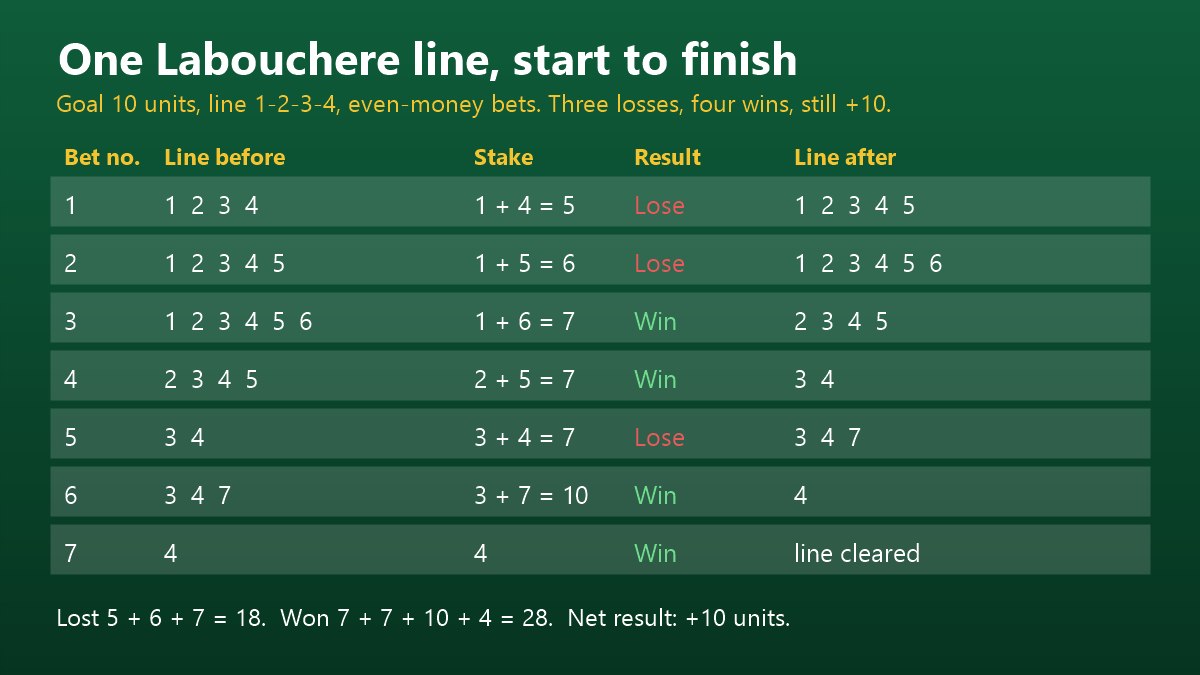
Our worked example below starts at 1-2-3-4 and finishes in seven bets with three losses and four wins. It loses 18 units and wins 28, for a net gain of 10, which is the exact goal set for this Labouchere betting system Canada line.
Bets one and two lose, so the line grows to 1-2-3-4-5-6.
Bets three and four win, cutting it to 3-4.
A loss adds 7, and two wins of 10 and 4 clear the line.
Why can the line finish with fewer wins than losses?
Each win removes two numbers and each loss adds only one. Wikipedia says that in the long run you only have to win about one-third of bets to clear the line, if the bankroll and table limit hold out. That is the appeal of the Labouchere betting system Canada players hear about.
A red or black bet on a single-zero wheel wins 48.65% of the time.
That is well above one-third, which makes the plan feel safe.
The catch is the size of the stakes along the way.
What share of wins does a four-number line need?
With no losses, two wins clear 1-2-3-4. Every two losses add one more win to the total required. The share of wins needed falls toward one-third as a Labouchere betting system Canada line gets longer, as our table shows.
| Losses along the way | Wins needed | Share of bets that must win |
|---|---|---|
| 0 | 2 | 100% |
| 2 | 3 | 60% |
| 4 | 4 | 50% |
| 6 | 5 | 45.5% |
| 10 | 7 | 41.2% |
| 20 | 12 | 37.5% |
We count numbers to cancel as four plus one per loss.
A long line needs fewer wins per bet but bigger stakes.
Which bets suit the Labouchere system?
Bets that pay one to one: red or black, odd or even, and 1-18 or 19-36 at roulette. Wizard of Odds also tests the baccarat Player bet and the craps pass and don’t pass lines. These are the natural homes of the Labouchere betting system Canada players run.
Bets at other odds break the link between the stake and the number cancelled.
The Punters Page says the system is also used at blackjack and baccarat.
Even-money bets keep the arithmetic of the Labouchere betting system Canada players use exact.
What does the zero do to the system?
The zero makes even-money bets lose more often than they win. On a single-zero wheel, red wins 18 of 37 spins, or 48.65%. On a double-zero wheel, it wins 18 of 38, or 47.37%. The Labouchere betting system Canada players use cannot remove that gap.
The house edge is 2.70% on single-zero roulette.
It rises to 5.26% with the extra double zero.
Prefer European or French tables when both are offered.
How fast do stakes rise after a losing run?
Slowly at first. From 1-2-3-4, each straight loss raises the next stake by one unit, while a Martingale starting at 5 doubles. After six losses in a row, the Labouchere betting system Canada line has lost 45 units against 315 for the Martingale.
| Losses in a row | Labouchere: lost so far | Labouchere: next stake | Martingale from 5: lost so far | Martingale: next stake |
|---|---|---|---|---|
| 3 | 18 | 8 | 35 | 40 |
| 5 | 35 | 10 | 155 | 160 |
| 6 | 45 | 11 | 315 | 320 |
| 8 | 68 | 13 | 1,275 | 1,280 |
| 10 | 95 | 15 | 5,115 | 5,120 |
Mixed runs of wins and losses push both ends up, so stakes grow faster in real play.
These figures are our own arithmetic.
How likely is a run of losses?
More likely than it feels. On a single-zero wheel, the chance of losing five even-money bets in a row is 3.57%, and six in a row is 1.83%. Across a long session, streaks like these hit every Labouchere betting system Canada player sooner or later.
| Losses in a row | Single-zero wheel | Double-zero wheel |
|---|---|---|
| 3 | 13.54% | 14.58% |
| 4 | 6.95% | 7.67% |
| 5 | 3.57% | 4.04% |
| 6 | 1.83% | 2.13% |
| 8 | 0.48% | 0.59% |
| 10 | 0.13% | 0.16% |
Each figure is the chance from any one starting point.
Over hundreds of spins, a run of six becomes routine.
What did our million-session simulation find?
With the line 1-2-3-4 on a single-zero wheel, 87.29% of sessions cleared the line with a 100-unit bankroll. The average result was still a loss of 1.94 units. We stopped a session when the next stake was larger than the bankroll left, the hard limit of any Labouchere betting system Canada player.
| Bankroll (units) | Lines cleared | Average bets | Average staked | Average result | Average loss when a line fails |
|---|---|---|---|---|---|
| 100 | 87.29% | 7.3 | 70.7 | -1.94 | -83.9 |
| 250 | 94.19% | 8.4 | 108.6 | -3.03 | -214.2 |
| 1,000 | 98.30% | 9.1 | 179.1 | -4.92 | -866.1 |
Each row is one million simulated sessions with a 10-unit goal.
Wins are small and frequent; losses are rare and large.
Does a bigger bankroll make the system safer?
It makes failure rarer but far more costly. In our runs, a 1,000-unit bankroll cleared 98.30% of lines, but a failed line cost 866 units on average. The Labouchere betting system Canada players run trades frequent small wins for rare large losses.
The average result got worse as the bankroll grew, because more money was staked.
Among sessions with 1,000 units, 1% saw a single stake of 233 units or more.
A bigger bankroll buys a Labouchere betting system Canada player time, not an edge.
What happens when a line fails?
You cannot cover the next stake, so the line stops with most of the bankroll gone. With 100 units, failed sessions lost 83.9 units on average in our simulation. One failure wipes out the profit from more than eight finished Labouchere betting system Canada lines.
At 10 units per cleared line, 83.9 units equals more than eight wins.
Wizard of Odds calls this a session win at the expense of huge losses when it fails.
Decide in advance what you will do if a line breaks.
Does the shape of the starting line matter?
It changes the pace, not the outcome. With a 100-unit bankroll, ten 1s took 19.6 bets on average, 1-2-3-4 took 7.3 and 5-5 took 3.4. Every shape of the Labouchere betting system Canada line still lost money on average in our runs.
| Starting line (goal 10) | Lines cleared | Average bets | Average result | Largest stake in 99% of sessions |
|---|---|---|---|---|
| 1-1-1-1-1-1-1-1-1-1 | 86.66% | 19.6 | -2.99 | 35 |
| 1-2-3-4 | 87.29% | 7.3 | -1.94 | 36 |
| 5-5 | 88.64% | 3.4 | -1.40 | 40 |
Shorter lines finish faster and put less money in action.
Less money in action means a smaller average loss.
How do table limits break the system?
A table maximum caps the stake, so a long line can no longer be bet. With 1,000 units and a cap of 50 per bet, 8.09% of our sessions hit the limit before clearing. That cap is the second wall every Labouchere betting system Canada player faces.
Those sessions lost 145.5 units on average when they stopped.
Wikipedia notes that table limits come into play after long losing runs.
Check the table maximum before you start a Labouchere betting system Canada line.
Can you split a large number to stay under the limit?
Yes, but it costs you. Wikipedia describes halving the next number and adding it to the line twice. Because you now add two numbers for one loss, the share of wins needed rises, and the Labouchere betting system Canada line becomes harder to clear.
Wikipedia says that if you always split, you would have to win more than half your bets.
No even-money casino bet wins that often.
Moving to a higher-limit table only raises the risk.
How does American roulette change the results?
It makes everything worse. With the same line and a 100-unit bankroll, the double-zero wheel cleared 85.14% of lines and lost 3.98 units per session on average, roughly double the single-zero figure. Skip double-zero tables for the Labouchere betting system Canada players run.
| Game (line 1-2-3-4, bankroll 100) | Lines cleared | Average result | Loss per unit staked |
|---|---|---|---|
| Single-zero roulette | 87.29% | -1.94 | 2.74% |
| Double-zero roulette | 85.14% | -3.98 | 5.32% |
| Single-zero with La Partage | 88.35% | -0.94 | 1.33% |
| Fair coin, no zero | 89.33% | 0.00 | 0.00% |
The loss per unit staked matches each game’s house edge within sampling noise.
The fair-coin row shows the system itself adds nothing.
Does La Partage help?
Yes. La Partage returns half of an even-money bet when the ball lands on zero, which Wikipedia says cuts the edge to about 1.35%. In our runs, it halved the average loss. It is the best table for the Labouchere betting system Canada players can find.
We added the half-stake lost on a zero to the end of the line.
En Prison rules give a similar edge.
Look for French roulette in the lobby before a Labouchere betting system Canada session.
What does Wizard of Odds’ simulation show?
Wizard of Odds ran over 6.9 billion single-zero sessions with a 10-unit goal. With 100 units, 88.01% reached the goal and the average session lost 3.188 units. It found that money lost divided by money bet matched the 2.70% house edge for the Labouchere betting system Canada players use.
With 2,500 units, it reached the goal 99.26% of the time.
On a double-zero wheel with 100 units, the rate fell to 84.71%.
Its rule lets the last stake use whatever bankroll is left, so its rates run slightly above ours.
What does the Wizard of Odds video cover?
In a video of about 20 minutes, the Wizard explains how to play the system and what to expect from it, using a free baccarat demo game. It sets out each step of the Labouchere betting system Canada players can follow, along with the risks.
The video calls it the cancellation or split Martingale system.
It links to the written analysis on his site.
Watch it before trying a line with real money.
Does the Labouchere change the house edge?
No. In every one of our simulations, the loss per unit staked landed within sampling noise of the game’s house edge. The Labouchere betting system Canada players use changes when you win and lose, not the share the casino keeps on each bet.
Each spin is independent of the line on your notepad.
No ordering of stakes turns a negative bet into a positive one.
Our page on whether online roulette is rigged explains how fair wheels behave.
What did the arXiv study conclude?
Jake Billings and Sebastian Del Barco simulated millions of rounds and found steady, linear-looking returns until the stakes outgrew the available capital and the player lost it all. Their paper says the outcome approached zero as bets increased, a warning for any Labouchere betting system Canada player.
They describe the system as psychologically appealing because of those consistent small wins.
They link the appeal to the gambler’s fallacy.
They also tested a bankroll approach that splits capital across rounds.
What is the reverse Labouchere?
It flips the rules: add the stake to the line after a win and cross off two numbers after a loss. Wikipedia calls it a positive progression, where stakes grow during winning runs. The reverse Labouchere betting system Canada players try caps losses at the sum of the line.
A line of 1-2-3-4 can lose at most 10 units.
Profits depend on a winning streak and on stopping in time.
The Punters Page calls it the more conservative of the two.
How does a reverse cycle end?
Either every number is crossed off, which means you lost the line’s total, or you stop when the next stake passes your limit and take the profit. Wikipedia notes the table limit decides how long a winning run can last in the reverse Labouchere betting system Canada players use.
Wikipedia’s example: a line of five 50s on a 500 table completes after nine straight wins.
Longer starting lines take more losses to clear.
Set your stop point before a reverse Labouchere betting system Canada cycle starts.
What did our reverse Labouchere simulation find?
With 1-2-3-4 and a stop once the stake tops 50 units, only 5.20% of cycles ended in profit; 94.80% lost the full 10 units. The average cycle lost 2.22 units. The reverse Labouchere betting system Canada players run swaps small, frequent losses for rare large wins.
| Reverse line 1-2-3-4 | Profitable cycles | Full 10-unit loss | Average result | Best cycle |
|---|---|---|---|---|
| Single zero, stop above 50 | 5.20% | 94.80% | -2.22 | +594 |
| Single zero, stop above 100 | 2.37% | 97.63% | -2.73 | +1,168 |
| Double zero, stop above 50 | 4.17% | 95.83% | -3.86 | +543 |
A higher stop point produced bigger wins but fewer of them.
The house edge showed up again in every row.
Who used the reverse system on the French Riviera?
Englishman Norman Leigh, whose thirteen-player team used a cancellation system at casinos on the French Riviera in the mid-sixties. Wikipedia ties the story to his book Thirteen Against the Bank. It is the best-known tale of a Labouchere betting system Canada readers will meet.
Wikipedia associates the reverse variant with Leigh’s team.
The book recounts the episode from his side.
One story does not change the maths of the wheel.
How does the Labouchere compare with the Martingale?
Both raise stakes after losses, but the Martingale doubles after each loss to win one unit, while the Labouchere spreads losses across the line. Stakes climb more slowly, so the Labouchere betting system Canada players use survives longer losing runs before it breaks.
Ten straight losses cost 95 units on our Labouchere line and 5,115 on a Martingale from 5.
The Labouchere aims at a bigger goal per line than one base stake.
Both lose to the house edge over time.
How does it compare with Fibonacci and D’Alembert?
All three are negative progressions. D’Alembert adds one unit after a loss and removes one after a win; Fibonacci moves along its number sequence. The Labouchere betting system Canada players use is more flexible, since you design the line yourself.
See how stakes move on our Fibonacci betting system page.
The gentlest of the three is on our D’Alembert betting system page.
None of them alters the edge on a single spin.
How does it compare with flat betting?
Flat betting stakes the same amount every time, so losses grow slowly and evenly. Over the same money staked, it loses the same share to the house as the Labouchere betting system Canada players run, without the risk of a sudden large loss.
Flat betting has no profit target.
It shows the true cost of play most clearly.
Compare the two on our flat betting page.
Can you use the Labouchere for sports betting in Canada?
You can, since Bill C-218 opened single-event sports betting, but sports odds are rarely true even money. The Punters Page says finding value matters more than staking. A Labouchere betting system Canada bettor would have to adjust stakes to the odds on offer.
Typical point-spread odds pay less than even money.
A win at those odds does not cancel the full two numbers.
Small units keep a losing run from draining the account.
Can you use it at baccarat or blackjack?
Baccarat suits it well, because the Player bet pays even money with a 1.235% house edge, Wizard of Odds says. Blackjack is messier, since blackjacks, doubles and splits change the payout. The Labouchere betting system Canada players use works cleanly only on fixed one-to-one bets.
Wizard of Odds found the baccarat Player bet lost 1.234% of money staked under the system.
The Banker bet pays less than even money after commission.
Craps pass and don’t pass bets also pay one to one.
Does it work on online roulette in Canada?
It works the same way online as on a land wheel, because each spin is independent. Online tables play faster, so a Labouchere betting system Canada line moves through more bets per hour, and losing runs arrive sooner in real time.
Live dealer tables run at a slower pace than RNG games.
Check the minimum and maximum stake before you begin.
Other plans are covered on our online roulette strategies page.
Is the Labouchere system allowed at Canadian casinos?
Yes. It is only a way of choosing stake sizes, and casinos let you pick any stake within the table limits. The Labouchere betting system Canada players use needs nothing but a notepad.
Ontario sets the minimum age for online play at 19.
Most other provinces use 19, while Alberta, Manitoba and Quebec use 18.
Stake limits on each table still apply.
How can you practise without risk?
Use a free roulette game and play a full line with play credits. Track each stake on paper and watch how a losing run stretches the line. Practice shows how the Labouchere betting system Canada players hear about behaves before money is involved.
With a 100-unit bankroll, about one line in eight failed in our runs.
Note the largest stake you reach.
Demo tables are listed on our free roulette in Canada page.
What are the strengths and weaknesses of a Labouchere line?
The pros are a clear profit goal, slower stake growth than the Martingale and a high share of finished lines. The cons are rare but large losses, table limits and an unchanged house edge. Weigh both before you start a Labouchere betting system Canada line.
- Pro: a fixed target for each line.
- Pro: stakes rise by one unit per loss at first.
- Pro: a written plan keeps play structured.
- Con: a failed line costs far more than a cleared line wins.
- Con: table maximums stop long lines.
- Con: the casino’s edge stays the same.
Which mistakes do players make with the Labouchere?
Setting a line too large for the bankroll, chasing a broken line at a higher-limit table, and playing on a double-zero wheel. Each one raises the cost of a failure. Avoid them when you run a Labouchere betting system Canada line.
- Choose a goal of 10 units or less per line.
- Pick single-zero or La Partage tables.
- Stop when the stake hits your limit.
- Never borrow to finish a line.
- Take a break after a failed line.
Which limits help with a negative progression?
Deposit limits, loss caps and session timers stop a long line from running away, and self-exclusion is there if play stops being fun. Set them before you open the table, since a Labouchere betting system Canada line can push stakes up quickly.
ConnexOntario offers free, confidential support at any hour.
Each limit is explained step by step on our gambling limits online page.
Gamble only with money set aside for fun.
Is the Labouchere betting system worth using?
As a way to structure play, yes; as a way to beat the casino, no. It clears most lines, but the rare failures cost more than the wins bring in. Use the Labouchere betting system Canada players like with small units, a single-zero wheel and a firm stop.
La Partage tables cut the cost by half.
The reverse version caps each cycle’s loss.
Treat every unit staked as the price of entertainment.