
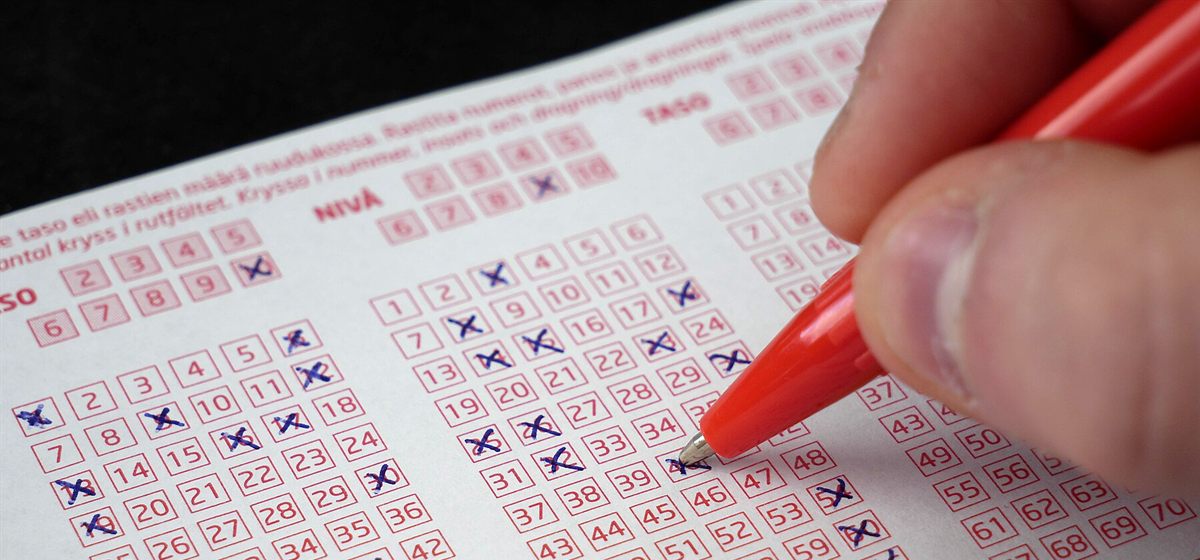
The keno strategy Canada players can actually use comes down to three things: choosing the number of picks with the best return, sizing bets to the game’s high house edge, and ignoring number patterns that do not exist. Keno returns far less than most casino games, so money management matters more than number choice. Licensed choices are on our online casinos for Canadian players list.
Below we use BCLC’s published Keno prize table to calculate the exact return for every pick size, then test money management with a 200,000-session simulation.
| Point | Keno in Canada |
|---|---|
| BC Keno (BCLC, WCLC) | 20 numbers drawn from 1 to 80 |
| Daily Keno (OLG), KENO Atlantic (ALC) | 20 numbers drawn from 1 to 70 |
| Best BC Keno return | Pick 5, at 67.17% by our calculation |
| Worst BC Keno return | Pick 1, at 50.00% |
| Online casino keno house edge | Around 25%, up to 40% (Betway) |
Is there a keno strategy that works?
No strategy changes which numbers are drawn, since every draw is random. A real keno strategy Canada players can use picks the bet type with the best return, keeps stakes small, and sets a budget before the first draw.
Betway calls keno a game of pure luck, with every draw independent from the last.
PokerNews says there is no guaranteed way to predict the next winning numbers.
Strategy in keno is about cost control, not prediction.
The sections below show which choices lower that cost and which ones only feel clever.
What happens in a keno draw?
You pick a set of numbers, choose your bet, and 20 numbers are drawn at random. The more of your numbers that match, the more you win. Every keno strategy Canada players follow starts with that simple rule.
BC Keno and WCLC Keno draw 20 numbers from 1 to 80.
OLG’s Daily Keno and ALC’s KENO Atlantic draw 20 numbers from 1 to 70.
Online casino keno usually draws 20 from 80, Betway says.
What pick sizes do Canadian keno games allow?
BCLC lets players choose 1 to 10 numbers, and OLG’s Daily Keno allows 2 to 10. Betway says online casino keno can allow up to 15. The pick size is the biggest choice in any keno strategy Canada players make.
Each pick size has its own prize table.
More picks mean bigger top prizes but longer odds.
Fewer picks mean smaller prizes but simpler targets.
Each lottery prints its pick options on the selection slip and online ticket screen.
Which pick size has the best return?
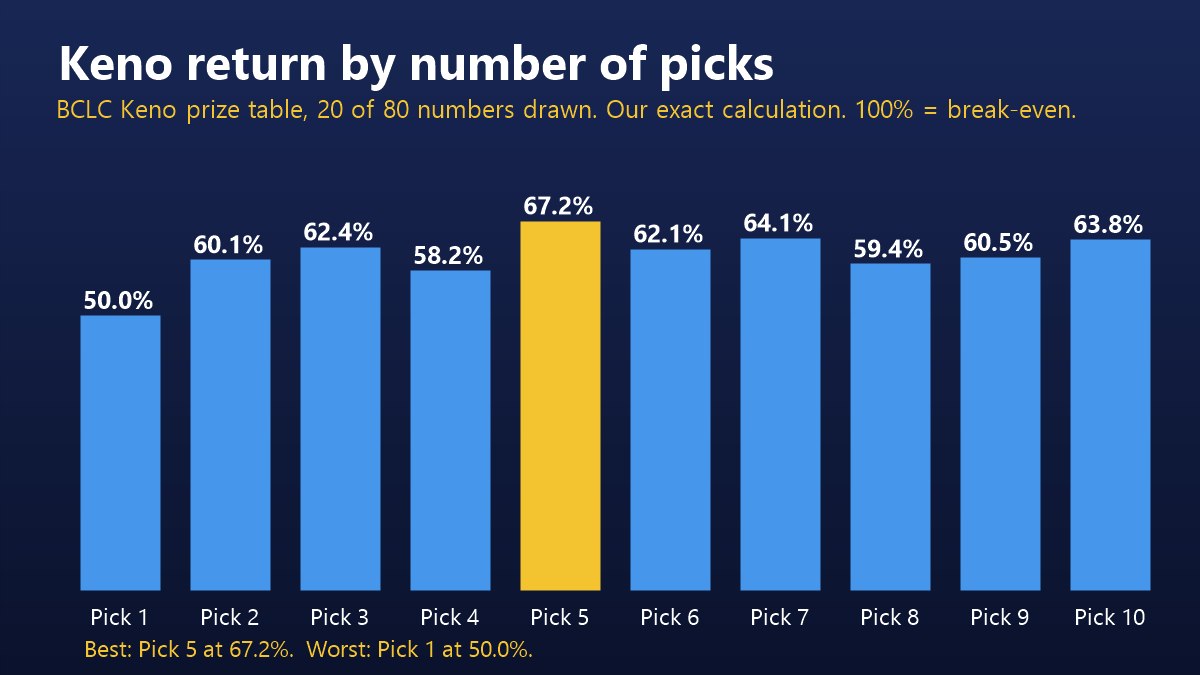
On BCLC’s prize table, Pick 5 returns the most, at 67.17% by our exact calculation. Pick 7 follows at 64.08% and Pick 10 at 63.84%. Pick 1 returns just 50%. That ranking is the core of a BC keno strategy Canada players can rely on.
| Pick | Return | Chance of any win |
|---|---|---|
| 1 | 50.00% | 1 in 4.0 |
| 2 | 60.13% | 1 in 16.6 |
| 3 | 62.44% | 1 in 6.6 |
| 4 | 58.20% | 1 in 3.9 |
| 5 | 67.17% | 1 in 10.3 |
| 6 | 62.08% | 1 in 6.2 |
| 7 | 64.08% | 1 in 4.2 |
| 8 | 59.37% | 1 in 9.8 |
| 9 | 60.54% | 1 in 6.5 |
| 10 | 63.84% | 1 in 9.1 |
We used BCLC’s prize table per 1 played and exact draw probabilities, the starting point for a keno strategy Canada players can trust.
How did we calculate the returns?
For each pick size, we multiplied each prize by the exact chance of each match count when 20 of 80 numbers are drawn, then added them up. That gives the long-run return per 1 bet in a keno strategy Canada players can check for themselves.
The chance of a given number of matches follows the hypergeometric formula.
The prize table comes from BCLC’s Keno game conditions.
Keno Bonus multipliers are not included in these figures.
Anyone with a spreadsheet can repeat the calculation from the published prize table.
What are the exact odds for each Pick 5 result?
On an 80-number draw, our calculation gives 5 matches 1 time in 1,551, 4 matches 1 in 82.7 and 3 matches 1 in 11.9. Fewer than 3 matches pay nothing. Those odds sit behind the Pick 5 keno strategy Canada players can use.
| Matches | Odds | BCLC prize per 1 |
|---|---|---|
| 5 | 1 in 1,551 | 500 |
| 4 | 1 in 82.7 | 15 |
| 3 | 1 in 11.9 | 2 |
| 0 to 2 | Most draws | 0 |
Zero matches comes up about 1 time in 4.4 on Pick 5.
What are the exact odds for each Pick 10 result?
Our calculation for 80 numbers gives 10 matches 1 in 8,911,711, 9 matches 1 in 163,381, 8 matches 1 in 7,385, 7 matches 1 in 621 and 6 matches 1 in 87. Five matches come 1 in 19.4. Those long odds shape the Pick 10 keno strategy Canada players chase.
Two or three matches are the most common results, at about 1 in 3.4 and 1 in 3.7.
Both pay nothing on BCLC’s table.
Zero matches, at 1 in 21.8, pays 3.
What does BCLC’s Keno pay?
BCLC’s table pays per 1 played. Pick 1 pays 2 for a match, Pick 5 pays 500 for five matches, and Pick 10 pays 200,000 for ten. Pick 10 also pays 3 for zero matches. The full table shapes every BC keno strategy Canada players use.
Pick 5 pays 500 for 5, 15 for 4 and 2 for 3.
Pick 7 pays 5,000 for 7, 150 for 6, 15 for 5, 2 for 4 and 1 for 3.
Pick 10 pays 200,000, 10,000, 500, 50, 10 and 3 for 10 down to 5 matches.
Why does Pick 4 win often but return less?
Pick 4 pays on 2, 3 or 4 matches, so it wins about 1 time in 3.9, the most often on BCLC’s table. But a 2-match win only returns the 1 staked. That push drags its return to 58.20% in any keno strategy Canada players compare.
Pick 4 pays 50 for 4 matches, 5 for 3 and 1 for 2.
Frequent pushes feel like wins but do not add profit.
Pick 5 wins less often but returns 9 points more.
What does each pick cost per draw?
At 1 per draw, Pick 1 costs about 0.50 on average, Pick 4 about 0.42, Pick 7 about 0.36 and Pick 5 about 0.33, from our return figures. Cost per draw is the clearest number in a keno strategy Canada players can plan around.
Multiply by the number of draws to see a session’s average cost.
Twenty Pick 5 draws cost about 6.57 on average.
Twenty Pick 1 draws cost about 10.
Why is Pick 1 the worst bet?
A single number matches 20 times in 80, or 25% of the time, and BCLC pays 2 for a match. That returns exactly 50% of every bet. The simplest bet is the most expensive in any keno strategy Canada players compare.
PokerNews notes that one number hits 20 times in 80.
Paying 2 on a 1-in-4 chance halves your money over time.
In our test, no 100-draw Pick 1 session ended ahead.
How large is the keno house edge?
On BCLC’s table, the house keeps 32.8% to 50% depending on the pick. Betway says online casino keno edges run around 25% and up to 40%. The Gambler’s Edge says house percentage is normally about 30%. High edges define every keno strategy Canada players need.
Compare that with 2.70% on European roulette.
Lottery-style keno funds prizes and provincial programs, which raises the edge.
Online casino keno can return more than lottery keno, so check the game’s RTP.
How does keno compare with other casino games on cost?
Keno is among the most expensive games. On BCLC’s table it keeps 32.8% to 50% of each bet, against 2.70% on European roulette and about 4% on a typical slot. That gap explains why budgeting sits at the centre of any keno strategy Canada players follow.
A 1 bet on Pick 5 costs about 0.33 on average.
The same 1 on European red costs about 0.03.
Players choose keno for the big prizes and the simple play, not the value.
Is keno a good long-run game?
No. Over long play, the high edge drains any bankroll. Keno suits short, low-stakes sessions with a fixed budget. A realistic keno strategy Canada players can use treats the game as occasional entertainment.
Play a set number of draws, then stop.
Avoid open-ended sessions on fast online keno.
Track the time and money keno takes over a month.
How do lottery keno and casino keno differ?
Lottery keno, such as BCLC Keno, OLG Daily Keno and KENO Atlantic, runs on fixed draw schedules with fixed prize tables. Online casino keno draws on demand with its own pay table. The right keno strategy Canada players choose depends on which type they play.
OLG’s Daily Keno draws twice a day, after 2 p.m. and 10:30 p.m. Eastern.
KENO Atlantic draws nightly at 11:29:59 p.m. Atlantic time.
BCLC runs draws through a Draw Day from 4:30 a.m. Pacific Time.
How do the odds change with 70 numbers instead of 80?
With 70 numbers, matching all your picks is far easier. Matching all 10 of 10 is 1 in 2,147,181 on a 70-number game, against 1 in 8,911,711 on an 80-number game, by our calculation. The pool size changes every keno strategy Canada players build.
| Pick | Match all, 70 numbers | Match all, 80 numbers |
|---|---|---|
| 2 | 1 in 13 | 1 in 17 |
| 4 | 1 in 189 | 1 in 326 |
| 6 | 1 in 3,383 | 1 in 7,753 |
| 8 | 1 in 74,941 | 1 in 230,115 |
| 10 | 1 in 2,147,181 | 1 in 8,911,711 |
Our 70-number figures match the odds ALC publishes for KENO Atlantic.
What does KENO Atlantic pay?
ALC lists top prizes per 1 wagered: 7 for 2 of 2, 25 for 3 of 3, 75 for 4 of 4, 250 for 5 of 5, 1,000 for 6 of 6, up to 250,000 for 10 of 10. Those top lines anchor any Atlantic keno strategy Canada players use.
ALC lists the 10-of-10 odds at 1 in 2,147,181.
It reserves the right to cap total prizes at 3 million per draw.
If the cap is reached, prizes are shared in proportion.
What does OLG’s Daily Keno offer?
OLG’s Daily Keno lets you pick 2 to 10 numbers from 1 to 70, bet 1, 2, 5 or 10, and play 1 to 10 draws. OLG says players can win from 2 to 2.5 million. It is Ontario’s lottery version of the keno strategy Canada players discuss.
Draws use a random number generator, OLG says.
You can add Encore to a Daily Keno ticket.
Quick Pick lets the terminal choose your numbers.
Does a bigger bet change the odds?
No. A 10 bet has exactly the same chance of matching as a 1 bet; it only multiplies the prizes. BCLC’s table pays per 1 played, so bigger bets scale both wins and losses in any keno strategy Canada players use.
The return percentage stays the same at every stake.
Prize caps can cut the very top prizes at high stakes.
Bet size is a budget choice, not an odds choice.
How do provincial prize tables compare?
They differ. BCLC’s 80-number Pick 2 pays 10 per 1 and returns about 60.1%. KENO Atlantic’s 70-number 2-spot pays 7 per 1 for 2 of 2, which works out to about 55.1% if that is its only 2-spot prize. Compare tables as part of the keno strategy Canada players use in each province.
A smaller number pool raises the odds but often lowers the prizes.
Read each lottery’s prize structure before you choose a pick size.
The best pick on one table is not always the best on another.
Do hot and cold numbers help?
No. PokerNews explains that hot numbers have come up often and cold numbers rarely, but each number has an equal chance in every draw. Chasing either is not a keno strategy Canada players can profit from.
PokerNews says the most often drawn numbers differ by game, such as German Keno and Washington Lottery Keno.
Those differences come from random variation, not from any lasting bias.
Past draws have no memory.
A number that has not come up for a week has the same chance as any other in the next draw.
Do patterns or lucky numbers work?
No. Birthdays, lucky 7s and board patterns all have the same odds as any other set. PokerNews says numerology has no scientific support. Picking numbers that feel meaningful is fine for fun, but it is not a keno strategy Canada players can win with.
The Toronto Star notes that certain players use birthdays or play the same numbers every draw.
Any set of 5 numbers has the same chance as any other set of 5.
Quick Pick is as good as a hand-picked set.
Is playing the same numbers every draw a strategy?
It is a habit, not an edge. The Toronto Star says certain players repeat their numbers, expecting hits eventually. The odds are the same each draw. As a keno strategy Canada players use, it only saves time.
Repeating numbers does not make them due.
Missing a draw on your numbers does not cost you anything.
Multi-draw tickets make repeat play simple.
Repeat play can also make spending less visible, so track it.
Do betting systems work in keno?
No. Systems such as doubling after a loss only raise the stakes against an edge of 30% or more. Betway advises small stakes for long-term keno play. Progressions turn a keno strategy Canada players use into faster losses.
A 32.8% edge eats a doubling system quickly.
Keno losing runs can last dozens of draws.
Our Hollandish betting system page shows how progressions fare even at a 2.70% edge.
What did our money management test show?
We simulated 200,000 sessions of 100 draws at 1 per draw on BCLC’s table. Average losses were 50 on Pick 1, 41.88 on Pick 4, 35.32 on Pick 7 and 35.63 on Pick 10. Session results guide the keno strategy Canada players can follow.
| Pick | Average result per 100 draws | Sessions ending ahead |
|---|---|---|
| 1 | -50.00 | 0.0% |
| 4 | -41.88 | 8.7% |
| 7 | -35.32 | 7.4% |
| 10 | -35.63 | 5.4% |
Each session started with a 100 budget and wagered 100 in total, a fair test of the keno strategy Canada players use most.
Why do most sessions end behind?
With returns of 50% to 67%, the expected loss over 100 draws is 33 to 50 units. Only a rare large hit pulls a session into profit. In our test, fewer than 1 session in 11 ended ahead under any keno strategy Canada players can pick.
Pick 4 had the most winning sessions, at 8.7%.
Pick 10 had the fewest winners but the biggest single result.
The best Pick 10 session won 199,954, from one 10-of-10 hit.
How do you set a keno budget?
Decide what you can afford to lose, divide it by your bet, and treat that as the number of draws you will play. Expect to lose a third to a half of everything wagered over time. That is the backbone of a sound keno strategy Canada players can stick to.
A 50 budget at 1 a draw covers 50 draws.
At a 35% average loss, those 50 draws cost about 17.50 over time.
Set the budget before you buy the first ticket, the first rule of any keno strategy Canada players follow.
What bet size makes sense?
The smallest stake that keeps the game fun. Betway recommends small stakes for long-term keno play. Lottery keno starts at 1 per draw at BCLC, WCLC, OLG and ALC. Small bets are the safest keno strategy Canada players can use.
BCLC’s maximum Keno wager is 100 per selection.
Higher bets raise prizes in proportion but not the return.
A 10 bet loses ten times as fast as a 1 bet.
What draw count suits a session?
Fewer draws mean smaller losses. Every extra draw adds about a third of your bet in expected cost. Pick a draw count that fits your budget as part of your keno strategy Canada players can plan ahead.
OLG’s Daily Keno allows 1 to 10 draws per ticket.
BCLC and WCLC allow up to 99 draws per ticket.
Long multi-draw tickets lock in spending up front.
Is it better to chase the top prize or small wins?
On BCLC’s table, Pick 5 offers the best return, Pick 4 the most frequent wins, and Pick 10 the biggest prize. Match the pick to your goal. That choice is the main lever in a keno strategy Canada players control.
Pick 4 wins about 1 time in 3.9.
Pick 10 wins about 1 time in 9.1, mostly small prizes.
Pick 5 balances return and prize size.
Your goal decides the pick, but Pick 5 gives the best value on BCLC’s table.
What is Keno Pattern Play?
BCLC’s Keno Pattern Play costs 2 per play and pays by the count of drawn numbers inside your pattern, from 50,000 for 20 or 0 down to 3 for 13 or 7. It is a twist on the keno strategy Canada players know.
If the pattern covers half the board, as its symmetric prize table suggests, our calculation puts its return near 69.8%.
Pattern Play is not available on PlayNow.com, BCLC says.
Keno Bonus cannot be added to Pattern Play.
Ten of 20 inside a half-board pattern happens about 1 time in 4.9 and pays nothing.
What is the Keno Bonus multiplier?
BCLC’s Keno Bonus costs an extra amount per draw and multiplies Keno prizes by a drawn multiplier of 1.5x, 2x, 5x, 7x or 10x. Whether it is worth adding depends on the multiplier odds, which BCLC sets. Weigh its cost in any BC keno strategy Canada players use.
Keno Bonus is not available on Keno Pattern Play.
The maximum Keno Bonus wager is 100.
Raised prize caps apply when Keno Bonus is played.
What are Keno Doubler and Tripler?
BCLC says Keno Doubler and Keno Tripler are free promotions that can randomly double or triple a winning prize during set periods. They cost nothing extra, so they slightly improve the return when running. Watch for them in your BC keno strategy Canada players can time.
BCLC says the designation alone does not mean a win.
Keno Doubler is not available on PlayNow.com, BCLC says.
They only run during temporary promotion periods.
What is the Pick 10 zero-match prize?
BCLC pays 3 per 1 played if none of your 10 numbers is drawn. That happens about 1 time in 21.8 on an 80-number draw, by our calculation. It softens the worst result in a Pick 10 keno strategy Canada players use.
The zero-match prize is part of why Pick 10 returns 63.84%.
WCLC’s game conditions also list a zero-match win on 10 Pick.
It is a small consolation, not a profit plan.
Are there prize caps?
Yes. WCLC caps any one ticket at 100,000 per draw, BCLC caps Keno prizes at 200,000 per draw before Keno Bonus, and ALC can cap total prizes at 3 million per draw. Caps limit the upside of any keno strategy Canada players use.
BCLC raises the caps when Keno Bonus or Doubler is in play.
Shared caps mean big prizes can be split in rare draws.
Read the game conditions for your province.
How long between top prizes?
On OLG’s twice-daily Daily Keno, which draws from 70 numbers, matching all 5 of 5 happens about 1 time in 781 by our calculation, or roughly once every 390 days of two draws. Top prizes are rare in any keno strategy Canada players follow.
On an 80-number draw, 5 of 5 takes about 1,551 draws on average.
10 of 10 is far rarer on either game.
Most results are partial matches or none.
What is a simple starter plan?
Pick a regulated game, choose the pick size with the best return on its table, bet the minimum, and set a fixed number of draws. On BCLC’s table, Pick 5 at 1 per draw for 20 draws is a sensible start. That is a practical keno strategy Canada players can begin with.
- Choose a provincial or licensed game.
- Read its prize table.
- Pick the size with the best return.
- Bet the minimum stake.
- Stop after your planned draws.
Use Quick Pick if choosing numbers feels like a chore.
Do Quick Picks win less often?
No. A Quick Pick set has the same odds as numbers you choose yourself, since every number has an equal chance. OLG and BCLC both offer Quick Pick. It is a neutral choice in the keno strategy Canada players use.
Quick Pick can stop you from choosing numbers based on myths.
It also speeds up buying multi-draw tickets.
Hand-picked numbers are fine if you enjoy choosing.
How do multi-draw tickets affect your budget?
They lock in spending up front. A 10-draw ticket at 1 on Pick 5 commits 10 and costs about 3.28 on average. Plan multi-draw tickets inside your keno strategy Canada players set before buying.
OLG allows up to 10 draws, and BCLC and WCLC up to 99.
Long tickets are easy to forget about.
Mark the end date of a long ticket so you know when spending stops.
Check results on each draw, not just at the end.
How does online casino keno compare?
Betway describes online keno where you pick 1 to 15 numbers from 80, with pay tables that vary by game. Certain versions add progressive jackpots. Check the RTP before applying any keno strategy Canada players use online.
Betway says online keno edges run about 25% to 40%.
Progressive jackpot versions can offer a slightly better return when the jackpot is large, Betway says.
Draws happen on demand, so play is faster.
Does faster online keno cost more?
Yes, per hour. Online keno can draw as fast as you click, while lottery keno runs on a schedule. At the same edge, more draws per hour mean more loss per hour in any keno strategy Canada players follow.
A 30% edge on 60 draws of 1 costs about 18 an hour.
The same edge on 300 draws costs about 90.
Slow play is the cheapest keno strategy Canada players have.
What are the origins of keno?
The Toronto Star says keno began in China more than 2,000 years ago as baige piao, played with 80 characters from The Book of a Thousand Characters. Chinese immigrants brought it to North America. The history explains the 80-number grid behind every keno strategy Canada players use.
The name keno comes from the French quine, meaning a group of five, the Star says.
Numbers replaced characters in the early Chinese lottery in North America.
The Star says baige piao also inspired bingo and modern lotteries.
Which Canadian lotteries run keno?
Provincial lotteries run keno: BCLC in British Columbia, WCLC in the Prairies, OLG in Ontario and ALC in Atlantic Canada. Licensed online casinos also offer casino keno. Pick a regulated option for any keno strategy Canada players follow.
BCLC Keno is also available on PlayNow.com.
OLG.ca sells Daily Keno online and at retailers.
Our page on online keno, bingo and scratch cards covers the wider game family.
What is the minimum age for keno?
OLG says players must be at least 18 for lottery games and 19 for online casino games in Ontario. Other provinces set their own ages. Check the rules before applying any keno strategy Canada players use.
Lottery keno is a lottery product in most provinces.
Casino keno follows casino age rules.
Licensed sites verify age before play.
Are keno draws random?
Yes. OLG says its Daily Keno numbers are drawn by random number generator, and WCLC says its numbers are selected at random. No keno strategy Canada players use can predict a random draw.
Betway says each draw is independent from the last.
Patterns seen in past results are coincidence.
Provincial lotteries publish their game conditions and prize structures for anyone to check.
Our page on casino random number generators explains how draws are tested.
Does a winning streak mean you are on a roll?
No. Each draw is independent, so a run of wins says nothing about the next draw. Treat a win as a chance to bank money, not a sign to raise stakes. That discipline belongs in every keno strategy Canada players follow.
Raising bets after wins feeds the edge faster.
Setting a win goal helps you leave while ahead.
Bank part of any large prize straight away.
When is it time to stop?
Stop when you reach your loss limit, your planned number of draws or your win goal, whichever comes first. Decide all three before you play. Clear stop points are the strongest keno strategy Canada players can adopt.
Never extend a session to win back losses.
Take a break after any big win.
If stopping feels hard, use account limits to enforce it.
Which mistakes cost keno players the most?
The costliest mistakes are playing Pick 1, chasing hot numbers, raising stakes after losses and buying long multi-draw tickets without a budget. Avoiding them is the most effective keno strategy Canada players have.
- Playing the lowest-return pick sizes.
- Believing a number is due.
- Doubling bets after losses.
- Locking in long runs of draws without a plan.
- Ignoring the prize table before playing.
Each one raises cost without raising your odds.
Fixing even one of them lowers the average cost of every session.
Which tools keep keno spending in check?
Deposit caps, loss caps, time reminders and self-exclusion all help, online and in lottery accounts. Keno’s high edge makes limits the most important part of a keno strategy Canada players follow.
OLG.ca offers its My PlayBreak tool for Ontario players.
Our page on gambling limits online shows the set-up steps.
ConnexOntario offers free help at 1-866-531-2600.
What is the best keno strategy overall?
Choose the pick size with the best return on your game’s table, bet small, set a draw budget, and ignore number patterns. On BCLC’s table, that means Pick 5. That is the most honest keno strategy Canada players can use.
Expect to lose about a third of what you wager over time.
Treat any big hit as a bonus, never as the plan.
Keep keno as a small part of your entertainment budget.
Stop when the budget is gone, every time.
Come back another day with a fresh budget if you still enjoy the game.
1 thought on “Keno Strategy Canada: Best Picks, Real Returns and Money Management”