

Viking slots are the theme where studios compete on the ceiling rather than on a mechanic. Where Egyptian titles share a book round and pirate titles share a collection round, Viking releases share only an appetite for enormous maximum wins. For the wider market picture, start at our Canadian online casino hub.
The table below sets out what the shelf actually delivers. Read it first, then work through the detail beneath.
| Trait | What it means |
|---|---|
| Shared trait | Large advertised maximum wins rather than one mechanic |
| Signature family | The Vikings Go series from Yggdrasil |
| Common features | Rage meters, sticky wilds and expanding grids |
| Return range | Roughly 94 to 96.5 percent |
| Volatility | High on most of the shelf |
| Jackpots | Rare, the ceiling is usually a fixed cap |
h
p
What are Viking slots?
Viking slots are titles built around Norse seafaring and mythology, using longships, axes, runes, ravens and horned warriors as symbols.
Viking slots span every studio serving Canada.
The setting behind Viking slots is public domain. That matters commercially.
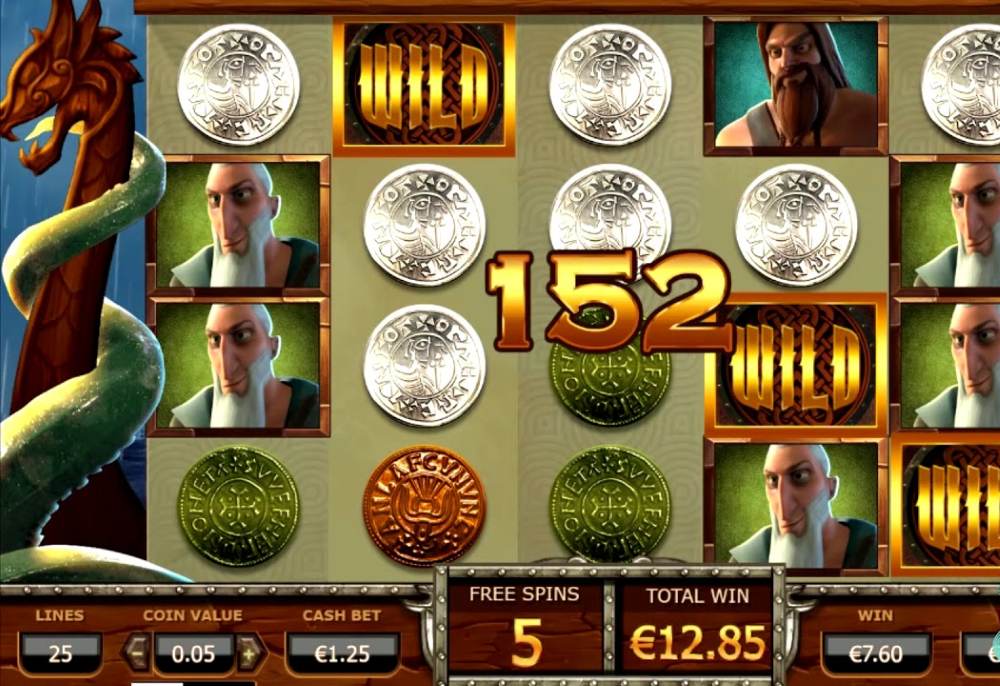
The symbol vocabulary is tight and instantly readable. A longship under a grey sky, a double headed axe, a round shield, a raven, a carved rune stone and a bearded warrior fill the high rows, with card royals cut into wood or stone beneath them.
Norse mythology sits in the public domain, which matters more commercially than it sounds. A studio building Viking slots pays no licence fee, needs no approval from a rights holder and can ship the same art into every regulated market it serves.
That freedom is why the Viking slots shelf is so crowded. Every major studio holds at least one Viking slot, and the long tail beneath them runs to hundreds of releases across Canadian lobbies.
Canadian lobbies carry the full spread under one filter. A player selecting the Viking tag on an Ontario registered site will see rage meter builds, cluster grids and Megaways conversions listed together, sorted by popularity rather than by structure. Reading the rules screen on two or three candidates separates them faster than the lobby ever will.
Why do Viking slots advertise such large maximum wins?
Because the theme attracts a high variance audience and studios build to it. A Norse raid reads as violent and decisive, so a title promising a very large ceiling fits the artwork rather than contradicting it.
The ceiling on Viking slots is funded by a harsh base game. Nothing is free.
The audience and the artwork point the same way. A raid is decisive by nature, so a title promising a very large ceiling matches the presentation rather than fighting it, and players drawn to the theme tend to be the same players drawn to high variance builds.
Studios compete on that number directly. Where an Egyptian release competes on how the book round feels and a pirate release competes on the collection grid, Viking slots compete on the figure printed on the specification sheet.
The funding is the part the marketing leaves out. A ceiling several thousand times the stake has to be paid for from ordinary play, which means longer flat stretches and a thinner base game than a modest cap would require.
Do Viking slots share one mechanic?
No. Rage meters, sticky wilds, expanding grids, cluster payouts and hold and respin rounds all appear under the same artwork, which makes Viking slots impossible to read from a thumbnail.
What Viking slots share is the ceiling. The route to it varies.
Viking slots never converged and it shows in how differently two titles play. A rage meter build progresses characters across a free spins round, a cluster grid pays on touching groups, and a Megaways conversion recounts the ways on every spin.
Hold and respin rounds appear as well, borrowed from the collection shelf rather than developed here. Sticky wilds, expanding grids and symbol upgrades all show up under the same longship artwork.
The practical consequence is that a thumbnail predicts almost nothing. A Canadian player who enjoyed one of these Viking slots cannot assume the next one runs anything like it, which makes the rules screen unavoidable.
Which Viking slots are the best known?
The Vikings Go series from Yggdrasil leads, followed by Viking Runecraft from Play n GO, Vikings Unleashed Megaways from Blueprint and Ozwin Jackpots from Yggdrasil.
Availability varies by operator. The Viking slots shortlist is stable.
The Yggdrasil family anchors Viking slots. Vikings Go Berzerk, Vikings Go Wild and Vikings Go To Hell share a character progression structure that no rival copied closely, and all three appear across Canadian lobbies.
Viking Runecraft from Play n GO is the strongest alternative shape, running a cluster grid with an ascending level structure rather than conventional reels. Vikings Unleashed Megaways from Blueprint represents the engine conversions.
Beneath that tier sit hundreds of releases. Return figures across them vary more than the artwork suggests, which is the usual pattern on a crowded shelf and the usual reason to open the rules screen.
What is the Vikings Go series?
A Yggdrasil family built around four named warriors who fill rage meters as they win. A full meter turns that warrior into a sticky wild for the remainder of the free spins round.
Character progression is unusual across Viking slots. It defines the family.
Yggdrasil built the family around four named warriors who sit beside the reels rather than on them. Each has a rage meter that fills when that character takes part in a winning combination, and a full meter promotes the character for the rest of the round.
Promotion turns a warrior into a sticky wild or a multiplier symbol depending on the title. Because the meters carry across spins inside the feature, a long free spins round can end with three characters promoted at once.
That progression is the reason the family stands apart from the rest of the Viking slots shelf. Most Viking slots deliver their outcome through a single feature, and these deliver it through a sequence that builds while the round runs.
What is a rage meter?
A counter beside each character symbol that fills when that character participates in a win. Filling it promotes the character, usually into a sticky wild or a multiplier symbol for the rest of the round.
Progress carries across spins inside a Viking slots feature. It resets afterwards.
The meter is a simple counter with a visible bar. Each time the attached character participates in a win the bar advances, and filling it triggers the promotion the title states in its rules screen.
Progress persists inside the feature and resets when it ends. A round that runs long enough to fill two or three meters produces a very different outcome from one that fills none, and that variance is where the ceiling on these Viking slots lives.
Nothing a player does influences the rate. The meters fill from certified random outcomes exactly as every other element of the build does, and the visible progress is presentation rather than control.
What return figures do Viking slots publish?
Most sit between 94 and 96.5 percent. High variance builds cluster near the middle of that band, and the figure is unrelated to the advertised maximum win on any of them.
The rules screen states the deployed figure. A large ceiling does not raise it.
The band is narrower than the maximum win figures suggest. Major releases cluster near 96 percent and the long tail sits lower, with Viking slots falling inside the same range every other theme occupies.
The advertised ceiling has no relationship to the published percentage. A title capping at twenty thousand times the stake and one capping at two thousand can publish identical return figures, because the ceiling describes the shape of the tail rather than the total returned.
Reading the running client settles it. On a Canadian regulated site the deployed figure is stated inside the game, and it is the only number describing what a session actually costs.
How volatile are Viking slots?
High across most of the shelf, and that follows directly from the ceilings. A title advertising a very large maximum has to remove value from ordinary play to fund the rare outcome that reaches it.
A handful of Viking slots run medium. They advertise smaller ceilings.
High variance is the Viking slots default and the ceilings explain why. Removing value from ordinary play is the only way to fund a rare enormous outcome, so the base game on most Viking slots pays less often and less generously than a medium build would.
The session shape follows directly. Long stretches of small returns and nothing at all, broken occasionally by a feature that either lands modestly or produces a result that carries an entire session.
A handful of titles run medium and they advertise smaller ceilings to match. The volatility rating in the rules screen separates the two groups in one line, and it predicts the next hour far better than the artwork does.
Matching a bankroll to that rating is the practical response. A balance sized for two hundred spins suits the medium rated Viking slots on a lobby and does not suit the headline titles, because those are designed around outcomes a two hundred spin session will almost never reach. The rating sits in one line of the rules screen and costs nothing to read.
Do Viking slots have progressive jackpots?
Rarely. The shelf sells a fixed maximum win rather than a shared pool, because a large advertised cap already gives the marketing what a progressive would provide.
Ozwin Jackpots is the notable exception. Most Viking slots carry none.
Viking slots sell a fixed ceiling instead, and commercially that works just as well. A large advertised maximum gives the marketing the same headline a progressive would provide without the pool contribution that lowers the base return.
Where a progressive does appear it usually sits alongside the main feature rather than inside it. A separate jackpot trigger or wheel runs independently, and the contribution comes out of the base game in the usual way.
For most Canadian players the stated cap is the relevant ceiling. It is reached through the feature rather than through a separate event, and it is stated in the rules screen in a single line.
The absence is worth noting when comparing across themes. A Canadian player moving from a jackpot linked shelf to Viking slots is moving to builds that keep their whole certified return inside ordinary play and the feature, with nothing diverted to a shared pool. That usually shows up as a slightly higher published figure for equivalent volatility, which is a real advantage the marketing never mentions.
Where can Canadians play Viking slots?
Ontario registered operators carry the full shelf, and provincial crown platforms carry a curated selection. Ontario Lottery and Gaming lists Viking Fury Spinfinity in its own catalogue.
The certified build behind Viking slots is identical in both. The return version can differ.
Ontario registered operators carry the deepest selection. Yggdrasil, Play n GO, Blueprint and NetEnt all hold supplier registration, so the major Viking slots appear as certified builds with the return figure stated inside each one.
Provincial crown platforms carry a curated subset. Ontario Lottery and Gaming lists Viking Fury Spinfinity in its own catalogue, and the other provincial operators each run smaller selections shaped by their supplier agreements.
The certified package is identical wherever it is deployed. What differs is which return version an operator selected and how deep the catalogue runs, and both are visible from inside the running game.
Which studios build Viking slots?
Yggdrasil owns the strongest family, with Play n GO, Blueprint, NetEnt, Pragmatic Play and Nolimit City all holding recognisable titles.
The theme is free to use, so every studio has one.
No licence is required for Norse mythology. That is why Viking slots are so crowded.
Yggdrasil owns the strongest family and has extended it steadily. Play n GO built the most original alternative in Viking Runecraft, and Blueprint holds the Megaways conversions that reach the widest Canadian distribution.
NetEnt, Pragmatic Play, Nolimit City and Thunderkick all hold recognisable titles, and dozens of smaller studios fill the long tail. The absence of any licence requirement is the reason the shelf is so evenly spread.
Studio origin predicts the feature structure reasonably well. It predicts nothing about the certified return figure, which varies more inside a studio catalogue than between studios.
Filtering by studio is the fastest way to narrow a crowded shelf. Filtering to Yggdrasil returns the rage meter family, filtering to Play n GO returns the cluster builds, and filtering to Blueprint returns the Megaways conversions. That single control separates the structures behind Viking slots faster than reading thumbnails ever will.
Do Viking slots use the same symbols every time?
Close to it. A longship, an axe, a shield, a raven, a rune stone and a horned warrior appear across most Viking slots, above card royals carved into wood or stone.
Recognition drives that repetition across Viking slots. Studios rarely depart from it.
The core set barely moves. A longship, an axe, a shield, a raven, a rune stone and a horned warrior appear across most Viking slots, and the low rows are almost always card royals carved into wood or stone.
Studios treat that consistency as an asset rather than a limitation. A player scanning a lobby recognises a Viking slot instantly, which is the entire purpose of a thumbnail, and departing from the vocabulary would cost more than it gained.
Variation sits in the peripheral symbols and the character design. Wolves, dragons, mead horns, longhouses and named gods fill out individual builds without changing what the feature underneath actually does.
Are Viking slots suitable for a small bankroll?
Mostly not. A high variance build funding a very large ceiling produces long stretches with nothing, and a small balance frequently ends before the feature that carries the return arrives.
Lowering the stake is the honest adjustment on Viking slots. The reward scales down with it.
The arithmetic is unforgiving on a high variance shelf. A title concentrating its return inside a feature that opens once in several hundred spins needs enough balance to reach that feature more than once, and a modest bankroll frequently runs out first.
Lowering the stake is the honest adjustment rather than choosing differently. Running at the lobby minimum extends the session enough to reach the feature, and the reward scales down proportionally, which is the trade the structure demands.
The alternative is choosing within Viking slots. The medium variance Viking slots advertising smaller ceilings pay more often and suit a small balance considerably better than the headline titles do.
How do Viking slots differ from each other?
By feature structure and by ceiling. One title runs rage meters across a free spins round, another runs a cluster grid with an expanding board, and a third runs a Megaways engine with a fixed cap several times higher.
Viking slots hide all of it behind the artwork. The rules screen states it.
Feature structure is the first axis and the largest. Rage meters, cluster grids, Megaways engines and hold and respin rounds produce four genuinely different session shapes, and all four appear across Viking slots under similar artwork.
The stated ceiling is the second. A cap of twenty thousand times the stake and a cap of two thousand describe very different tail behaviour even where the published return figures match exactly.
Grid format is the third. Five reel payline builds, six reel ways engines and square cluster grids all wear Norse art, and the route count changes the rhythm of the base game entirely.
What should you check before playing a Viking slot?
Three things in the rules screen. The published return figure, the stated maximum win, and which feature the title actually carries.
On Viking slots the ceiling is the least useful of the three. Read it last.
The return figure comes first because it is the only number describing cost. Two Viking slots on the same lobby can differ by more than two percentage points, which outweighs every difference in presentation over a session.
The feature comes second and it matters more here than on most shelves. Knowing whether a title runs rage meters, a cluster grid or a Megaways engine is the difference between an accurate expectation and a mistaken one.
The ceiling comes third and it is the least useful of the three. A very large stated maximum describes a rare outcome rather than a likely one, and reading it first is how players end up on the harshest builds in the catalogue.
Which slot pages are worth reading next?
A theme sits on top of a mechanic, a scoring rule and a published return figure. The pages below cover the parts of a slot that a longship thumbnail never tells you anything about.
- The engine behind the six reel conversions
- The grid Viking Runecraft runs on
- What a sticky wild actually changes
- The shelf that did converge on one mechanic
- Titles with the strongest published return figures
Viking slots sell a number rather than a mechanic, and the number is the part least worth trusting. Read the published return figure and the feature rules before the first spin, and the advertised ceiling becomes what it always was, which is a description of the rarest outcome the build can produce. The shelf rewards a reader more than most, because two longships on the same lobby page can hide a rage meter round and a cluster grid behind identical artwork.