
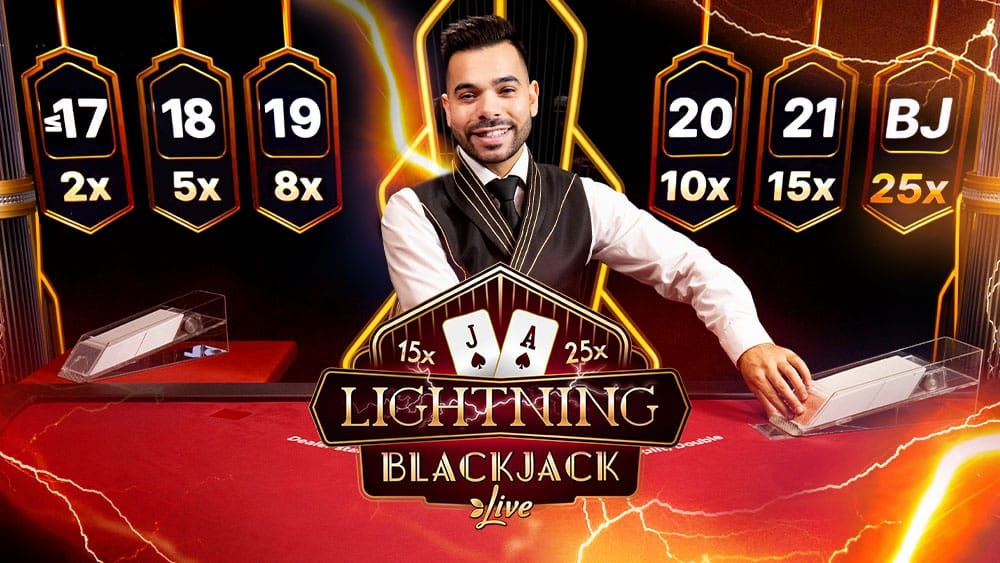
Lightning blackjack live is Evolution’s blackjack table with multipliers from 2x to 25x. A winning hand earns a multiplier that boosts the next winning hand, and a 100% Lightning Fee on every initial bet pays for it. The cards underneath are standard eight-deck blackjack. For the wider market picture, start at our online casino Canada hub.
The table sets out the lightning blackjack live numbers a Canadian player checks first. Each line traces to a source named in the sections below.
| Trait | Detail |
|---|---|
| Provider | Evolution |
| Seats | Unlimited; one shared deal |
| Decks | 8 |
| Dealer | Stands on soft 17 |
| Lightning Fee | 100% of each initial bet |
| Multipliers | 2x, 5x, 8x, 10x, 15x, 20x or 25x on the next win |
| RTP | 99.56% with optimal play, per BlackjackInfo |
| Limits | $1 to $2,500, per BlackjackInfo |
What is lightning blackjack live?
Lightning blackjack live is Evolution’s multiplier version of live blackjack. Every winning hand earns a random multiplier between 2x and 25x, and that multiplier boosts the payout if the player wins again in the next round.
Evolution describes it as classic blackjack electrified with RNG-based Lightning multipliers, and says that in this game the multiplier depends on the winning player’s score.
BlackjackInfo sums up the structure: standard eight-deck blackjack with win multipliers from 2x to 25x, paid for by a mandatory 100% Lightning Fee on every bet.

Who makes Lightning Blackjack?
Evolution makes lightning blackjack live. Its launch release called the game the latest addition to the award-winning Lightning series, available from the first day in both Live and First Person versions.
Todd Haushalter, Evolution’s Chief Product Officer, said it was high time the Lightning brand came to blackjack, and that the studio was careful to preserve the true essence of the game while adding multipliers.
BlackjackInfo says the lightning blackjack live table streams from Evolution’s studio in Riga, Latvia, with English-speaking dealers.
How does a round work?
A lightning blackjack live round takes bets and fees first, then a standard deal. Evolution says that once betting closes, the dealer deals one card face-up to every player and one to the dealer, then a second card face-up to every player and a face-down card to the dealer.
The multipliers appear before the play. Bally Casino says Lightning multipliers are displayed after the bets close for every winning hand result, so a player can see what each final score would earn.
The hand then plays as normal blackjack. Players hit, stand, double or split, the dealer completes the hand, and every winning score earns the multiplier shown against it.
How are multipliers awarded?
Lightning blackjack live multipliers follow the score the winning hand finishes on. Bally lists six score bands: 17 and below, 18, 19, 20, 21 and blackjack, each carrying its own random multiplier for the round.
Evolution’s rules name the values: a winning score always earns a multiplier of 2x, 5x, 8x, 10x, 15x, 20x or 25x.
Evolution’s own footage shows the boards above the table, with each score band lit and a multiplier printed beneath it, such as 2x on 17, 5x on 18 and 20x on blackjack in one round.
When is a multiplier paid?
A lightning blackjack live multiplier pays on the next winning hand, not the current one. Evolution says the multiplier is saved for the next game round, and the payout is increased by that multiplier if the player wins that next round.
BlackjackInfo puts the rule plainly: use it or lose it. Win the next hand and the stored multiplier pays; lose it and the multiplier expires unused.
That two-step structure is the heart of lightning blackjack live. The first win earns the multiplier, and the second win cashes it.
How is each multiplier chosen?
Lightning blackjack live multipliers are drawn at random, for each score band, every round. Evolution calls them RNG-based Lightning multipliers, and BlackjackInfo says they are drawn by a certified random number generator.
The draw happens before the play. Bally says the multipliers appear once the bets close, so the values on the six score boards are fixed before any player decides to hit or stand.
Nothing a player does changes those values. A lightning blackjack live hand that finishes on 19 earns whatever the 19 board showed at the start of that round.
What does a 17-and-below win mean?
In lightning blackjack live, it covers any winning total from 17 down. Bally lists 17 and below as a single band, so a hand that wins on 13 because the dealer busts earns the same multiplier as one that wins on 17.
BlackjackInfo describes the same range from the other end, saying every winning total from 17 to blackjack earns a multiplier that is locked in on the win.
Low totals win mainly on dealer busts. The band still carries its own multiplier each round, and that multiplier still waits for the next winning hand.
What is the 100% Lightning Fee?
The lightning blackjack live fee is an extra charge equal to the initial bet. Evolution says a 100% Lightning Fee is added to each initial bet in a round, and that the fee is visible in the game’s interface.
BlackjackInfo puts it in dollars: a $1 minimum seat costs $2 per round, and a $10 bet costs $20.
The fee cannot be declined. BlackjackInfo notes that it funds the multipliers, and that a player who does not want to pay it has to play a classic table instead.
Where does the fee show on screen?
Beside the bet in the betting circle. Evolution says the 100% Lightning Fee is visible in the game’s interface, so the full cost of the round is on screen before the cards come out.
The total bet counter reflects it too. A player who places $10 sees $20 committed once the fee is added, which is the number to watch against a budget.
Doubles and splits add only the extra stake, since no fee applies to them. The counter on a lightning blackjack live table therefore rises by the stake alone when a hand is doubled.
Is the fee charged on doubles and splits?
No. Bally says the lightning blackjack live fee of 100% does not apply to Double Down and Splits, and Evolution’s felt prints the same rule: No fee on Split/Double.
That keeps the strategy unchanged. A player who doubles a $10 hand puts $10 more on the table, not $20, and a split adds one more $10 stake for the second hand with no fee on top of it.
The multiplier still reaches split hands. Bally says that when a hand is split, the multiplier is applied to the better of the two hands.
What does the fee do to the cost of a session?
The fee doubles the money a lightning blackjack live session puts through the table. BlackjackInfo works it through: 100 rounds at $10 stake $2,000 at lightning blackjack live, against $1,000 for the same rounds at a table with no fee.
BlackjackInfo describes the fee as not lost money, since it funds mechanics a player can win back, but warns that the bankroll must cover the doubled turnover.
In practice that means a budget covers half as many hands. $200 at $10 a hand buys 10 rounds here and 20 at a classic table.
What is the RTP of lightning blackjack live?
Lightning blackjack live returns 99.56% with optimal play. BlackjackInfo reports Evolution’s stated theoretical return at that figure and says the fee and the multipliers roughly exchange value over time.
The base game on its own carries a 0.59% house edge, per BlackjackInfo, the same as Evolution’s classic Silver Blackjack table.
BlackjackInfo ranks 99.56% third of the 33 live blackjack games it tracks, behind ONE Blackjack at 99.59%. Read as cost, it is about 44 cents for every $100 staked over the long run.
What does the fee really buy?
The lightning blackjack live fee buys variance. BlackjackInfo says rounds cost double and the multiplier pool pays that back in rare, larger hits, so the fee changes the shape of the results rather than the long-run return.
That shows in the swings. BlackjackInfo describes a multiplied blackjack on a decent stake as spectacular, and a losing streak as costing twice as fast as the same streak at a classic table.
A player choosing lightning blackjack live is choosing that shape: more money through the table and bigger outliers at roughly the same long-run cost.
What does the first hand of a session earn?
A multiplier for later, if it wins. The first hand carries no stored multiplier unless one is left over from a previous session, so it pays the normal amount and banks a multiplier for the hand after.
Bally’s 180-day rule is what makes a carried multiplier possible. A player who earned a multiplier on their last hand of a previous session starts the next one with it already stored.
From then on the rhythm is the same every round of lightning blackjack live: each win cashes the old multiplier and banks a new one.
How does a budget stretch at this table?
Half as far in hands. A $100 budget at $5 a hand covers ten rounds once the fee is added, against twenty at a classic table.
The expected cost is small either way. At 99.56%, $100 of turnover costs about 44 cents over the long run, and the swings around that figure are what decide a short session.
Picking the stake with the fee in mind is the whole plan. The $1 minimum BlackjackInfo lists means a $2 round, which keeps a small budget alive for fifty hands.
What are the table rules?
Lightning blackjack live runs standard Evolution eight-deck blackjack. BlackjackInfo lists the dealer standing on soft 17, blackjack paying 3:2, doubling on any two cards, one split per hand and a single card on split Aces.
| Rule | Setting |
|---|---|
| Decks | 8 |
| Dealer | Stands on soft 17, hits 16 or less |
| Blackjack | Pays 3:2 |
| Double down | Any two initial cards; no double after split |
| Split | Once per hand; one card on split Aces |
| Surrender | No |
| Insurance | Offered on a dealer Ace; pays 2:1 |
| Dealer peek | On an Ace |
Rules come from BlackjackInfo and Bally Casino. The table carries no side bets beyond insurance, per BlackjackInfo.
How many players can join?
As many lightning blackjack live players as want to. Evolution says an infinite number of players can play in the same game round, and BlackjackInfo notes that seats are unlimited, so a player always gets a hand.
Everyone plays the same dealt cards. BlackjackInfo explains that all players at the table face the same dealer with the same cards, and each makes their own decisions.
That is the same scalable format Evolution uses at Infinite Blackjack, with the Lightning multipliers laid on top.
What does a winning hand pay?
A lightning blackjack live win pays the normal payout, multiplied if a stored multiplier is waiting. BlackjackInfo says a blackjack pays 3:2 first and the multiplier is applied on top of the win.
Bally adds a detail that matters for bet sizing: the multiplier is applied to the Lightning Fee placed, and if a player raises the wager after the fee, a regular blackjack payout applies to the excess.
In short, the fee locks the size of the multiplied bet. Raising the stake on the next hand does not raise the multiplied part of the win on a lightning blackjack live table.
What does a stored multiplier pay in dollars?
A stored lightning blackjack live multiplier pays the normal win times the multiplier. Evolution says an awarded multiplier produces multiplied winnings of between 2x and 25x on a winning hand in the next round.
On a $10 hand, a 2x multiplier turns a $10 win into $20, a 10x into $100 and a 25x into $250. A blackjack paying $15 at 3:2 becomes $375 with 25x on top.
Those are the rare rounds the fee pays for. Most stored multipliers on a lightning blackjack live table are the low values, and a share of them expire on a losing hand.
What happens to the fee on a losing hand?
The lightning blackjack live fee goes with the bet. The Lightning Fee is part of the cost of the round, so a $10 hand that loses costs $20, not $10.
A losing hand also wipes any stored multiplier. BlackjackInfo says that if the hand after a win loses, the multiplier expires unused.
That double hit is where the swings come from. Two losing hands in a row at $10 cost $40, where a classic table would cost $20.
What happens on a push or an insurance win?
The lightning blackjack live multiplier is lost. Bally states that a player who wins a push or an insurance bet loses their Lightning Fee and their multiplier.
That makes insurance even less attractive here than at a classic table. On top of its own edge, an insurance win wipes out a stored multiplier.
Bally sets out the insurance terms: an extra bet worth half the initial wager, offered when the dealer shows an Ace, paying twice the insurance bet if the dealer has blackjack.
What if a player leaves before using a multiplier?
The multiplier is kept. Bally says a lightning blackjack live multiplier is held for up to 180 days for the player’s next game if they leave before using it.
That removes one pressure from the game. A player who earns a 25x multiplier at the end of a session does not have to play another hand straight away to keep it.
The 180-day window is the limit. A multiplier left unused past that point is gone, so a long break from the table can cost a stored win boost.
Does basic strategy change?
No. BlackjackInfo says the lightning blackjack live multipliers pay on winning hands, so the decision that wins the hand most often for the most money is unchanged, and the fee does not alter any play.
Its chart for these rules, eight decks with the dealer standing on soft 17 and no double after split, doubles hard 11 against every dealer card but an Ace and hard 10 against 2 to 9.
It splits Aces and 8s against every dealer card, and never splits 10s. BlackjackInfo’s advice is to ignore table chatter about changing doubles or splits because of the fee.
How often does a lightning blackjack live player earn a multiplier?
Every time they win a hand. Evolution guarantees a multiplier on a winning score, so the frequency of multipliers is simply the frequency of wins.
The payoff needs two wins in a row. Each hand is dealt fresh, so the chance of cashing a stored multiplier is simply the player’s normal chance of winning the next hand.
That is why the fee is steep but the long-run return stays at 99.56%. Most multipliers are earned; a large share of them expire on a losing hand.
How likely is a blackjack here?
About one lightning blackjack live hand in 21. The eight-deck shoe holds 32 Aces and 128 ten-value cards among 416 cards, which puts a natural at roughly 4.75% of hands.
A blackjack earns its own multiplier band. Evolution’s footage shows the blackjack band carrying one of the higher values in a round, such as 20x.
A blackjack on a hand that also carries a stored multiplier pays 3:2 first and then the multiplier on top, per BlackjackInfo.
What are the bet limits?
$1 to $2,500 per BlackjackInfo, which ties lightning blackjack live for the cheapest seat of the 39 live blackjack games it tracks.
The fee doubles the real minimum. A $1 seat costs $2 a round, and a $2,500 bet costs $5,000 once the fee is added.
BlackjackInfo compares that with Silver Blackjack, Evolution’s classic table on identical rules, which carries a $50 minimum and seven seats.
How does it compare with a classic Evolution table?
Lightning blackjack live deals the same cards for different money. BlackjackInfo lines lightning blackjack live up against Silver Blackjack: both run eight decks, S17, 3:2 and no double after split, with a 0.59% base-game edge.
| Feature | Lightning Blackjack | Silver Blackjack |
|---|---|---|
| Stated RTP | 99.56% | 99.29% |
| Cost per $10 round | $20 | $10 |
| Multipliers | 2x to 25x on the next win | None |
| Seats | Unlimited | 7 |
| Minimum bet | $1 | $50 |
| Side bets | Insurance only | Perfect Pairs, 21+3 |
Figures come from BlackjackInfo. The higher stated RTP on the Lightning table comes with twice the turnover per round.
Why is the stated RTP higher than Silver Blackjack’s?
Because the multipliers return slightly more than the base game gives up. BlackjackInfo lists the same 0.59% base-game edge at both tables, yet 99.56% here against 99.29% at Silver Blackjack.
The gap of 0.27 points is the net effect of the fee and the multipliers together, in the player’s favour, as Evolution publishes it.
The catch is turnover. A lightning blackjack live player pays that slightly lower cost on twice as much money per round.
How wild are the swings?
Lightning blackjack live swings run high, by BlackjackInfo’s rating. It places the variance profile at the top of its scale and says players should expect deeper swings than at any classic table, in both directions.
The fee drives the downside and the multipliers the upside. Every round risks double the stake, and the multiplier pool pays it back in rare, large chunks.
A bankroll sized for a classic table runs out twice as fast here, which is the practical meaning of that rating.
How does it compare with Infinite Blackjack?
Lightning blackjack live and Infinite Blackjack both deal one hand to unlimited players. Infinite Blackjack adds four side bets and the Six Card Charlie rule, while this table adds the multipliers and the fee.
The returns sit close together. Infinite Blackjack lists 99.47%, and lightning blackjack live 99.56% per BlackjackInfo.
Our infinite blackjack live page covers the side-bet version of the shared-hand format.
What does the studio look like?
The lightning blackjack live studio is black and gold Art Deco. Evolution says the game shares the stunning set of Lightning Roulette and Lightning Baccarat, with electrifying visual and sound effects accompanying the multipliers.
Evolution’s own footage shows the dealer at a red felt table with tall lit columns behind, and the six score boards glowing above the table with their multipliers.
The felt carries the key lines in print: Dealer stands on soft 17, and No fee on Split/Double.
What is First Person Lightning Blackjack?
It is the RNG version of lightning blackjack live. Evolution’s release describes a 3D animated game with the same gameplay and chance of multiplied payouts, launched alongside the live table.
It includes a GO LIVE button. Evolution says that button takes a player directly from the RNG game to the live dealer lightning blackjack live table.
Can card counting beat the table?
No. BlackjackInfo says the lightning blackjack live shoe is eight decks cut roughly in half, so penetration is shallow, and the unlimited-seat format deals one shared hand.
Its conclusion is direct: card counting gives no practical edge at this table, whatever the size of the multipliers on offer.
The multipliers are drawn by a certified random number generator, per BlackjackInfo, so no pattern in past rounds predicts the next one either.
Is lightning blackjack live free to try?
Not the lightning blackjack live table itself. BlackjackInfo notes that Evolution live tables are real-money only, and points players to practice tools for the strategy instead.
Evolution’s games site runs as a freeplay demo site meant to educate users, with demo access depending on the jurisdiction, and the First Person version offers an RNG route into the same rules.
Who is it for?
Players who want the ride. BlackjackInfo says to play lightning blackjack live for the ride, not the maths: it suits multiplier chasers with a bankroll for swings, not grinders hunting the lowest cost per hand.
Its skip list is clear too. Players who want the lowest cost per hand, clear bonuses at the tables, like side bets, or find losing streaks stressful are better served by a classic table.

Roll Dorado is number 9 on our homepage list and runs a live dealer section, according to our Roll Dorado review, which also covers its welcome offer and withdrawal rules. Check that its lobby lists Lightning Blackjack Live before you deposit, and see our page on best online casinos in Canada for the other casinos we list.
What does a Canadian player check before playing?
Five items on a lightning blackjack live table: the limits, the 100% fee, the stored multiplier from the last session, the insurance rule and the operator’s registration. All five are visible before the first hand.
Budget for double turnover. A session that would take $500 at a classic table takes $1,000 here for the same number of hands.
Players in Ontario who want support can call ConnexOntario at 1-866-531-2600. Our page on responsible gambling practices for Canadians covers limits and tools.
Which blackjack pages are worth reading next?
Four pages sit closest to this one. Each covers blackjack rules, strategy or another live table tied to the subjects above, and each stands on its own.
Lightning blackjack live keeps the cards and doubles the money on the table. The multipliers pay on the second of two wins, and the fee is the price of waiting for them.
2 thoughts on “Lightning Blackjack Live Casino Canada: 2x to 25x Multipliers and the 100% Fee”