
Learning how to play craps takes about five minutes, because the game reduces to one bet on the pass line and two dice, and everything else on the crowded table is optional. This guide covers the come-out roll, the point, every bet worth making, the house edge on each one and how the online version differs from a live table. For the wider market picture, start at our online Canada casinos hub.
The table below ranks the standard craps bets by house edge. Read it first, then work through the detail beneath.
| Bet | House edge | Pays | Verdict |
|---|---|---|---|
| Free odds behind pass or don’t pass | 0.00% | True odds | The best bet in the casino |
| Don’t pass / don’t come | 1.36% | Even money | Excellent |
| Pass line / come | 1.41% | Even money | Excellent |
| Place 6 or 8 | 1.52% | 7 to 6 | Good |
| Field (with triple 12) | 2.78% | Even money, 2 to 1, 3 to 1 | Acceptable |
| Place 5 or 9 | 4.00% | 7 to 5 | Weak |
| Field (standard) | 5.56% | Even money, 2 to 1 | Weak |
| Place 4 or 10 | 6.67% | 9 to 5 | Poor |
| Hard 6 or hard 8 | 9.09% | 9 to 1 | Poor |
| Big 6 or Big 8 | 9.09% | Even money | Poor |
| Hard 4 or hard 10 | 11.11% | 7 to 1 | Avoid |
| Any seven | 16.67% | 4 to 1 | Avoid |
How do you play craps in one paragraph?
Place a chip on the pass line, wait for the shooter to roll, and you win immediately on a seven or eleven, lose immediately on a two, three or twelve, and on any other number that number becomes the point.
Once a point is set, the shooter keeps rolling. Your pass line bet wins if the point appears again before a seven, and loses if the seven arrives first.
That single rule is the whole game. Everything else printed on the felt is an additional wager layered on top of the same sequence of rolls.
A beginner learning how to play craps at an online table needs nothing beyond it. One bet, two outcomes, and a house edge of 1.41 percent that beats almost every other game in the lobby.
The table looks intimidating because it shows every optional bet at once. Ignoring nine tenths of the layout costs nothing and removes the entire learning curve.
Nothing about how to play craps requires memorising odds during play. The dealer or the software settles every bet automatically, and a player who knows the pass line knows enough to sit down.
Treat that paragraph as the entire syllabus. Anybody asking how to play craps has been answered by it, and the rest of this guide simply prices the optional bets that sit around the one rule it describes.
What happens on the come-out roll?
The come-out roll is the first roll of a new sequence, and it resolves the pass line immediately on four numbers: seven and eleven win, while two, three and twelve lose and are collectively called craps.
Any other total sets a point. Four, five, six, eight, nine and ten are the six possible points, and the game moves into its second phase once one of them appears.
The come-out is the most favourable roll for a pass line bettor. Eight of the thirty-six dice combinations win it outright, and only four lose it.
The puck on the table shows which phase is active. Black side down reading OFF means a come-out is coming, and white side up reading ON marks the point.
Anyone learning how to play craps watches that puck before betting. A pass line bet placed after the point is set forfeits the advantage the come-out roll carries.
Online tables display the same puck and enforce the same timing. The bet window closes between phases exactly as a live dealer would close it.
Timing the bet to the come-out is the first habit worth building. A player learning how to play craps who waits for the puck to read OFF captures the eight winning combinations that phase offers.
What is the point in craps?
The point is the number established on the come-out roll, and from that moment the shooter is trying to roll that number again before rolling a seven, which is the event that ends the sequence.
Six numbers can become the point. Four and ten are the hardest to repeat, five and nine sit in the middle, and six and eight are the easiest after seven itself.
Seven is the most common total on two dice, appearing in six of thirty-six combinations. That is why it wins instantly on the come-out and loses everything afterwards.
The sequence ends in one of two ways. The point repeats and the pass line pays even money, or a seven arrives and the pass line loses along with most other bets on the table.
Understanding that single reversal is the core of how to play craps well. The same number that was the best result on the first roll becomes the worst on every roll after it.
A new come-out follows either ending. The dice pass to the next shooter after a seven-out, and the same shooter continues after making the point.
The reversal around the seven is the one idea to hold onto. Everything else in how to play craps follows from a number that wins instantly on the first roll and loses everything on every roll afterwards.
Three questions cover the whole game. How to play craps is answered by the pass line, how to play craps at the lowest price is answered by free odds, and how to play craps online is answered by checking the odds multiple before sitting down.
What does the shooter do?
The shooter throws the dice, and at a live table each player takes a turn in clockwise order, keeping the dice until a seven ends the sequence after a point has been established.
Declining to shoot is always permitted. Passing the dice to the next player carries no penalty, and plenty of regular players never shoot at all.
Live etiquette asks for one hand, a clean throw and dice that reach the far wall. Those rules exist to keep the roll genuinely random rather than to inconvenience anybody.
The shooter has no mathematical advantage. Dice control claims surface regularly, and no casino has ever been shown to lose money to a controlled throw under normal table conditions.
Online, the software rolls and the concept of a shooter is cosmetic. A player learning how to play craps online never handles dice, and every outcome comes from a certified generator.
Live dealer craps restores the physical throw with a real stickperson. The rules and the odds are identical, and only the pace and atmosphere change.
Shooting is optional and always has been. Nobody learning how to play craps at a live table is obliged to take the dice, and the odds on every bet stay exactly where they were regardless of who throws.
What is the pass line bet?
The pass line is the fundamental craps bet, placed before the come-out roll, winning even money on a seven or eleven, losing on two, three or twelve, and otherwise riding until the point repeats or a seven arrives.
Its house edge is 1.41 percent, which places it among the cheapest wagers available anywhere in a casino, ahead of every roulette bet and every slot in the lobby.
The bet cannot be removed once a point is set. It is contracted at that moment, which is a rule rather than a restriction and applies at every table.
Payment is one to one. A ten dollar pass line bet returns ten in winnings plus the original ten, settled the instant the point repeats.
Everybody learning how to play craps starts here and most experienced players stay here. The bet is simple, cheap and the foundation that free odds are built on.
The crowd at a live table is betting the pass line together, which is why a seven-out draws a groan and a made point draws a cheer.
One bet at 1.41 percent is a complete game. A player who never learns another wager has learned how to play craps to a standard that beats every roulette table and every slot in the lobby.
Start here and stay here. How to play craps begins with the pass line, how to play craps cheaply ends with the pass line plus odds, and how to play craps badly means everything printed in the centre of the felt.
What is the don’t pass bet?
The don’t pass bet is the mirror image of the pass line: it loses on a seven or eleven, wins on a two or three, pushes on a twelve and then wins if a seven arrives before the point repeats.
Its house edge is 1.36 percent, marginally better than the pass line, because the barred twelve removes one winning combination rather than converting it into a loss.
The bar twelve rule is printed on the felt. Without it the bet would favour the player, and the push is precisely what restores the casino margin.
Don’t pass bettors are betting against the table. That is socially awkward at a live game and completely invisible online, which is where most of them play.
The bet may be removed after a point is set, unlike the pass line, because at that stage it holds an advantage the player would rarely want to surrender.
Anybody learning how to play craps for the lowest possible cost takes the don’t pass and accepts winning quietly while the rest of the table loses.
The five hundredths of a percent between the two sides is real but small. Choosing between them is mostly a question of temperament, and both sit near the top of how to play craps cheaply.
What are odds bets and why do they matter?
The odds bet is an additional wager placed behind an existing pass or don’t pass bet once a point is established, and it is paid at true odds with no house edge whatsoever.
Payouts follow the real probability. A point of four or ten pays two to one, five or nine pays three to two, and six or eight pays six to five.
Because the odds bet is priced fairly, adding it lowers the combined edge on the total amount wagered. Single odds behind a pass line takes the blended figure from 1.41 percent to 0.85 percent.
Tables state a maximum, commonly written as 3x, 5x or 10x odds. Larger multiples push the blended edge lower still, approaching a quarter of one percent at high limits.
No other bet in a casino carries a zero edge. Anybody serious about how to play craps efficiently backs every point with the largest odds bet the bankroll comfortably allows.
The bet is not marked on the felt, which is why beginners miss it. It sits behind the pass line, and asking the dealer to place it is entirely routine.
This is the bet that separates a casual player from an informed one. Nobody has finished learning how to play craps until free odds are part of every point, because nothing else in the building is priced at zero.
Zero percent is not a marketing phrase here. How to play craps at the best price in any casino means backing every point with the largest odds bet permitted, and how to play craps without it leaves that discount unused.
What are come and don’t come bets?
A come bet works exactly like a pass line bet but starts on the next roll, establishing its own personal point and letting a player have several numbers working at once.
Place a come bet after the point is set, and the following roll treats it as a fresh come-out. Seven or eleven wins it, two, three or twelve loses it, and anything else becomes its point.
The don’t come bet mirrors it in the same way don’t pass mirrors pass. Same edge, same barred twelve and the same reversal once its number is established.
Come bets also accept free odds, which is what makes them worth using. Two or three numbers each backed by odds keeps the blended edge low across the whole position.
The confusion for a beginner is that a seven now does two things at once. It wins any come bet still on the come-out and loses every come bet with an established point.
A player learning how to play craps beyond the pass line adds one come bet at a time until the pattern is obvious, rather than covering the table at once.
Build the position slowly rather than all at once. Adding a single come bet with odds is the natural second step in how to play craps, and covering four numbers at once mostly creates confusion.
What do place bets pay?
A place bet wagers that a chosen number appears before the next seven, paying seven to six on six and eight, seven to five on five and nine, and nine to five on four and ten.
The house edge varies sharply across them. Six and eight cost 1.52 percent, five and nine cost 4.00 percent, and four and ten cost 6.67 percent for the identical mechanic.
That spread makes place six and place eight the only two worth using regularly. The other four are priced well above the pass line for no additional benefit.
Place bets can be taken down at any time, unlike a contracted pass line bet, which suits a player who wants control over their exposure between rolls.
They are also off by default on a come-out roll unless the player asks for them to work. That default protects the bet from the seven that a come-out invites.
Anybody learning how to play craps encounters place bets early because dealers offer them constantly. Taking six and eight and declining the rest is the disciplined response.
Six and eight, and nothing else. That one filter handles the entire place category, and it is among the simplest rules in how to play craps without paying more than the pass line charges.
Which craps bets should you avoid?
Avoid the proposition bets in the centre of the table, where any seven costs 16.67 percent, hard four and hard ten cost 11.11 percent, and Big Six and Big Eight cost 9.09 percent.
Those centre bets exist because they pay large multiples on a single roll. The payouts are eye-catching and the pricing is the worst on the table by a wide margin.
Big Six and Big Eight are the clearest trap. They win on exactly the same event as a place six or place eight and pay even money instead of seven to six.
Hardway bets require a number to appear as a pair. Hard eight means two fours specifically, and any four and four combination is the only way it wins.
The field bet sits in between. It costs 5.56 percent at most tables and 2.78 percent where the twelve pays three to one, and the felt states which version applies.
A player who has learned how to play craps properly uses four bets in total: pass or don’t pass, free odds, come, and place six or eight. Everything else is priced against them.
The centre of the table is the whole answer. Learning how to play craps well is largely learning to look past the biggest payouts on the felt, because they carry the biggest prices attached.
Four bets in, eight bets out. How to play craps profitably is a short list of what to use and a longer list of what to walk past, and how to play craps expensively is simply reversing the two.
What is the house edge on each craps bet?
Craps spans the widest range of any casino game, from zero percent on free odds and 1.36 percent on don’t pass to 16.67 percent on any seven, all on the same table at the same time.
That range is what makes the game rewarding for an informed player and expensive for an uninformed one. The good bets and the terrible bets sit inches apart on the felt.
Blended figures matter more than individual ones. A pass line bet with double odds costs 0.61 percent across the total wagered, which beats every standard roulette bet comfortably.
Compare that with the alternatives in a lobby. European roulette charges 2.70 percent, most slots charge between three and twelve, and a backed pass line charges well under one.
The comparison only holds if the player stays on the good bets. A session drifting into hardways and any seven costs several times a roulette session for the same turnover.
Learning how to play craps is therefore mostly learning what not to bet. The rules take five minutes and the discipline is the part that saves money.
Two figures bracket the game. A backed pass line under one percent and any seven at 16.67 percent are both available on the same felt, and how to play craps sensibly is choosing which end to sit at.
How does online craps differ from a live table?
Online craps uses identical rules and identical odds, with three practical differences: the pace is faster, the minimums are lower, and there is no crowd, dealer or physical throw.
Speed is the significant one. A software table resolves rolls as fast as a player clicks, which multiplies turnover and therefore multiplies the expected loss per hour.
Lower minimums work in the player’s favour. Tables accepting a dollar a roll let a modest bankroll back every point with full odds, which a twenty-five dollar live table would not.
Live dealer craps sits between the two formats. A real stickperson, real dice and a real table, streamed, with the slower rhythm of a physical game and online minimums.
Odds limits vary between operators and matter more than any bonus. A table offering 5x odds is materially better value than one offering 1x, whatever the promotion attached to it.
Our guide to live dealer casinos covers streaming quality and table availability, and our page on roulette odds makes the same edge comparison for the wheel.
Speed is the difference that costs money. Someone learning how to play craps online is playing the same odds at three times the pace, and pacing the session deliberately restores what the software removed.
Same odds, different clock. How to play craps online means the identical maths at a faster pace, and how to play craps online sensibly means setting a spin budget the software will not set for you.
What does the craps table layout show?
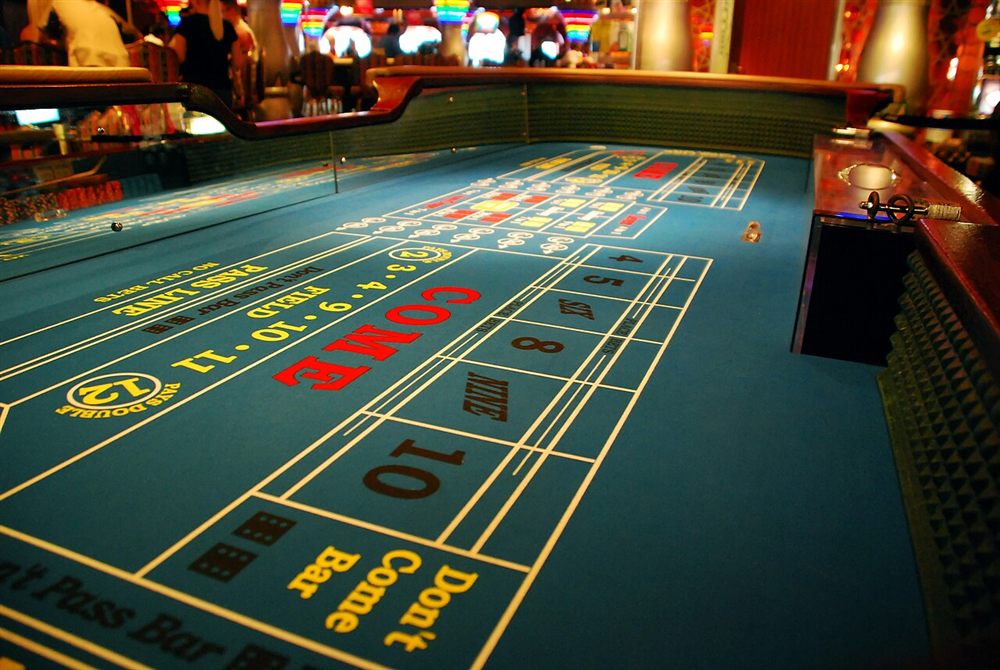
The craps layout is one design printed twice so both ends of a long table can reach it, with the pass line running around the outside, the come and place numbers inside, and the proposition bets in the centre.
The mirroring is why the table looks twice as complicated as it is. Learning one half is learning the whole thing.
The outer band holds the pass line and the don’t pass bar. Directly inside sit the come box, the field and the six place numbers along the top.
The centre section belongs to the stickperson and holds every one-roll proposition. Its visual prominence is inversely related to its value.
Free odds have no printed area at all. They sit physically behind the pass line bet, which is exactly why beginners never notice the best bet in the building.
Online tables reproduce the same layout with clickable regions and a highlighted total. Anybody learning how to play craps online can hover each area to see what it pays before committing a chip.
Half the felt is a mirror and most of the rest is optional. Reading the layout that way turns how to play craps from an intimidating diagram into four regions that actually matter.
What craps terms do you need at the table?
Six terms cover almost everything: come-out, point, seven-out, natural, craps and boxcars, and knowing them is enough to follow any table conversation.
A natural is a seven or eleven on the come-out. Craps is a two, three or twelve on the come-out. Boxcars is a twelve and snake eyes is a two.
Seven-out means the seven arrived after a point was set, ending the sequence and passing the dice. It is the phrase that empties the table.
Working and off describe whether a bet is live on the current roll. Place bets are off on the come-out by default and work again once a point is set.
Yo is called for eleven because it sounds too much like seven across a loud table. That single substitution prevents a genuinely expensive misunderstanding.
None of this vocabulary is required to play. A person learning how to play craps online never speaks a word of it, and the software labels every outcome plainly.
Vocabulary is a live-table courtesy rather than a requirement. The software narrates every outcome, so how to play craps online involves no calls, no stickperson and no risk of mishearing eleven as seven.
How much bankroll does craps require?
Plan for roughly thirty times the pass line bet to survive ordinary variance, and more if odds bets are being backed, because the odds wager multiplies the amount exposed on every point.
A five dollar pass line with double odds risks fifteen dollars per point rather than five. The blended edge falls and the swing per sequence rises, and both are worth planning for.
Sequences resolve quickly. A point of six or eight settles in a handful of rolls on average, while four and ten take longer and produce a slower, wider ride.
Online minimums make the arithmetic manageable. A one dollar table with 5x odds lets a hundred dollar bankroll play properly, which a live table minimum would not permit.
Set the session budget before the first come-out. Craps rewards a player who sits at one bet size through the variance and punishes one who raises stakes chasing a seven-out.
Our guide to minimum deposit casinos covers which Canadian-facing operators support small stakes properly.
Size the stake to survive the swings rather than to chase them. Thirty units is the working figure, and it is the part of how to play craps that decides whether a session lasts an hour or ten minutes.
Bankroll is the quiet half of the game. How to play craps for an evening rather than ten minutes is decided before the first come-out, and how to play craps at full odds needs a stake sized for it.
What is the simplest way to start playing craps?
Put one chip on the pass line, add the maximum free odds once a point is set, ignore every other area of the table, and that single routine is a complete craps strategy.
Nothing needs to be added to it. The blended house edge on that pattern sits below one percent, which is better than any other game a Canadian online casino offers.
Add one come bet with odds after a few sessions if more action is wanted. Two working numbers is plenty and keeps the whole position cheaply priced.
Decline everything the centre of the table offers. Any seven, hardways, Big Six and Big Eight cost between nine and seventeen percent, and no pattern of use makes them worthwhile.
Check the odds multiple before choosing a table. It is the single field that separates a good craps game from an ordinary one, and it appears in the game information panel.
That is the whole of how to play craps profitably in the sense that matters: not winning, which no bet achieves over time, but paying the lowest price in the lobby for the entertainment.
Pass line, full odds, nothing else. That is how to play craps at the lowest price a Canadian online casino offers, and it takes one sentence to learn and one session to become automatic.
One line covers it. How to play craps well is a pass line bet, maximum odds and a closed wallet for the centre of the table, and how to play craps badly is anything more complicated than that.
Everything above collapses into one habit. How to play craps well means the same four bets every session, how to play craps consistently means the same stake through the swings, and how to play craps for entertainment means a budget agreed before the dice move.
Gambling is entertainment rather than income, and a 1.41 percent edge is still an edge. Set a deposit limit, decide the session length in advance, and stop when it stops being enjoyable. For independent help with gambling in Canada, the Responsible Gambling Council publishes free resources and support contacts.
Site optimisation by SEO.