
Dragon tiger phoenix live is Evolution’s three-card showdown: one card each for Dragon, Tiger and Phoenix, and the highest card wins. Each hand pays 1.8:1, and a Tie bet pays 7:1 or 20:1. For the wider market picture, start at our online casino Canada hub.
The table sets out the dragon tiger phoenix live numbers a Canadian player checks first. Each line traces to a source named in the sections below.
| Trait | Detail |
|---|---|
| Studio | Evolution |
| Shoe | 8 decks, shuffled by hand |
| Card order | Ace low, King high, suits ignored |
| Dragon, Tiger, Phoenix | Each pays 1.8:1 |
| Tie | 7:1 on a two-card tie, 20:1 on a three-card tie |
| RTP | 96.99% on each hand, 94.51% on the Tie |
| Limits in footage | €0.50 to €2,500 |
| In Ontario | Listed on OLG.ca |
What is dragon tiger phoenix live?
Dragon tiger phoenix live is a live card game with three hands and one card each. Evolution describes it as a three-card showdown where the aim is to predict which hand, Dragon, Tiger or Phoenix, will draw the highest card.
Players at a dragon tiger phoenix live table can also bet on a Tie. Evolution says a Tie pays 7:1 when two cards match in value and up to 20:1 when all three match.
Evolution pitches it at Dragon Tiger fans and at players who want fast, decisive action. Its launch post adds a third selling point: crossover appeal to Baccarat and Top Card audiences.

Where did the game come from?
It is Dragon Tiger with a third hand. Livedealer.org says the game adds a Phoenix bet to the traditional game of Dragon Tiger and otherwise closely resembles it, which keeps the rules simple.
Evolution announced dragon tiger phoenix live on LinkedIn ahead of a 17 September launch, promising three hands to bet on per round, simple rules and fast-paced play.
Livedealer.org reports dragon tiger phoenix live in the live lobby of most casinos that carry Evolution’s games. Our introduction to live dealer casinos covers the original two-hand Dragon Tiger.
How is it different from Dragon Tiger?
It adds a hand and raises the payout. Dragon Tiger pits two cards against each other, while dragon tiger phoenix live deals three, and each hand pays 1.8:1 instead of the even money LTC Casino gives for Dragon Tiger.
The return moves up as well. livecasinos.com and LTC Casino both put regular Dragon Tiger’s main bets at 96.27%, against 96.99% here, per Livedealer.org.
With three hands in play, each dragon tiger phoenix live hand wins less often. The higher payout is the price of that lower hit rate.
How does a round work?
In six steps, per Livedealer.org and Evolution. The only decision is the bet, and the result is known the moment the three cards are turned over.
- Bet on Dragon, Tiger or Phoenix, and on the Tie if wanted.
- Betting closes.
- The dealer deals one card face down to Dragon, then Tiger, then Phoenix.
- The dealer turns the three cards over.
- The highest card wins, with Aces low and suits ignored.
- Matching top cards trigger the tie rules, and all bets are settled.
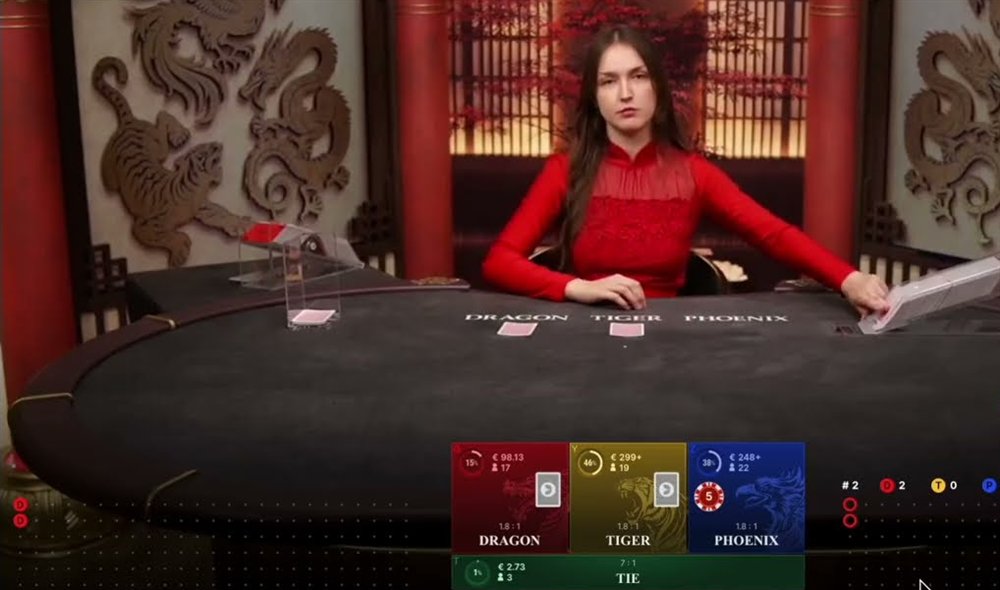
Footage of a dragon tiger phoenix live round shows the order in action: face-down cards already on the Dragon and Tiger spots while the dealer draws the next card from the shoe.
How are the cards ranked?
From Ace up to King. Livedealer.org says that, as in Dragon Tiger, Aces are low and suits do not matter, so the order runs Ace, 2, 3 and so on up to 10, Jack, Queen and King.
That gives 13 ranks in dragon tiger phoenix live. A King cannot be beaten, only matched, and an Ace can only tie or lose.
The cards come from an eight-deck shoe that is shuffled by hand, per Livedealer.org. That is 416 cards, with 32 of each rank.
What does each bet pay?
Dragon, Tiger and Phoenix each pay 1.8:1, and the Tie pays 7:1 or 20:1. Livedealer.org lists the same fixed win payout on all three hands, and Evolution gives the two Tie rates.
| Bet | Wins when | Pays | Win on a $10 bet |
|---|---|---|---|
| Dragon, Tiger or Phoenix | That hand has the highest card | 1.8:1 | $18 |
| Dragon, Tiger or Phoenix | That hand ties for the highest card with one other | 1:1 | $10 |
| Tie | Two cards tie for the highest | 7:1 | $70 |
| Tie | All three cards match | 20:1 | $200 |
The second row is the two-card tie rule, set out in the next section. On a three-card tie, every Dragon, Tiger and Phoenix bet loses.
What happens on a two-card tie?
The Tie bet pays 7:1, and the two tied hands are paid even money. Livedealer.org says that on a two-card tie, Tie bets pay 7:1 and bets on the tied Dragon, Tiger or Phoenix hands return 1:1.
The third dragon tiger phoenix live hand, holding the lower card, loses. A $10 bet on one of the tied hands earns $10 instead of $18.
Livedealer.org illustrates the rule with a bet on Dragon paid even money on a tie. It is the one outcome where a winning hand pays less than 1.8:1.
Why are tied hands paid only 1:1?
Because the full rate would tip the game in the player’s favour. If a hand tied for the top were paid 1.8:1, each dragon tiger phoenix live hand bet would return about 102.5% instead of 96.99%.
That is the gap of 0.8 times the 6.93% chance of a top tie. The even-money rule on ties is what keeps the house edge in place.
What happens on a three-card tie?
The Tie bet pays 20:1 and every hand bet loses. Livedealer.org says that when all three cards match, Tie bets pay 20:1 and bets on Dragon, Tiger or Phoenix are lost.
In a dragon tiger phoenix live shoe of eight decks, all three cards match about 0.54% of the time, or roughly once every 185 rounds, per our count.
On a $10 Tie bet, that is a $200 win. A player with $10 on a dragon tiger phoenix live hand loses the stake.
What if two lower cards match?
Then the highest card simply wins. A pair below the top card is not a tie for the win, so the hand holding the higher single card collects 1.8:1 and the two matched hands lose.
For example, a King for Dragon and two 5s for Tiger and Phoenix is a Dragon win. The Tie bet loses, since no two cards tie for the highest.
This reading is the one that fits the published returns, as the next section shows.
Why do sources describe the tie differently?
Some summaries are loose. livecasinos.com says the Tie pays 7:1 if any two cards match, and MyPrize says the tied hands push, while Livedealer.org describes the tied hands being paid 1:1.
Our exact count of every card combination in an eight-deck shoe settles it. Paying 7:1 on any matching pair would return 177.65%, which no casino game offers.
Paying the Tie only when two cards tie for the highest gives 94.51%, and paying the tied hands 1:1 gives 96.99% on each hand. Both match Livedealer.org’s figures, while a push would give only 90.06%.
The in-game paytable is still the final word, as MyPrize advises. It is the first thing to check at any dragon tiger phoenix live table.
What is the RTP of dragon tiger phoenix live?
96.99% on each hand and 94.51% on the Tie, per Livedealer.org. That is a 3.01% house edge on Dragon, Tiger or Phoenix and a 5.49% edge on the Tie.
Livedealer.org notes that the main bets return under 97%, while live baccarat returns closer to 99%. Our live baccarat page covers those tables.
livecasinos.com gives 96.99% in one place and 96.66% in another. Our count matches the 96.99% figure.
How often does each outcome happen?
Three different ranks come up about 79% of the time. Our count of an eight-deck shoe gives these shares for the three cards dealt in a dragon tiger phoenix live round.
| Outcome | Share of rounds | About once in |
|---|---|---|
| Three different ranks | 78.67% | 1.3 rounds |
| Two cards tie for the highest | 10.39% | 9.6 rounds |
| Two lower cards match | 10.39% | 9.6 rounds |
| All three cards match | 0.54% | 185 rounds |
The two pair shares are equal because a matched pair is as likely to sit above the third card as below it.
How often does a single hand win?
Just under 30% of the time outright. Our count gives each dragon tiger phoenix live hand a 29.69% chance of holding the single highest card, in line with livecasinos.com’s “just under 30%”.
Each hand also ties for the top about 6.93% of the time, which pays 1:1. It loses the other 63.38% of rounds.
Those figures produce the return: 1.8 times 29.69%, plus 1 times 6.93%, minus 63.38%, is a loss of about 3 cents per dollar staked.
What does each card give a hand?
Almost everything. Once the cards are turned, a hand’s own card sets its chances, and our count of an eight-deck shoe shows how steeply they climb from Ace to King.
| Hand’s card | Wins outright | Ties for the top |
|---|---|---|
| Ace | 0.0% | 0.0% |
| 2 | 0.6% | 1.2% |
| 3 | 2.3% | 2.3% |
| 4 | 5.3% | 3.5% |
| 5 | 9.5% | 4.6% |
| 6 | 14.8% | 5.8% |
| 7 | 21.3% | 6.9% |
| 8 | 29.1% | 8.1% |
| 9 | 38.0% | 9.2% |
| 10 | 48.1% | 10.4% |
| Jack | 59.4% | 11.5% |
| Queen | 71.9% | 12.7% |
| King | 85.6% | 13.9% |
An Ace can never win: at best it matches two other Aces, and a three-card tie loses every hand bet. A King wins outright 85.6% of the time and shares the top most of the rest.
The bet goes down before any card is seen, so this table explains the result rather than guiding the bet. Averaged over all 13 ranks, it gives the 29.69% outright win chance of every dragon tiger phoenix live hand.
How does 1.8:1 compare with a fair price?
It falls about a tenth short. With a 29.69% outright win chance and a 6.93% chance of an even-money tie, a dragon tiger phoenix live hand bet would break even at about 1.90:1.
Paying 1.8:1 instead is where the 3.01% house edge comes from. The same kind of gap sits under every fixed payout in the game.
Where does the Tie’s return come from?
Mostly from the 7:1 two-card ties. Per $1 staked, the two-card ties return about 73 cents in winnings, the three-card ties about 11 cents, and the stakes returned on winning Tie bets about 11 cents more.
That adds up to the 94.51% dragon tiger phoenix live Tie return. The 20:1 three-card tie grabs attention, but at roughly once in 185 rounds it carries only a small share of the bet’s value.
What does the Tie bet really cost?
About $55 for every $1,000 staked. The Tie wins about 10.93% of rounds in all, but most of those are the 7:1 two-card ties, and the 20:1 three-card tie is rare.
On a $10 Tie bet, a two-card tie pays $70 and a three-card tie $200. The bet loses $10 in the other 89.07% of rounds.
livecasinos.com’s advice is blunt: never bet on the Tie. At 94.51%, it costs almost twice as much as a hand bet at the same dragon tiger phoenix live table.
How do Dragon, Tiger and Phoenix differ?
Only in name and colour. livecasinos.com says the three bets are equal in all respects, with the same payouts and the same chance of winning. On the bet panel in footage, Dragon is red, Tiger gold and Phoenix blue.
The dealing order, Dragon then Tiger then Phoenix, favours no dragon tiger phoenix live hand, since every card comes from the same shuffled shoe.
How often do two cards match at all?
About one round in five. Our count shows at least two matching ranks in 20.79% of dragon tiger phoenix live rounds, but only half of those, 10.39%, are ties for the highest card.
The other half are lower pairs, which settle as a normal 1.8:1 win for the hand holding the higher card.
What does a hundred rounds cost?
About $30 on a hand and about $55 on the Tie, at $10 a round. One hundred rounds put $1,000 on the table, and the house edge sets the long-run cost.
| Bet | Staked over 100 rounds | Expected cost |
|---|---|---|
| Dragon, Tiger or Phoenix | $1,000 | $30.10 |
| Tie | $1,000 | $54.90 |
A single session can land far from these figures in either direction. The dragon tiger phoenix live averages only settle over many rounds.
What does a $50 session look like?
Take 20 rounds at $2.50 on one hand, $50 in all. On average, about 5.9 of those rounds are outright wins at $4.50, about 1.4 are top ties at $2.50 and about 12.7 are losses at $2.50.
That averages out to a loss of about $1.50, the 3.01% edge on $50. Any real session of dragon tiger phoenix live will land above or below it.
Can you bet on more than one hand?
On two of the three. livecasinos.com says players can place up to two bets per dragon tiger phoenix live round on Dragon, Tiger or Phoenix, and can add a Tie bet to any combination.
Blocking the third hand stops a player from covering every outcome. The same logic appears at other live tables with fixed hands.
Footage shows money spread across all three hands by different players: 15% of the stakes on Dragon, 46% on Tiger and 38% on Phoenix, with 1% on the Tie.
What happens if you back two hands?
You win more often and pay the same edge. With $10 on Dragon and $10 on Tiger, one of them wins outright 59.38% of the time, for an $8 profit on the $20 staked.
Phoenix wins outright 29.69% of the time, costing $20. A Dragon-Tiger tie for the top pays both bets even money, a $20 profit, about 3.46% of the time.
A top tie between Phoenix and one of the two breaks even, and a three-card tie loses $20. The average works out to a loss of about 60 cents a round, 3.01% of the $20 staked.
What if you add a Tie bet to a hand bet?
You pay both edges. With $10 on Dragon and $2 on the Tie, the expected cost is about 30 cents on the hand plus about 11 cents on the Tie, or 41 cents a round.
The Tie does soften one outcome. When Dragon ties for the top, the hand bet pays $10 and the Tie pays $14, for $24 in total.
On a three-card tie, the $10 hand bet loses but the $2 Tie pays $40. Neither case changes the long-run cost of the dragon tiger phoenix live side of the bet.
What does a losing streak look like?
Longer than it feels. A hand bet loses about 63.38% of rounds, so five losses in a row happen about 10.2% of the time and ten in a row about 1.0%.
Those runs are part of the game’s shape, not a sign of anything wrong. Each round is a fresh draw of three cards.
A stake plan built for 1.8:1 wins about three rounds in ten needs room for those runs at a dragon tiger phoenix live table.
What does a winning streak pay?
Three outright wins in a row at $10 earn $54. That run happens about 2.6% of the time, since each outright win is a 29.69% chance.
Two wins in a row happen about 8.8% of the time. Streaks in either direction are the normal spread of a 1.8:1 dragon tiger phoenix live bet.
Do the cards already dealt change the odds?
Slightly. Our count describes a fresh eight-deck shoe, and each round removes three cards, so the shares drift a little as the shoe runs down.
Livedealer.org says the shoe is shuffled by hand. With 416 cards in play, the drift from any single round is small, and the paytable does not change with it.
Is there a strategy?
No. livecasinos.com points out that Dragon, Tiger and Phoenix are equal in every respect: the same payouts, the same odds and the same chance of winning.
It also warns against the gambler’s fallacy. A run of Tiger wins does not make Dragon or Phoenix due, because every round is a fresh draw of three cards.
The only lever at a dragon tiger phoenix live table is the Tie. Leaving it alone keeps the house edge at 3.01% instead of 5.49%.
What does the table show?
The dealer, three card spots and a four-part bet panel. Footage of dragon tiger phoenix live shows a dark felt marked Dragon, Tiger and Phoenix, with carved dragons and tigers on the studio walls.
The bet panel shows Dragon in red, Tiger in gold and Phoenix in blue, each marked 1.8:1, with the Tie marked 7:1 beneath them. Each spot lists the money on it and the number of players backing it.
A counter to the right tallies wins by hand. In the clip, it reads 2 rounds, with Dragon winning both.
What are the bet limits?
They depend on the casino. The dragon tiger phoenix live table in one clip shows a range of €0.50 to €2,500 in its header.
The header at the top of the game window carries the limits in force. It is the first line to read before the first chip goes down.
Where can Canadians play it?
OLG lists it for players in Ontario. Its game page is titled Dragon Tiger Phoenix, Live Dealer 3-Card Showdown, on OLG.ca.
Outside Ontario, Livedealer.org reports dragon tiger phoenix live in the lobby of most casinos that carry Evolution’s live games. The operator’s registration and the in-game paytable are the two things to check.

Ice Casino is number 5 on our homepage list and runs a live dealer section, according to our Ice Casino review, which also covers its welcome offer and withdrawal rules. Check that its lobby lists Dragon Tiger Phoenix Live before you deposit, and see our page on best online casinos in Canada for the other casinos we list.
How does it compare with baccarat?
Baccarat returns more. Livedealer.org puts live baccarat closer to 99%, against 96.99% on each dragon tiger phoenix live hand bet.
The two games share a rhythm: no decisions after the bet and a quick result. Evolution’s launch post names baccarat players as part of the target audience.
The difference is the structure. Baccarat has two hands and drawing rules; in dragon tiger phoenix live, one card per hand decides everything.
How does it compare with 32 Cards?
Both are fixed-hand races to the top, but the payouts work differently. In 32 Cards, four hands start from 8 to 11 and pay from 11:1 down to even money, while the three dragon tiger phoenix live hands all pay the same 1.8:1.
Both games stop a player from covering every hand: three of four positions at 32 Cards, two of three here, per livecasinos.com.
The house edge also differs. 32 Cards runs from 6.01% to 9.92% depending on the position, against 3.01% on every hand here.
Is the game fair?
The result rests on real cards dealt on camera. Livedealer.org describes an eight-deck shoe shuffled by hand, with one card dealt face down to each hand and then turned over.
Evolution’s site lists licences from the Malta Gaming Authority and Great Britain’s Gambling Commission, among a number of jurisdictions. In Ontario, the operator’s registration is the second check.
Who is the game for?
Players who want the simplest possible card game with a bigger payout. Evolution names Dragon Tiger enthusiasts and players who crave fast, decisive action as its audience.
It suits players who prefer 1.8:1 wins about three rounds in ten over even-money wins about half the time. It suits less those chasing the best return, which baccarat offers.
What does a Canadian player check before playing?
Four items: the table header for limits, the in-game paytable for the tie rules, the RTP in the game help and the operator’s registration. All four are visible before the first round of dragon tiger phoenix live.
Set a money limit and a time limit first. Players in Ontario who want support can call ConnexOntario at 1-866-531-2600.
Our page on responsible gambling practices for Canadians covers limits and tools.
Which pages are worth reading next?
Four pages sit closest to this one. Each covers another fast live card or dice table tied to the subjects above, and each one stands on its own.
Dragon tiger phoenix live turns Dragon Tiger into a three-way race for the highest card. Each hand returns 96.99%, the Tie returns 94.51%, and the tie rules in the paytable decide the close calls.