
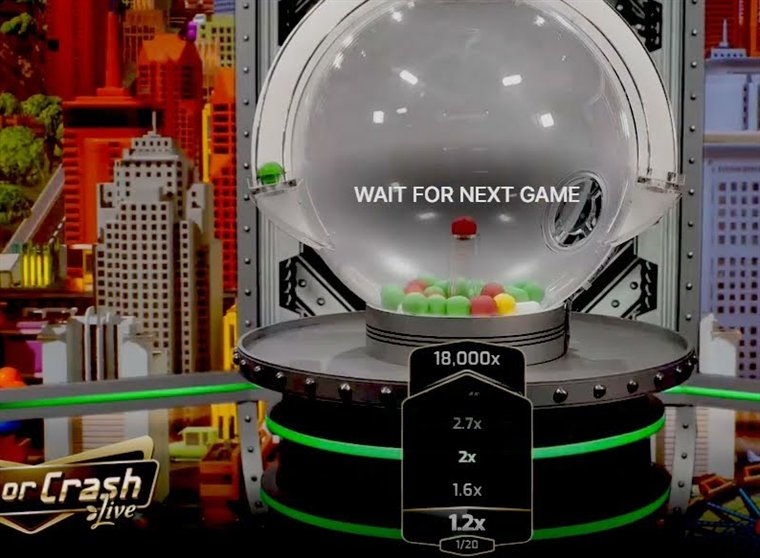
Cash or crash live is a ladder with a trapdoor under every rung. A blimp climbs twenty levels, one ball is drawn before each climb, and a red ball ends the game. After every safe draw the player chooses to cash out, bank half, or keep everything riding. For the wider market picture, start at our online casino Canada hub.
The table below sets out how the game behaves. Read it first, then work through the detail beneath.
| Trait | Detail |
|---|---|
| Provider | Evolution |
| Levels | Twenty |
| Balls | 19 green, 8 red, 1 gold |
| Choices | Cash out, take half and continue, or continue in full |
| Top prize | 18,000x at level twenty, 50,000x with the gold ball |
| RTP | 99.59 percent, as listed by Canadian reviews |
What is cash or crash live?
A live game show from Evolution where players climb a twenty level ladder of rising multipliers. A ball drawn before each level decides whether the climb continues or crashes.
Cash or crash live runs with a presenter, a blimp themed studio and a ball drawing machine.
Every player at the table rides the same ladder.

Cash or crash live suits players who like a decision at every step of a game.
Cash or crash live comes from Evolution and runs on a twenty level ladder, with one ball drawn before every level and three choices after every safe ball.
How does a game play out?
Players place a single bet. The presenter draws a ball. Green moves everyone up a level, red crashes anyone still riding, and gold moves players up while adding protection. After each green ball, players decide what share to keep in play.
The game ends at a crash, a cash out or the top level.
All players share the same draws, so a crash hits everyone still riding at the same moment. Cash or crash live players differ only in when they chose to step off.
Those who cashed out watch the rest of the climb risk free.
Cash or crash live repeats that cycle of one draw and one decision until a crash, a cash out or level twenty.
What do the three ball colours mean?
Green is safe and moves the game up one level. Red is a crash, losing everything still in play. Gold is safe, moves the game up and gives one extra life against a later red ball.
The drawing machine holds nineteen green, eight red and one gold ball.
Green balls outnumber red ones by more than two to one. Cash or crash live still crashes often, because the risk compounds with every level climbed.
The single gold ball is the rarest draw of all.
Cash or crash live uses twenty eight balls in total: nineteen green, eight red and one gold. Every draw comes from that set.
What choices does the player have?
After a green or gold ball, there are three options: take the full amount and leave, take half and continue with the other half, or leave everything in play and continue.
Each choice applies only to that player’s own bet.
Cash or crash live repeats the same three choices at every level.
Cash or crash live offers cash out, take half, or continue after every green or gold ball, and the same three buttons return at each level.
What does cashing out do?
It locks in the current multiplier on the whole stake and ends the game for that player. Nothing further can be won or lost, and the player watches the rest of the climb.
Cashing out early keeps wins small but certain.
What does taking half do?
Half the current value is paid immediately and the other half stays on the ladder. If a red ball crashes the game later, only the riding half is lost.
The option splits the difference between safety and ambition.
What does the gold ball do?
It gives one extra life. If a red ball is drawn later, the gold ball cancels it and the game continues. The gold ball is also required to unlock the 50,000x top prize.
Only one gold ball sits in the machine.
A cash or crash live player holding the gold ball protection survives the next red ball drawn.
The protection covers one red ball only.
Cash or crash live players can only reach the 50,000x prize after the gold ball has been drawn during that game.
What is the top prize?
Reaching level twenty pays 18,000 times the stake. Reaching level twenty with the gold ball already drawn lifts the top prize to 50,000 times the stake.
Operator terms state any cap on total payouts per round.
Level twenty sits at the end of a long run of safe draws. Cash or crash live players see the top prize rarely, which is why it can be so large.
Cash or crash live pays 18,000 times the stake at level twenty without the gold ball and 50,000 times with it.
Cash or crash live multiplies the stake by 18,000 at the top of the ladder, and by 50,000 when the gold ball has already been drawn in that game.
What is the RTP?
Canadian reviews list the return to player at 99.59 percent. That figure describes the long run average across every game played, not the result of any single session.
Return to player describes the long run average. Cash or crash live sessions swing well above and below it in the short term.
How often does a red ball appear?
Eight of the twenty eight balls are red, so each draw carries a meaningful risk of crashing. The risk accumulates with every level, which is why reaching the top is rare.
Long climbs become rarer the higher the ladder goes.
The chance of a red ball stays meaningful at every level. Cash or crash live players weigh that risk before each decision.
Cash or crash live draws a single ball before every level.
Cash or crash live places eight red balls among twenty eight, so red makes up a little under a third of the full set.
Is it better to cash out early?
Cashing out early locks small wins frequently. Riding longer produces rare large wins. Both approaches sit inside the same published game, and the choice mainly changes how results swing.
Players chasing steady small wins cash out early. Cash or crash live players chasing one large win ride longer and accept more crashes.
Cash or crash live suits both styles within the same game.
What is a sensible cash out plan?
One approach sets a target level before the game starts and cashes out on reaching it. Taking half at a midpoint and riding the rest is another plan that keeps part of the profit certain.
A fixed plan prevents emotional decisions mid game.
What are the betting limits?
Canadian reviews list a minimum of ten cents and maximums around one thousand dollars at the operators they checked. Limits vary by operator and appear before the first bet.
Maximum payouts per round may also apply.
Cash or crash live bets start at ten cents in the Canadian reviews checked, with a one thousand dollar maximum at those operators.
Is cash or crash live a crash game?
It shares the crash idea of cashing out before a loss, but it runs as a live game show with physical balls rather than a rising graph. Crash games such as Aviator use a random multiplier curve instead.
The decision points in cash or crash live come level by level.
Crash games settle in seconds. Cash or crash live takes longer per game because each level involves a physical draw and a decision window.
Cash or crash live borrows the cash out idea from crash games but decides every step with a physical ball draw.
How does it compare with Aviator?
Aviator lets players cash out at any instant as a multiplier climbs, using a software curve. Cash or crash live pauses after every ball, so decisions happen in fixed steps with a presenter.
Both reward stopping at the right time.
How does it compare with other Evolution game shows?
Wheel based shows such as Crazy Time spin for multipliers without any decision after the bet. Cash or crash live asks for a decision at every level, which gives players more control.
Monopoly Live and Crazy Time centre on bonus rounds. Cash or crash live centres on a single climb with no bonus wheel.
Does the presenter affect the result?
No. The ball drawing machine decides each outcome, and the presenter announces the result. The studio format is entertainment rather than influence.
Cash or crash live draws come from the machine alone.
Does every player see the same draws?
Yes. One ball machine serves every seat, so all players ride the same sequence of green, red and gold balls. The only difference between players is when each one chose to cash out or take half.
What happens after a crash?
Every stake still riding is lost, and the game ends for everyone who had not cashed out. Players who took half keep the half they banked, and a new game opens for fresh bets shortly afterwards.
A crash on the first draw ends a game within seconds.
Cash or crash live stakes that were cashed out or banked through take half stay paid after a crash.
How long does a game last?
It depends entirely on the draws. An early red ball ends a game almost immediately, while a long run of green balls with decision windows between them can take minutes.
Cash or crash live has no fixed round length, which makes sessions harder to time than wheel based shows.
Cash or crash live sessions are easiest to manage with a fixed number of games.
Why take half instead of cashing out?
Taking half secures a profit while leaving a stake in play for the higher levels. It suits players who want a chance at a large multiplier without risking everything already won.
What are the odds on the first draw?
With all twenty eight balls in the machine, the first draw is green nineteen times in twenty eight, about 68 percent. It is red eight times in twenty eight, about 29 percent, and gold one time in twenty eight, under 4 percent.
Green and gold together make twenty safe balls out of twenty eight, roughly 71 percent on that opening draw.
What does the top prize mean in dollars?
At 18,000 times the stake, a ten dollar bet reaching level twenty returns one hundred and eighty thousand dollars. At 50,000 times the stake with the gold ball, the same ten dollar bet returns five hundred thousand dollars.
Operator terms can cap total payouts per round below those figures, so the cap line matters before a large bet.
How does taking half work in practice?
Suppose a ten dollar stake has climbed to a level showing four times the stake, making it worth forty dollars. Taking half banks twenty dollars immediately and leaves twenty dollars riding up the ladder.
If the next ball is red, the riding twenty is lost and the banked twenty stays paid. If the climb continues, the riding half keeps growing with every safe level.
What do the key terms mean?
A level is one rung of the twenty step ladder. A crash is a red ball that ends the game for every stake still riding. Cashing out takes the full current value, and taking half banks half while the rest continues.
The gold ball is the single protective ball, and the multiplier is the amount the stake is worth at the current level.
How large can a bet be?
Canadian reviews list a minimum bet of ten cents and a maximum of one thousand dollars at the operators they checked. At the maximum, level twenty would represent eighteen million dollars before any payout cap.
Any payout cap in the operator terms limits that figure, which is why the terms deserve a careful read.
How does a player keep cash or crash live affordable?
Setting a deposit limit, a session budget and a fixed stake before the first game keeps spending under control. Registered Ontario operators provide deposit limits inside the account menu.
Players in Ontario who want support can call ConnexOntario at 1-866-531-2600.
What does a 99.59 percent return mean in dollars?
A return of 99.59 percent means the average cost is 41 cents for every hundred dollars staked across a long run of games. A player staking one thousand dollars in total over a session would expect to lose about four dollars ten on average.
Individual sessions land far from that average in either direction. Cash or crash live results swing widely because a single long climb can outweigh dozens of early crashes.
What happens if a red ball follows the gold ball?
The gold ball’s extra life absorbs that red ball and the game continues. A second red ball after that ends the game, because the gold ball gives one extra life and no more.
Players holding the protection still face every later draw. The difference is that one red ball no longer ends the climb on its own.
What are the three choices side by side?
Cashing out takes the full current value and ends the game for that stake. Taking half banks half the value and keeps half riding. Continuing leaves the full value riding into the next draw.
Each choice trades certainty for upside in a different proportion. Cash or crash live offers all three after every safe ball.
How does cash or crash live compare with mines?
Mines lets a player reveal tiles on a grid and cash out before hitting a mine, choosing how many mines sit on the board. Cash or crash live uses a fixed ball set and a shared ladder instead of a personal grid.
Both games end a round on a single bad outcome and reward stopping at the right moment.
Why does a red ball end the game for everyone?
All players ride the same ladder and the same draws. A red ball therefore crashes every stake still in play at once, while stakes already cashed out are unaffected.
That shared outcome is what gives cash or crash live its game show feel. Every decision is personal, but every draw is common to the whole table.
What makes a good first session?
A small fixed stake, a written cash out target and a set number of games make a first session easy to follow. Taking half at the target instead of cashing out in full is a gentle way to watch higher levels without risking the whole stake.
Stopping after the planned number of games keeps the session within budget whatever the results.
Cash or crash live sessions stay affordable with a fixed stake from the ten cent minimum upward.
Is cash or crash live good for beginners?
Yes. The rules fit in one sentence: green climbs, red crashes, gold protects. A beginner learns the choices within a single game.
Setting a cash out target makes the first sessions simpler.
What mistakes cost the most?
Chasing the top prize with the whole stake every game is the costliest habit, because games reaching level twenty are rare. Changing plans mid game after a string of green balls is the second.
A consistent plan avoids both extremes.
Doubling the stake after a crash is another costly habit. Cash or crash live results are independent from one game to the next.
Where can Canadians play cash or crash live?
Canadian reviews list it at operators carrying the Evolution game show catalogue. Searching a live lobby by name confirms whether a given operator carries cash or crash live.
Searching the live lobby by name finds it fastest.
Cash or crash live availability changes as operators update their live lobbies.
Cash or crash live appears in the game show sections of lobbies that carry Evolution titles, according to the Canadian reviews checked.

For a casino from our homepage list, Ice Casino sits at number 5 and carries live dealer tables, per our Ice Casino review. That review also checks the wagering and withdrawal terms. Confirm Cash or Crash Live is in the lobby first, and weigh the offer against our page on free spins offers.
Is cash or crash live certified in Ontario?
Registered operators run Evolution tables tested by an approved laboratory. The ball set, the ladder and the payout table are fixed at certification and cannot change afterwards.
Operators display their registration number in the site footer.
Certification covers the studio and the drawing equipment together. A cash or crash live studio serving Ontario is approved for that market specifically.
Does cash or crash live count toward wagering?
Live casino games usually contribute at a reduced rate, often ten percent or less, and certain bonus terms exclude game shows outright. The contribution clause matters more than the headline bonus.
Rates differ between operators.
Game shows usually sit in the lowest contribution band. A cash or crash live session clears a bonus slowly, if at all.
Cash or crash live contribution rates appear in each operator’s bonus terms, often in the live casino band.
Is cash or crash live good for a small bankroll?
A ten cent minimum suits the smallest deposits, and early cash outs keep losses controlled. The main risk is chasing long climbs with large stakes.
Deposit limits sit inside every registered Ontario account.
Small stakes stretch a bankroll across many games. Cash or crash live suits players who cash out steadily rather than chasing the top prize.
Cash or crash live minimums start at ten cents at operators reviewed in Canada.
What does a Canadian check before playing cash or crash live?
Four lines decide the table. The bet limits, any maximum payout cap, the wagering contribution and the operator registration status all appear before any money moves.
None of it requires a deposit to read.
Cash or crash live terms also list any cap on total payouts, which matters for players aiming at the top of the ladder.
Which game pages are worth reading next?
Four pages sit closest to this one. Each covers a game or a rule that touches the subject above, and each stands on its own.
Cash or crash live hands every player the same question at every level: take it or ride it. Set a target before the first ball, take half when unsure, and the game plays close to its published return.
5 thoughts on “Cash or Crash Live Casino Canada: Twenty Levels, One Red Ball Away”