
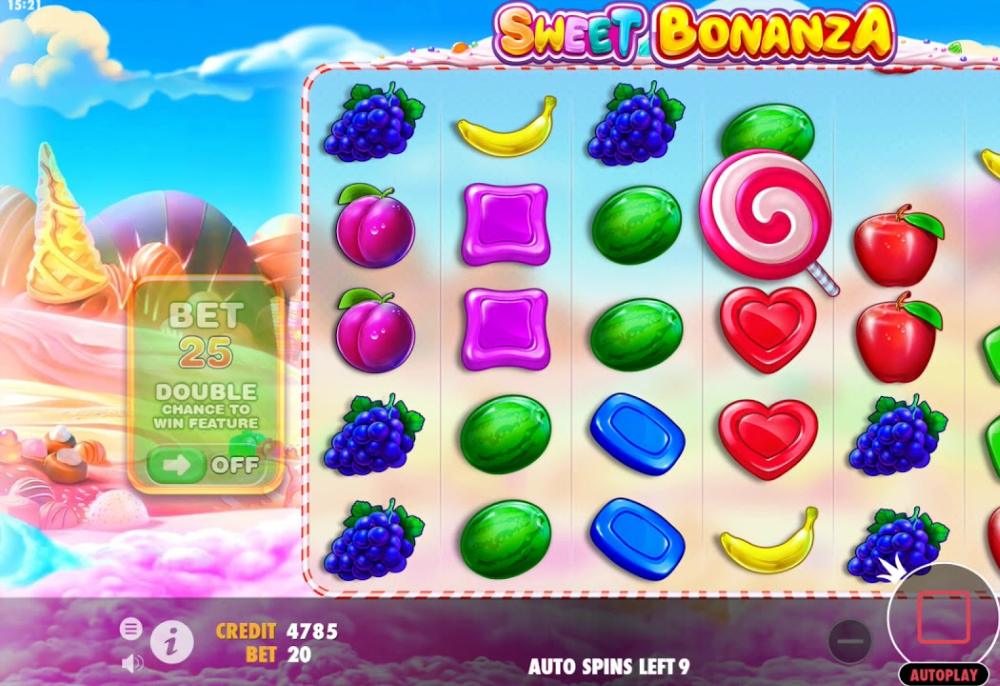
Sweet Bonanza has no paylines and no ways. Symbols pay by how many land anywhere on the grid, which is why a title that looks like a children’s sweet shop became one of the most played slots in the Canadian market. For the wider market picture, start at our Canadian online casino hub.
The table below sets out what the game delivers. Read it first, then work through the detail beneath.
| Trait | Detail |
|---|---|
| Studio | Pragmatic Play |
| Grid | Six reels by five rows, scatter pays |
| Trigger | Four or more lollipop scatters anywhere |
| Feature | Ten free spins with multiplier bombs |
| Return figure | 96.51 percent on the standard certified build |
| Volatility | High |
What is Sweet Bonanza?
Sweet Bonanza is a six by five grid slot from Pragmatic Play where symbols pay by count rather than by position.
Eight or more matching symbols anywhere on the grid award a win.
The sweet shop artwork hides a modern engine. The engine is the point.
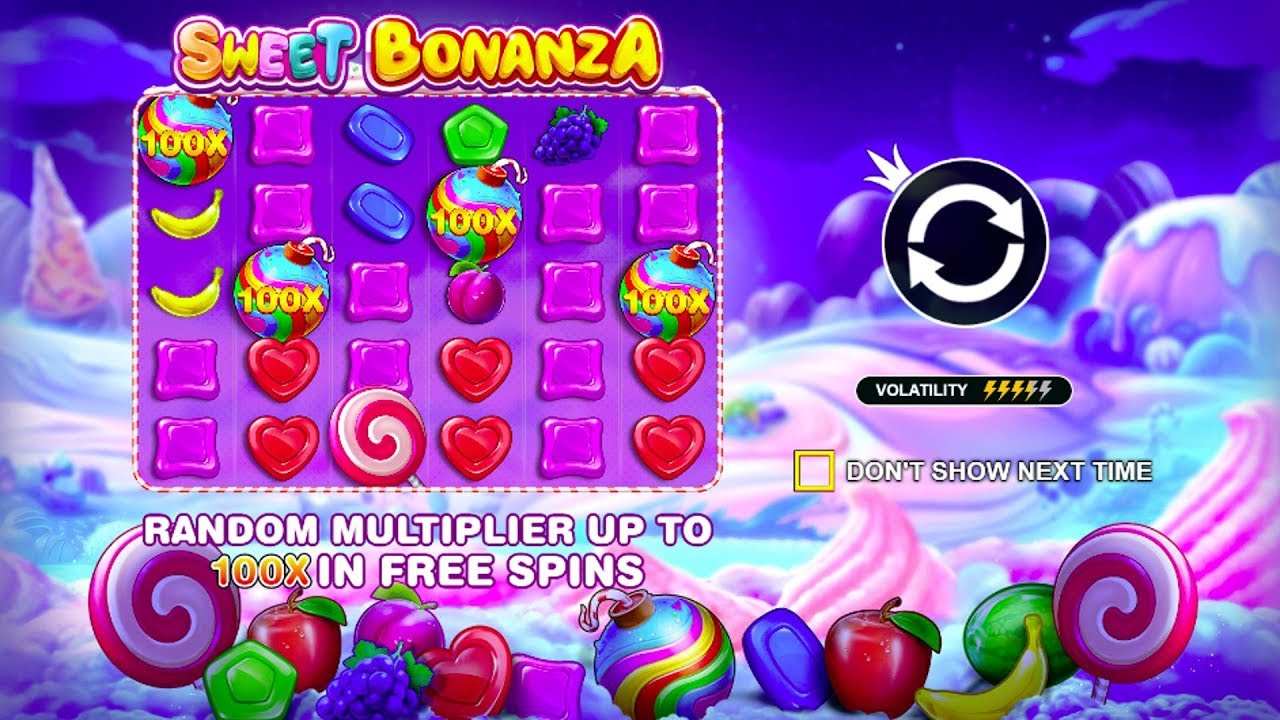
The grid runs six reels across and five rows deep, which gives thirty positions for symbols to land in. Eight matching symbols anywhere among those thirty pay, and the award scales upward as the count rises toward the full thirty.
Symbol design is deliberately plain. Bananas, plums, apples, watermelons and grapes fill the low rows and four coloured hearts fill the high ones, with a lollipop acting as the scatter.
Nothing about the presentation suggests a modern engine and everything underneath is one. That gap between the artwork and the mathematics is a large part of why Sweet Bonanza reached the audience it did.
Paytable reading is unusually quick as a result of the structure. Each symbol shows three award bands, one for eight to nine matches, one for ten to eleven and one for twelve or more, and there is nothing else to interpret.
That simplicity is the commercial argument for the whole engine. A player who has never opened a rules screen can understand what Sweet Bonanza is doing within two spins, which is a lower barrier than any line based build manages.
The title is now old enough to have a market position rather than a launch. It sits permanently in the most played rows on Canadian lobbies, which means a player meets Sweet Bonanza whether or not they were looking for it.
Lobby placement is worth understanding before browsing. A title sitting permanently in the most played row accumulates play because it is promoted, and the promotion continues because it accumulates play, which says nothing about whether Sweet Bonanza suits a particular session.
What settles that is the volatility rating and the published figure. Both sit in the rules screen and both take one line to read.
Why does Sweet Bonanza have no paylines?
Because the scatter pays rule replaces them entirely. Position stops mattering once a win depends only on how many matching symbols appeared, so drawing routes across the grid serves no purpose.
Removing lines simplifies the paytable enormously. It also removes a stake decision.
Payline slots draw fixed routes across the grid and only symbols sitting on those routes count. Ways engines widen that to adjacent reels. Both approaches make position matter, and both require a player to understand a structure before reading a paytable.
Scatter pays removes the whole question. A symbol either landed or it did not, and where it landed is irrelevant, so the paytable reduces to a count against an award.
Stake reading simplifies at the same time. There is no per line stake to convert, so the figure shown is the whole commitment for the spin, which is one fewer thing to misread on Sweet Bonanza than on a line based build.
The engine also removes an entire category of player error. Nobody can accidentally play fewer lines than the paytable assumes, and nobody has to convert a per line figure into a total stake before judging what a spin costs.
Comparing against a twenty line build makes the difference obvious. A payline slot at twenty cents a line costs four dollars a spin and quotes its awards per line, and Sweet Bonanza quotes everything against the one figure on screen.
The rule also travels badly in conversation. Players describing a win on Sweet Bonanza reach for payline language that does not apply, which is why the count based structure is worth stating plainly once.
The structure also explains why the stake range looks the way it does. With no line count to multiply, the minimum is set directly by the publisher, and Sweet Bonanza starts at a level most Canadian lobbies list as twenty cents.
What is a scatter pays grid?
A grid where any eight or more matching symbols pay regardless of where they sit. No adjacency, no left to right rule and no drawn route, just a count against the paytable.
Cluster grids require touching symbols. This one does not.
The term describes a rule rather than a layout. Any symbol counts toward a win regardless of position, which is why the mechanic is also called pay anywhere on other titles using it.
Cluster grids are the closest relative and they are genuinely different. A cluster requires matching symbols to touch each other, so position still matters, and a scatter pays grid removes even that requirement.
The practical effect is a higher rate of small wins from the base game. Eight symbols scattered across thirty positions is a far easier condition to meet than eight forming a connected group, which shapes how Sweet Bonanza feels minute to minute.
The rule appears across the wider market now under three names. Pay anywhere, scatter pays and all ways any position all describe the same arrangement, and the studios using it rarely explain that they are the same thing.
What varies between those titles is the count threshold. Eight is the standard on a thirty position grid, and a larger grid raises the requirement while a smaller one lowers it, so the threshold is worth reading before assuming Sweet Bonanza rules apply elsewhere.
Reading the threshold rather than assuming it is the habit that transfers. Eight is the requirement here, and a title using the same rule on a different grid size will state its own number in the same place.
Comparing the three grid rules side by side settles the confusion for good. Paylines need a route, clusters need contact, and a scatter pays grid needs neither, which is why Sweet Bonanza pays on arrangements the other two would ignore entirely.
Grid size is the variable that travels with the rule. Thirty positions on Sweet Bonanza set the eight symbol threshold, and a title running the same rule on a forty nine position grid will set a higher one, which is why the threshold is always printed rather than assumed.
How do tumbles work in Sweet Bonanza?
Winning symbols disappear and new ones drop into the gaps. The grid is evaluated again, and the sequence continues until a drop produces no win, so one spin can pay several times.
Each tumble is a fresh evaluation. The stake is paid once.
A winning combination is paid and then removed from the grid. Everything above the gaps falls downward and new symbols drop in from the top, filling every empty position.
The new arrangement is evaluated as a fresh spin would be. If it produces another win the sequence repeats, and the chain continues until a drop produces nothing.
Each link in that chain pays separately against the same stake. A long tumble sequence in the base game can therefore return four or five times the spin cost without any multiplier being involved at all, which is the mechanic doing most of the work outside the feature.
Chain length is where the base game variance actually sits. Most sequences resolve in one or two drops and pay a fraction of the stake, and an occasional long chain produces a result four or five times the spin cost.
The engine is doing something subtle for engagement. A sequence that keeps dropping creates the impression of escalation even when the total is small, which is a large part of why sessions on Sweet Bonanza feel active while a balance falls.
Watching a chain resolve is also the fastest way to learn the paytable. Each drop shows which symbol paid and how many landed, which teaches the count bands without opening anything.
The engine is also what makes the base game bearable on a high variance build. Without tumbles the stretches between features would be almost entirely empty, and the chain sequences give a session something to watch.
Speed settings interact with the engine in a way worth knowing. Turbo mode resolves a chain almost instantly, which makes a session move far faster than the same number of spins on a conventional build and empties a balance correspondingly quicker. Leaving turbo off is the simplest way to slow a session down without changing the stake.
How do you trigger the free spins?
Four or more lollipop scatters landing anywhere on the grid. The round awards ten free spins and three more scatters during the round retrigger it for five additional spins.
Position never matters for the trigger. Only the count does.
Four lollipop scatters anywhere on the grid open the round. Position is irrelevant here as it is everywhere else on the title, so four scatters spread across six reels count exactly as four clustered together would.
The round awards ten free spins. Landing three more scatters during the round adds five more spins, and the retrigger can repeat without a stated cap.
Retriggers matter more on Sweet Bonanza than the spin count suggests. The multiplier bombs only appear during the round, so extending it extends the only phase where the ceiling is reachable.
Trigger frequency is what the ante bet toggle acts on and nothing else. Doubling the rate does not change what the round pays, the bomb distribution or the ceiling, it simply shortens the wait between features.
Four scatters is a demanding condition on a thirty position grid. That is why the base game runs as long as it does between rounds and why so many players on Sweet Bonanza reach for the ante bet or the purchase button.
The retrigger rule is worth noting because it has no stated cap. A round that keeps producing three scatters keeps extending, and the longest Sweet Bonanza rounds come from exactly that.
Scatter count is the only condition and it is worth repeating because players assume otherwise. No reel restriction applies, no adjacency rule applies, and four lollipops anywhere on the Sweet Bonanza grid open the round.
Counting scatters during a spin is the one thing worth watching. Three on screen means a fourth anywhere completes the trigger, and on Sweet Bonanza that moment is the only genuinely tense point in the base game.
What are the multiplier bombs?
Coloured bomb symbols that appear only during the free spins round, each carrying a printed multiplier running from two times at the low end to one hundred times at the top.
They apply to the total of the tumble sequence they land in.
Bombs never appear in the base game. That separation is deliberate.
Bombs are a separate symbol class that exists only inside the free spins round. Each carries a printed multiplier, and the values run from two times at the low end to one hundred times on the original Sweet Bonanza build.
They do not form part of any winning combination. A bomb landing on a spin that produces no win pays nothing, and the multiplier is simply discarded.
Where they do land alongside a winning tumble sequence they apply to the total of that whole sequence rather than to a single drop. That distinction is the single most misunderstood rule on Sweet Bonanza.
Bomb frequency is low by design and the high values are rarer still. Most rounds see three or four small bombs and no large ones, which is why the average feature outcome sits far below what the ceiling suggests.
Reading the bomb range in the rules screen is worth the moment it takes. the original Sweet Bonanza build tops out at one hundred times and the Sweet Bonanza sequel at one thousand, and knowing which version is deployed changes what a Sweet Bonanza round can reach.
Bombs landing on a losing spin are simply discarded, which surprises players regularly. The multiplier has nothing to apply to, and nothing carries over to the next spin of the round.
Bomb values are printed on the symbol itself, so a player reads the round without opening anything. That legibility is consistent with the rest of the title and it is a large part of why the feature is as watchable as it is.
Bomb colour corresponds loosely to value on most builds, which gives a player a rough read before the number resolves. That is presentation rather than information, since the outcome was settled when the spin began, and the colour is simply how Sweet Bonanza communicates the size of what already landed.
How do the multipliers combine?
They add rather than multiply against each other. Three bombs showing ten, twenty and fifty produce a combined eighty times multiplier applied to the sequence total.
Addition caps the ceiling more than multiplication would. That is the design.
Multiple bombs landing in the same sequence add their values together. Three bombs showing ten, twenty and fifty produce eighty times rather than ten thousand times, which is what multiplying them would have given.
Addition is what keeps the ceiling where it is. A multiplicative rule on the same bomb distribution would push the maximum win into a range no certified build could fund.
Timing is the other part of the rule. Bombs are collected across the entire tumble sequence and applied once at the end, so a bomb landing on the fourth drop still counts toward the total on Sweet Bonanza.
Understanding the addition rule prevents a common disappointment. A player who sees four bombs land and expects a multiplicative result will misread what the round produced by a very wide margin.
The sequence total is the other half of the calculation. A large combined multiplier applied to a small tumble total still produces a modest result, which is why big bomb rounds on Sweet Bonanza do not always pay what they appear to promise.
The rule is stated plainly in the rules screen and still misread constantly. Reading it once removes a whole category of misunderstanding about what a Sweet Bonanza round produced.
Working an example through is the fastest way to internalise it. A tumble sequence totalling five times the stake with bombs of ten and twenty produces one hundred and fifty times, and the same bombs on a sequence totalling half the stake produce fifteen.
What is the ante bet?
An optional stake increase of twenty five percent that doubles the chance of landing the free spins trigger on every spin while it is switched on.
It is toggled before the spin and applies to every spin while active.
The certified return shifts slightly with it. The rules screen states both figures.
The toggle raises the stake by twenty five percent and doubles the frequency of the free spins trigger. It is switched on before a spin and stays active until switched off.
Both figures are certified separately. The rules screen states a return percentage for ordinary play and a second one for play with the ante bet active, and the two differ slightly.
What it does not change is the feature itself. The round, the bombs and the ceiling are identical whether a player reached them through an ante bet spin or an ordinary one on Sweet Bonanza.
The toggle persists between sessions on most clients, which is the practical trap. A player who switched it on last time returns to a game quietly costing a quarter more per spin with no prompt beyond the stake display.
Checking the toggle before the first spin is therefore worth as much as checking the return figure. It sits on the interface rather than in the rules screen on most Sweet Bonanza deployments.
Operators rarely highlight the toggle after the first session. It persists quietly, and a player returning to Sweet Bonanza should glance at the stake before spinning rather than assuming it reset.
The two certified figures differ by a small margin rather than a large one. Neither is dramatically better value, and the choice between them is about session shape rather than about cost on Sweet Bonanza.
Operators occasionally present the toggle as a promotion rather than a stake change, which is worth reading past. It is a cost increase attached to a trigger rate increase, both certified, and neither side of that trade is a favour. The rules screen on Sweet Bonanza states the two percentages plainly and the interface states the stake.
Is the ante bet worth using?
It depends entirely on what the session is for. Paying a quarter more per spin to double the trigger rate concentrates the session on the feature, which suits a player uninterested in the base game.
The published figure changes marginally. The variance changes considerably.
The honest answer depends on what a session is for. A player interested in the base game tumbles is paying a quarter more per spin for a feature they were not chasing, and a player waiting for the round is shortening the wait meaningfully.
Cost per feature is roughly comparable either way. Doubling the trigger rate at a twenty five percent higher stake works out close to neutral, which is what the certified figures reflect.
Variance is where the real difference sits. The ante bet concentrates a session into feature outcomes and thins the ordinary play between them, which suits certain players on Sweet Bonanza and frustrates others.
Bankroll size settles it more often than preference does. A modest balance spending a quarter more per spin reaches fewer spins overall, and fewer spins on a high variance title means fewer chances at the round regardless of the doubled rate.
A larger balance can take the trade sensibly. Doubling the trigger rate compresses a session into feature outcomes, which is exactly what a player chasing the ceiling on Sweet Bonanza wants.
Testing both settings in demo mode costs nothing and answers the question directly. Two hundred spins each way shows the difference in wait and in cost far better than any argument about it does.
The decision also interacts with the purchase button where one exists. A player willing to pay for faster access to the round has two routes, and buying outright is the more expensive and more immediate of the two.
What does the bonus buy cost?
One hundred times the stake on the standard build, which opens the free spins round immediately. Pricing is covered in full on our bonus buy slots page.
Ontario permits it on certified builds. The figure sits on the interface.
One hundred times the stake opens the round immediately on the standard build. At a one dollar spin that is a hundred dollars committed in a single action for ten free spins.
The price is set against what the round returns on average. A feature averaging somewhere near that figure justifies the price and leaves the house edge intact, which is how every purchase option is priced.
Ontario permits the mechanic on titles certified with it, and other markets prohibit it entirely. That is why the button appears on a number of deployments of Sweet Bonanza and not on others.
The price is fixed rather than variable, which differs from titles offering three entry levels. One hundred times the stake buys the standard round and nothing else is on offer.
Comparing the purchase figure against the base game figure is the check most players skip. Buying the round on Sweet Bonanza is a separately certified product and the two percentages rarely match exactly.
Where the button is absent the deployment simply does not carry it. That is a market or operator decision rather than a different game, and the base Sweet Bonanza build is unchanged.
Purchasing repeatedly is where a balance disappears fastest. One hundred times the stake per entry means three unsuccessful purchases cost three hundred times the stake, which ends most modest Sweet Bonanza sessions outright.
What is Sweet Bonanza 1000?
A sequel raising the multiplier ceiling to one thousand times and adjusting the bomb distribution. The scatter pays grid, the tumble engine and the trigger rule all carry across unchanged.
The ceiling rose and the base game thinned. That trade is always present.
the Sweet Bonanza sequel keeps the engine and raises the ceiling. Multiplier bombs run to one thousand times rather than one hundred, and the distribution is adjusted so the larger values remain rare enough to fund.
Everything structural carries across unchanged. Six reels, five rows, scatter pays, tumbles, four scatter trigger and ten free spins all behave exactly as they do on the original Sweet Bonanza.
The trade is visible in the base game. Funding a ceiling ten times higher requires taking value out of ordinary play, so the Sweet Bonanza sequel runs harsher than Sweet Bonanza does at the same published figure.
Choosing between the two comes down to appetite rather than value. Both publish comparable figures, and the Sweet Bonanza sequel concentrates more of that return into outcomes most sessions will never reach.
A player who found the original Sweet Bonanza harsh will find the Sweet Bonanza sequel harsher. The artwork and the engine are close enough that the difference only shows up in the volatility rating and in how the base game behaves on Sweet Bonanza 1000.
Checking which build a lobby runs takes one glance at the title name. the Sweet Bonanza sequel carries the number in its name, and the bomb range in the rules screen confirms it.
Both builds appear on Canadian lobbies simultaneously rather than one replacing the other. Reading which is which takes one glance at the title and one line of the rules screen.
What other titles are in the family?
Sweet Bonanza Xmas, Sweet Bonanza Dice, Sweet Bonanza CandyLand and the 1000 sequel. Each reuses the engine with seasonal artwork or a different format entirely.
CandyLand is a live game show. The rest are slots.
Seasonal reskins came first. Sweet Bonanza Xmas rebuilds the original Sweet Bonanza with winter artwork and minor adjustments, and it appears on Canadian lobbies alongside the standard version rather than replacing it.
Format variants extend it further. Sweet Bonanza Dice replaces the fruit with dice faces for markets where that presentation is required, and the 1000 sequel raises the multiplier ceiling.
CandyLand is the outlier and it is not a slot at all. A live game show built on the branding, it sits in the live dealer lobby rather than beside the reels, and its mathematics has nothing in common with Sweet Bonanza.
Canadian lobbies rarely carry the whole family. The standard build appears almost everywhere, the Sweet Bonanza sequel appears widely, and the seasonal and format variants show up on a narrower set of registered operators.
Checking which version a lobby has deployed matters because the figures differ. Two titles carrying the Sweet Bonanza name can publish different return percentages and different ceilings.
The family shares a name and not a specification. Treating any Sweet Bonanza variant as identical to the original Sweet Bonanza is the mistake, and the rules screen separates them in one line.
Variant proliferation is now the publisher standard approach. A successful engine gets seasonal reskins, format conversions and a numbered sequel, and the Sweet Bonanza family followed that pattern exactly.
Naming conventions across the family are looser than they look. A variant carrying the brand can run a different grid, a different threshold or a different trigger, so treating the name as a specification is how players end up surprised. Checking the grid size and the scatter count settles it in two lines.
What return figure does Sweet Bonanza publish?
96.51 percent on the standard certified build, which sits above the market average. Lower certified versions exist and operators select which to deploy.
The rules screen states the live figure. Comparison tables quote the flagship.
The standard certified build publishes 96.51 percent, which sits comfortably above the market average for a title this widely deployed. Few games promoted this heavily publish a figure that strong.
Lower certified versions exist and operators select which to deploy. A Canadian lobby running a reduced build states that figure inside the game, and the difference against the flagship can exceed a full percentage point.
The ante bet carries its own certified figure and the bonus buy carries a third. Reading which one applies to the session in front of you takes one line of the rules screen on Sweet Bonanza.
Comparing across two Canadian operators is worth doing once. Finding the flagship certified build rather than a reduced one is a real difference in cost per spin and it takes two rules screens to establish.
Affiliate tables quote the flagship figure almost universally. That number describes the best certified version rather than the one a particular lobby deployed, which is the usual gap between a comparison page and a running client.
The figure is a long run statistic rather than a session prediction. A build certified at 96.51 percent can return nothing across two hundred spins and far more across another two hundred.
Checking the deployed version is a thirty second habit that pays for itself. Two Ontario registered operators listing the same title can differ by more than a percentage point, which over a session is real money.
How volatile is Sweet Bonanza?
High. The base game pays modestly and almost all of the value sits in the free spins round, which produces long flat stretches between triggers.
The ante bet shortens the wait. It does not soften the distribution.
The rating sits high and the structure explains why. Base game tumbles produce frequent small returns that rarely hold a balance level, and the value that matters sits inside a round opening infrequently.
Multiplier distribution sharpens it further. Most bombs carry low values and the large ones are rare, so a feature that opens is no guarantee of a meaningful result.
What softens the impression is the tumble engine. Something returns often enough that a session feels active even while the balance falls, which is a genuine part of why Sweet Bonanza holds players as long as it does.
Matching a balance to the rating is the practical response. A balance covering two hundred spins will frequently not reach the round at all, and that is the designed behaviour rather than an unlucky session.
The tumble engine disguises the variance rather than reducing it. Frequent small returns keep a session feeling alive, and the volatility rating on Sweet Bonanza states what is actually happening underneath.
Setting a loss limit before the first spin is the discipline a high variance title asks for. A session can end quickly through entirely ordinary variance, and deciding the stopping point in advance is worth more than any strategy.
Comparing against a medium variance build makes the difference concrete. The same balance covers a long steady session on a medium title and a shorter one punctuated by nothing on Sweet Bonanza.
Comparing the published figure against the volatility rating is the pairing that describes the title properly. A strong return percentage on a high variance build means the money is there and arrives rarely, which is a different proposition from the same percentage on a medium build that pays steadily. Reading one without the other produces the wrong expectation every time.
What is the maximum win?
Twenty one thousand one hundred times the stake on the original Sweet Bonanza build. Reaching it requires a long tumble sequence during free spins with several high multiplier bombs landing together.
The cap is stated in the rules screen. It is reached extremely rarely.
Twenty one thousand one hundred times the stake caps the original Sweet Bonanza build. At a one dollar spin that is twenty one thousand one hundred dollars, and the cap applies regardless of what the remaining tumbles would have produced.
Reaching it requires an extreme combination. A long tumble sequence during free spins with several high value bombs landing together is the only route, and the probability is small enough that the figure describes the tail rather than an outcome.
the Sweet Bonanza sequel raises the ceiling and the same logic applies. A larger cap on Sweet Bonanza describes a rarer event rather than a more generous game.
Treating the figure as a target rather than a tail description is the common error. The ceiling describes the extreme edge of a certified distribution, and the overwhelming majority of feature outcomes sit far below it.
What the number does usefully signal is the shape. A ceiling that large on a grid this size confirms that the base game has been thinned to fund it, which the volatility rating on Sweet Bonanza then supports.
Regulators require the figure to be accurate rather than aspirational. It is the genuine ceiling of the tested distribution on Sweet Bonanza, and it is still close to useless as a prediction.
Comparing ceilings between titles is less informative than it appears. A build capping at five thousand times and one capping at twenty one thousand can publish similar percentages, because the two distribute the same return differently.
The two builds carry different ceilings and that difference is the clearest reason to check which one a lobby deployed. Reading the figure takes one line and it sets the correct expectation for the whole session on Sweet Bonanza.
What is the hit rate like?
Frequent small returns in the base game and a rare feature. The tumble engine produces something on a reasonable share of spins, and almost none of it holds a balance level.
Counting paying spins overstates the generosity. Size is what matters.
The base game produces something on a reasonable share of spins because eight symbols among thirty positions is not a demanding condition. Counting paying spins therefore overstates how generous the title is.
Size is the part that matters and most of those returns fall below the stake. A tumble sequence paying a fraction of the spin cost counts as a paying spin while the balance still falls.
The feature is where the distribution actually lives. Reading the volatility rating rather than watching the win counter is the accurate way to judge what Sweet Bonanza is doing.
Separating paying spins from profitable spins is the distinction worth holding. A tumble returning forty cents on a dollar stake counts as a win in every counter on the screen while the balance falls by sixty.
Across a long session that gap is the whole story. The published return figure already accounts for it, and watching the win counter on Sweet Bonanza tells a player almost nothing about what the session is costing.
The win counter is the least informative element on the screen. Balance direction over a hundred spins tells a player more about what Sweet Bonanza is doing than any individual result does.
A useful test is to note the balance every fifty spins rather than watching individual results. That single habit separates the impression the tumble engine creates from what Sweet Bonanza is actually returning.
Where can Canadians play Sweet Bonanza?
Ontario registered operators carry it almost universally, and provincial crown platforms carry it too. Ontario Lottery and Gaming lists the title in its own catalogue.
Availability is about as broad as any slot. The deployed version can differ.
Availability is about as broad as any title in the market. Pragmatic Play holds supplier registration in Ontario, so the game appears on nearly every registered private operator as a certified build.
Provincial crown platforms carry it as well. Ontario Lottery and Gaming lists the title in its own catalogue, which places it in front of an audience that rarely meets high variance content.
What differs between sites is the deployed version. Two Canadian lobbies listing Sweet Bonanza can be running different certified packages with different published figures.
Finding the specific variant is the only real difficulty. The standard build is everywhere, and a player wanting the Sweet Bonanza sequel or a seasonal version may need to check more than one Ontario registered operator.
Deployment version matters more than availability here. Two lobbies both listing Sweet Bonanza can be running certified packages that differ by more than a percentage point.
Using the search box rather than browsing is the quickest route. The title name returns it immediately on any Ontario registered lobby that carries the publisher.
Availability is broad enough that a player can choose an operator on other grounds. Banking options, bonus terms and withdrawal speed all vary far more between Canadian sites than access to this title does.
Operator choice matters more than title availability here. Every Ontario registered lobby carrying the publisher lists Sweet Bonanza, so the decision comes down to banking, bonus terms and which certified version the site deployed.
Do provincial crown platforms carry Sweet Bonanza?
Yes, which is unusual for a title this volatile. Recognition earned the placement, and crown catalogues generally avoid high variance content.
The certified build is identical. The return version may not be.
The placement is unusual and recognition explains it. Crown catalogues generally avoid high variance titles because the audience is broad, and this one reached them on the strength of how widely known it is.
Presentation helped as well. Sweet shop artwork and a legible engine read as approachable in a way that a dark high variance title never would, whatever the volatility rating says.
Selection is narrower than a private lobby carries. A player wanting the Sweet Bonanza sequel, the seasonal variants or the ante bet version may find only the standard build of Sweet Bonanza on a crown platform.
Crown placement puts the title in front of an audience that rarely reads a volatility rating. A player whose introduction to online slots is a provincial platform is meeting a high variance build without the context a private lobby row would give.
That is worth knowing rather than criticising. The certified figures are published inside the game on a crown platform exactly as they are anywhere else, and reading them takes the same minute.
Crown selections also update slowly. A variant added to private lobbies this year may take considerably longer to appear on a provincial platform, if it appears at all.
The certified package is identical on a crown platform and a private lobby. Only the deployed return version and the depth of the surrounding catalogue differ between the two channels.
Is Sweet Bonanza certified for Ontario?
Yes. Pragmatic Play holds supplier registration, and every deployed build has passed independent laboratory testing of the generator, the reel strips and the feature mathematics.
The bonus buy is certified separately. It carries its own figure.
Supplier registration with the Alcohol and Gaming Commission of Ontario covers the publisher, and every deployed build passes independent laboratory testing before it reaches a registered lobby.
Testing covers each variant separately. The base game, the ante bet path and the bonus buy path are all certified as their own products with their own published figures.
Ontario then audits operators against those builds. A registered site cannot modify a package or substitute a different certified version of Sweet Bonanza without going through the process again.
Certification records are traceable rather than asserted. A laboratory issues a report for each build, the operator retains it and the regulator can request it, which is what makes a published figure an auditable claim.
The three certified paths are the part players overlook. Ordinary play, ante bet play and purchased entry each carry their own tested percentage on Sweet Bonanza, and the rules screen states all three.
The testing standard is the same one applied to every title on a registered lobby. Popularity changes nothing about the process, and the published figures on Sweet Bonanza are auditable claims rather than marketing.
Reading all three certified figures is the complete check. Ordinary play, ante bet play and purchased entry each carry their own percentage, and a player using all three paths in one session is paying three different rates.
Anyone uneasy about a title this heavily promoted can verify the position directly. The Alcohol and Gaming Commission of Ontario publishes its registered supplier list, and the certification behind Sweet Bonanza is the same process applied to every title on a registered lobby regardless of how well known it is.
Can you play Sweet Bonanza for free?
Demo versions run the identical certified build with a play money balance, and Ontario registered operators publish them alongside the real money client.
The demo shows the tumble engine clearly. It cannot show the trigger rate.
Demo mode loads the identical certified package with a play money balance attached. The reel strips, the bomb distribution and the published return figure are all unchanged from the real money client.
The demo is genuinely useful for learning the engine. Watching a tumble sequence chain and then seeing bombs applied at the end explains the multiplier rule faster than any written description does.
What it cannot show is the trigger rate. A hundred spins is far too small a sample to observe how often the round opens on Sweet Bonanza, and the rules screen remains the source for that.
A structured demo session beats an unstructured one considerably. Setting a spin count, running it at a fixed stake and noting what came back turns play money into a genuine read on how long a balance of that size would last.
Testing the ante bet in demo mode is the other useful exercise. Running two hundred spins with it on and two hundred with it off shows the difference in wait time and in cost without risking anything.
Demo availability is broad because the title is everywhere. Most Ontario registered operators publish a play money version alongside the real money client without requiring a deposit.
Demo play also answers the ante bet question directly, which no amount of reading can. Running the toggle both ways for two hundred spins each shows the trade in wait time and cost plainly.
Demo sessions also make the tumble speed visible in a way a description cannot. Watching a chain resolve at full speed and then at turbo shows how much faster a balance moves, which is the single most useful thing a play money session teaches about this title.
Is Sweet Bonanza good for a small bankroll?
Not especially. A high variance build holding its value inside a rare round needs enough balance to reach that round more than once, and the ante bet raises the cost per spin further.
Lowering the stake is the honest adjustment. The ceiling scales down with it.
The arithmetic works against it. A round opening infrequently and holding almost all of the value means a balance has to survive long enough to reach it more than once.
The ante bet makes that harder rather than easier. A quarter more per spin shortens the wait in spins and lengthens it in money, which is the wrong trade for a small balance.
Lowering the stake is the honest adjustment. Running Sweet Bonanza at the lobby minimum extends the session enough to reach the round, and the ceiling scales down proportionally.
Session planning helps more than title selection here because there is only one title. Deciding the spin count first and setting the stake to reach it produces a far more predictable session than choosing a stake and hoping.
The purchase button is the trap for a small balance. One hundred times the stake in a single action can end a modest session immediately, and two unsuccessful purchases end it with certainty on Sweet Bonanza.
Choosing the lobby minimum and leaving the ante bet off is the configuration that stretches a modest balance furthest. Both decisions are made before the first spin and neither can be undone mid session cheaply.
The honest position is that the title asks for a particular session rather than a particular balance. A small balance at the lobby minimum across enough spins works, and the same balance at a comfortable stake does not.
A practical arrangement for a modest balance is to decide the spin count first. Two hundred spins at the lobby minimum with the ante bet off and the purchase button untouched gives the longest session the title can produce at that money, and anything else shortens it.
Why did Sweet Bonanza become so popular?
Because the engine was legible and the ceiling was enormous at a time when neither was common. Scatter pays removed the paytable confusion and the multiplier bombs gave streamers something to show.
Imitators followed immediately. the original Sweet Bonanza kept the audience.
Timing and legibility together. The scatter pays engine removed the paytable confusion that line based slots carry, and the multiplier bombs gave a visible escalation that reads well on a stream or a clip.
The artwork did more work than it appears to. Bright sweet shop imagery reads as harmless and approachable, which widened the audience well beyond players who seek out high variance titles deliberately.
Imitators followed immediately and none displaced it. A queue of scatter pays fruit and candy titles arrived across the market, and Sweet Bonanza kept the lobby positions and the recognition.
Streaming culture did as much as the design. A title producing long flat stretches broken by rare enormous rounds is compelling to watch, and the multiplier bombs gave a visible escalation that reads well in a short clip.
Operator promotion reinforced it from the other side. A recognisable title fills a lobby row reliably, and the more Sweet Bonanza was promoted the more recognisable it became, which is the usual loop behind any category leader.
Accessibility did more than any single feature. A title that needs no explanation reaches players who would never open a rules screen, and Sweet Bonanza reached that audience earlier than its rivals did.
Longevity is the part worth noting now. Titles that dominate a lobby row usually fade within a couple of years, and this one has held its position long enough to receive a sequel and a live game show.
The engine also arrived at the right moment commercially. Lobbies were filling with feature heavy releases that required reading, and a title that explained itself in two spins stood out immediately against them.
What should you check before playing Sweet Bonanza?
Three things in the rules screen. The published return figure for the deployed version, whether the ante bet is active, and the separate certified figure for the bonus buy.
The second is easy to leave on accidentally. It costs a quarter more per spin.
The return figure comes first because it is the only number describing cost, and the deployed version varies enough between Canadian operators to be worth confirming every time.
The ante bet toggle comes second and it is the one players miss. Left active from a previous session it quietly raises the cost of every spin by a quarter without any further prompt.
The bonus buy figure comes third where the button exists. Buying the round is a separately certified product with its own published percentage, and it rarely matches the base game figure on Sweet Bonanza.
A fourth check is worth adding for anyone new to the title, which is the bomb range. the original Sweet Bonanza tops out at one hundred times and the Sweet Bonanza sequel at one thousand, and knowing which version is deployed sets the correct expectation.
All four sit in one place. The return figure and the bomb range are in the rules screen, and the ante bet toggle and the purchase price are on the interface, and reading Sweet Bonanza properly takes under a minute.
One habit covers all of it. Open the rules screen, glance at the stake bar, and treat the sweet shop artwork as the last thing on the page rather than the first.
Applying the four checks takes under a minute and settles the session before any money moves. That is a better use of attention than any review, because only the running client knows which certified version a Canadian operator deployed.
Which slot pages are worth reading next?
One title sits on top of mechanics, scoring rules and published return figures that apply right across a Canadian lobby rather than to Sweet Bonanza alone.
The pages below cover the parts that travel beyond a single game.
- The tumble engine on every other title that uses it
- The grid rule this one deliberately avoids
- What a purchase option actually costs
- The studio behind the title
- The other family that took over a shelf
Sweet Bonanza is a scatter pays engine wearing sweet shop artwork, and the numbers that decide a session are the return figure, the ante bet toggle, the purchase price and the bomb range. Read all four before the first spin, and a title that looks like a children game separates into a high variance build with a clearly stated cost. The artwork is the least informative thing on the screen, and everything that matters is published inside the client.
1 thought on “Sweet Bonanza Canada: The Scatter Pays Engine Explained”