

One Light and Wonder title can exist three times over. A physical cabinet on a casino floor, a free app with no cash payout, and a real money client in an Ontario lobby all carry the same name and none of them run the same mathematics. For the wider market picture, start at our online casino Canada hub.
The table below sets out what the catalogue delivers. Read it first, then work through the detail beneath.
| Trait | Detail |
|---|---|
| Business model | A pure content supplier across three channels |
| Heritage | Bally, WMS and Shuffle Master cabinets |
| Social arm | Free coin apps with no cash redemption |
| Signature titles | Raging Rhino, Zeus, Invaders from the Planet Moolah |
| Return range | Roughly 94 to 96 percent online |
| Canadian supply | Ontario registered operators and crown platforms |
What are Light and Wonder slots?
Light and Wonder slots are titles from the supplier formerly trading as Scientific Games, which absorbed the Bally, WMS and Shuffle Master catalogues.
The company sold its lottery and sports divisions to become a content business alone.
Three channels carry the same names. No two of the Light and Wonder slots builds match.
The rename mattered more than a rebrand usually does. Selling the lottery and sports betting divisions left one business with one product, and Light and Wonder slots became the whole company rather than a division inside a conglomerate.
Focus shows in the release schedule. Online originals now arrive alongside cabinet conversions rather than behind them.
A Canadian meeting the supplier for the first time rarely meets the name. The tile says Zeus or Raging Rhino, and the studio behind the Light and Wonder slots catalogue registers only after a second or third session.
Treating the catalogue as one style is the mistake worth avoiding. Light and Wonder slots span three row cabinet conversions and six reel ways engines, and the only shared trait across the shelf is the age of the underlying designs.
Why does one title exist in three versions?
Because each channel is regulated differently and monetised differently. A cabinet answers to a gaming board, a social app answers to an app store, and an online client answers to a provincial regulator with its own certification rules.
The artwork is shared across all three Light and Wonder slots channels. The mathematics are not.
Each channel also earns differently. A cabinet takes its margin from floor space, a social app takes it from coin purchases, and a regulated online client takes it from a published percentage a laboratory verified.
Nothing forces the three to align. Light and Wonder slots share a name across them because recognition is the asset, not the mathematics.
Working out which version is running takes one look at the balance. Real currency means a certified build, and a coin count with a purchase button means the social app, whatever the artwork on the Light and Wonder slots screen suggests.
What is the social casino version?
A free application using coins that carry no cash value and cannot be redeemed. Jackpot Party, Gold Fish and Hot Shot all run Light and Wonder slots artwork with no payout attached to any result.
Coins are bought and never cashed out. No Light and Wonder slots app pays money.
The apps are large businesses in their own right. Millions of players spend on coin packages that never convert back into money, and that revenue funds development that reaches the regulated catalogue later.
Canadians meet them without any gambling licence involved. No provincial regulator governs a product that pays nothing out.
Age gating on those apps is weaker than on a regulated lobby. An app store rating is not a provincial identity check, which is the strongest practical argument for keeping the two products separate in a household.
Nothing in an app store listing carries a certified percentage. The free builds wearing Light and Wonder slots artwork publish no return figure because no return exists, and that absence is the clearest signal a player gets.
Do social app results predict the real money game?
No, and assuming otherwise is the expensive mistake. A social build carries no certified return figure because nothing is being returned, so its hit rates are tuned for retention rather than for a published percentage.
The names match and nothing else does. Treat the two Light and Wonder slots products separately.
Retention tuning is the reason the difference is so wide. A social build wants a player back tomorrow, so its early sessions land wins freely and nothing about that pattern carries into a certified client.
A player arriving at Light and Wonder slots from the app expects the app. The regulated build owes them nothing of the sort.
The figure a player should trust appears in one place only. Light and Wonder slots on a registered Ontario lobby print a certified percentage in the rules screen, and no social build prints anything comparable.
Which brands did the company absorb?
Bally, WMS and Shuffle Master arrived through acquisition and their catalogues came with them. That is why a single supplier now owns cabinet names that competed against each other on casino floors for decades.
The names survive on the Light and Wonder slots tiles. The companies behind them do not.
Bally arrived through a chain of acquisitions rather than one deal. WMS came in separately and brought the six reel ways engine with it, which is the part of the inheritance that matters most online.
Shuffle Master contributed table content instead. Its influence on Light and Wonder slots is smaller than the other two.
Older cabinet names still signal the underlying design. A title carrying WMS heritage usually runs a large ways count, and a Bally build usually runs fixed lines, which is a useful shortcut across the Light and Wonder slots shelf.
The inherited names do most of the marketing. A Canadian recognises Zeus or Raging Rhino without recognising Light and Wonder slots as a supplier, and the company has never tried to change that order.
What is Raging Rhino?
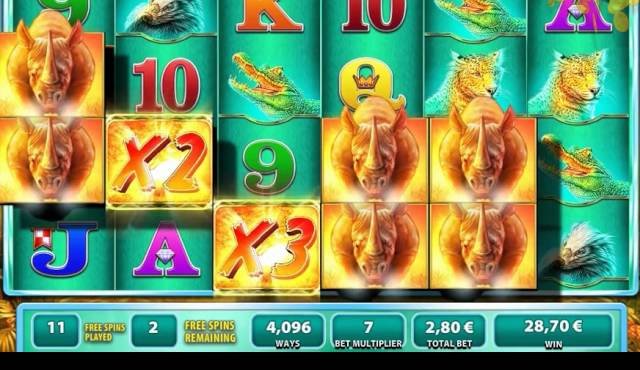
The most recognisable title in the catalogue and a genuine high variance build. Six reels and a large ways count produce long empty stretches broken by free spins rounds carrying stacked multipliers.
It reached online lobbies from a cabinet. Among Light and Wonder slots the reputation travelled first.
The build runs four thousand and ninety six ways across six reels. That count is fixed rather than variable, which separates it from the engines that recalculate ways on every spin.
Free spins carry stacked multipliers that compound. Among Light and Wonder slots it produces the widest gap between a dead session and a good one.
Bankroll requirements are the honest caveat. Long empty stretches are ordinary rather than faulty, and a modest balance at a comfortable stake frequently ends before the free spins round arrives at all.
Stakes start at a lobby minimum on most Ontario deployments. That floor matters on a build this harsh, because spin volume is the only thing that lets the free spins frequency show itself.
What is Zeus?
A WMS cabinet that became one of the most cloned designs in the industry. The layout, the symbol set and the free spins structure were copied across dozens of Greek mythology builds by other studios.
The original still runs in Canadian lobbies. Recognition carries it.
The cabinet predates most of the online market. Its three row layout, its lightning bolt scatter and its free spins count became the template dozens of later Greek mythology builds followed almost exactly.
Copying at that scale is a compliment nobody paid for. The original sits in Canadian lobbies alongside its imitators.
Its descendants outnumber it in a Canadian lobby now. A player scrolling a mythology shelf meets a dozen builds that borrowed the structure, and only one of the Light and Wonder slots there is the original.
What are Light and Wonder slots known for mechanically?
Large ways counts and stacked symbols rather than modern feature stacking. A round resolves through volume of symbols on the reels instead of through layered mechanics, which is a cabinet design habit carried online.
Feature depth is modest across the Light and Wonder slots shelf. Symbol volume replaces it.
Stacked symbols do most of the work. A full reel of the same symbol across a large ways count produces the outsized results, and the base game is built around making those stacks land often enough.
Modern studios layer features instead. Light and Wonder slots reach the same ceiling through symbol volume alone.
Presentation follows the same logic. Bold symbols, a loud win sequence and short animation cycles all come from a machine competing with a noisy room rather than with a browser tab.
What return figures do Light and Wonder slots publish?
Online builds sit between 94 and 96 percent across most of the catalogue. Cabinet versions of the same titles publish considerably lower figures because a floor machine funds rent, staff and floor space.
The online figure is the higher one on Light and Wonder slots. Check it in the client.
The cabinet gap is worth stating plainly. A floor machine commonly publishes in the high eighties or low nineties, and the online conversion of the same title clears ninety four.
Nothing about the game changed. The overheads did, and Light and Wonder slots online carry none of them.
Comparing a floor machine against an online build is the single most useful habit for a Canadian who plays both. The same title on the same trip can cost several percentage points more on the floor.
The band is unremarkable for the market and that is the honest position. Light and Wonder slots compete on recognition rather than on percentage, and nothing in the figures is built to win a comparison table.
Does the studio ship multiple return builds?
Yes, and the practice matters on converted titles. A cabinet conversion is certified at more than one percentage, and the Ontario operator chooses which build to deploy on its own lobby.
Two Canadian sites can differ by a full point. The rules screen says.
Certification at more than one percentage is standard supplier practice. The operator selects which build to deploy, and commercial terms rather than player preference drive that decision every time.
Comparison tables quote the flagship figure. The client running the Light and Wonder slots states what was actually deployed.
Two Ontario registered operators can therefore run genuinely different versions of an identical tile. Checking the deployed figure on Light and Wonder slots takes one glance and settles the question before any money moves.
What volatility do Light and Wonder slots run?
High on the six reel ways builds and medium on the line based conversions. The rhino title is the reference point for the harsh end and a classic three reel conversion sits at the gentle end.
The gap inside the Light and Wonder slots catalogue is wide. Read the rating first.
Reel count is the quickest indicator. A six reel ways build sits at the harsh end almost without exception, and a five reel line based conversion sits comfortably below it.
The rating appears beside the percentage in the rules screen. Reading both takes one glance.
Feature frequency is what a player actually feels across a session. A build opening its round every eighty spins keeps a balance alive, and one opening it every two hundred and fifty does not.
Matching the build to the balance is the practical decision here. Light and Wonder slots split cleanly into a steady line based half and a punishing ways half, and picking the wrong half ends a modest session early.
Are Light and Wonder slots available in Ontario?
Yes. The supplier holds registration with the Alcohol and Gaming Commission of Ontario, and registered operators carry the online catalogue as separately certified builds.
Social apps sit outside that framework entirely. Those Light and Wonder slots pay nothing.
Registration covers the supplier and certification covers each title separately. That two stage process is why the Ontario catalogue is a subset of the full international one rather than all of it.
Depth varies by operator agreement. A registered site carrying the full range stocks far more Light and Wonder slots than one carrying the headline set.
The regulator publishes its registered supplier list openly. Confirming that a lobby carrying Light and Wonder slots is operating legally in the province takes one search rather than trust in an operator claim.
Availability is broad on private Ontario lobbies. Most registered operators carry at least the recognisable Light and Wonder slots, and the deeper agreements reach well past the cabinet conversions everybody stocks.
Do provincial crown platforms carry Light and Wonder slots?
Selected titles appear, and the crossing rate is better here than for most suppliers. Recognisable cabinet names with medium variance fit a crown catalogue brief unusually well.
The harsh ways builds cross less often. Breadth decides it.
Cabinet recognition helps enormously in crown procurement. A player who met a title on a floor machine recognises it on a provincial lobby, and that familiarity is exactly what a curated catalogue wants.
Turnover remains slow. A title reaching a crown shelf keeps its place for years.
Players outside Ontario work from that curated shelf rather than an open market. The crossing rate here is better than most suppliers manage, which makes the catalogue unusually visible nationally.
The certified package is identical on both channels. Only the deployed return version and the depth of the surrounding catalogue differ between a crown platform and a private lobby.
Are Light and Wonder slots certified?
Every online title on a registered Ontario lobby has passed independent laboratory testing of the generator, the reel strips and the published return percentage before deployment.
The certificate covers that build alone. Not the cabinet, not the app.
Testing is market specific as well as title specific. A build cleared in another jurisdiction requires separate Ontario certification, which is part of why the provincial catalogue trails the international one.
The social apps sit entirely outside this. No laboratory tests a product that pays nothing.
Testing covers spin independence as well as the long run percentage. No sequence of losing spins makes the next one more likely on certified Light and Wonder slots, whatever a forum thread claims about a machine being due.
A certificate number appears in the rules screen on most builds. Verifying it is rarely necessary on a registered Ontario lobby, and it exists so a player can check rather than trust what Light and Wonder slots claim.
Can you play Light and Wonder slots for free?
Demo versions of the real money client run the identical certified mathematics with a play money balance. That is a different thing from the social app, which runs its own uncertified build.
Demo teaches the real game. The app teaches nothing about it.
The distinction confuses players constantly and it costs them money. A demo of the regulated client runs certified mathematics, and the free app running the same artwork runs something else entirely.
One teaches the game. The other teaches a coin economy with no payout in it.
Demo play also answers the variance question directly. Two hundred spins on a six reel ways build shows a player exactly what the rating means, and no written description manages the same thing.
One rule settles the whole channel question. A demo of Light and Wonder slots opens from the lobby, and anything opening from an app store is the other product entirely.
Are Light and Wonder slots good for a small bankroll?
The line based conversions suit one and the six reel ways builds do not. A classic conversion at the lobby minimum stretches a modest balance across a genuinely long session.
The rhino build burns through it. Both sit in the same lobby.
Stake selection does more than title selection at the low end. Dropping to the lobby minimum buys the spin volume a ways build needs before its feature frequency shows itself at all.
The classic conversions need less of that patience. They pay small and often by design.
Setting a deposit limit before the first session does more than any title choice. The tooling sits inside every registered Ontario account and it applies across the whole lobby rather than one supplier.
How do Light and Wonder slots compare with IGT slots?
Both convert a deep cabinet library and the difference is the third channel. This supplier runs a large social casino business alongside the regulated one, and its rival has no equivalent scale there.
Catalogue age is comparable. Channel spread is not.
Both catalogues carry titles older than the online market itself. Age is the shared trait, and it explains why neither supplier competes on feature depth against a modern studio release.
Recognition is what both sell. Light and Wonder slots simply sell it through three doors instead of two.
Both reach Ontario through the same registration route and the same laboratory testing. A Canadian choosing between them is choosing a catalogue style rather than a difference in oversight.
Cabinet heritage gives both catalogues the same weakness against a modern release. Light and Wonder slots trade feature depth for recognition, and a player who wants layered mechanics is on the wrong shelf entirely.
What should a Canadian check before playing a Light and Wonder slot?
Three things in the rules screen. The published return figure of the deployed build, the volatility rating, and whether the title is a cabinet conversion or an online original.
Then check which app you are in. That one decides everything.
A fourth check helps anyone on a modest balance. The minimum stake on the deployed build decides how many spins a deposit buys, and it varies between Ontario operators carrying the same title.
All four sit in the running client. None of them require a deposit to read.
The routine generalises past one supplier. Reading the percentage, the volatility rating and the build type works on every title in an Ontario lobby, and Light and Wonder slots are simply where the channel trap makes it urgent.
Which slot pages are worth reading next?
Four pages sit closest to this one. Each covers a supplier or a subject that appears somewhere in the catalogue above, and each stands on its own.
Light and Wonder slots put one name on three products that behave nothing alike, and only the regulated online build publishes a figure that means anything. Read that figure first.