
Playtech is not a studio. It is a group of studios sharing one platform and one progressive network, which is why two Playtech slots sitting beside each other on a Canadian lobby can come from teams that have never worked together. For the wider market picture, start at our online casino Canada hub.
The table below sets out what the group delivers. Read it first, then work through the detail beneath.
| Trait | Detail |
|---|---|
| Structure | A group of owned studios rather than one team |
| Progressive network | Age of the Gods |
| Signature titles | Age of the Gods, Buffalo Blitz, Gladiator |
| Own engine | The 4096 ways six reel layout |
| Return range | Roughly 93 to 96.5 percent across Playtech slots |
| Canadian supply | Ontario registered operators and selected crown catalogues |
What are Playtech slots?
Playtech slots are titles built or published by the Playtech group, a supplier that operates its own studios alongside a platform used by operators.
the Playtech slots catalogue runs to well over a thousand titles.
Group structure is the defining trait. It explains almost everything else.
Catalogue size is the first thing that separates Playtech slots from a single studio library. Where a browser era studio publishes two or three dozen titles a year from one team, the Playtech group publishes across several teams at once, and the combined output reaches a scale almost no rival matches.
The second difference is that the group sells more than games. Operators can license the platform that runs their whole site, and that arrangement pulls the game catalogue along with it, which is why a number of Canadian facing lobbies carry hundreds of Playtech slots and others carry a handful.
For a player the practical consequence is inconsistency. Two Playtech slots opened one after the other can differ in interface layout, feature vocabulary, sound design and published return figure, because they were built by different teams under different assumptions.
That inconsistency is neither a fault nor a virtue. It simply means the badge on a lobby tile carries less information here than it does on a catalogue produced by one studio with one house style.
Scale also changes how a lobby merchandises the catalogue. An operator carrying a thousand Playtech slots cannot surface them individually, so it promotes the jackpot families and the two or three recognisable ways builds and leaves the rest to search. A player who never opens the supplier filter therefore meets a narrow slice of what is actually available, and the deeper catalogue stays invisible. That is worth knowing because the strongest published return figures across Playtech slots sit in that deeper catalogue rather than in the promoted rows, and reaching them takes one filter click rather than any special knowledge.
One more consequence follows from the size. A catalogue this deep contains titles that have not been updated in years alongside releases from the current quarter, and a Canadian lobby sorts them together. Checking the interface style is a rough age test, and checking the published figure is the accurate one.
A Canadian lobby listing Playtech slots therefore mixes eras as freely as it mixes studios, and the sort order rarely separates them.
The supplier filter is the single most useful control on a lobby carrying Playtech slots, because it converts an unsorted wall of thumbnails into a list a player can actually work through.
Is Playtech one studio or several?
Several, and that is unusual among the majors. Playtech acquired and built studios across more than a decade, and each retained its own design habits, so Playtech slots carry no single house style.
A player cannot predict a Playtech title from the badge alone. Other suppliers are far more consistent.
The group grew by acquisition as much as by building. Across more than a decade it bought established studios outright, kept their teams in place and published their output under the group umbrella, which is a very different model from hiring designers into a single internal team.
Each acquired team arrived with its own habits. A studio that had spent years building high production releases for European markets designs nothing like a team that built simple low stake titles for a different audience, and both continue under the same badge.
The flagship families are the exception that proves the pattern. Age of the Gods was designed as a group product with a shared network, so its titles do share a house style, and that consistency is unusual across the wider catalogue of Playtech slots.
Reading the studio name inside the rules screen is therefore genuinely useful. It predicts the design language, the feature vocabulary and frequently the volatility band far better than the group badge does.
The group model has a commercial logic that explains why it persists. Acquiring a studio buys an audience, a back catalogue and a team in one transaction, and keeping the studio name intact preserves the recognition that made it worth buying. Building the same breadth internally would take a decade and produce a single house style rather than several. The cost of that approach is exactly the inconsistency a player meets, and the benefit is that Playtech slots cover design territory no single team could occupy at once.
The group name on a tile therefore works like a publisher credit rather than an author credit. It tells a player who distributed the title and who stands behind the certification, and it says almost nothing about who designed it or how it plays.
Treating Playtech slots as one catalogue with one character is the mistake the structure invites, and reading the studio line avoids it entirely.
Anyone recommending Playtech slots as a single category is describing a distribution arrangement rather than a body of work with shared design decisions behind it.
Which studios sit inside the Playtech group?
Quickspin, Ash Gaming, Eyecon, Rarestone, Fuga and three smaller teams all publish under the group. Each targets a different segment, from high production releases to simple low stake builds.
The badge on the lobby tile hides that variety. The rules screen names the studio.
Quickspin is the best known and the most independent. The Swedish studio built a reputation on polished mid variance releases before the acquisition and continues publishing under its own name, which is why its Playtech slots read as a separate catalogue.
Ash Gaming came from a different tradition entirely, building licensed and branded content for operators. Eyecon arrived from the low stake bingo adjacent market and its titles reflect that origin in simple structures and small minimum bets.
Rarestone, Fuga and three smaller teams fill out the group, each targeting a specific segment. The result is a Playtech slots catalogue covering nearly every design approach in the market without any single team having to cover them all.
Canadian lobbies rarely surface this structure. The filter says Playtech, the tile says Playtech, and only the rules screen inside the running title names the studio that actually built it.
Knowing the studio also predicts the stake range. The teams that came from the low stake market build titles with minimums a fraction of what a high production release demands, and the teams building for competitive European markets set higher floors and deeper feature stacks. A Canadian player choosing between two Playtech slots on the same page is frequently choosing between those two traditions without knowing it, and the rules screen is the only place the distinction is stated outright.
Filtering by studio is not always possible on a Canadian lobby. Where the operator offers only a supplier filter, sorting the resulting list by popularity or by release date is the next best way to separate the traditions inside it.
Sorting by release date separates the traditions reasonably well, because the newest Playtech slots come overwhelmingly from the studios still shipping regularly.
Minimum stakes across Playtech slots therefore range from a few cents on the simplest builds to substantially more on the high production releases, with no warning on the tile.
What is Age of the Gods?
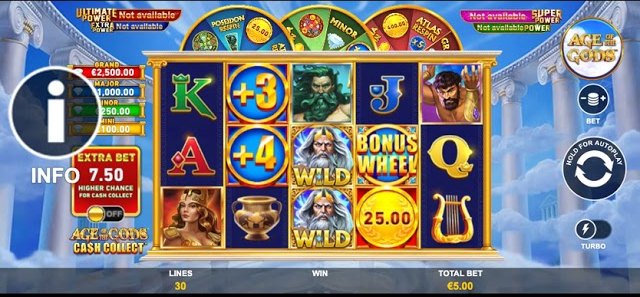
The Playtech progressive network and the group flagship. A family of Greek mythology titles shares one four tier jackpot pool, and every qualifying spin across all of them feeds the same prize.
The network is the reason the family exists. Individual titles are entry points.
The family is the commercial centre of the group and the clearest example of a network built deliberately rather than assembled. Every title shares Greek mythology artwork, a four tier jackpot structure and the same wheel that decides which tier pays.
Scale is what makes it work. A pool fed by dozens of titles across dozens of operators grows far faster than one attached to a single game, so the top tier reaches figures that a standalone progressive could never sustain.
The family keeps expanding. New Age of the Gods titles arrive regularly with different base games, different volatility and different return figures, all feeding the same pool and all carrying the same jackpot wheel.
For Canadian players the family is the most recognisable part of the Playtech slots catalogue. It is also the part where reading the published return figure matters most, because the pool contribution comes out of it.
The family also demonstrates how a modern network is merchandised. Each new release carries the same wheel, the same tier names and the same jackpot panel above the reels, so a player who has met one title recognises the structure instantly on the next. That consistency is deliberate and it is the main reason the family outperforms the rest of the Playtech slots catalogue in lobbies that promote it. The base games underneath vary considerably, which is where a player should look when choosing between them.
Tier names are worth learning because they recur across every release in the family. Power, Extra Power, Super Power and Ultimate Power describe the same four levels wherever they appear, and the top two carry the figures worth checking before a session.
No other family inside Playtech slots carries the same promotional weight, and none of the alternatives reaches comparable pool sizes.
Players who enjoy the structure will find the family easy to move around, since every entry in these Playtech slots presents the jackpot panel in exactly the same position.
The base games underneath the family vary far more than the shared panel suggests. One entry runs a conventional payline build, another runs a ways engine, and a third carries a cascade, so a player who dislikes one of these Playtech slots may well enjoy the next. Reading the base game rather than the jackpot panel is the useful comparison inside the family.
How does an Age of the Gods jackpot trigger?
Randomly rather than by symbol combination. Any spin can open a four segment wheel, and where the pointer settles decides which of the Power, Extra Power, Super Power or Ultimate Power tiers pays.
The probability scales with the stake. Nothing else influences it.
The trigger is random and independent of the reels. Any spin at a qualifying stake can open the jackpot screen regardless of what landed, which means watching for a symbol pattern is watching for something the build does not contain.
The wheel that follows is divided into segments across four tiers. Power sits at the bottom and pays most often, Extra Power and Super Power sit in the middle, and Ultimate Power holds the headline figure and appears on a single narrow segment.
Stake scaling keeps the structure fair. The certified probability of opening the jackpot screen rises with the amount staked, so a player betting more faces the same chance per dollar committed as a player betting less.
Nothing a player does changes any of it. Timing, stopping the reels, switching titles within the family and playing longer sessions all leave the certified probability exactly where it started.
The qualifying stake deserves particular attention because it is easy to miss. Most jackpot linked Playtech slots require a minimum bet before a spin contributes to the pool and becomes eligible for the wheel, and a player staking below that line is funding nothing and cannot trigger the jackpot at all. The figure sits in the rules screen alongside the tier names, it is usually modest, and ignoring it turns a jackpot title into an ordinary slot with a lower than normal return.
The wheel itself is decided by the same certified draw that opened it. Segment sizes are fixed in the build, the pointer follows the result rather than producing it, and the animation exists to present an outcome that already exists.
That randomness is why jackpot linked Playtech slots need no special play pattern, and why none exists.
The absence of a symbol trigger is itself worth noting, because it makes these Playtech slots behave differently from every jackpot build that requires a specific combination.
What does the shared pool cost the base return?
A visible slice of the published figure. A jackpot linked title returns less in ordinary play than an unlinked build of similar design, because the pool contribution has to come out of the same total.
The rules screen states the deployed figure. It already includes the pool.
Every progressive is funded the same way and Playtech slots are no exception. A fraction of each qualifying stake is diverted into the pool, and that fraction is removed from the return the base game would otherwise have paid.
The published figure already accounts for it. A rules screen quoting a percentage on a jackpot linked title is stating the total including the pool contribution, so the ordinary play a session actually experiences returns less than the headline suggests.
The practical effect is a harsher base game. Long stretches without a meaningful win are the designed consequence of funding a prize that most sessions will never reach, and the volatility rating reflects that honestly.
Comparing a jackpot title against an unlinked one on the published figure alone therefore understates the difference. The unlinked build pays its whole return in ordinary play, and the linked build does not.
The size of the deduction varies by title and it is rarely stated separately. A studio publishing a linked build at 94 percent and an unlinked build of similar design at 96 percent has effectively moved two percentage points into the pool, and the player carries that cost on every spin whether or not the jackpot is ever reached. Understanding that trade is the single most useful thing to know before choosing jackpot linked Playtech slots over the rest of the catalogue.
A player content to skip the jackpot entirely has a simple option. Choosing the unlinked build of a similar title recovers the pool contribution in ordinary play, and on a Canadian lobby both versions frequently sit within a few rows of each other.
Unlinked Playtech slots return their whole certified percentage in ordinary play, which is the entire trade the jackpot builds make.
A session spent entirely on jackpot linked Playtech slots therefore costs more per spin on average than the same session spent on unlinked builds from the same supplier.
Which Playtech slots do Canadians know?
The Age of the Gods family leads, followed by Buffalo Blitz, Gladiator, White King and the Quickspin releases such as Big Bad Wolf.
Most Ontario registered lobbies carry the whole set.
Recognition varies by channel. The jackpot titles travel furthest.
The Age of the Gods family travels furthest because the jackpot is promoted heavily. Canadian players meeting the group for the first time usually meet it through one of those titles rather than through the wider catalogue.
Buffalo Blitz sits alongside it as the best known non jackpot release. The North American plains setting and the 4096 ways engine gave it an audience well beyond the group regular players, and the sequel and live version extended that reach.
Gladiator and White King represent the older catalogue, both from an era when the group leaned on licensed and cinematic presentation. Both of those Playtech slots remain available in places and both show their age beside current releases.
The Quickspin titles form a separate recognition set entirely. Big Bad Wolf and Sakura Fortune are known to players who could not name the parent group, which is exactly the independence the studio retained.
Recognition and quality are not the same thing and this catalogue separates them clearly. The titles Canadian players name first are the ones operators promote hardest, which are usually the jackpot families carrying the lowest published return figures in the group. The strongest figures sit on releases most players have never opened. That gap between what is promoted and what pays best is wider across Playtech slots than across most supplier catalogues, and closing it requires nothing more than opening the rules screen on an unfamiliar title.
Popularity sorts amplify the same effect. A Playtech slot promoted heavily accumulates play, the play pushes it up the sort, and the sort drives more play, which keeps the same handful visible regardless of what the published figures say.
Recognition across Playtech slots therefore tracks promotion rather than published figures, and the two diverge noticeably.
Working down from the promoted rows into the wider list is how a player finds the Playtech slots that publish the strongest certified figures.
What is Buffalo Blitz?
A six reel four row title running 4096 ways, built on North American plains iconography. It became one of the most played Playtech slots in regulated markets and spawned a sequel and a live game show version.
The ways count is the appeal. The base game pays frequently.
A six reel four row title built on a North American wildlife theme, running 4096 ways rather than drawn paylines. It arrived at a point when wide ways engines were still uncommon and the sheer route count made the base game feel unusually generous.
The free spins round is conventional and the base game is where the title earns its reputation. Frequent small wins from stacked symbols across six reels keep a balance moving in a way the jackpot families deliberately do not.
Its success produced a family. A sequel widened the engine further, a Megaways style variant appeared, and a live game show version brought the branding into the live catalogue beside the Playtech slots.
For a Canadian player it remains one of the most accessible entries in the Playtech slots catalogue. The mechanic needs no explanation and the volatility suits a modest balance.
Its longevity says something useful about design. A Playtech slot with no progressive, no purchase option and no elaborate modifier has held a lobby position for years purely on the strength of a wide ways engine and a generous base game. That is the opposite of the direction the wider market has taken, and it explains why the title still appears near the top of popularity sorts on Canadian lobbies carrying Playtech slots. Simplicity aged better here than feature density did elsewhere.
The sequel and the wider engine raised the route count without changing the character of the base game. A player who liked the original will recognise the rhythm immediately, and the published return figures across the family sit close together.
Among Playtech slots it remains the clearest example of a title carried entirely by its base game.
Its base game rhythm is the reason it suits a modest balance better than most of the jackpot linked Playtech slots sitting near it on a lobby page.
The title is easy to recommend for one reason. It explains itself. No purchase button, no modifier stack, no qualifying stake. A player opens it and understands it inside two spins. Very few Playtech slots manage that now.
What is a 4096 ways engine?
Six reels of four positions each, where matching symbols on consecutive reels pay regardless of row. Six reels at four positions produces four to the power of six, which is 4096 possible routes.
No paylines are drawn. Position count does the work.
The arithmetic is simple once the structure is clear. Six reels each showing four symbol positions produce four multiplied by itself six times, which is 4096 distinct routes from the leftmost reel across the grid.
A win requires matching symbols on consecutive reels starting from the left, and the row makes no difference. That removes the payline concept entirely, so a player never chooses how many lines to activate and the stake covers the whole grid.
Paytable numbers look smaller under this structure and that is expected. Spreading the same certified return across 4096 routes rather than twenty lines means each individual award is worth less, and the compensation is how often something pays.
Modern engines have pushed far beyond the figure. Megaways builds reach 117,649 routes and cluster grids abandon route counting altogether, and the 4096 layout now reads as a mid range option rather than a headline feature.
The engine also changes how a stake is read. With no lines to select, the amount shown is the whole commitment for the spin, which removes the confusion that line based builds create when a player compares a per line stake against a total bet. Every award across these Playtech slots is quoted against that total, so the paytable reads consistently and the arithmetic needs no conversion. That clarity is a genuine advantage for anyone comparing two titles quickly.
Stacked symbols are what make the engine work in practice. A full reel of one symbol multiplies the route contribution from that reel, which is how a wide ways build produces the occasional large result without any multiplier mechanic attached.
Several Playtech slots use the layout, and the paytables across them read consistently because the basis never changes.
Reading a ways paytable takes a moment of adjustment for anyone arriving from line based Playtech slots, because the numbers look smaller for the same certified return.
What is Gladiator and why does it still matter?
A licensed title from the early Playtech catalogue that carried a progressive jackpot and reached an audience far beyond regular slot players.
It established the group in markets that had not carried its games before.
The licence has since lapsed. The title remains available in places.
The title mattered commercially rather than mechanically. It arrived carrying a film licence at a time when branded content was rare online, and it pulled players into the Playtech slots catalogue who had never opened a slot from a supplier they had heard of.
The progressive attached to it did the rest. A jackpot promoted alongside a recognisable brand reached an audience far beyond regular slot players, and that template shaped how the group marketed everything that followed.
Mechanically it is ordinary by current standards. A five reel payline build with a pick round and a jackpot trigger describes hundreds of titles, and nothing inside it would stand out on a lobby page today.
The licence has since lapsed and availability has narrowed. What survives is the approach, visible in how Age of the Gods was built and marketed as a family rather than as a collection of separate Playtech slots.
It is also a useful warning about licensed content generally. A Playtech slot built on an external agreement can disappear from a lobby with no notice, taking its jackpot and its player base with it, and nothing about the certified build protects against that. The group learned the lesson publicly and rebuilt around owned properties, which is why the Playtech slots a Canadian player meets now are anchored by a network the company controls outright rather than by brands it rents.
The presentation standard it set outlasted the licence. Cinematic intros, voiced characters and jackpot panels above the reels all became normal after it, and those conventions still shape how the group presents its owned families today.
Its influence on later Playtech slots is presentational rather than mechanical, and it is visible in every jackpot panel since.
The title is also a reminder that availability across Playtech slots depends on agreements a player never sees and cannot influence.
What happened to the licensed Playtech titles?
Most have gone. The group held comic book and film licences for years and built substantial jackpot families around them, and when those agreements ended those Playtech slots were withdrawn from regulated lobbies.
Age of the Gods replaced them. It is owned rather than licensed.
Licensing was a deliberate strategy for more than a decade. The group held agreements covering comic book characters, film properties and television formats, and built jackpot families around them that reached audiences a generic slot never would.
Those agreements have finite terms. When a licence ends the titles have to be withdrawn from regulated lobbies, the associated jackpot pools are settled, and players lose access to games that had been available for years.
The withdrawals left a gap the group filled deliberately. Age of the Gods was designed as an owned property precisely so that no external agreement could remove it, which is why it now anchors the catalogue.
Canadian players arriving now will not meet the licensed families at all. What they meet is the owned network and the studio catalogues, which is a more stable foundation than the licensed era provided.
Pool settlement is the part most players never see. When a licensed family is withdrawn the progressive pool attached to it has to be paid out rather than simply switched off, and regulators require a documented process for that. The mechanics vary by jurisdiction and by agreement, and the outcome is that the money committed by players is returned to players rather than retained. It is a small detail that explains why licensed withdrawals happen slowly and with notice rather than overnight.
Owned properties also allow long term investment. A family the company controls can receive new releases for a decade without an agreement lapsing, which is why Age of the Gods keeps expanding while the licensed families did not.
The owned families now anchoring Playtech slots exist precisely because the licensed ones could be removed.
Stability is the practical benefit for a Canadian player, since owned Playtech slots stay on a lobby for as long as the operator wants them there.
What return figures do Playtech slots publish?
The range runs from about 93 percent on older jackpot linked builds to 96.5 percent on the strongest Quickspin releases.
Group breadth produces a wider spread than a single studio catalogue carries.
The rules screen states the deployed figure. It is the only one that applies.
Breadth produces the spread. A group publishing across five studios and two product eras carries return figures from the low nineties on older jackpot linked builds to the mid nineties on current Quickspin releases.
The jackpot families sit at the bottom of that range by design. Funding a four tier pool removes return from ordinary play, so a linked title publishes a lower figure than an unlinked build of otherwise similar construction.
The Quickspin releases sit at the top. Built for competitive European markets where players compare published figures, those titles ship at percentages that stand up against any modern studio.
Reading the running client is the only reliable approach across a Playtech slots catalogue this wide. Two Playtech slots on the same Canadian lobby can differ by more than three percentage points, and nothing on the tile reveals it.
Comparing across Playtech slots is therefore a two step job rather than one. Filter to the supplier, then read the figure inside each candidate, because the spread is wide enough that the supplier name alone tells a player almost nothing about what a title costs to play. On a catalogue produced by one studio that second step is often unnecessary. Across Playtech slots it is the whole exercise, and skipping it is how players end up on the weakest builds in a strong catalogue.
The figure is a long run statistic rather than a session prediction. A Playtech slot certified at 96 percent can return nothing across two hundred spins and well above its figure across another two hundred, and neither outcome says anything about the certification.
No other major slots catalogue asks a Canadian player to check as carefully, because no other major catalogue spans this many teams and eras.
Filtering the supplier and then reading each candidate figure is a two minute exercise that separates the strongest Playtech slots from the weakest on any lobby.
Does Playtech ship multiple return builds?
Yes, and it matters more here than on most catalogues. Popular titles are certified at three or four percentages and an operator selects which to deploy, so two Canadian lobbies can run genuinely different versions.
Comparison tables quote one figure. The running game states the real one.
The practice is industry wide and the group applies it across most of the catalogue. A Playtech slot is certified at three or four percentages, each with its own reel strips and its own laboratory submission, and the operator chooses which certified package to deploy.
Operator economics decide the choice. A site competing on game quality deploys the higher build, a site competing on bonus generosity frequently deploys a lower one to fund the promotions, and neither choice is visible from outside the running game.
The consequence for a Canadian player is that a Playtech slot name is not a specification. Two lobbies listing the same Playtech slots can be running packages that differ by two or three percentage points, which over a session outweighs almost every other difference between them.
Affiliate tables compound the problem by quoting the studio headline figure. That number describes the best certified version rather than the one deployed, and it is frequently the only figure a comparison site has access to.
The rules screen inside the client is the authority. It states the percentage for the package actually running, it is required on a regulated Canadian site, and reading it takes seconds.
Checking is quick once the habit forms. Open the title, open the rules screen, find the line stating the theoretical return, and compare it against the figure the comparison site quoted. Where the two differ the deployed package is the lower one, and moving to a different Ontario registered operator frequently finds the same title running the higher certified version. That is a real difference in cost per spin and it is available to any player willing to spend thirty seconds looking.
Operators rarely advertise which version they deploy. The information exists inside the client because regulation requires it, and it almost never appears on the lobby page, the promotional material or the affiliate table pointing at the site.
Two Canadian sites listing identical Playtech slots can therefore charge materially different amounts per spin for the same game.
Anyone moving between Ontario registered operators should expect the same Playtech slots to carry different figures, because that is what the certification model permits.
What volatility do Playtech slots run?
The spread is wide because the group is wide. Jackpot linked titles run high, the 4096 ways builds run medium with frequent small wins, and the Quickspin releases cover the full range on their own.
The rating sits in the rules screen. The badge predicts nothing.
No single answer covers a Playtech slots catalogue this wide. The group publishes across studios that were building for different audiences, so the volatility distribution spans nearly the whole market rather than clustering the way a single studio catalogue does.
The jackpot families run high and the reason is structural. A build funding a four tier pool has to thin the ordinary play that funds it, which produces long flat stretches punctuated by rare large outcomes.
The 4096 ways builds sit in the middle. Wide route counts produce frequent small wins that keep a balance moving, and the paytable is scaled down to compensate, which is a classic medium variance shape.
The Quickspin releases cover the full range on their own. The studio publishes low variance titles aimed at long sessions and high variance titles aimed at large outcomes, and it states the rating clearly on each.
Reading the rating rather than the badge is the practical advice. Across Playtech slots the group name predicts volatility poorly, and the rules screen predicts it exactly.
Matching the rating to a bankroll is the practical use of it. A balance covering two hundred spins suits a medium rated ways build and does not suit a high rated jackpot family, because the second one is designed around outcomes a two hundred spin session will almost never reach. The rating is published on nearly every modern release in the group, it takes one line to read, and it predicts the shape of the next hour far better than the artwork or the promoted position does.
Ratings use different scales across Playtech slots, which is another consequence of the studio structure. A three star rating from one team does not mean the same thing as a medium label from another, so reading the accompanying description is worth the extra few seconds.
Reading the rating on each candidate is the only approach that works across Playtech slots, because the badge carries no information about it.
A rating and a return figure read together describe any of these Playtech slots accurately enough to decide whether the next hour is worth committing to it.
The rating also predicts how a bonus will behave. Clearing a wagering requirement on high volatility Playtech slots produces a wide range of outcomes and frequently ends early, and clearing it on a medium rated ways build progresses steadily. That difference matters more than the return figure when a bonus balance is in play, and it is stated in the same screen.
What is Quickspin and how does it fit?
A Swedish studio the group acquired, known for polished releases such as Big Bad Wolf and Sakura Fortune, and the source of the strongest published figures across Playtech slots.
It operates with more independence than the other group studios and publishes its own return figures.
Quickspin titles feel nothing like the jackpot families. That is deliberate.
The studio was founded in Sweden by people who had worked at other major suppliers, and it built a reputation before the acquisition rather than after it. That history is why it retained a separate identity inside the Playtech slots group.
Its titles are recognisable on sight. High production artwork, clearly explained features and a consistent interface language run across the catalogue, which is exactly the house style the wider Playtech slots catalogue lacks.
Big Bad Wolf is the best known release and it demonstrates the approach. A cascading build with a visible progress meter and a clearly stated feature trigger, aimed at players who compare published return figures before choosing.
Sakura Fortune, Hidden Valley and the Sticky Bandits line fill out the recognition set. All of them sit at the upper end of the Playtech slots return range and all of them publish volatility ratings clearly.
For a Canadian player looking for the strongest Playtech slots on a lobby, filtering to this studio is the most reliable shortcut available. The parent badge tells you far less.
The studio also publishes its figures more openly than most of the group. Return percentages, volatility ratings, hit rates and maximum wins all appear in the rules screens of its releases, which makes the catalogue unusually easy to compare against rivals. For a Canadian player treating the supplier filter as a shortlist tool, that transparency is worth as much as the production quality. It is also the clearest evidence that the group operates as several studios rather than one, because the rest of the catalogue is nothing like as consistent.
The independence also shows in release pace. The studio ships fewer titles a year than the Playtech slots catalogue as a whole and finishes each to a higher standard, which is the trade a specialist team makes against a volume publisher.
For a shortlist of strong Playtech slots the studio filter is the fastest route available on any Canadian lobby.
Its releases consistently sit at the top of the published figures across Playtech slots, which makes the studio name a reliable quality signal on a crowded lobby.
What is the platform behind Playtech slots?
An operator platform handling accounts, payments, bonuses and game delivery. A number of Canadian facing operators run on it, which is why their lobbies lean heavily on Playtech slots.
The platform is invisible to a player. It shapes what the lobby carries.
The group sells an operator platform alongside the games, covering accounts, payments, bonus engines, reporting and game delivery. An operator licensing it gets a complete site rather than a content feed.
That arrangement shapes what a lobby carries. A site running the group platform surfaces the Playtech slots catalogue first because the integration is native, while a site integrating through an aggregator lists a much narrower selection.
Canadian facing operators split along that line. A number carry hundreds of Playtech slots and promote the jackpot families heavily, and others carry a dozen recognisable titles alongside content from a dozen other suppliers.
None of this changes the certified builds. The platform decides which Playtech slots reach a lobby and how they are merchandised, and the mathematics inside each game is identical wherever it is deployed.
A player will never see the platform directly. Its effect shows up only as catalogue depth, which is worth knowing when a specific title cannot be found on a particular site.
Bonus terms are the other place the platform shows through. A site running the group platform builds its offers inside that bonus engine, which decides how wagering is tracked, which games contribute at what rate and how a bonus balance is separated from cash. None of that touches the certified games, and all of it affects what a promotion is actually worth. A player comparing two Canadian sites carrying the same Playtech slots may find the offers behave quite differently for exactly this reason.
Account and payment handling sit in the same layer. Deposit options, withdrawal processing and verification flows on a platform site all come from the supplier rather than the operator, which is why sites running it feel similar to use.
Catalogue depth is the only part of the arrangement a player sees, and it decides how many Playtech slots a lobby actually lists.
A player unable to find particular Playtech slots on one Canadian site is usually looking at an integration decision rather than a market restriction.
The effect is simple to test. Open two Canadian lobbies. Filter both to the supplier. Compare the counts. A platform site will list several hundred Playtech slots and an aggregator site will list a fraction of that.
How does the live casino connect to the slots?
Through shared branding and shared jackpots. Age of the Gods appears as a live game show alongside the slot family, and the group runs live tables from studios serving the same operators.
The crossover is commercial. The certified mathematics stays separate.
The group runs one of the larger live dealer operations alongside its slot catalogue, and the two are marketed together rather than separately. Shared branding is the most visible connection.
Age of the Gods appears in both. A live game show built around the same mythology sits in the live lobby, carrying the same visual identity and in some deployments feeding the same progressive structure as the slots.
Buffalo Blitz received the same treatment. The wildlife branding moved into a live format, which extends the recognition a slot built years earlier already carried.
The certified mathematics stays entirely separate. A live game is tested as a live game and a slot is tested as a slot, and sharing artwork creates no connection between the two beyond the marketing.
For a Canadian player the crossover mainly affects discovery. Meeting the branding in one lobby makes the other lobby feel familiar, which is precisely the commercial intent.
The shared identity has a practical use for a player as well. A live game show carrying slot branding usually publishes its own return figure and its own volatility characteristics, and those numbers are unrelated to the slot despite the matching artwork. Assuming the live version behaves like the reel version is a common mistake, and reading the rules on each separately is the only reliable approach. The branding is a marketing bridge rather than a statement about the mathematics.
Cross promotion runs in both directions. A slot lobby surfaces the live version of a familiar brand and the live lobby surfaces the reels, which keeps a player inside one supplier catalogue across two very different product types.
Shared branding between a live game and the Playtech slots it borrows from says nothing about the certified mathematics behind either.
Treating a live game and the Playtech slots it shares branding with as the same product is a mistake the marketing actively encourages.
Where can Canadians play Playtech slots?
Ontario registered operators carry the catalogue, with the depth varying by which platform an operator runs. Sites built on the group platform list far more of it than sites integrating through an aggregator.
The certified build is identical everywhere. Only the selection differs.
Ontario registered operators are the main route and the depth varies enormously between them. A site built on the group platform lists the catalogue in full, and a site integrating through an aggregator lists whichever titles that aggregator carries.
Supplier registration is the gating requirement. The group holds it, so its titles reach registered lobbies as certified builds with the deployed return figure stated inside each game.
Finding a specific title is therefore an operator question rather than a market question. A player unable to locate a particular Age of the Gods release on one Ontario site will frequently find it on another without leaving the regulated market.
Provincial crown platforms carry a narrower selection shaped by their own agreements. The Playtech slots that reach them are usually the recognisable jackpot families rather than the deeper studio catalogues.
The certified package is identical across every channel. Only the selection and the chosen return version differ, and both are visible from inside the running client.
Lobby search behaviour is worth adjusting for this catalogue. Searching a title name returns nothing when an operator has not integrated that specific release, and filtering to the supplier returns everything the operator does carry in one list. Starting with the filter rather than the search box therefore gives an accurate picture of the available Playtech slots in a few seconds, and it surfaces the deeper catalogue that the promoted rows never show.
Operator catalogues change without notice. A Playtech slot available last month can be absent this month because an agreement lapsed or an aggregator dropped it, and nothing about that change is announced to players in advance.
Using the supplier filter first gives an accurate count of the Playtech slots any given Ontario lobby carries.
Catalogue depth varies enough between operators that a shortlist of Playtech slots built on one site may be largely unavailable on another.
Operators also differ in how they surface the studio names inside the group. A lobby offering only a supplier filter hides the distinction entirely, and a lobby offering studio filters makes the strongest Playtech slots reachable in one click. That difference is worth noticing when choosing where to play rather than what to play.
Do provincial crown platforms carry Playtech slots?
Selected titles appear. Crown catalogues are curated rather than comprehensive, and the Playtech slots reaching them are usually the recognisable jackpot families rather than the deeper catalogue.
Supplier agreements decide the list. Nothing about the games differs.
Crown catalogues are curated rather than comprehensive, which is the first thing to understand about them. A provincial operator negotiates individually and lists a few hundred titles where a private operator lists thousands.
Playtech slots reaching those catalogues are the recognisable ones. Jackpot families and the best known ways builds appear because they justify the shelf space, and the deeper studio catalogues generally do not.
The certified builds are the same packages the private operators deploy. A crown operator selects a return version exactly as a private operator does, and states it in the rules screen in the same way.
Catalogue depth is therefore the practical difference. A player looking specifically for Playtech slots will find more of them on a registered private lobby than on a crown platform.
Availability also shifts over time. Supplier agreements are renegotiated, titles are added and withdrawn, and a game present on a crown site one year may not be there the next.
Crown catalogues also tend to favour the lower volatility end. A provincial operator selecting a small number of titles for a broad audience leans toward builds that pay frequently and explain themselves quickly, which excludes most of the high variance material a private lobby carries. The result is a shorter list of Playtech slots that suits a casual session better than it suits a player looking for the widest outcomes.
Crown sites also update more slowly. A private operator adds new releases weekly and a provincial platform reviews its catalogue far less often, so the selection there reflects earlier decisions rather than the current release schedule.
The Playtech slots that reach a crown catalogue are chosen for a broad audience rather than for range.
A player set on a specific title will generally do better on a registered private lobby, where the Playtech slots catalogue is listed in full.
Are Playtech slots certified for Ontario?
The group holds supplier registration and every title on a registered lobby has passed independent laboratory testing. The Alcohol and Gaming Commission of Ontario audits operators against that standard afterwards.
Crown platforms apply equivalent requirements. The testing process is the same.
Supplier registration with the Alcohol and Gaming Commission of Ontario is the entry requirement and the group holds it. Without it no title could legally appear on a registered lobby in the province.
Certification happens at the game level as well. An accredited laboratory examines the random number generator, confirms the reel strips match the submitted specification, and simulates the build to verify the published return figure.
Ontario then audits operators against that standard. A registered site has to run the certified package unmodified and has to make the return figure available, which is the practical difference between the regulated market and an offshore one.
Crown platforms apply equivalent requirements through procurement rather than through a regulator registration. The testing process behind the games is the same in both channels.
The certification covers the jackpot structure too. Age of the Gods pool mechanics are tested as part of the build rather than treated as a separate marketing layer on top of it.
Certification also covers what the player is shown. A regulated build has to display the return figure, has to state the rules accurately and has to resolve a disconnected spin on the server rather than in the client, and all three are tested rather than assumed. That is the substantive difference between playing Playtech slots on an Ontario registered site and playing the same certified package somewhere with no regulator behind it. The game is identical and the accountability is not.
Certification numbers are traceable. An accredited laboratory issues a report for each certified build, operators retain it, and the regulator can request it, which is what makes the published figure an auditable claim rather than marketing copy.
Every one of the Playtech slots on a registered lobby has been through that process before deployment.
That testing is what makes the published figure on Playtech slots a verifiable claim rather than something an operator asserts about its own games.
The checks run in a fixed order. The generator is tested first. The reel strips are matched against the submission. The return is simulated. Only then does a build reach a lobby. Every one of these Playtech slots went through it.
How do Playtech slots compare with IGT slots?
Both are old suppliers with progressive networks, and the difference is origin. IGT converted a cabinet library for browsers, while the Playtech group built for online play first and acquired studios rather than manufacturing hardware.
The catalogues feel different because of that. Neither is uniformly stronger.
Both are old suppliers with progressive networks and long catalogues, and the difference starts with where they came from. One manufactured cabinets for casino floors and converted that library for browsers, and the other built for online play and acquired studios instead of factories.
That origin shows in the design. The converted cabinet titles carry simple features and restrained animation drawn for a screen viewed from standing, and the Playtech slots catalogue carries the density and variety of teams building for browsers from the start.
Network structure differs as well. MegaJackpots attaches to a set of recognisable titles, and Age of the Gods was designed as a family from the beginning with the network as the organising idea rather than an addition.
Return ranges overlap closely. Both catalogues run from the low nineties on older or jackpot linked builds to the mid nineties on current releases, and neither is uniformly stronger than the other.
The honest comparison is that they suit different preferences. A player wanting simplicity and recognition leans one way, and a player wanting variety and modern feature density leans toward Playtech slots.
Catalogue navigation differs too and it matters more than it first sounds. The IGT library rewards knowing which generation a title came from, because the return figures moved between the cabinet era and the browser era. the Playtech slots catalogue rewards knowing which studio built a title, because the design and the figures vary by team rather than by date. Both are two step checks and both take one rules screen, but a player who applies the wrong filter to the wrong catalogue learns very little.
Both groups also supply live dealer content, which narrows the difference further at the lobby level. A Canadian operator carrying one of them often carries the other, and the two catalogues sit side by side under separate filters.
A player comparing the two catalogues is really comparing eras and structures rather than deciding which supplier pays better.
Both reward the same habit, which is opening the rules screen before the first spin rather than trusting the lobby position of any title.
Are Playtech slots good for a small bankroll?
The 4096 ways builds are, and the jackpot families are not. Frequent small wins on a wide ways engine stretch a balance, and a title funding a four tier pool thins the base game to pay for it.
The volatility rating separates the two. It takes one read.
The answer splits along the jackpot line. A title funding a four tier pool thins its base game to pay for it, so a small balance on one of those frequently ends with nothing memorable happening at all.
The 4096 ways builds run the opposite way. Frequent small wins across a wide route count keep a balance moving in narrow steps, which stretches a fixed amount across far more spins and reaches the feature more often.
The Eyecon titles inside the Playtech slots group go further still. Built originally for a low stake audience, they carry small minimum bets and simple structures aimed explicitly at long sessions on modest balances.
Minimum stakes vary more across this catalogue than most. A jackpot linked title frequently carries a qualifying stake requirement, and playing below it can exclude a spin from the pool entirely.
Reading that qualifying line matters as much as reading the return figure. A player staking below it on Playtech slots is funding nothing and eligible for nothing from the jackpot.
Session planning helps more than title selection alone. Deciding in advance how many spins a balance should cover, then choosing a stake that reaches that number on a medium volatility build, produces a far more predictable session than picking a title first and adjusting afterwards. Across Playtech slots that approach also steers a small balance away from the jackpot families automatically, because the qualifying stake requirements on those builds rarely fit a modest bankroll.
Demo mode removes the cost of finding out. Running fifty spins on a candidate Playtech slot with play money shows the rhythm of the base game clearly, and the rules screen inside the demo carries the same certified figures as the real money client.
Matching a balance to a volatility rating works across Playtech slots exactly as it does anywhere else, and it matters more here.
Choosing a medium rated ways build and staking to reach two hundred spins is the most reliable way to make a small balance last across Playtech slots.
What should a Canadian check before playing a Playtech slot?
Three things in the rules screen. The published return figure, whether a jackpot pool is attached, and which studio inside the Playtech slots group actually built the title.
All three take one read. The third matters more here than elsewhere.
The return figure comes first because it is the only number describing cost, and on this catalogue the spread is wide enough that two titles on one lobby page can differ by more than three percentage points.
Jackpot attachment comes second. A linked Playtech slot publishes a lower base figure, runs a harsher base game and carries a qualifying stake requirement, and all three are stated in the rules screen.
The studio name comes third and it matters more here than on any other supplier catalogue. Knowing whether a Playtech slot came from Quickspin or from one of the low stake teams predicts the design, the feature density and frequently the volatility.
The volatility rating rounds it out. Across Playtech slots the group badge predicts nothing about session shape, and the rating predicts it precisely.
All four checks sit in one screen and take under a minute together. On a Playtech slots catalogue this broad that minute is worth more than any comparison table.
One habit covers all four checks. Open the rules screen before the first spin, read the return figure, the jackpot line, the studio name and the volatility rating, and treat the lobby tile as the last thing on the page rather than the first. Playtech slots reward that order of reading more than most catalogues, because the group badge hides several studios, several product eras and a return range wide enough to matter on every spin.
The four checks also work as a shortlist tool. Applying them to five candidate Playtech slots takes three or four minutes and usually eliminates three, which is a far better use of attention than reading a ranked list written by someone with no view of the deployed build.
Four lines in one screen describe any of the Playtech slots on a Canadian lobby accurately enough to choose.
Applying those four checks turns the breadth of the Playtech slots catalogue from an obstacle into an advantage, because a wide catalogue contains genuinely strong builds.
Which slot pages are worth reading next?
A supplier catalogue sits on top of mechanics, scoring rules and published return figures that apply across every studio rather than to Playtech slots alone.
The pages below cover the parts that travel beyond one group.
- The other old supplier with its own network
- How a four tier pool actually pays
- Titles with the strongest published return figures
- The engine that replaced fixed ways counts
- Why a wide ways build pays so often
Playtech slots are a group catalogue rather than a house style, and the studio behind a title predicts more than the badge on the lobby tile. Read the return figure, the jackpot line, the studio name and the volatility rating before the first spin, and a catalogue that looks impenetrable from a lobby page becomes straightforward to navigate. The breadth that makes the group hard to summarise is also what makes it worth filtering, because the strongest builds in it are genuinely strong and they sit beside builds that are not.