
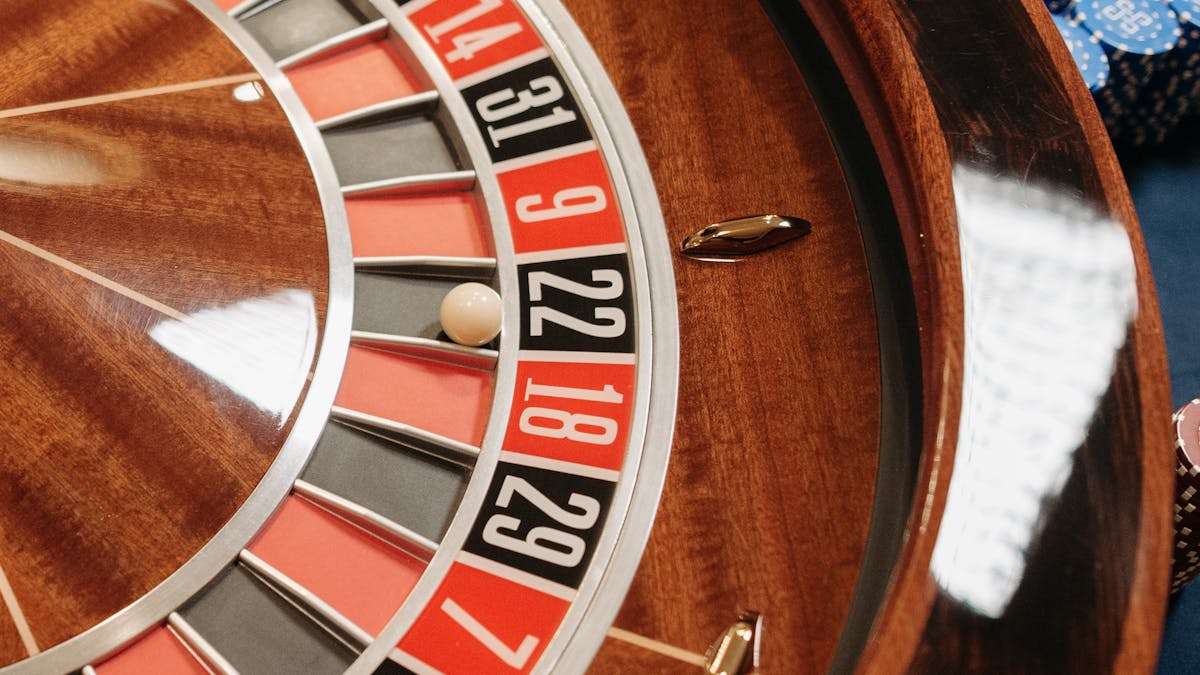
Roulette odds Canada players meet at an online table are fixed by the wheel rather than by the casino, and the single decision that matters is whether that wheel carries one zero or two. This guide sets out the true probability of every bet, what each one pays, why the two figures differ and what the gap costs per hour of play. For the wider market picture, start at our online Canada casinos hub.
The table below gives the probability and payout of every standard bet on a single-zero wheel. Read it first, then work through the detail beneath.
| Bet | Numbers covered | Chance on a single-zero wheel | Payout | True odds |
|---|---|---|---|---|
| Straight up | 1 | 2.70% | 35 to 1 | 36 to 1 |
| Split | 2 | 5.41% | 17 to 1 | 17.5 to 1 |
| Street | 3 | 8.11% | 11 to 1 | 11.33 to 1 |
| Corner | 4 | 10.81% | 8 to 1 | 8.25 to 1 |
| Six line | 6 | 16.22% | 5 to 1 | 5.17 to 1 |
| Column | 12 | 32.43% | 2 to 1 | 2.08 to 1 |
| Dozen | 12 | 32.43% | 2 to 1 | 2.08 to 1 |
| Red or black | 18 | 48.65% | 1 to 1 | 1.06 to 1 |
| Odd or even | 18 | 48.65% | 1 to 1 | 1.06 to 1 |
| High or low | 18 | 48.65% | 1 to 1 | 1.06 to 1 |
What are the real odds in roulette?
The real odds in roulette come from counting pockets. A single-zero wheel holds thirty-seven of them, so a bet on one number wins once in thirty-seven spins, which is a chance of 2.70 percent on every spin taken on its own.
Nothing else affects that number. The dealer, the software, the table, the time of day and the previous result leave the pocket count untouched, and the pocket count is the whole of the mathematics.
Double-zero wheels hold thirty-eight pockets. The same single-number bet wins once in thirty-eight spins there, a chance of 2.63 percent, and every other bet on the layout drops by the same proportion.
The roulette odds Canada players see quoted in casino lobbies are almost always the single-zero figures, because European wheels dominate the online market served from offshore platforms.
Confirming which wheel is loaded takes one glance at the layout before the first spin. One green pocket means thirty-seven, two green pockets means thirty-eight, and that glance is worth more than any strategy article.
Probability describes the long run rather than the next spin. A number absent for a hundred spins carries exactly the same 2.70 percent chance on spin one hundred and one as it did on spin one.
That independence is the property every losing system misunderstands. Wheels hold no memory, results do not owe anybody a correction, and the roulette odds Canada players face reset completely on every spin.
Expressing the same figure three ways helps it stick. One number on a European wheel is a chance of one in thirty-seven, a probability of 2.70 percent, and true odds of thirty-six to one against.
Casinos quote the third form and pay the shortened version of it. That gap between true odds and paid odds is the only thing separating the roulette odds Canada players calculate from the roulette odds Canada tables actually pay.
Start every session from the pocket count and the rest follows. The roulette odds Canada players meet online are decided the moment a table loads, the roulette odds Canada operators advertise are the same published figures, and the roulette odds Canada regulators require disclosure of are printed in the game information panel rather than hidden anywhere.
Two words cause most of the confusion around this game. Probability describes how often something happens, expressed as a percentage, while odds describe the ratio of losing outcomes to winning ones. A single number carries a probability of 2.70 percent and odds of thirty-six to one against, and both statements describe the same pocket count. Casinos quote odds because payouts are quoted the same way, and the two forms convert into each other with a division.
How do European and American roulette odds differ?
European and American wheels differ by exactly one pocket, and that single extra green slot on the American layout raises the cost of play from 2.70 percent of every wager to 5.26 percent.
The bets look identical. Red still pays even money on both wheels, a straight number still pays thirty-five to one, and the felt in front of the player is laid out the same way.
What changes is the denominator. Eighteen red pockets out of thirty-seven is 48.65 percent, while eighteen out of thirty-eight is 47.37 percent, and the casino keeps the difference on every spin.
Doubling the cost is the fair way to describe it. An American wheel takes nearly twice as much from the same bankroll over the same session, and the player receives nothing extra in return.
That makes wheel selection the largest single lever in the whole game. The roulette odds Canada players get on a European table beat the American table by a margin no betting pattern comes close to matching.
American wheels persist online because some suppliers build both and some lobbies list both without distinguishing them. The title of the game usually names the variant, and the layout confirms it.
Where a lobby offers both at the same stake, the choice is settled before it is made. Play the single-zero wheel, and treat the double-zero version as a table with a worse price for the same product.
The gap widens with turnover rather than with stake. A player staking a thousand dollars across a session expects to lose twenty-seven on a European wheel and fifty-two on an American one, for identical entertainment.
Lobby filtering makes the choice quick. Sorting a table list by variant and opening only the single-zero games removes the worse roulette odds Canada lobbies still list, and the filter takes one click to apply.
One pocket is the entire story. The roulette odds Canada players get on a European wheel cost 2.70 percent of turnover, the roulette odds Canada lobbies still list on American tables cost 5.26 percent, and choosing between the two takes a single glance at the layout before the first chip is placed.
The wheels also differ in how the numbers are arranged around the rim, which matters to called bets and to nothing else. European wheels alternate high and low numbers in a specific sequence, American wheels place opposing pairs across from each other, and neither arrangement changes any probability. A player betting neighbours on the racetrack is covering a different set of numbers on each wheel, and the price of that coverage stays where the pocket count puts it.
What is the house edge on each roulette wheel?
House edge is the share of every wagered dollar the casino expects to keep, and roulette carries 2.70 percent on a single-zero wheel, 5.26 percent on a double-zero wheel and 1.35 percent where La Partage applies.
The figure comes straight from the payout gap. A straight-up bet wins once in thirty-seven and pays thirty-five to one, so the missing unit divided across thirty-seven spins is the edge.
Every bet on a single-zero layout carries the identical 2.70 percent. Straight numbers, corners, columns and red or black all cost the same proportion of the amount staked, which surprises players who assume the outside bets are cheaper.
The double-zero wheel breaks that uniformity in one place. The five-number bet available only on the American layout carries 7.89 percent, which makes it the worst wager on either wheel.
Edge is a rate rather than a schedule. It applies to the total staked over a session rather than to the deposit, so a player recycling the same hundred dollars through twenty spins has staked two thousand.
That distinction explains why roulette odds Canada players describe as reasonable still empty a bankroll steadily. The rate is modest and the turnover is large, and the product of the two is what leaves the account.
Comparing games on edge alone is the correct comparison. Blackjack played accurately sits well under one percent, slots run from three to twelve percent, and roulette sits between them on a single-zero wheel.
Return to player is the same figure inverted. A 2.70 percent edge is a 97.30 percent return, a 5.26 percent edge is 94.74 percent, and suppliers publish whichever form suits their marketing.
Comparing the two forms across a lobby exposes any variant quickly. A roulette game listing a return under 97.30 percent has either a second zero or a feature attached, and the roulette odds Canada players get there are worse than the standard table beside it.
Three figures cover the entire game. The roulette odds Canada players face are 1.35 percent under La Partage, 2.70 percent on a standard European wheel and 5.26 percent on an American one, and any table quoting roulette odds Canada suppliers describe differently is running a feature funded from the same layout.
The edge is also why comparing roulette against slots on the headline percentage alone misleads. A slot at four percent taken at six hundred spins an hour produces far more turnover than roulette at sixty, so the hourly cost of the slot is many times higher despite the rates sitting closer together than the experience suggests. Speed multiplies the rate, and any honest comparison between two casino games measures both together rather than either alone.
Hold the three rates in mind as a filter. The roulette odds Canada players want are 1.35 percent, the roulette odds Canada players will usually find are 2.70 percent, and the roulette odds Canada players ought to walk away from are the 5.26 percent an American wheel charges for the same game.
What does each roulette bet pay?
Roulette payouts follow the number of pockets a bet covers: one number pays thirty-five to one, two pays seventeen to one, three pays eleven to one, four pays eight to one, six pays five to one, twelve pays two to one and eighteen pays even money.
The pattern behind the list is arithmetic rather than tradition. Thirty-six divided by the number of pockets covered, minus one, produces the payout for that bet on either wheel.
Four numbers gives thirty-six divided by four, which is nine, minus one, which is eight to one. The same calculation reproduces every entry on the table without memorising any of it.
Payouts stay constant across both wheels. An American table pays a straight number thirty-five to one exactly as a European table does, which is precisely why the extra pocket costs the player.
The word “to” matters at the cashier. A bet paying thirty-five to one returns thirty-six units in total, the thirty-five won plus the one staked, and reading it as thirty-five in total understates the return.
Outside bets return the stake alongside an equal amount. A ten dollar bet on red returns twenty when it wins, and the roulette odds Canada players calculate from these figures are the same at every licensed operator.
No online casino alters the payout table. A game advertising better payouts is either running a side bet with its own maths or removing pockets elsewhere, and both are worth reading carefully.
Chip denominations interact with the payouts on small stakes. A one dollar corner bet paying eight to one settles cleanly, while odd fractions appear on split stakes at tables with fine-grained chips.
Online tables handle the arithmetic automatically and display the settled amount. Confirming one payout by hand early in a session verifies the table pays the standard schedule, and the roulette odds Canada operators offer are checkable in exactly that way.
Payout schedules are the one part of the game nobody negotiates. Every licensed operator pays the identical table, the roulette odds Canada players calculate from it are the same everywhere, and a lobby claiming better roulette odds Canada tables elsewhere cannot match is advertising a side bet rather than a wheel.
The schedule is fixed everywhere. The roulette odds Canada operators pay on a straight number are thirty-five to one, the roulette odds Canada tables pay on a dozen are two to one, and no licensed lobby in the country varies either figure.
Why do roulette payouts not match the true odds?
Payouts fall short of true odds because the wheel holds thirty-seven pockets while the payouts are calculated on thirty-six, and the missing pocket is the casino margin built into every bet on the layout.
True odds on a single number are thirty-six to one. The table pays thirty-five to one. That one unit, spread across every spin, is the entire commercial model of the game.
The same shortfall repeats everywhere. Red or black wins 48.65 percent of the time and pays as though it won half, and the 1.35 point difference is the identical margin expressed differently.
Nothing is hidden in the arrangement. The payouts are published, the pocket count is visible, and a player able to count to thirty-seven has all the information the casino has.
That transparency separates roulette from games with variable returns. The roulette odds Canada players face are fixed, published and identical at every licensed table, which makes the game unusually honest about its price.
The green pocket is what the player buys with the shortfall. Without it the game would return exactly what it takes over the long run, and no operator would offer it.
Understanding the gap reframes the whole exercise. Roulette is entertainment priced at 2.70 percent of turnover, and treating it as a puzzle to solve misreads what the numbers are describing.
A useful way to picture the shortfall is to bet every number at once. Thirty-seven single-unit bets guarantee one winner paying thirty-five plus its own unit, returning thirty-six units for thirty-seven staked.
The lost unit is the house edge made visible in a single spin. No arrangement of chips avoids it, and the roulette odds Canada players face reduce to that one missing unit however the bets are spread.
The shortfall is a price rather than a trick. It is published, it is constant, and the roulette odds Canada players pay are visible to anybody willing to count pockets, which makes roulette one of the most transparent products in a casino lobby and the roulette odds Canada operators quote genuinely checkable.
What are the odds on a straight-up number bet?
A straight-up bet on one number wins 2.70 percent of the time on a single-zero wheel and 2.63 percent on a double-zero wheel, paying thirty-five to one against true odds of thirty-six to one.
Expressed as a wait, the number lands once every thirty-seven spins on average. At a typical online pace of sixty spins an hour, that is roughly one hit and a half per hour.
The variance around that average is enormous. Long droughts are ordinary rather than exceptional, and a hundred spins without a chosen number occurs often enough to be unremarkable.
Covering more numbers narrows the swings without changing the price. Six straight-up bets win six times as often and cost six times as much per spin, and the expected loss per dollar staked stays at 2.70 percent.
That fixed cost is the point most systems miss. The roulette odds Canada players get on one number and on twenty numbers are priced identically, and spreading chips buys smoothness rather than value.
Bankroll sizing matters more here than anywhere else on the layout. A stake that survives a hundred and fifty spins of drought is a stake that gets to see the average arrive.
Neighbour bets and racetrack wagers are simply several straight-up bets placed together. They carry the same 2.70 percent and the same payouts, arranged by wheel position rather than by number.
The chance of a chosen number appearing at least once across a run of spins climbs slowly. Over thirty-seven spins it sits near sixty-four percent, which leaves a substantial minority of sessions with no hit at all.
That figure explains most disappointment at the table. A player expecting one win per thirty-seven spins meets a third of sessions with none, and the roulette odds Canada tables offer make that outcome ordinary rather than unlucky.
Patience is the whole requirement on a single number. The roulette odds Canada tables offer put a hit at once in thirty-seven spins on average, the roulette odds Canada players experience across a short session frequently look nothing like that, and only a bankroll built for the drought survives to see the average.
Birthday numbers, repeated numbers and numbers absent for a long stretch all carry the identical chance. The wheel holds no record of what it has produced, and no pocket becomes more likely through neglect. A number that has appeared three times in twenty spins and a number that has appeared none are both sitting at one in thirty-seven for the next spin, and treating either pattern as information is the oldest mistake at the table.
What are the odds on red or black?
Red or black wins 48.65 percent of spins on a single-zero wheel and 47.37 percent on a double-zero wheel, paying even money, which makes it the most commonly misunderstood bet in the game.
It is not a coin flip. The green pocket belongs to neither colour, so the eighteen red pockets sit against nineteen that are not red, and that asymmetry is the entire house edge.
The cost per dollar is identical to a straight-up bet. Both carry 2.70 percent on a European wheel, and choosing red over a single number changes the shape of the session rather than its price.
What the even-money bet buys is duration. A bankroll on red survives far longer than the same bankroll on one number, because the wins arrive constantly rather than rarely.
That makes it the sensible choice for a player wanting table time. The roulette odds Canada players describe as safest are simply the ones with the lowest variance, which is a different property from a lower price.
Streaks of one colour are routine and carry no information. Eight blacks in a row happens roughly once in two hundred and fifty sequences, and the ninth spin remains 48.65 percent for either colour.
Odd or even and high or low behave identically. All three even-money bets cover eighteen pockets, pay one to one and carry the same edge, and no meaningful difference separates them.
The single green pocket is easy to underrate because it looks small against thirty-six coloured ones. It is the whole margin, and removing it would leave a game returning exactly what it takes.
Doubling it is what the American wheel does. Two green pockets against thirty-six coloured is the entire difference between the two sets of roulette odds Canada lobbies list side by side.
Treat it as the long-session bet rather than the safe one. The roulette odds Canada players get on red are priced exactly as a straight number is priced, and what the roulette odds Canada tables give an even-money bettor is duration and steadiness rather than any reduction in cost.
Betting both colours at once is worth thinking through as a demonstration. Covering red and black with equal stakes wins nothing on thirty-six pockets and loses both stakes on the zero, which produces the same 2.70 percent expected loss as either bet alone. The exercise removes any suspicion that spreading chips across the layout creates value, because the only pocket that matters to the arithmetic is the one neither bet covers.
How do split, street and corner bets compare?
Split, street and corner bets cover two, three and four numbers respectively, winning 5.41, 8.11 and 10.81 percent of spins on a single-zero wheel while paying seventeen, eleven and eight to one.
Each is a package of straight-up bets rather than a distinct wager. A corner is four numbers at a quarter of the stake each, and the payout reflects exactly that arithmetic.
The edge is unchanged across all three. Every one costs 2.70 percent of the amount staked on a European wheel, so no combination on the inside of the layout is better value than another.
What changes is the rhythm. A corner bet lands roughly once every nine spins, which produces a far steadier session than a single number without the flatness of an even-money bet.
Chip placement is the practical risk. A chip resting a millimetre off the intersection becomes a different bet, and online layouts make the position explicit in a way felt tables do not.
The six-line covers two adjacent streets, wins 16.22 percent of the time and pays five to one, which sits between the inside and outside bets on both frequency and swing.
Players comparing these are choosing variance rather than value. The roulette odds Canada tables offer on every inside bet carry the identical price, and the choice among them is about how a session feels.
A helpful way to compare them is by average wait. A split lands roughly every nineteen spins, a street every twelve, a corner every nine and a six-line every six.
Matching that rhythm to a session length is the real decision. A short session suits the faster-hitting bets, and the roulette odds Canada players pay for each one are identical whichever rhythm they pick.
Pick by rhythm and stop worrying about value. The roulette odds Canada tables charge on a split, a street and a corner are identical to the decimal, so the roulette odds Canada players compare across the inside of the layout differ only in how often the chips come back.
What are the odds on a column or dozen bet?
Column and dozen bets each cover twelve numbers, winning 32.43 percent of spins on a single-zero wheel and paying two to one against true odds of roughly 2.08 to one.
The two are mathematically identical and differ only in arrangement. A dozen groups numbers by value, a column groups them by position on the layout, and both cover twelve pockets.
They sit between the even-money bets and the inside bets on frequency. A win arrives roughly once every three spins, which gives a session more movement than red or black without long inside droughts.
Covering two dozens at once is a common pattern. It wins 64.86 percent of the time, pays two to one on the winner while losing the other stake, and still costs the same 2.70 percent overall.
That last point defeats the appeal of the pattern. Covering more of the layout raises the hit rate and lowers the return per hit, and the two movements cancel exactly.
The roulette odds Canada players get on a dozen are therefore neither better nor worse than on red, and anybody promising otherwise is selling a system rather than describing the wheel.
Where these bets genuinely help is bankroll pacing. A steady two-to-one return keeps a session alive through the swings that would end it on straight-up numbers alone.
Losing runs on a twelve-number bet are longer than players expect. The chance of missing five consecutive spins sits near fourteen percent, which arrives several times in an ordinary session.
Sizing stakes for that run keeps a bankroll intact. A stake that survives eight consecutive misses matches the roulette odds Canada tables actually produce rather than the ones a short sample suggests.
Twelve-number bets are the middle ground of the layout. The roulette odds Canada players get there sit at the same 2.70 percent as everywhere else, and the roulette odds Canada tables produce across a session simply arrive in a more even pattern than the inside bets manage.
Covering two columns or two dozens at once is a common pattern worth pricing properly. Twenty-four numbers win two to one on the covering stake while the second stake loses, netting a single unit on 64.86 percent of spins and losing two units on the rest. Working it through returns the familiar 2.70 percent, which is the point of doing it: the layout offers no arrangement that escapes the pocket the bets leave uncovered.
Does the French wheel change the odds?
A French roulette table uses the same single-zero wheel as European roulette, so the base odds are identical, and the difference lies entirely in two rules that apply when the zero lands.
Those rules are La Partage and En Prison, and both apply only to even-money bets. Where a table offers either, the cost of red, black, odd, even, high and low halves.
The inside bets receive nothing. A straight-up number on a French table carries the same 2.70 percent it carries anywhere, because the zero rules never touch it.
The layout also differs cosmetically. French tables label the outside bets in French and arrange the racetrack differently, and neither change affects a single probability.
Finding a French table online is worth the search for an even-money player. It is the only place the roulette odds Canada players face improve without any change in how the game is played.
The rule appears in the game information panel rather than in the lobby title. Opening it before the first spin confirms whether the table carries the benefit or merely the name.
Some suppliers label a table French while omitting both rules. That table is a European wheel with French labelling, and the distinction costs an even-money player half their expected loss.
The French layout also carries called bets grouped by wheel position rather than by number. Voisins, Orphelins and Tiers cover fixed arcs of the wheel and are simply bundles of splits and straight-up bets.
Their pricing is unchanged at 2.70 percent. They alter which numbers a player covers and leave the roulette odds Canada tables charge exactly where the standard bets sit.
The name on the table settles nothing on its own. Check the rule rather than the label, because the roulette odds Canada players get on a genuine French table halve on even-money bets while the roulette odds Canada lobbies attach to a French-labelled European wheel do not move at all.
How does La Partage change the house edge?
La Partage returns half of an even-money stake when the ball lands in zero, which cuts the house edge on those bets from 2.70 percent to 1.35 percent and makes them the best value on any roulette layout.
The mechanism is simple. A ten dollar bet on red loses five rather than ten when zero appears, and the recovered half is credited immediately rather than held for the next spin.
Halving the loss on the zero halves the edge exactly, because the zero is the entire source of the margin on an even-money bet. Nothing else in the game changes.
At 1.35 percent the bet compares with blackjack rather than with slots. It sits among the cheapest wagers available in a Canadian online casino lobby, and it requires no strategy to obtain.
The rule applies to red, black, odd, even, high and low alone. Straight numbers, splits, corners, columns and dozens keep the full 2.70 percent whatever the table calls itself.
Checking for it takes seconds and pays every spin. The roulette odds Canada players get on a La Partage table are the best in the game, and the rule appears in the information panel.
A player committed to even-money betting has one decision worth making before any other. Find the table with La Partage, and the price of the session halves before a chip is placed.
Over a session the saving compounds quietly. A player staking two thousand dollars on even-money bets expects to lose fifty-four on a European table and twenty-seven under La Partage.
Nothing about the play changes to obtain it. Identical bets at identical stakes at a different table produce the better roulette odds Canada players are entitled to, which makes the rule the highest-value check in the game.
This is the single best price in the room. The roulette odds Canada players obtain under La Partage sit at 1.35 percent, which beats every other standard wager, and finding the roulette odds Canada tables offer under that rule takes one look at the information panel before the session starts.
One rule, one panel, one check. The roulette odds Canada players secure under La Partage halve, the roulette odds Canada tables without it stay at the standard rate, and the roulette odds Canada lobbies list rarely mention the rule in the game title at all.
What is En Prison and when does it apply?
En Prison holds an even-money stake for one further spin when zero lands rather than returning half of it, and the stake is released in full if the next spin wins and lost entirely if it does not.
The expected value works out almost identically to La Partage. Recovering the whole stake half the time is worth the same as recovering half of it every time, so the edge lands at roughly 1.35 percent.
The experience differs sharply. La Partage settles immediately while En Prison suspends the bet, and a second zero on the following spin loses the imprisoned stake outright at most tables.
Variants exist. A handful of tables imprison the stake twice on a second zero rather than taking it, which improves the figure slightly, and the game rules state which version applies.
Very few online tables offer En Prison. La Partage is far more common in Canadian-facing lobbies, and a player finding either has found the same improvement in the roulette odds Canada casinos offer.
The imprisoned bet cannot be withdrawn or altered while it is held. It rides the next spin as placed, which matters to a player working through a session with a fixed staking pattern.
Where both rules appear on separate tables at the same stake, La Partage is the cleaner choice. Identical value, immediate settlement and no second-zero complication is a better product for the same price.
The imprisoned stake is worth thinking through once. Recovering it requires the next spin to win, which happens 48.65 percent of the time, so roughly half of imprisoned bets come back whole.
That arithmetic produces the same expected value as returning half immediately. Both rules land the roulette odds Canada players get on even-money bets at approximately 1.35 percent.
Two rules, one outcome, different feel. The roulette odds Canada players get under En Prison match La Partage at roughly 1.35 percent, and choosing between the roulette odds Canada tables present under each rule comes down to whether a suspended stake or an immediate half-return suits the session better.
How do you calculate a roulette payout yourself?
Divide thirty-six by the count of numbers a bet covers, subtract one, and the result is the payout in units to one, which reproduces every entry on the payout table without memorising any of it.
A street covers three numbers. Thirty-six divided by three is twelve, minus one is eleven, so a street pays eleven to one on any wheel in any casino.
A dozen covers twelve. Thirty-six divided by twelve is three, minus one is two, giving the familiar two to one on both the dozens and the columns.
The probability side needs the pocket count. Numbers covered divided by thirty-seven gives the chance on a European wheel, and dividing by thirty-eight gives it on an American one.
Total return uses the stake as well. A five dollar corner bet paying eight to one returns forty dollars won plus the five staked, which is forty-five at the cashier.
Doing this once removes any need for a payout calculator. The roulette odds Canada tables display are the same arithmetic every time, and the calculation takes longer to read about than to perform.
The formula also exposes bad offers instantly. A side bet paying less than thirty-six divided by its coverage is priced above the standard edge, and the gap is the extra cost.
The same formula works backwards as a check on any variant. Multiplying the payout plus one by the numbers covered returns thirty-six on a fairly priced bet and less on a discounted one.
Running that check across a lobby takes a couple of minutes. Any result under thirty-six marks a table where the roulette odds Canada players receive have been trimmed to fund a feature elsewhere.
One formula replaces every calculator on the internet. Thirty-six divided by the numbers covered, minus one, reproduces the roulette odds Canada tables pay on any bet, and running it backwards exposes any variant where the roulette odds Canada players receive have been quietly trimmed.
What does the house edge cost per hour?
Expected loss per hour equals the stake per spin multiplied by the spins per hour multiplied by the house edge, so five dollars a spin at sixty spins an hour on a European wheel costs roughly eight dollars an hour.
The arithmetic is worth doing before a session rather than after. Three hundred dollars staked in an hour at 2.70 percent produces an expected loss of eight dollars and ten cents.
Doubling the stake doubles the figure. Ten dollars a spin at the same pace costs sixteen dollars and twenty cents an hour, and the pace matters as much as the stake.
Online tables run faster than physical ones. A live dealer table turns roughly forty to fifty spins an hour while a software table can exceed a hundred, which changes the hourly cost accordingly.
An American wheel roughly doubles every figure above. The same five dollar stake at sixty spins costs fifteen dollars and seventy-eight cents an hour, for an identical experience.
These are averages rather than outcomes. Any single hour finishes well above or well below the expected figure, and the roulette odds Canada players experience converge on it only across long play.
Treating the number as the price of entertainment is the honest framing. Eight dollars an hour is comparable with other paid leisure, and a player who accepts it in advance plays a different game from one hoping to beat it.
Session budgeting follows directly from the hourly figure. A player allocating forty dollars for an evening at five dollars a spin expects roughly five hours of play before the expected loss consumes it.
Variance moves the actual result a long way either side of that. The roulette odds Canada players face describe the centre of a wide distribution, and any single evening lands somewhere across its width.
Convert the rate into dollars before the session rather than after. Stake times spins times edge gives the hourly cost of the roulette odds Canada players are accepting, and a player who has done that arithmetic treats the roulette odds Canada tables charge as a price agreed in advance.
Comparing formats on hourly cost rather than on edge changes which table looks expensive. A live dealer table at forty spins an hour and five dollars a spin costs about five dollars forty an hour on a European wheel, while the same stake on a software table running a hundred and twenty spins costs sixteen dollars twenty. Identical odds, identical bets, three times the cost, decided entirely by how fast the table runs.
Do roulette systems change the odds?
No betting system changes roulette odds, because every system is a rule for sizing bets rather than a rule for changing pocket counts, and the house edge applies to each bet independently of how large it is.
The mathematics is settled rather than contested. A sequence of wagers each carrying 2.70 percent carries 2.70 percent in total, whatever pattern governs their size.
Systems do change the shape of results. Progressive staking produces frequent small wins with rare large losses, and flat staking produces a wider spread of ordinary outcomes.
That reshaping is what makes systems persuasive. A player winning small amounts on most sessions concludes the method works, and the occasional catastrophic session is remembered as bad luck.
The gambler’s fallacy sits underneath most of them. Wheels carry no memory, and the roulette odds Canada players face on the next spin ignore every spin that came before it.
Where systems help is discipline. A rule that fixes stake size and session length keeps a player from chasing, and that benefit is behavioural rather than mathematical.
Our guide to online roulette strategies covers the individual systems in detail, including where each one breaks down in practice.
Testing a system needs no money and very little time. A spreadsheet running ten thousand simulated spins reproduces the expected loss precisely, whatever staking rule is applied on top.
Every such test lands on the same figure. Simulations of the roulette odds Canada tables offer converge on 2.70 percent of turnover regardless of the pattern governing bet size.
No sequence of bets edits a wheel. The roulette odds Canada players face on the next spin are what they were on the last, and every system ever sold rearranges the distribution of results without touching the roulette odds Canada tables actually run on.
Why does the Martingale fail on a real table?
The Martingale fails because table limits and finite bankrolls cut it short exactly when it needs one more double, and the rare long losing streak wipes out every small win the method collected before it.
The sequence grows brutally. Starting at five dollars, eight consecutive losses require a ninth bet of one thousand two hundred and eighty dollars to recover five.
Eight losses in a row on an even-money bet happen roughly once in every two hundred and fifty attempts. That is uncommon per session and close to inevitable across a season of play.
Table maximums end it before the bankroll does. A table taking five dollars minimum and five hundred maximum permits six doubles, and the seventh loss is unrecoverable by design.
The expected loss stays at 2.70 percent throughout. Every bet in the sequence carries the same edge, and the roulette odds Canada players face are indifferent to whether a stake is five dollars or five hundred.
What the system produces is a distribution most players misread: many small winning sessions and one enormous losing session that removes the total of all of them.
Reverse and modified versions inherit the same ceiling. Any method whose recovery depends on an unlimited bankroll against a limited table fails at the point the limit binds.
The risk-reward shape is worth stating numerically. A Martingale run risks a large bankroll to win one unit, which is a trade nobody would accept if it were presented that way directly.
Dressing it as a recovery method hides the trade rather than removing it. The roulette odds Canada players face are unchanged by the sequence, and only the distribution of outcomes has moved.
Limits and bankrolls end it, not bad luck. The roulette odds Canada players carry through a doubling sequence stay at 2.70 percent on every bet in it, and the roulette odds Canada tables enforce through a maximum stake guarantee the sequence terminates before the recovery arrives.
Are there better and worse bets on the same wheel?
On a single-zero wheel every standard bet costs the identical 2.70 percent, so no inside or outside wager is better value than another, and the only genuinely worse bets sit on the American layout and in side markets.
The five-number bet is the clearest example. Available only on double-zero tables, it covers zero, double zero, one, two and three and carries 7.89 percent, which is three times the European rate.
Even-money bets under La Partage are the clearest improvement. At 1.35 percent they are the only standard wager priced below the base rate, and the discount requires nothing from the player.
Everything between those two extremes is equivalent. Choosing a corner over a column changes how often a session pays and leaves the price untouched.
That equivalence is a useful filter for advice. Any claim that a particular bet offers better roulette odds Canada players ought to prefer is describing variance rather than value, unless it names La Partage.
Side bets and bonus markets are the exception and usually the expensive one. Their pricing is set by the supplier rather than by the wheel, and it frequently exceeds the base edge substantially.
Reading the game information panel settles it in under a minute. Pocket count, zero rules and any side bet return are all published there, and those three fields describe the entire price of the table.
Ranking the whole field takes one short list. La Partage even-money at 1.35 percent, every European bet at 2.70 percent, every American bet at 5.26 percent, and the five-number bet at 7.89 percent.
That list covers every standard wager in the game. Anything priced outside it is a side bet or a variant feature rather than one of the roulette odds Canada tables carry as standard.
Four prices describe the entire game. The roulette odds Canada players can reach run from 1.35 percent under La Partage to 7.89 percent on the American five-number bet, and everything between those two roulette odds Canada tables offer is a choice about variance rather than about value.
Do live dealer roulette odds differ from software?
Live dealer and software roulette carry identical odds when the wheels match, because a single-zero physical wheel and a single-zero simulated wheel both hold thirty-seven pockets and pay the same table.
The difference is pace rather than price. A live table runs roughly forty spins an hour against a hundred or more on software, which changes hourly expected loss without changing the rate.
That slower pace is a genuine advantage for a fixed bankroll. Fewer spins means less total turnover, and less turnover means a smaller expected loss for the same session length.
Physical wheels carry minute imperfections that simulated wheels do not. Detecting a bias requires thousands of recorded spins under stable conditions, and modern casino maintenance removes exploitable bias long before it becomes measurable.
Software wheels have no bias to find. Outcomes come from a certified generator, every pocket is equally likely by construction, and the roulette odds Canada players get are exact rather than approximate.
Live tables also carry higher minimums. A software table accepting one dollar a spin and a live table starting at five change what a modest bankroll can sustain.
Our guide to live dealer casinos covers streaming quality, table availability and the practical differences beyond the mathematics.
Auto roulette sits between the two formats. A physical wheel spun by a machine with no dealer runs faster than a live table and slower than software, and the pocket count still decides the price.
Format choice therefore controls hourly cost rather than the rate. The roulette odds Canada players get are set by the wheel, and the spins per hour set what those odds cost across an evening.
Same wheel, same price, different pace. The roulette odds Canada players get on a live single-zero table match the software version exactly, and what separates the roulette odds Canada formats deliver across an hour is the number of spins each one fits into it.
Dealer signature is the other claim worth addressing directly. The idea that a dealer releases the ball with enough consistency to make sectors predictable requires a stable release, a stable wheel speed and a stable deflector pattern across hundreds of spins. Casinos vary release points, alternate dealers and maintain the wheel precisely to prevent it, and online streaming adds no information the room does not already control for.
How does a roulette random number generator work?
A software roulette table selects its result with a certified random number generator, an algorithm producing an unpredictable value for every spin that maps to one of the thirty-seven or thirty-eight pockets with equal probability.
Certification is what makes the claim checkable. Independent testing houses examine the generator across millions of simulated spins and confirm that each pocket appears at the expected frequency.
The result is determined at the moment the spin is requested. The animation shown afterwards is presentation, and no amount of watching it affects an outcome already fixed.
Each spin is independent by construction. Previous results form no part of the calculation, which is the technical reason the roulette odds Canada players face never drift toward a due number.
Licensed operators publish the testing house behind their games. The name appears in the site footer or the game information panel, and its absence at an operator is worth noting before depositing.
Return to player figures for roulette follow directly from the edge. A single-zero wheel returns 97.30 percent, a double-zero wheel 94.74 percent, and a La Partage even-money bet 98.65 percent.
Our guide to licensed casinos covers what certification actually verifies and how to confirm it independently.
Players occasionally ask whether results are adjusted for account balance or session history. Certified generators take no such input, and a licensed operator adjusting outcomes would fail the audits its licence depends on.
The published return figure is the verifiable claim. It ties directly to the pocket count, and it is how the roulette odds Canada operators advertise can be checked against the arithmetic.
Certification is what makes the numbers trustworthy. The roulette odds Canada players are quoted tie directly to the pocket count, testing houses confirm each pocket appears at the expected rate, and the roulette odds Canada operators publish are auditable rather than promotional.
Do side bets and multipliers improve the odds?
Side bets and multiplier features on roulette variants almost always worsen the odds, because the enhanced payouts are funded by reducing the standard payouts elsewhere on the same table.
Lightning-style games are the common example. Selected numbers receive large multipliers while every straight-up win pays less than thirty-five to one, and the trade favours the operator.
The published return figure exposes it. A multiplier variant returning 97.10 percent sits below the 97.30 percent of a plain single-zero wheel, and the difference is the cost of the feature.
Some variants go considerably further. Returns in the mid-nineties appear on games marketed on their jackpot potential, and the roulette odds Canada players get there are materially worse than on a standard table.
What the feature buys is a larger top prize. A player who values the possibility of a very large win accepts a higher price for it, and that is a legitimate preference rather than a mistake.
The error is assuming the multiplier is free. Every enhancement on a roulette table is funded from somewhere on the same layout, and the information panel names the return figure.
Comparing the return figure against 97.30 percent settles any variant in one step. Above it is unusual and worth examining, at it is standard, and below it is the price of the feature.
Multiplier variants also change the shape of the bankroll curve sharply. Frequent small losses punctuated by rare large hits empties an account faster than a standard table at the same stake.
A player who wants the jackpot shape accepts that trade knowingly. A player who wants table time takes the standard roulette odds Canada tables offer and keeps the longer session.
Every enhancement is funded from the same table. The roulette odds Canada players get on a multiplier variant are worse than the standard wheel beside it, and comparing the published return against 97.30 percent shows exactly what the roulette odds Canada suppliers charge for the feature.
Jackpot roulette variants deserve the same treatment as jackpot slots. A portion of every wager funds the prize pool rather than returning to the table, which lowers the base return in exchange for a possibility most players never meet. The published return figure already accounts for the jackpot contribution, so a variant listing 96 percent is charging four percent of turnover against the 2.70 percent of the plain wheel beside it.
What do table limits do to your expected loss?
Table limits shape how long a bankroll survives rather than what it costs, because the house edge applies to the amount staked and a minimum bet sets the smallest amount a player is able to stake per spin.
A high minimum forces turnover. A table starting at ten dollars a spin runs three hundred dollars an hour at thirty spins, which produces triple the expected loss of a table accepting three.
Matching the minimum to the bankroll is the practical discipline. A stake of one percent of the bankroll per spin survives ordinary variance, and five percent per spin rarely lasts an hour.
Maximums matter only to progressive bettors. A player flat-staking never approaches the ceiling, while any doubling method meets it within seven or eight losses at most tables.
Online lobbies carry a wide range. Software tables accepting a dollar and high-limit tables taking thousands sit in the same lobby, and the roulette odds Canada players face are identical across all of them.
Choosing the lowest workable minimum is close to free. It buys more spins for the same expected loss, and more spins means more entertainment for the same money.
Limits also interact with bonus rules. Maximum bet clauses attached to a bonus frequently sit below the table minimum on high-limit games, which voids the bonus without the player noticing.
Minimum stakes vary widely between formats at the same operator. Software tables frequently accept a fraction of the live minimum, which suits a modest bankroll far better.
The price per dollar staked never moves. Low limits buy more spins at the same roulette odds Canada tables charge, and more spins is the only thing a small stake genuinely buys.
Limits govern duration rather than price. The roulette odds Canada tables charge stay at 2.70 percent whether a spin costs one dollar or five hundred, and choosing the lowest workable minimum buys more spins at the roulette odds Canada players were paying anyway.
How do you choose a roulette table in Canada?
Choose a roulette table on four fields in this order: pocket count, zero rules, minimum stake and the published return figure, and those four settle the price of the table before a single chip is placed.
Pocket count comes first because it is the largest lever. One green pocket rather than two halves the cost of every bet on the layout, and the layout itself shows which is present.
Zero rules come second for even-money players. La Partage halves the price again, taking an even-money bet to 1.35 percent, and it appears in the information panel rather than the lobby.
Minimum stake comes third because it governs turnover. The lowest minimum that suits the bankroll produces the most spins for the least expected loss.
The return figure confirms everything else. Anything at 97.30 percent is a standard single-zero table, anything below it carries a feature the player is paying for, and the roulette odds Canada tables publish are stated there plainly.
Everything else is presentation. Studio quality, dealer, table theme and racetrack layout affect enjoyment and leave the mathematics entirely untouched.
Our review of Zizobet and our review of Vulkan Vegas both list the roulette variants each lobby carries, including which tables run single-zero wheels.
Writing the four fields down once turns the check into a habit. Pocket count, zero rule, minimum stake and return figure fit on a single line and settle any table in under a minute.
Applying it across a lobby produces a short list quickly. Two or three tables usually offer the best roulette odds Canada players can access at an operator, and the rest are variations on a worse price.
Four fields, one minute, every session. Pocket count and zero rule fix the roulette odds Canada players will pay, minimum stake fixes how long the bankroll lasts, and the published return confirms the roulette odds Canada tables advertise match the arithmetic behind them.
Bonus terms belong in the same check for anybody playing with promotional funds. Roulette usually contributes ten or twenty percent toward a wagering requirement, and maximum bet clauses frequently sit below the minimum on high-limit tables. A player clearing a bonus on roulette turns over five to ten times what a slots player turns over for the same requirement, which converts a modest edge into a substantial expected cost.
What are the best odds a Canadian roulette player can get?
The best available price is an even-money bet on a single-zero French table carrying La Partage, at 1.35 percent, and the best standard price without that rule is 2.70 percent on any bet on a European wheel.
Those two figures bound the sensible range. Anything above 2.70 percent means an American wheel, a side bet or a multiplier variant, and each of the three is avoidable by choice.
Reaching the better figure requires no skill. It requires reading the information panel, confirming one green pocket and confirming the zero rule, which takes less than a minute.
Bet selection beyond that changes nothing. Once the table is chosen, the roulette odds Canada players face are fixed, and the choice among bets is a choice about variance alone.
Pace is the remaining lever. Fewer spins per hour means less turnover, and a live table at forty spins costs less per hour than a software table at a hundred and twenty for the same stake.
Bonuses rarely help on roulette. Wagering requirements usually weight the game at ten or twenty percent, which means clearing a requirement on roulette takes five to ten times the turnover it takes on slots.
Our guide to no deposit bonuses covers those weighting tables, and a player intending to play roulette reads them before accepting any offer.
The whole guide reduces to two numbers and one check. The roulette odds Canada players should look for are 1.35 percent on an even-money bet under La Partage and 2.70 percent on everything else on a single-zero wheel, and the roulette odds Canada tables charge above those figures are avoidable by reading one panel.
End where the guide began. The roulette odds Canada players face come from the pocket count, the roulette odds Canada tables improve on come from the zero rule, and the roulette odds Canada players pay for a multiplier feature are always worse than the plain wheel beside it.
Gambling is entertainment rather than income, and a 2.70 percent edge is the price of that entertainment rather than an obstacle to overcome. Set a deposit limit, decide the session length in advance, and stop when it stops being enjoyable. For independent help with gambling in Canada, the Responsible Gambling Council publishes free resources and support contacts.
Site optimisation by SEO.
4 thoughts on “Roulette Odds Canada: Payouts and House Edge Explained”
Comments are closed.