A blacklisted casino is a site watchdogs flag for not paying, unfair terms, pirated games or running without a valid licence. This page from our Canada online casino reviews covers who keeps blacklists, red flags and Canadian rules. It shows how to check a licence and what to do if you are not paid.
Gambling is for adults only: the age is 19+ across most provinces and 18+ in Alberta, Manitoba and Quebec. The clip below is Casinomeister’s short English video on how to spot a rogue online casino.
What makes a casino blacklisted?
Proof of bad conduct. NewCasino defines a blacklist as a published list of operators flagged for licence revocation, confiscated winnings, predatory bonus terms, pirated games or regulator enforcement action. Each one can put a site among the blacklisted casinos Canada players avoid.
CanadaCasino calls “Blacklisted Casino” the industry’s warning label for outlaw operators that proved their intent to defraud players of money or personal data. Rogue operators stay outside jurisdictions that can police them.
Casino Guru blacklists casinos for unfair practices or other serious issues. Theft is not the only route onto its list of blacklisted casinos Canada players check. Unfair rules count too, so read the terms with care before you sign up.
Is a rogue casino the same as a blacklisted one?
Yes. Blacklisted casinos, also called rogue casinos, are sites shown to operate illegally, unethically or against Casinomeister’s code of conduct. Both labels cover the blacklisted casinos Canada players run into, from frauds to careless operators.
Casinomeister says most of the blacklisted casinos Canada players find on its Rogue list are guilty of gross customer negligence bordering on the criminal. Certain operators have vanished and left players empty-handed. Others run fully illegal operations, while the rest use unethical but not necessarily illegal tactics.
CasinosOnline separates lazy casinos from ones that deliberately steal, like a misdemeanour versus a felony. Per GreatBridgeLinks, bad business practice or poor support can blacklist even a registered casino. Our page on licensed vs offshore casinos explains the difference.
Who keeps casino blacklists?
Watchdog sites and players. Casinomeister, Casino Guru, AskGamblers ADR, ThePogg and LCB keep public lists of the blacklisted casinos Canada watchdogs track. GreatBridgeLinks notes that blacklist sites rely on player reports to build them.
Casinomeister has advocated fair play since the late nineties. A full-time team finds dodgy casinos, and Casinomeister will blacklist a casino regardless of its age, reputation or relationship with the team.
LCB lists casinos that are blacklisted, carry warnings, are on probation or have closed. CanadaCasino says players who share experiences and name names remain the first line of defence.
How does Casinomeister sort rogue casinos?
Into five categories. Casinomeister files rogue sites under Not Recommended, Rogue Affiliate Programs, Bumblings, Blunders and Negligence, Evil Casino Software Providers and the Dungeon of Evil archive. Each names a different failure among the blacklisted casinos Canada players face.
Not Recommended covers poor support, serious payment delays, bad bonus terms and questionable practices. The Rogue Affiliate Programs category lists casinos that cheat affiliates by detagging players or skimming.
Bumblings, Blunders and Negligence records serious mistakes, such as failing to protect players from software bugs and stolen databases. Evil Casino Software Providers covers cheating software or a hands-off approach to licensees.
What is the Dungeon of Evil archive?
A record of old rogues. The Dungeon of Evil archives casinos that faded away, kept on file in case their operators are still active. It is Casinomeister’s long memory of the blacklisted casinos Canada watchdogs track.
Each entry records the software provider, the level of rogueness, the reason and the status: dead, rebranded or turned into a portal. Levels include “Mega rogue”, “Rogue with a capital R”, “One of the first rogues”, “Mindnumbing Rogue”, “Rogue” and “Not Recommended”.
Reasons include “No Pay, No Response”, “Confiscation of winnings, No Response”, “Slow Payments”, “Funkified software, vanished”, “No Pay, Manager AWOL” and “Non Payment, angry cashier”. A rebranded site can hide an old operator, so check the archive for both names.
What evidence puts a casino on NewCasino’s list?
One of four proofs. NewCasino lists a casino after a regulator action, a formal watchdog listing, matching independent complaints or named investigative journalism. These thresholds keep rumour out of its record of blacklisted casinos Canada players check.
Accepted regulators include the MGA, UKGC, Curaçao GCBC, Kahnawake, AGCO, ACMA and Lotteritilsynet. NewCasino excludes anonymous forum posts, single negative reviews and competitor smears. It checks every tip against at least two independent sources.
Its five sections cover unlicensed sites or those running after revocation, licensed sites with predatory terms or confiscated winnings, and pirated games. The last two hold ACMA-blocked sites aimed at Australia and the advertising fraud and impersonation cases among blacklisted casinos Canada players see.
How do CasinosOnline’s three warning tiers differ?
By how serious the harm is. CasinosOnline ranks the blacklisted casinos Canada players report as Rogue Casinos, Not Recommended or Be Cautious, mixing expert investigation with a pattern of complaints. Three tiers exist because blacklisting takes time.
Rogue Casinos are “lairs of customer negligence and unfair operations”, and “No pay, no response” sums them up. Not Recommended is the middle tier. Keep your deposit away from the blacklisted casinos Canada players find in either group.
Be Cautious covers sites that are “not evil” but have room for improvement. Complaints about them rarely involve major issues such as a bogus licence, hidden terms or piracy.
How long are today’s casino blacklists?
From 9 to 57 entries. Casinomeister’s current rogue list shows 9 casinos, each rated 1. NewCasino’s blacklist holds 57 verified entries. Both lists of blacklisted casinos Canada players check are short enough to scan before signing up.
NewCasino rates 22 entries Critical and 33 High severity, and 19 are blocked in Australia by ACMA. It flags all 57 as unsafe for players in Canada, Ireland and Norway.
CasinosOnline notes there are thousands of casinos on the web, all eager to take your deposit. A site missing from the blacklisted casinos Canada watchdogs track is not safe by default. Check its licence before you deposit.
Do blacklists agree with each other?
No. NewCasino notes that Casino.Guru does not blacklist every casino on NewCasino’s list, and its Safety Index uses different weighting. One watchdog’s record of blacklisted casinos Canada players check can miss a site another one flags.
Each watchdog sets its own bar and wording. A warning on one site and a full blacklist entry on another carry different weight, so read why a casino was listed.
Run the name through the main trackers of blacklisted casinos Canada players rely on: Casinomeister, Casino Guru, AskGamblers and LCB. A clean result on one of them is only a first step.
Which casinos on our list does Casino Guru clear?
Eight, but only on blacklists. Casino Guru’s records put Slota, 24Casino, SkyCrown, Drakaris, Sportaza, Galactic Wins, 5bet and Spinsino on no relevant blacklist. Staying off the blacklisted casinos Canada players check is not the same as a high safety score.
Slota holds a Safety Index of 8.5, rated High, and SkyCrown scores 7.7. For Drakaris, Casino Guru says links to 2 other casinos lowered its Safety Index. Our Slota review has the details.
24Casino scores 8.1 with zero blacklist entries. Casino Guru says a blacklist entry hints at past misconduct toward players. Galactic Wins sits Below average at 6.4, which reflects terms, not unpaid wins. 5bet scores a below-average 5.7 and Spinsino a low 4.6. Read more in our 24Casino review.
Which licences show up most on blacklists?
Curaçao and Panama. Casinomeister says most of the blacklisted casinos Canada players run into hold a licence from one of those two, if they hold one at all. A UK or Malta licence is fine most of the time, though not always.
A polished look proves nothing. Casinomeister notes that a large share of blacklisted sites look reputable but run on untested, unlicensed platforms and never apply for a licence.
Other operators claim a licence they do not hold. Big regulators such as the MGA now issue statements when brands do this. Check the brand on the regulator’s website and against the blacklisted casinos Canada watchdogs publish.
How do revoked seals fool players?
By staying on display after the licence is gone. Operators keep showing revoked Curaçao seals months after the GCBC pulled the licence. Treat any seal on the blacklisted casinos Canada players report as unproven until its link checks out.
Click the footer seal. Per NewCasino, if it does not link straight to a valid, active licence page on the regulator’s own website, the casino is lying. CasinosOnline adds that no trace of a licence number on the homepage is a reason to leave.
GreatBridgeLinks says a domain based where online gaming is illegal is a reason to steer clear. A whois lookup reveals where a domain is registered. Among the blacklisted casinos Canada watchdogs list, one site misrepresents its regulatory details, offers fake games and has no dispute resolution.
Which bonus tricks mark a rogue site?
A big welcome bonus with hidden terms. The blacklisted casinos Canada players complain about advertise great-looking welcome bonuses, then hide ridiculous terms behind them. The offer gets you in the door, and the terms keep your winnings.
Certain rogue sites change their terms page after a player hits a big win. Take a screenshot of the bonus terms on the day you opt in. That gives you proof if the rules shift.
Others post vague, confusing terms that give them room to avoid paying. False advertising of games, bonuses or payout limits is a red flag. Too-good-to-be-true offers, missing support and complaints of slow or no payouts are each reason enough to leave.
How do rogue casinos stall withdrawals?
With rules that only bite at cash-out. At rogue sites, payment problems never happen when you deposit, only when you withdraw. Judge the blacklisted casinos Canada watchdogs track by their payouts, never by their deposits.
At blacklisted casinos Canada players run into, onerous withdrawal terms, thirty-day processing and huge fees aim to make you leave funds and spend them. Any withdrawal process that deviates from the industry’s fairly set standard is cause for concern.
A narrow set of unknown payment processors is another red flag, because the best-known payment firms only work with vetted operators. Documented cases include withdrawals rejected after full verification, a 7-month delay and accounts blocked for no clear reason.
What do pirated games look like?
Exactly like the real thing. Pirated games look identical to the originals in graphics, audio, bonuses and features. So fakes pass as genuine at a glance on the blacklisted casinos Canada players join.
Outlaw operators clone popular games and strip out RNG protections that novices find hard to spot. Slot games are the usual target, but blackjack, roulette and craps are also at risk. Other games are built to cheat from the start, such as a progressive jackpot that cannot pay.
Slot games with an RTP as low as 10% are built the same way. Stolen software means hosting copies of a known studio’s games on the casino’s own server. One group of the blacklisted casinos Canada watchdogs track did this with a major studio’s slot games, altering the RTP or RNG.
Why does support go silent at blacklisted sites?
Because silence helps them avoid paying. Rogue casinos answer questions before a problem, but after a win and a withdrawal request, emails go unanswered and live chat never connects. Expect that switch when you deal with blacklisted casinos Canada players flag.
A large number of rogue sites run no support at all. Test support before you join. Send an email and open live chat, then see who answers.
CanadaCasino calls poor service a “blazing red flag” and a top reason for its blacklist. If a simple question gets no reply, treat the site like the blacklisted casinos Canada watchdogs warn about.
How do fake ads borrow Canadian casino brands?
By copying the look of real venues. Scam operators rarely invent a brand when they can borrow one. An ad for one of the blacklisted casinos Canada players fall for can carry a trusted local name.
In June this year, Lotteries and Gaming Saskatchewan went public over fake ads on Facebook, X and Instagram. They lifted the names, logos and photos of a Regina casino, other Saskatchewan venues and the provincial VLT program to harvest card and banking details. BCLC issued a near-identical warning in British Columbia.
In Ontario, an unlicensed casino with no AGCO licence and no iGaming Ontario registration ran fraudulent social media ads impersonating a legitimate Ontario-licensed brand. Ontario Provincial Police warned the public last year. Read up on online casino scams in Canada before you click a casino ad.
What happens to your data at a rogue casino?
It can leak or be sold. Rogue sites with weak security let card details and uploaded ID be stolen or stored insecurely. Sites without GDPR or PIPEDA data protection are prime candidates for every list of blacklisted casinos Canada players check.
PIPEDA is Canada’s equivalent of the EU’s GDPR. It protects personal data held by businesses operating in Canada. Look for a privacy policy that names one of these laws before you upload ID.
Outlaw casinos often sell players’ personal and financial data, which leads to identity theft, fraud and hacking. Shady casinos also spam players, and unethical operators can sell your contact details.
Which documented confiscations reached the blacklists?
Payout fraud cases. GreatBridgeLinks calls payout fraud one of the most common blacklist reasons. CasinosOnline says refusing a payout over a broken term is fair only with proof of cheating or bonus abuse. At blacklisted casinos Canada players hear about, the aim is often to delay until you give up.
A German player won €1,500 on a bonus, and the casino refunded deposits but refused the withdrawal. A Swedish player had a full balance confiscated over disputed betting limits. Another German player was denied €1,100 after winning €1,500 on an “unpermitted game”, and that casino refused Casino.Guru mediation.
A Polish player’s 26,000 PLN was voided over a claimed system error. In February this year, another player had $2,376.52 confiscated over alleged bonus abuse without evidence. A different player had $1,003.82 withheld over a claimed game malfunction.
How big can a single blacklist case get?
Six figures and hundreds of complaints. NewCasino records one player who filed a bankruptcy petition against a revoked Curaçao master licensee for €244,950 in unpaid winnings. Cases of that size explain why blacklisted casinos Canada players meet deserve a check before any deposit.
Another player lost €245,000 on a sister brand within six months, NewCasino adds. One casino on its list has 43 direct complaints on Casino.Guru and 264 more across related casinos. Count the complaints on the whole group, not one brand.
Groups stay flagged for years. NewCasino says LCB blacklisted one group nine years ago after a takeover, and the entire group remains blacklisted. It also links entries on its list to a network of 114+ blacklisted brands, citing Investigate Europe and FinTelegram.
Which excuses do rogue casinos give for not paying?
A broken rule nobody can find. Casinomeister says certain rogue sites claim you broke an obscure term and run you around for months, while others simply stop answering. The blacklisted casinos Canada watchdogs track rely on excuses like these to keep winnings.
GreatBridgeLinks lists deposits that “disappear” and a sudden “technical flaw” that blocks access to funds. CanadaCasino adds refusals based on fictitious regulations. Casinomeister notes bonus winnings confiscated without any reason given to the player.
One player won $7,000, followed every rule and was never paid, per NewCasino, and BBB complaints show a pattern of fast deposits and slow or refused withdrawals. Save every message, because a written excuse becomes evidence in your complaint.
Why do rogue sites target self-excluders?
To sign up the players who are trying to stop. Certain rogue sites built pages around the search terms people use when they try to ban themselves from gambling. Those pages steer vulnerable players straight toward blacklisted casinos Canada watchdogs warn about.
Most rogue platforms, including the blacklisted casinos Canada players report, lack responsible gambling tools. That means no deposit limits, no time-outs and no self-exclusion. Before you deposit, check the responsible gambling page and confirm each tool exists.
A casino that lets you back in during a self-exclusion period is the one at fault. Report it to the regulator named on its licence page.

Are blacklisted casinos illegal in Canada?
Yes, in Ontario. Betting sites are barred from operating there without permission from the provincial government, yet the Toronto Star reports unlicensed sites do it anyway. The blacklisted casinos Canada players run into belong to this grey market.
The Toronto Star says unlicensed grey market sites often expose consumers to greater harm. Their practices can worsen addiction or enable money laundering and match fixing. Our page on Ontario online gambling laws covers the details.
Ontario’s standards ban registered companies from running unlicensed sites in the province. Sites must verify identity and return the balance when a player deactivates an account. If the blacklisted casinos Canada players use show irregularities, report them to Canadian authorities.
Can playing at an illegal site get you in trouble?
In certain countries, yes. GreatBridgeLinks warns that gambling from a country where it is illegal can bring fines, laundering charges, bank account closures, fund seizures or even jail time. Check the law where you live before you join any of the blacklisted casinos Canada players hear about.
Regulators abroad act against these brands. NewCasino says one brand operates unlicensed across the EU and is blacklisted by regulators in France, Italy, Spain, Greece and 2 more countries. In Australia, ACMA orders internet providers to block unlicensed offshore casinos.
CanadaCasino’s rule is simple: share card and ID details only with licensed operators that use end-to-end encryption, publish a data protection statement and list government consumer help for disputes.
How do you check whether a site is regulated in Ontario?
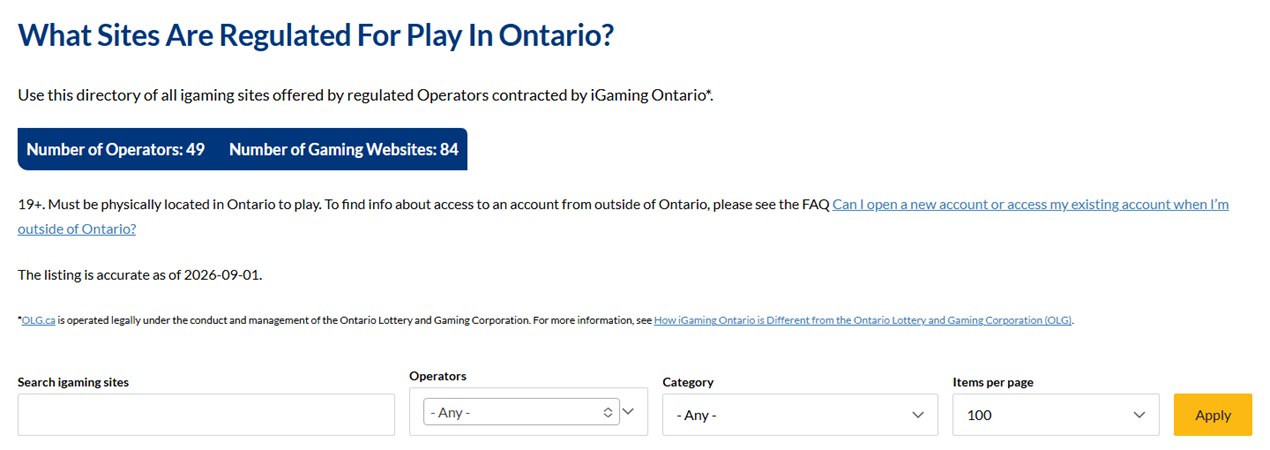
Use the iGaming Ontario directory. At the time of writing it listed 49 operators and 84 gaming websites. Search it before you deposit. A site missing from it is not regulated in Ontario, like the blacklisted casinos Canada players stumble on.
The directory is searchable by site name, operator and category: casino, poker, sports betting, bingo or betting exchange. Type the exact name of any site you plan to join.
Play is for people 19 and over who are physically in Ontario. A fully authorized operator holds an AGCO registration and, except for OLG.ca, an operating agreement with iGaming Ontario. OLG.ca runs under the Ontario Lottery and Gaming Corporation.
What does Ontario’s regulated market promise players?
Protection backed by a legal business. iGaming Ontario says regulated operators protect deposits, pay out winnings, secure your data and offer fair odds. No provincial regulator stands behind the blacklisted casinos Canada players find online.
A regulated market means the provincial government sets rules on who can operate legally, as it does with alcohol and cannabis. When Ontario opened its online market four years ago, the government said licensing was key to protecting bettors.
Regulated operators meet standards of game integrity, fairness, player protection and social responsibility. They have controls against underage play, signed anti-money laundering agreements and responsible gambling resources. Look for those tools before you deposit.
How large is Ontario’s regulated market?
Large enough to draw rogue copies. The Toronto Star reports that 2.6 million accounts wagered $82.7 billion in Ontario’s licensed market over one recent fiscal year, adding $2.9 billion to government revenue. Money on that scale draws the attention of the blacklisted casinos Canada regulators chase.
Ontario has granted licences to over 80 gambling sites so far, the Star says. Each regulated site sits in iGaming Ontario’s directory, so one search settles whether a site belongs to that market.
Protection lagged behind the money. Until this spring, Ontario left self-exclusion in the hands of the gambling websites themselves, the Star reports. Two years ago, calls to the province’s problem gambling helpline were surging, which led to calls for stricter rules.
What risks come with unregulated sites?
Lost money and exposed data. iGaming Ontario says unregulated sites give no guarantee that deposits are stored securely, and payouts can be delayed or never paid. These are the dangers of the blacklisted casinos Canada players are warned about.
Your personal information can be exposed without consent. Operators have no accountability to regulators and can stack the odds. The site can even be run by illegal entities.
Responsible gambling resources on these sites are limited. Deposit limits, time-outs and self-exclusion act as your brakes. Without them, the blacklisted casinos Canada players join can keep taking bets after a session has turned into a problem.
How does the Kahnawake Gaming Commission license operators?
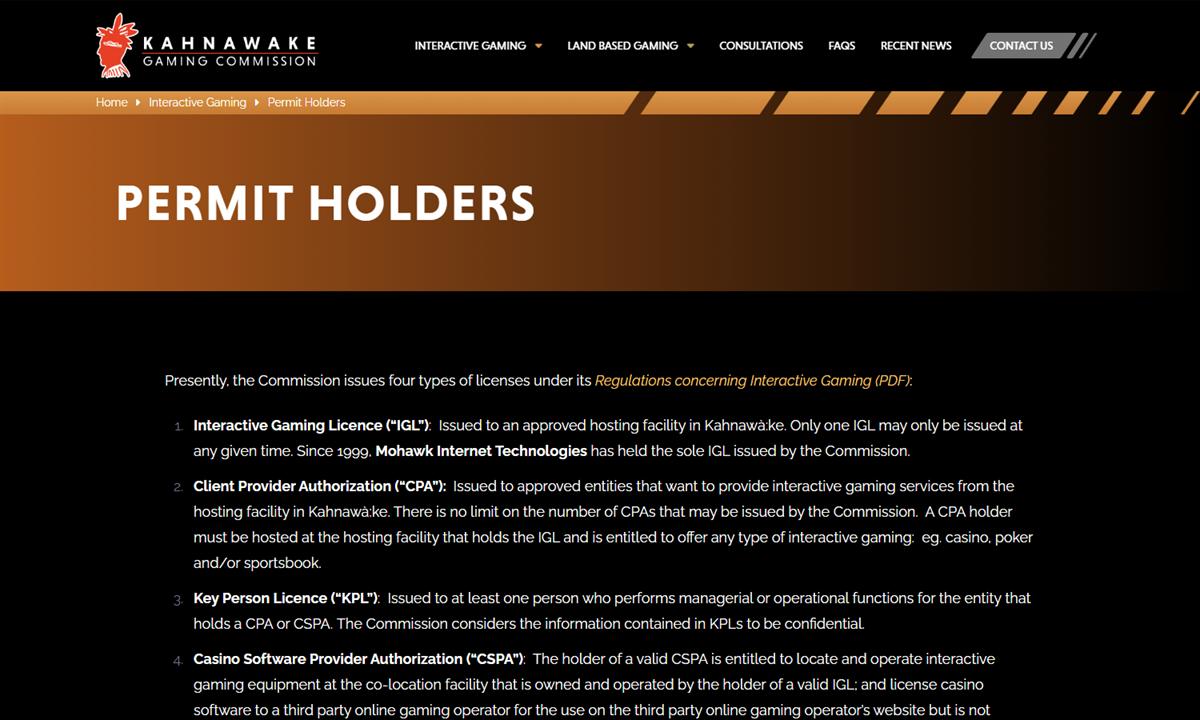
Through four licence types: the Interactive Gaming Licence, Client Provider Authorization, Key Person Licence and Casino Software Provider Authorization. Knowing these names helps you test Kahnawake claims on the blacklisted casinos Canada players come across.
Kahnawake is a sovereign Mohawk territory just outside Montreal, Quebec, and the commission has regulated online gaming since the late nineties. Only one Interactive Gaming Licence exists at a time, issued to an approved hosting facility in Kahnawake.
The Key Person Licence covers managers. The Client Provider Authorization has no limit on numbers and covers entities offering casino, poker or sportsbook from that facility. That is the authorization a Kahnawake casino holds.
How does Kahnawake warn about fake licence claims?
Through public notices. In June this year the Kahnawake Gaming Commission warned that a website was falsely implying KGC affiliation. Notices like this expose false licence claims among the blacklisted casinos Canada players spot.
The commission says all legitimate KGC licences are issued only through its official website, gamingcommission.ca. Players can contact the commission to check a licence. Type that address yourself, because blacklisted casinos Canada players meet can fake a seal.
In another June notice, the commission said a gaming site was claiming, without authority, to be KGC-regulated. The site had no legal right to claim a licence. The commission’s news page lists revocations, suspensions and voluntary terminations, which one public blacklist counts as evidence.
What did the Toronto Star investigation uncover?
Nearly $1 billion. The Toronto Star found the parent group of an Ontario-licensed casino brand and its associated companies took in that sum. It came from a global network of blacklisted casinos Canada players can reach, sites hit with fines or blacklists elsewhere for operating without a licence.
The Star worked with Investigate Europe and media in 14 other countries. The Ontario brand launched two years ago and signed partnerships with Canadian pro sports leagues and teams. A sports deal does not prove a clean corporate family.
The Ontario subsidiary is not accused of wrongdoing. The parent denied wrongdoing, calling the reporting “an incorrect and misleading interpretation of our business and corporate structure”. Before trusting a brand, check its owner against every list of blacklisted casinos Canada players use.
How did the blacklisted network operate?
Through shell companies. The Toronto Star says the parent ran offshore sites through two Curaçao shell companies. It says Curaçao is known for cheap licences with minimal oversight. Layers like these hide who runs the blacklisted casinos Canada players join.
Reporters used a leaked list of casino properties, corporate records, trademarks, IP data, leaked chats and interviews with six former employees. Leaked files show more than 150 casino brands as of last year, with more than 140 blacklisted in at least one European country.
About $969 million flowed from two Cyprus payment subsidiaries to the parent and related entities over four years. Linked casinos were fined $24 million in Spain for illegal gambling. The Curaçao and Cyprus firms went bankrupt after players sued in German and Austrian courts.
How did the linked sites treat Canadian players?
Poorly, by Ontario standards. The Toronto Star says the linked sites let users pick Canadian English and pay in Canadian dollars but skipped identity checks. That gap left these blacklisted casinos Canada players can join open to minors and people self-excluded from Ontario’s other casinos.
One linked site let a reporter open an account under a fake name and a Toronto address. A reporter posing as an addicted gambler was told “any balance in your game account will be voided”, apparently against Ontario rules. The funds were eventually sent.
Former agents called the practices “predatory”. Players closing accounts were offered bonuses to stay. Accounts closed for gambling problems were often reopened without consent, and withdrawals were delayed, at times for more than a month.
How did Ontario and Alberta regulators respond?
A probe in Ontario and a review in Alberta. The AGCO said it opened an investigation, with its Financial Investigations Unit and Licensing and Registration Branch reviewing the issues. Those issues tie a licensed brand’s parent to blacklisted casinos Canada players can find.
The AGCO said that at registration “the operator and its related entities held licences in good standing in other regulated jurisdictions”. It renewed the Ontario brand’s licence in March this year, after Investigate Europe had already reported on the parent’s unlicensed sites. It did not say why.
Alberta Gaming, Liquor and Cannabis approved the same brand for Alberta’s market. It says it will review all relevant information, including from other jurisdictions. A provincial licence covers one brand, not other sites the same owner runs, even blacklisted casinos Canada players can reach.
How do you vet a casino in five minutes?
Six checks in five minutes. NewCasino’s vetting covers the licence register, the licence history, blocking lists and red flags in the terms. That short routine spots the blacklisted casinos Canada players run into before any money leaves your account.
Before joining a casino you do not know, check every list of blacklisted casinos Canada players use. Google its name and search player forums. If the same themes repeat, such as confiscated winnings or non-payment, walk away.
Next, run a small test of customer service and start betting with caution. If you cannot research the payment providers, the casino is probably blacklisted or about to be.
Which signs point to a trustworthy licence?
A valid licence from a body that answers complaints, such as the MGA, the UKGC or Ontario’s AGCO. Add transparent terms, a clear responsible gambling section and independent dispute resolution. All four set a casino apart from the blacklisted casinos Canada watchdogs track.
Respectable licensing bodies include the UK Gambling Commission and the Malta Gaming Authority. Top licences demand transparent ownership, the financial strength to pay large wins, and third-party audits. Unlicensed casinos face no penalties or closure, whatever they do.
Licensed casinos show their licence in the footer, usually as a clickable link, so you can confirm it on the regulator’s own site. Check that an independent testing agency audits the software and that licensed developers make it.
What happens when a Curaçao licence is revoked?
The casino can keep taking deposits. When one Curaçao master licensee lost its master licence two years ago, more than 40 brands under it kept accepting players. That shows how the blacklisted casinos Canada players report can stay open.
Problem casinos hold revoked or sub-licensed Curaçao permissions with no enforcement backing. Two brands that lost their Curaçao licences moved to Anjouan. NewCasino calls that move “a step down the licence ladder after revocation, not a clean record.”
Not every Curaçao casino is unsafe, because Curaçao licensing tightened after a reform three years ago. Verify a Curaçao licence number at curacao-egaming.com or on the GCBC public register. No match? Treat the site like the blacklisted casinos Canada watchdogs flag.
Which regulators stand behind the casinos we list?
A mix of offshore and First Nations licences, with no Canadian provincial licence. 24Casino, Drakaris and WinCrown cite the Tobique Gaming Commission of Tobique First Nation in New Brunswick, which is not an Ontario iGaming registration. Check each brand against the blacklisted casinos Canada watchdogs publish.
Our Galactic Wins review records a Malta Gaming Authority licence, and AskGamblers shows all three of the casino’s complaints resolved. Cashed’s Anjouan licence sits at operator level, shared by more than 80 brands. RG.org places Anjouan in a lighter tier than Malta, the UK or Kahnawake.
Sources split on LolaJack between Anjouan and Costa Rica. We saw no licence seal or number on the Dudespin pages we opened. PlayCasino checked GGBet’s Curaçao licence on the regulator’s site and found it active. It also found Vegazone’s operator in the public Curaçao Commercial Register.
What do you do first if a casino will not pay?
Contact support first, and keep every email and bank notice. That record matters at licensed sites and at the blacklisted casinos Canada players report alike. Then withdraw, follow the terms to the letter, complete verification and make no further deposits.
If the casino is regulated, complain to its regulator next. If you already joined one of the blacklisted casinos Canada players warn about, stop playing and withdraw. Walking away can cost less than a data breach.
If you never deposited at a rogue site, you likely have nothing to worry about. Still, change any password you reused there. Report spam from blacklisted operators and block them.
Where can you file a complaint about a casino?
The regulator, if there is one. The MGA, UKGC, AGCO, ACMA, GRAI and Lotteritilsynet accept player complaints directly. An MGA or iGO operator must answer a formal complaint, while offshore licences often give you nothing beyond the support desk. Against the blacklisted casinos Canada players report, turn to watchdog mediation.
Casinomeister’s PAB is free for forum members, though little can be done if the site is on its blacklist. Casino.Guru offers free mediation with a public case log. Each complaint there is sorted as opened, unresolved, resolved or rejected.
AskGamblers runs the AGCCS, which has returned over 80 million dollars to players since the late two-thousands. Filing with Casino.Guru, AskGamblers and the regulator at the same time can recover money in certain cases. Back every complaint with deposit receipts, KYC confirmation and screenshots of the disputed terms.
Can a chargeback recover money from a rogue site?
Yes, in certain cases. If a rogue casino will not pay, a chargeback through your bank or card provider is an option. A bank report made within a reasonable time can reverse the transaction. Act fast when the blacklisted casinos Canada players report hold your money.
Chargebacks are a common trigger for a licensed casino to close an account. Save them for the blacklisted casinos Canada players run into, after support and complaints fail.
Operators in one group often share closure decisions. A ban from one brand can follow you to its sister sites, so check who owns a casino before you file a chargeback.
Why are recovery services a trap?
They are frequently scams themselves. Do not pay a third-party recovery service that promises to pull money back from the blacklisted casinos Canada players report. Losing a second payment only deepens the damage.
A police report for fraud against one of the blacklisted casinos Canada watchdogs name is possible when you hold proof. Take the deposit receipts, emails and screenshots you gathered for your complaint.
A lawyer can sue, but international law and the cost often make that impractical. Operators know it. Weigh the legal bill against the amount at stake.
How does self-exclusion work across Canada?
By your own choice. Self-exclusion is a commitment not to gamble for a period you pick. It is voluntary across Canada, so you cannot register another person. Provincial programs cover provincial operators, not the blacklisted casinos Canada players find online.
Ontario’s My PlayBreak covers OLG venues and OLG.ca for three months, six months, or one, two, three, four or five years. Members leave OLG marketing lists and go into OLG’s facial recognition database. Join at a PlaySmart Centre, through casino security, or by calling 1-800-387-0098.
Alberta’s AGLC program runs through GameSense Info Centres or casino security. BC’s BCLC program uses GameSense Info Centres or 1-866-815-0222, and Quebec’s Loto-Québec program works at casino service desks. Ontario selected a vendor on August 1 to build a centralized self-exclusion system. See our page on casino self-exclusion in Canada.
Which help lines serve players across Canada?
ConnexOntario in Ontario, plus a toll-free line in each territory. ConnexOntario runs 24 hours a day, seven days a week at 1-866-531-2600. Call whether your losses came from a provincial site or from the blacklisted casinos Canada players report.
The territories have no land-based self-exclusion programs. Call 1-800-661-0844 in the Northwest Territories, 1-800-265-3333 in Nunavut or 1-866-456-3838 in Yukon. GameSense is another Canadian help resource.
The RGC suggests calling a help line, finding other activities, trying Gamblers Anonymous, forums or counselling, and telling family. Casino Guru runs a Global Self-Exclusion Initiative that aims to let vulnerable players block all online gambling, even the blacklisted casinos Canada watchdogs track.