

To shuffle cards like a pro Canada card rooms would recognise, you need four moves: the riffle, the bridge, the wash and the cut, done in a set order with the cards kept face down. This page breaks each move into steps and adds the maths behind a fair shuffle. For licensed sites with live dealers who shuffle on camera, see our top-rated Canadian casino sites.
We cover every common shuffle, the dealer routine used in poker rooms, the number of riffles a 52-card deck takes, our own odds on cuts and repeated decks, and how casinos and online games shuffle today.
| Shuffle | Difficulty | Mixing power | Where you see it |
|---|---|---|---|
| Overhand | Easy | Weak | Home games |
| Table riffle | Medium | Strong | Casino and poker dealers |
| Riffle with bridge | Medium | Strong | Dealers, magicians |
| In-the-hands riffle | Hard | Strong | Close-up magicians |
| Wash (scramble) | Easy | Strong with time | New decks, baccarat, poker rooms |
| Faro (perfect weave) | Very hard | None if perfect | Magic tricks |
What does shuffling like a pro actually involve?
Splitting the deck evenly, mixing it with riffles, never flashing a card, and finishing with a clean cut, all at a steady pace. Speed comes later; control comes first. That is the standard when you shuffle cards like a pro Canada poker rooms expect.
Professional dealers repeat the same routine every hand, so players can see nothing unusual happened.
Casino.org calls the classic table shuffle the one move that makes you look at home at a poker table.
The good news, it adds, is that basic shuffles are far easier than they look.
Which shuffles do professional dealers use?
Mainly the table riffle, repeated, plus a wash for new decks and a strip cut between riffles. Casino.org says dealers usually riffle at least three times. Those moves are the core of how dealers shuffle cards like a pro Canada tables see.
Poker.org adds that a dealer runs the riffle two or three times between every hand.
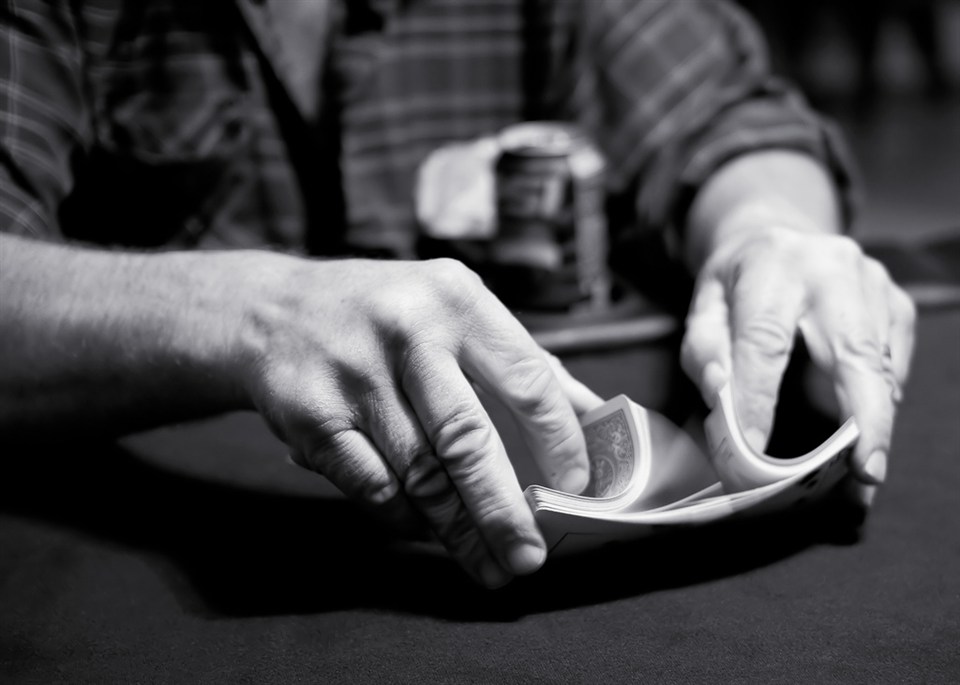
The overhand shuffle is rare at casino tables because it mixes slowly and can expose cards.
Large card rooms often pair the dealer’s shuffle with an automatic shuffler working on a second deck.
How do you do an overhand shuffle?
Hold the deck on its long edge in one hand, then use the other thumb to pull small packets off the back into the first hand, again and again. Madison Cards calls it the best shuffle for beginners. It is the starting point before you shuffle cards like a pro Canada dealers’ way.
- Hold the deck upright in your dominant hand, faces toward your palm.
- Lift the deck and let your other thumb pull a packet off the front.
- Keep dropping small packets on top of each other until the deck is through.
- Repeat the pass, then square the deck.
The move is quiet and safe for worn cards, which is why it suits family games.
Its weakness is mixing power, covered in the maths sections below.
How do you riffle shuffle on the table?
Split the deck into two even halves, put the inner corners together, lift the near edges with your thumbs and let the cards fall so they interleave, then push the halves together. Poker.org’s steps follow this order. It is the key move to shuffle cards like a pro Canada card rooms use.
- Cut the deck into two piles of about 26 cards each.
- Hold one pile in each hand, long edges facing you.
- Angle the piles so the two near corners touch.
- Bend the near long edges up with your thumbs, the far edges resting on the table.
- Release the cards from both thumbs at an even pace.
- Push the two halves together into one square deck.
Keep the cards low and face down so nobody sees the bottom cards, poker.org advises; that habit is the base of every attempt to shuffle cards like a pro Canada tables respect.
Use light pressure; bent cards are the classic beginner mistake.
How do you bridge the cards after a riffle?
After the riffle, keep the halves interlaced, arch the deck upward with your thumbs while your fingers hold the ends, then relax the pressure so the cards cascade down into one pack. The bridge is the flourish people picture when they think of how to shuffle cards like a pro Canada style.
Casino.org describes the cards cascading like a waterfall into a neat pack.
Bridging bends the cards slightly, so plastic decks handle it better than paper ones.
Dealers often skip the bridge at the table and simply push the halves together, which is gentler on the deck and still lets you shuffle cards like a pro Canada rooms accept.
How do you riffle shuffle in the hands?
Hold each half in one hand, bend both with the thumbs, release them together in the air above the table and finish with a bridge. Casino.org notes it is the shuffle favoured by close-up magicians because it looks and sounds good. It is the showiest way to shuffle cards like a pro Canada players see.
It works standing up or walking around, which is why magicians use it.
It is harder to keep the bottom card hidden, so dealers prefer the table version.
Learn it only after the table riffle is smooth.
What is a wash or scramble?
Spreading the cards face down on the table and mixing them with both palms in circles, then gathering them back into a deck. Dealers wash a new deck because it arrives in suit order. Any routine to shuffle cards like a pro Canada rooms trust starts a new deck this way.
The wash also turns cards end for end at random, which breaks up any pattern on the card backs.
Mathematician Persi Diaconis has reported that roughly a minute of washing mixes a deck well.
Keep every card face down and inside your hands’ reach so none slide off the table.
What is a strip or box cut?
Pulling small packets off the top of the deck onto the table in a new pile, so their order reverses, then putting the rest on top. Dealers use it between riffles. The strip adds a second kind of mixing when you shuffle cards like a pro Canada dealers’ way.
A strip breaks up clumps that a riffle can leave near the top and bottom.
Pull three or four packets, then drop the remaining cards on the new pile.
Casino.org’s “cool and fast casino table cards” move is a showy version that cuts the deck in one cascade.
What is the full poker-room routine?
A common poker-room sequence is wash, riffle, riffle, strip, riffle, then cut, with the cards low and face down throughout. It mixes the deck and gives every player the same view each hand. Learn this order to shuffle cards like a pro Canada card rooms recognise.
| Step | Move | Purpose |
|---|---|---|
| 1 | Wash | Breaks the previous hand’s order |
| 2 | Riffle | Interleaves two halves |
| 3 | Riffle | Doubles the possible patterns |
| 4 | Strip | Reverses packet order |
| 5 | Riffle | Mixes the stripped deck |
| 6 | Cut | Hides the bottom card |
House procedures vary, so dealers learn the exact order their room uses.
Speed matters less than consistency, since surveillance watches for any change.
What riffle count randomises a 52-card deck?
Seven, according to Dave Bayer and Persi Diaconis, whose study showed the deck stays far from random until five riffles and becomes close to random at seven. Madison Cards and 52Kards repeat the seven figure. It is the number to remember when you shuffle cards like a pro Canada games deserve.
| Riffles | Distance from a random deck (Bayer and Diaconis) |
|---|---|
| 1 to 4 | 1.000 |
| 5 | 0.924 |
| 6 | 0.614 |
| 7 | 0.334 |
| 8 | 0.167 |
| 9 | 0.085 |
| 10 | 0.043 |
A distance of 1 means fully predictable patterns remain; 0 means perfectly random. Seven riffles is the practical bar to shuffle cards like a pro Canada games for money set.
The drop is sharp: the value roughly halves with each riffle after seven.
Why can five riffles never be enough?
Each riffle at most doubles the rising runs in the deck, so five riffles allow no more than 32. A reversed deck has 52 runs, so reaching every order takes at least six riffles, by our sums. That logic underpins any claim to shuffle cards like a pro Canada players test.
| Riffles | Maximum rising runs | Can reach every order? |
|---|---|---|
| 4 | 16 | No |
| 5 | 32 | No |
| 6 | 64 | Yes, in principle |
| 7 | 128 | Yes |
A rising run is a stretch of cards still in their original relative order.
Reaching every order is not the same as being random, which is why seven beats six.
How even does the cut have to be?
Not perfectly even. In the standard model of a riffle, the cut follows a binomial pattern: an exact 26-26 split happens 11.0% of the time, a cut between 24 and 28 cards 51.2%, and between 22 and 30 cards 78.8%, by our sums. Close is fine when you shuffle cards like a pro Canada style.
| Cards in the top half | Chance under the binomial model |
|---|---|
| Exactly 26 | 11.0% |
| 24 to 28 | 51.2% |
| 22 to 30 | 78.8% |
The model behind the seven-riffle result assumes natural human cuts, not perfect ones, so you can shuffle cards like a pro Canada style without measuring each half.
Very uneven halves, such as 15 and 37, leave large blocks unmixed.
What is a faro shuffle?
A perfect riffle that interlaces the two halves one card at a time. 52Kards notes that eight perfect faros with an even 26-26 cut return the deck to its starting order. Magicians love it, but it is the wrong tool to shuffle cards like a pro Canada games for money require.
| Faro type | Top card stays on top? | Perfect shuffles to restore 52 cards |
|---|---|---|
| Out-faro | Yes | 8 |
| In-faro | No | 52 |
We checked both figures with modular arithmetic: 2 raised to the 8th power leaves 1 after division by 51, and the in-faro’s cycle on 53 positions has length 52.
Because a perfect faro is predictable, it adds no randomness at all.
Why is the overhand shuffle so weak?
Each pass moves cards in packets that keep their order inside each packet, so mixing is slow. Robin Pemantle’s analysis showed the overhand shuffle needs thousands of passes to mix a 52-card deck as well as seven riffles. Skip it when you shuffle cards like a pro Canada rooms judge.
Small packets help, but the shuffle still keeps neighbours together for too long.
That is why Madison Cards lists it as a beginner move, not a casino one.
If riffling is not possible, follow overhand passes with a long wash.
What is the number of possible deck orders?
52 factorial, about 8.07 times 10 to the power of 67, a number with 68 digits, by our sums. A properly shuffled deck is almost certainly in an order no deck has ever held before. That scale explains why it pays to shuffle cards like a pro Canada games rely on.
The first card can be any of 52, the next any of 51, and so on down to 1.
Multiplying those choices together gives the 68-digit total.
52Kards lists this among its two cool shuffling facts.
Has the same shuffled deck ever appeared twice?
Almost certainly not. A 50% chance of one repeat needs about 1.06 times 10 to the power of 34 random decks, by our birthday-problem sums: 42 million billion years of 8 billion people shuffling once a second. Fair play rests on dealers who shuffle cards like a pro Canada wide.
The universe is about 13.8 billion years old, a tiny fraction of that time.
The claim only holds for genuinely random shuffles; poor shuffles repeat patterns far more often.
Four overhand passes on a new deck leave it close to suit order, nowhere near random.
How do dealers hide the bottom card?
By keeping the deck low, close to the felt and face down at every stage, and by squaring it before lifting. Poker.org stresses guarding the cards so no player sees the bottom two. Protection is half of what it means to shuffle cards like a pro Canada tables watch for.
Tilt the riffle so the faces point toward the table, never toward a player.
Finish with a cut so the bottom card moves to an unknown spot.
A flashed card ruins the shuffle’s fairness even if the mixing was perfect.
How do you cut the deck like a dealer?
Lift the top part of the deck, set it on the table, then place the bottom part on top of it, keeping the cards square. At a home game the player to the dealer’s right usually makes the cut. A clean cut finishes the routine to shuffle cards like a pro Canada home games follow.
Cut near the middle; a cut of only one or two cards does little.
Casinos often use a coloured cut card so the bottom card never shows.
In blackjack, the cut card also marks where the dealer stops dealing from a shoe.
How do dealers check a deck is complete?
By spreading the cards face up in an even arc across the table and scanning the suits, Casino.org explains. Counting 52 cards by eye takes seconds once each suit is in order. Checking the deck belongs to the craft when you shuffle cards like a pro Canada rooms expect.
New decks are checked before the first wash, while still in suit order.
A missing or extra card voids a hand in most rules, so the check matters.
A smooth table spread is also a popular flourish on its own.
Which mistakes give a beginner away?
Bending the cards, cutting very uneven halves, lifting the deck high, flashing faces, rushing and dropping cards. Poker.org lists bending and exposed cards among the main errors. Fix these before you try to shuffle cards like a pro Canada players notice.
- Squeezing too hard during the riffle.
- Letting one half fall in a block of ten cards or more.
- Bridging a paper deck so hard it stays curved.
- Skipping the cut at the end.
Practise slowly; even pace beats speed for anyone learning to shuffle cards like a pro Canada home games admire.
Which deck is easiest to shuffle?
A plastic or plastic-coated poker-size deck that is clean and flat. Plastic survives riffles and bridges without creasing, while new paper decks can stick at first. The right deck makes it easier to shuffle cards like a pro Canada card nights enjoy.
Bridge-size cards are narrower and can feel easier for small hands.
Madison Cards gives deck choice its own section, a sign of the weight feel carries when you shuffle cards like a pro Canada style.
Replace a deck once cards start to bend or mark, since marked backs can be recognised.
How long does it take to learn to shuffle like a pro?
About a week for the basic moves, casino.org says, with short daily practice. The table below spreads the work over seven days, by our own plan. Regular practice is all it takes to shuffle cards like a pro Canada home games respect.
| Days | Practice focus |
|---|---|
| 1 to 2 | Overhand passes and even splits |
| 3 to 4 | Table riffle at slow, even pace |
| 5 | Bridge after the riffle |
| 6 | Wash, strip and cut |
| 7 | Full routine with cards kept low |
Casino.org points out that a deck is portable, so you can practise while watching TV.
How do casinos shuffle by machine?
Automatic shufflers mix one deck while the dealer deals from another, and continuous shuffling machines on blackjack tables return used cards to the machine after each round. Machines remove human error, but dealers still learn to shuffle cards like a pro Canada casinos require.
Machines speed up the game, which raises the number of hands dealt each hour.
Dealers still wash and spread decks when they come into play.
Hand shuffles remain common in poker and at private games, where hosts still shuffle cards like a pro Canada card rooms taught them.
Does shuffling affect card counting?
Yes. Counting depends on how deep into a shoe the dealer goes before reshuffling, and continuous shufflers leave no shoe to track. Frequent, thorough shuffles cut the counter’s edge. That is a reason casinos train staff to shuffle cards like a pro Canada tables need.
An early cut card placement shortens the shoe and limits counting gains.
Our baccarat card counting page explains why counting in baccarat rarely pays.
Counting is not illegal, but casinos can refuse play to suspected counters.
Why does a wash matter against edge sorting?
Edge sorting relies on cards keeping the same orientation, so tiny printing flaws on the backs point one way. A wash rotates cards at random and breaks that pattern. It is one more reason to shuffle cards like a pro Canada casinos insist on.
Automatic shufflers can keep card orientation, which is how a famous edge-sorting case unfolded.
Our edge sorting page covers the technique and the court cases around it.
Decks with symmetrical back designs reduce the risk further.
How do online casinos shuffle?
With a random number generator that produces a fresh virtual deck order every hand, so no physical shuffle exists. The RNG does in milliseconds what a dealer does in seconds. Online games do not depend on anyone to shuffle cards like a pro Canada players can watch.
Most digital table games reshuffle the virtual deck after every hand, so counting has no use.
Licensed games are tested by independent labs for random output.
Our random number generator page explains how these virtual shuffles work.
How do live dealer tables shuffle?
Live studios use real cards, dealt from shoes or single decks, and shuffle them by hand or by machine on camera. Viewers see the shuffle, which builds trust. Live tables are the online place to watch staff shuffle cards like a pro Canada viewers can follow.
Multi-deck shoes are reshuffled when the cut card appears.
Baccarat squeeze tables show the dealer handling every card slowly.
Our live dealer casinos introduction explains how studio games run.
Do you have to shuffle well to become a dealer?
Yes. Dealer training covers shuffling, pitching cards, chip handling and game rules, and auditions often include a shuffle test. A clean, consistent riffle is the first skill trainers look for. Learning to shuffle cards like a pro Canada dealer jobs demand starts at home.
Online studio dealers also shuffle on camera, so the skill carries over.
Our online casino dealer page covers the training path.
Practise the full routine until you can run it without looking at your hands.
Which flourishes impress at a home game?
The bridge, a cascade cut and a smooth table spread. Casino.org says all of these look harder than they are and can be learned within a week. Add them only after the basics work, since a flourish is the last step to shuffle cards like a pro Canada friends admire.
Casino.org’s demonstration features Spanish magician Miquel Roman, an expert in cardistry.
Cardistry is the art of card flourishes, separate from fair shuffling.
Keep flourishes outside the deal itself so nobody questions the shuffle.
Can a shuffle be faked?
Yes. Magicians use false shuffles that look real but keep cards in place, which is why casinos use fixed routines, cameras and machines. A fair shuffle hides nothing from players. Honest technique is the point when you shuffle cards like a pro Canada games trust.
A faro done perfectly is one way to control a deck, which is why it never belongs in a money game.
At home, rotate the deal and let a different player cut each hand.
If a shuffle looks odd, ask for a new one; any fair dealer agrees.
Which shuffle suits a beginner first?
The overhand shuffle for confidence, then the table riffle as soon as possible, since the riffle is what mixes the deck. Madison Cards ranks the overhand as the best start. That order is the fastest path to shuffle cards like a pro Canada players expect.
Move to the riffle once you can split the deck evenly by eye.
Add the bridge, wash and strip after the riffle feels natural.
Leave the in-the-hands riffle and faro for last; neither is required to shuffle cards like a pro Canada dealers’ way.
How do you run the shuffle at a home poker night?
Rotate the deal clockwise, have the dealer wash a new deck, run three or more riffles with a strip, and let the player on the dealer’s right cut. Keep the cards low and face down. That routine lets every host shuffle cards like a pro Canada card nights enjoy.
Use two decks with different back colours so one is shuffled while the other is dealt.
Count the deck at the start of the night with a quick spread.
Agree on house rules for exposed cards before the first hand.
What are the key steps to remember?
Wash new decks, split evenly, riffle at least seven times for a truly mixed deck or three or more for a quick game, keep the cards low, and cut at the end. Practise daily for a week. Those steps let anyone shuffle cards like a pro Canada tables accept.
Speed follows from smooth technique, never the other way round.
Protect the deck from view at every step.
Replace worn cards before they become marked.