

32 cards live is Ezugi’s live dealer card game in which four fixed hands race to the highest total. Each hand starts with its own number, 8, 9, 10 or 11, and gets one card from a 32-card deck. For the wider market picture, start at our online casino Canada hub.
The table sets out the 32 cards live numbers a Canadian player checks first. Each line traces to a source named in the sections below.
| Trait | Detail |
|---|---|
| Studio | Ezugi, an Evolution brand |
| Deck | 32 cards, 6 to King |
| Positions | Player 8, Player 9, Player 10 and Player 11 |
| Payouts | 11:1, 4.5:1, 2.2:1 and 1:1 |
| Lowest house edge | 6.01% on Player 8 |
| Highest house edge | 9.92% on Player 9 |
| Side bets | None |
| Betting window | About 15 seconds |
What is 32 cards live?
32 cards live is a betting game on four fixed hands. Wizard of Odds describes it as a simple game where the player chooses which of four betting positions will have the highest total.
Each position starts with its own number: 8, 9, 10 or 11. The dealer adds one card to each, and the highest total wins the 32 cards live round.
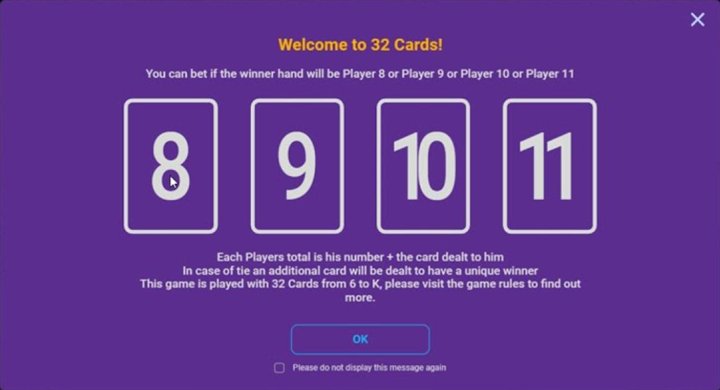
There are no player decisions after the bet. Livedealer.org notes that the complete house rules just about fit in the summary graphic shown when a 32 cards live table first opens.
Where does the game come from?
India. Livedealer.org calls it a favourite Indian casino card game, and Live Casino Comparer places it among Ezugi’s Indian card games, next to Andar Bahar and Teen Patti.
Ezugi runs it from its live studio in Romania, per Live Casino Comparer, and Bollywood Casino names the city as Bucharest. The set has an Indian theme, with presenters wearing dupattas over their outfits.
Live Casino Comparer adds that the game is not reserved for Indian players. Anyone who likes live dealer card games can join a 32 cards live table. Our andar bahar live page covers the other Ezugi classic.
Which cards are in the deck?
Thirty-two cards, from 6 to King. Wizard of Odds, Livedealer.org and Live Casino Comparer all describe a standard deck with the Aces, 2s, 3s, 4s and 5s removed.
That leaves eight ranks in four suits. In 32 cards live, cards 6 to 10 count at face value, a Jack counts 11, a Queen 12 and a King 13.
Live Casino Comparer says the 32 cards live deck is shuffled between rounds, and Livedealer.org says the dealer reshuffles the small deck during betting time.
How does a round work?
In six steps. The only decision in the round is the bet, and Bollywood Casino notes that an on-screen timer gives players about 15 seconds to place it.
- The dealer reshuffles the 32-card deck while betting is open.
- Players place chips on up to three of the four positions: Player 8, 9, 10 or 11.
- Betting closes, and the dealer deals one card to each position.
- Each total is the position’s number plus its card, shown on screen as the cards land.
- If two or more positions share the top total, they get extra cards until one leads.
- The highest total wins, and bets on that position are paid.
The welcome screen in 32 cards live footage sums it up in three lines: each total is the player’s number plus the card, a tie brings another card, and the game uses 32 cards from 6 to King.
How is each hand scored?
By simple addition. Wizard of Odds says a position’s score is its own number plus the card dealt to it, so position 8 with a Queen scores 8 plus 12, or 20.
Bollywood Casino gives two more: Player 10 with a Jack makes 21, and Player 11 with a 6 makes 17. In that round, position 10 wins.
The first-card totals run from 14, an 8 with a 6, to 24, an 11 with a King. Player 11 can never score less than 17 on its first card.
What happens on a tie?
The tied positions draw again. Wizard of Odds says extra cards go only to the positions involved in the tie, and the dealing continues until the tie is broken.
Its worked example had positions 9 and 10 level on 20. After one more card each, position 9 won with 27. A tie in 32 cards live never splits the pot; the extra cards always produce one winner.
Gameplay footage shows the same rule. Players 10 and 11 both reached 22, with a Queen and a Jack. The next cards gave Player 10 a 7 for 29 and Player 11 a Queen for 34, and Player 11 won the round.
What does each position pay?
The lower the starting number, the bigger the payout. Wizard of Odds and Livedealer.org list 11:1 on Player 8, 4.5:1 on Player 9, 2.2:1 on Player 10 and even money on Player 11.
| Position | Pays | Win chance | RTP |
|---|---|---|---|
| Player 8 | 11:1 | 7.83% | 93.99% |
| Player 9 | 4.5:1 | 16.38% | 90.09% |
| Player 10 | 2.2:1 | 29.30% | 93.77% |
| Player 11 | 1:1 | 46.49% | 92.97% |
The win chances come from Wizard of Odds and the returns from Livedealer.org. The two sources line up to within a rounding on every 32 cards live position.
On a $10 bet, a win pays $110 on Player 8, $45 on Player 9, $22 on Player 10 and $10 on Player 11, with the stake returned on top.
How often does each position win?
Player 11 wins most often, just under half the time. Wizard of Odds puts its chance at 46.49%, against 29.30% for Player 10, 16.38% for Player 9 and 7.83% for Player 8.
In round numbers, Player 8 wins about once in 13 rounds, Player 9 about once in 6 and Player 10 about 3 times in 10.
Players 10 and 11 together win 75.79% of 32 cards live rounds. Live Casino Comparer puts the same pair at approximately 75%.
Why does Player 9 return the least?
Its payout falls furthest short of its odds. A fair price for a 16.38% chance would be about 5.11:1, while 32 cards live pays 4.5:1, which leaves a 9.92% house edge.
The same sum for the other spots: Player 8 would need about 11.77:1 and pays 11:1, Player 10 would need about 2.41:1 and pays 2.2:1, and Player 11 would need about 1.15:1 and pays 1:1.
Each gap is the house’s margin. Player 9’s is the widest, which is why Livedealer.org marks its 90.09% return with an “Ouch!”.
Which bet has the lowest house edge?
Player 8, at 6.01%. Wizard of Odds names it the best bet in the game, just ahead of Player 10 at 6.23%, with Player 11 at 7.03% and Player 9 at 9.92%.
The best bet is also the least likely to win. At 7.83%, a Player 8 bettor at a 32 cards live table goes through long stretches between wins.
Livedealer.org’s summary of the 32 cards live returns is blunt: they are not great, whichever position a player backs.
What does a hundred rounds cost?
Between about $30 and $50 at $5 a round, depending on the position. One hundred rounds put $500 on the table, and the house edge sets the long-run cost.
| Position | Staked over 100 rounds | Expected cost |
|---|---|---|
| Player 8 | $500 | $30.03 |
| Player 9 | $500 | $49.59 |
| Player 10 | $500 | $31.16 |
| Player 11 | $500 | $35.14 |
A single session can land far from these figures in either direction. The 32 cards live averages only settle over many rounds.
Can you bet on more than one position?
Yes, on up to three. Live Casino Comparer and Bollywood Casino both say the interface blocks a bet on all four positions, and Live Casino Comparer gives the reason: to stop players hedging their bets.
Footage of a 32 cards live round shows chips on three spots at once, Player 8, 9 and 10, with the fourth spot left empty.
Covering more positions raises the chance that one of them wins, but it does not change the house edge on any 32 cards live bet.
What happens if you back Player 10 and Player 11 together?
You trade upside for frequency. Live Casino Comparer suggests backing these two and sizing the stakes so that a win on one covers the loss on the other.
With $10 on each, a Player 10 win pays $22 and loses $10, for $12 profit. A Player 11 win pays $10 and loses $10, so the round breaks even. A win for Player 8 or 9 costs $20.
Those outcomes come up 29.30%, 46.49% and 24.21% of the time. The expected cost is about $1.33 a round, the two house edges added together.
What would backing all four positions do?
It would lock in a loss on average, which is why the 32 cards live interface does not allow it. With $10 on each spot, $40 is staked and exactly one spot wins.
A Player 8 win returns $120, a profit of $80. A Player 9 win returns $55, up $15. A Player 10 win returns $32, down $8, and a Player 11 win returns $20, down $20.
Weighted by the win chances, that comes to a cost of about $2.92 a round, the four house edges added together. Covering every outcome removes the suspense but not the margin.
Which cards can win for Player 8?
A high card, and luck with the others. Player 11 starts at 11, so its lowest possible total is 17, with a 6.
Player 8 needs at least a 9 to tie that floor at 17 and a 10 or better to pass it. Even an 8 with a King makes only 21, which Player 11 matches with a 10.
That is why the spot pays 11:1. In both 32 cards live rounds shown in the footage above, Player 8 drew a 6 for 14, the lowest score on the table.
What does a winning bet look like?
A banner and a total. In one 32 cards live clip, Player 10 wins with 22, a 10 plus a Queen, and the screen shows You Win: €3.20 on a €1 bet.
That is the 2.2:1 payout, €2.20, plus the €1 stake. The same player also had €1 on Player 11, which finished on 18 with a 7, so the round netted €1.20.
Player 9 made 20 with a Jack and Player 8 made 14 with a 6, so Player 10’s 22 was the top total and no tie-break was needed.
What does the table show?
The four hands, the result and the recent history. Footage shows a panel listing each position’s number, card and running total, with the sum spelled out beneath, such as 10+12+7.
The felt carries the 32 Cards Live logo, the four numbered spots and the payouts printed under them: 11:1, 4.5:1, 2.2:1 and 1:1. A banner names the winner, such as Player 11 Wins.
Live Casino Comparer describes an Indian-themed studio and the standard Ezugi interface. The table header in one clip reads 32 Cards, Min €0.50 to Max €2,500.
What do the Latest 100 Rounds statistics mean?
They count the recent winners. One 32 cards live clip shows Player 8 on 5%, Player 9 on 28%, Player 10 on 25% and Player 11 on 42% over the latest 100 rounds.
Those shares drift around the long-run chances of 7.83%, 16.38%, 29.30% and 46.49%. A hundred rounds is a small sample.
Live Casino Comparer notes that the statistics show what has happened but cannot predict what comes next. Each round is dealt from a freshly shuffled deck.
How long is the betting window?
About 15 seconds, per Bollywood Casino, with a timer on screen. Footage from another casino shows the prompt as a countdown bar reading 14 Place Your Bets.
The short window suits a game with one decision. The chips, a Double button and an Undo button sit under the countdown, so a 32 cards live bet can be placed, doubled or taken back in a few taps.
What are the bet limits?
They depend on the casino. One 32 cards live clip shows a table header of €0.50 to €2,500, and another casino’s version shows R10 to R50,000 in South African rand.
The header at the top of the game window carries the limits in force. It is the first thing to check before the first chip goes down.
Are there side bets?
No. Live Casino Comparer and Bollywood Casino both say 32 cards live has only the four betting positions, with no side bets.
That keeps the pay table to four lines. The biggest win in the game is 11:1 on Player 8, per Live Casino Comparer.
Is there a strategy?
Not one that changes the odds. Bollywood Casino calls it a game of chance, and each position’s house edge is fixed by its payout and its win chance.
What a player controls is the choice of spot and the stake. In 32 cards live, Player 8 has the lowest edge, Player 11 wins most often and Player 9 costs the most.
Live Casino Comparer’s own approach is to chase small, frequent wins on Players 10 and 11 rather than the 11:1 on Player 8. The cost of that approach is set out above.
Bollywood Casino leans the same way and suggests staking more on Player 11 because it wins most often. The numbers show the trade: Player 11 wins 46.49% of 32 cards live rounds but carries a 7.03% edge, higher than the 6.01% on Player 8.
Is 32 cards live on mobile?
Yes. Live Casino Comparer says the standard Ezugi interface works on desktop and mobile, and Bollywood Casino says the game can be played on a phone or a computer.
One bet and a short window suit a small screen. An unlimited number of players can join the same 32 cards live table, per Live Casino Comparer.

Our homepage lists Zizobet at number 2. The Zizobet review notes live dealer tables and sets out the bonus terms and withdrawal rules; open the lobby and confirm 32 Cards Live is there before a first deposit. Our page on online casino bonuses compares the rest of the list.
What does a Canadian player check before playing?
Four items: the table header for limits, the pay table, the return figures in the game help and the operator’s registration. All four are visible before the first round of 32 cards live.
Set a money limit and a time limit first. Players in Ontario who want support can call ConnexOntario at 1-866-531-2600.
Our page on responsible gambling practices for Canadians covers limits and tools, and our introduction to live dealer casinos explains how live tables work.
Which pages are worth reading next?
Four pages sit closest to this one. Each covers another live or table card game tied to the subjects above, and each one stands on its own.
32 cards live asks one question each round: which of four fixed hands finishes highest. The payouts follow the odds, and the house keeps between 6.01% and 9.92% of what is staked.