
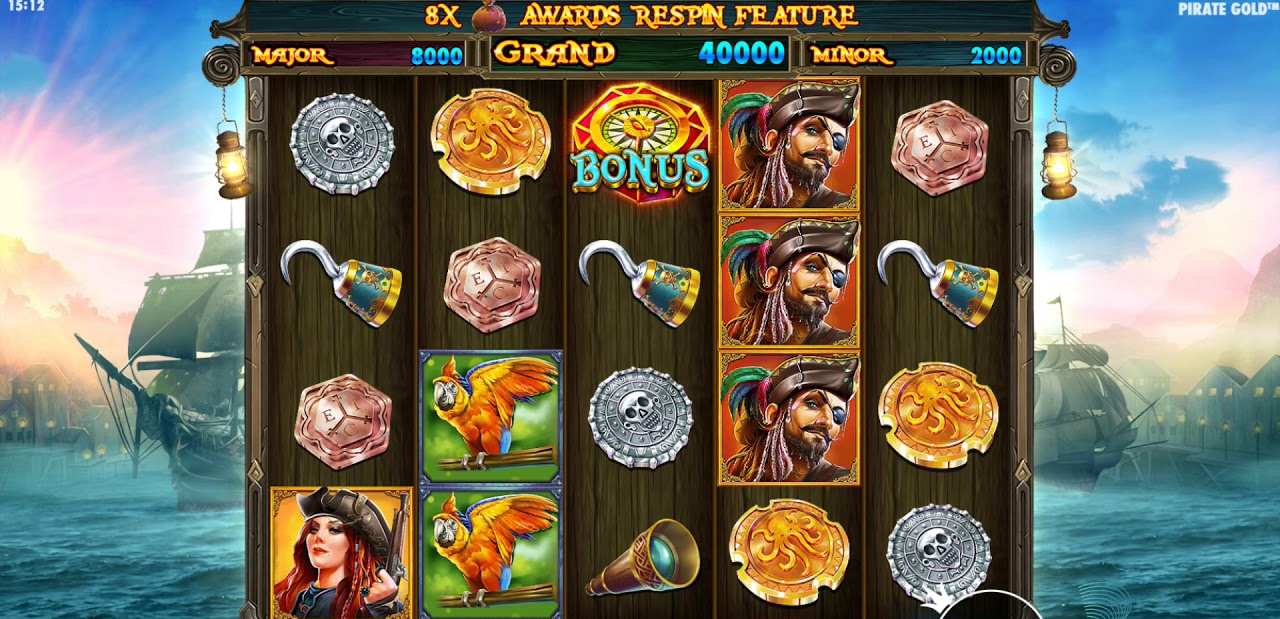
Pirate slots converged on one mechanic and it is not free spins. The treasure chest collection round, where coin and chest symbols lock in place and fill a grid, became the shape the whole shelf is built around. For the wider market picture, start at our Canadian online casino hub.
The table below sets out what pirate slots deliver. Read it first, then work through the detail beneath.
| Trait | What it means |
|---|---|
| Defining mechanic | Treasure collection with locking symbols |
| Signature titles | Pirate Gold, Pirates Plenty, Ghost Pirates |
| Typical grid | Five reels, three or four rows |
| Return range | Roughly 94 to 96.5 percent |
| Volatility | Medium to high, depending on the collection tier |
| Jackpots | Fixed tiers far more often than shared pools |
What are pirate slots?
Pirate slots are titles built around seafaring iconography, using ships, treasure chests, maps, parrots, cannons and gold coins as their paying symbols.
Pirate slots span hundreds of games across the studios serving Canada.
The setting on pirate slots is decorative. The collection round underneath is what matters.
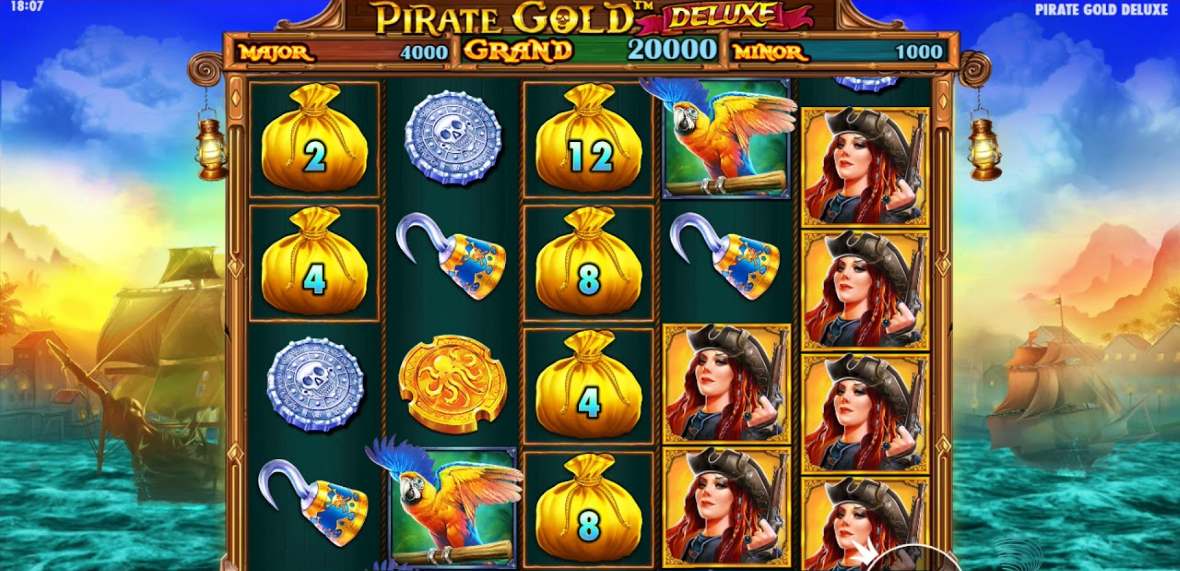
The symbol vocabulary is narrow and instantly readable. A galleon under full sail, a treasure chest, a skull, a parrot, a cutlass and a compass fill the high paying rows, and card royals carved into weathered plank or rope fill the low rows on nearly every build.
What separates pirate slots from the other big themes is that the mechanic arrived with the artwork rather than after it. Buried treasure is a collection by definition, so a studio building a pirate slot reaches for a collection round almost automatically.
Canadian lobbies carry the full spread. A registered Ontario operator will list a straightforward five reel collection build beside a Megaways conversion and a ways engine, all under a galleon thumbnail.
What mechanic defines pirate slots?
Treasure collection. Coin and chest symbols land, lock in place, and a respin counter resets each time a new one arrives, so the grid fills gradually and the round ends when nothing new lands.
Pirate slots fit the mechanic perfectly. Buried treasure is literally a collection.
Hold and respin is the technical name and the structure is the same everywhere it appears. Trigger symbols lock into their positions, the rest of the grid respins around them, and a counter starting at three resets every time a new symbol locks.
The round ends when the counter reaches zero or the grid fills completely. A full grid almost always pays the top fixed award on the title, which gives the player a visible target rather than an abstract multiplier.
What pirate slots added was thematic fit. A chest filling with coins reads as literal progress, and studios lean on that by printing a running total on screen so the player sees the value accumulate position by position.
What is a treasure chest collection feature?
A hold and respin round where each locked symbol carries a printed cash value. The total climbs visibly as positions fill, and a full grid usually awards the top fixed prize outright.
Nothing has to be explained during a pirate slots round. The screen states it.
Each locked symbol carries a value printed on its face, scaled to the stake, so a player can read the round without opening a paytable. Values run from a small multiple of the stake on ordinary coins to a fixed jackpot tier on rare special symbols.
The counter is what shapes the distribution. Three respins is enough to keep a partially filled grid alive briefly and not enough to make a full fill common, which is why most rounds end with a modest total.
Special symbols extend the idea on the stronger pirate slots. Collector coins that absorb every other value on the grid, multiplier coins that scale the total and unlock coins that add a row all appear as variations on the same core round.
Which pirate slots are the best known?
Pirate Gold from Pragmatic Play leads the pirate slots shortlist, followed by Pirates Plenty from Red Tiger, Ghost Pirates from NetEnt and Pirate Kingdom Megaways from Iron Dog.
Each runs a variation on collection.
Availability differs by operator. The pirate slots shortlist changes slowly.
Pirate Gold from Pragmatic Play is the reference build and the one most Canadian lobbies list first. Its row unlocking collection round became the pattern other studios copied, and the sequel carries the same structure with a larger grid.
Pirates Plenty from Red Tiger is the best known alternative structure, replacing instant collection with persistent progress across spins. Ghost Pirates from NetEnt predates both and runs a conventional free spins round instead of collection.
Below that tier sit hundreds of releases sharing the mechanic. Pirate Kingdom Megaways, Razor Shark and dozens of smaller collection builds fill out the pirate slots catalogue, and the return figures across them vary more than the artwork suggests.
What is Pirate Gold?
The Pragmatic Play title that set the pattern for pirate slots. Coin symbols lock across a six by four grid and a full row unlocks an extra row, which raises both the collection space and the top prize.
Row unlocking is the innovation. Everything else follows standard pirate slots collection.
Pragmatic Play released it as a straightforward money collection title and it became one of the studio signature builds. Coin symbols land on a six by four grid, lock in place, and each carries a value the player can read immediately.
Row unlocking is the mechanic that separates it. Filling an entire row opens an additional row beneath, which expands the collection space mid round and raises the ceiling without changing any other rule.
Fixed jackpot tiers sit on top of the coin values. Mini, minor, major and grand prizes appear as special coins rather than as a separate wheel, which keeps the whole round inside one screen.
What is Pirates Plenty?
A Red Tiger title built around a ship that advances one step per trigger symbol until it reaches a sunken treasure reel.
The progress carries across spins rather than resetting.
Persistent progress is unusual across pirate slots. It is the defining feature here.
Red Tiger built it around persistence rather than a single round. A ship icon at the side of the reels advances one step each time a trigger symbol lands, and the progress carries across spins rather than resetting when a spin ends.
Reaching the end of the track unlocks a sunken treasure reel on the right of the grid. That reel stays unlocked, changing the game permanently for the rest of the session rather than for a fixed number of spins.
The structure is closer to a collection meter than to hold and respin, which makes it the clearest alternative shape among pirate slots. It also makes the title harder to read from a thumbnail than the standard pirate slots around it.
Do pirate slots have progressive jackpots?
A minority do. Most pirate slots place their ceiling in fixed tier prizes attached to the collection round, because the mechanic already delivers a visible top award without a shared pool.
Fixed tiers on pirate slots pay far more often than a network jackpot. They pay far less.
The collection mechanic already supplies a visible ceiling, so most studios see no reason to add a shared pool on top. Fixed tier prizes attached to the round deliver the same sense of a top award while remaining entirely inside the certified build.
Where a progressive does appear it usually sits alongside collection rather than inside it. A random jackpot trigger or a separate wheel round runs independently, and the pool contribution is taken from the base return in the usual way.
For most Canadian players the fixed grand tier is the relevant ceiling. It is stated in the rules screen, it is reached through a full grid fill, and it arrives far more often than any network jackpot would.
What return figures do pirate slots publish?
Most sit between 94 and 96.5 percent. Collection builds frequently ship in several certified versions, so the figure on one Canadian lobby can differ from the same title elsewhere.
The rules screen on pirate slots states the deployed figure. Lobby tiles never do.
The spread is wide enough to matter. Major studio releases cluster near 96 percent, and the long tail of smaller collection clones routinely ships at 94 percent or below while looking almost identical on a lobby tile.
Multiple certified versions complicate every comparison. Popular collection titles ship at several percentages and an operator selects one, so an affiliate table quoting a single figure is describing one deployment rather than the game.
Reading the running client settles it. On a Canadian regulated site the deployed figure is stated inside the title, and checking it takes less time than the lobby page took to load.
How volatile are pirate slots?
Medium to high, and the collection tier decides which. A title paying a fixed grand prize on a full grid runs harsher than one paying a modest total for a partial fill, because the ceiling has to be funded.
The volatility rating on pirate slots states it in one line. Read it first.
The tier structure drives the rating directly. A title reserving a grand jackpot for a complete grid fill has to fund that outcome from the rest of the round, which thins the ordinary collection totals and pushes the build toward high variance.
Titles without a grand tier run gentler. A collection round paying a modest multiple on a partial fill arrives often, keeps a balance moving and produces a narrow outcome distribution closer to medium variance.
Ways engines and Megaways conversions sit above both. The changing route count raises variance on its own, so a pirate Megaways title runs hotter than the five reel collection build wearing similar artwork.
What is a map bonus on a pirate slot?
A trail or pick round dressed as a treasure map, where the player advances toward a marked location one step at a time until a collect square ends it.
It appears as a secondary feature alongside collection rather than instead of it.
The outcome is drawn before a pirate slots map opens. The route only reveals it.
The format is a trail or pick screen dressed as a chart, with the player advancing toward a marked position one step at a time. Cash values, multipliers and occasional jackpot entries sit along the route.
It appears as a secondary feature rather than a replacement. A title carrying both offers collection for the main reward and a map round for variety, and the rules screen states which trigger opens which.
The outcome is settled before the map appears. A certified random draw fixes the destination at the moment the round opens, and the advance sequence reveals a result that already exists.
Where can Canadians play pirate slots?
Ontario registered operators carry the full shelf, and provincial crown platforms carry a curated selection. Ontario Lottery and Gaming lists Pirate Plunder in its own catalogue.
The certified build behind pirate slots is identical in both. The return version can differ.
Ontario registered operators carry the deepest selection. Pragmatic Play, Red Tiger and NetEnt all hold supplier registration, so the major pirate slots appear as certified builds with the return figure stated inside each one.
Provincial crown platforms carry a curated subset. Ontario Lottery and Gaming lists Pirate Plunder in its own catalogue, and the other provincial operators each run smaller selections shaped by their supplier agreements.
The certified package is identical wherever it is deployed. What differs is which return version an operator selected and how deep the catalogue runs, and both are visible from inside the running game.
Which studios build pirate slots?
Pragmatic Play, Red Tiger, NetEnt, Play n GO and Iron Dog all hold major pirate slots, and smaller studios release collection variants constantly.
The mechanic is easy to rebuild.
Studio origin predicts the collection structure on pirate slots. It predicts little else.
Pragmatic Play holds the reference build and releases collection variants at a steady pace. Red Tiger built the strongest alternative structure, and NetEnt, Play n GO and Iron Dog each hold recognisable pirate slots.
The mechanic is unusually easy to rebuild, which is why the long tail is so deep. A hold and respin round requires no new engine, so a small studio can ship a competent pirate slot without the development budget a ways engine demands.
Studio origin predicts the collection structure reasonably well. It predicts nothing at all about the certified return figure, which varies more within a studio catalogue than between studios.
Do pirate slots use the same symbols every time?
Close to it. A ship, a chest, a skull, a parrot, a cannon and a compass appear on most pirate slots, above card royals rendered in weathered wood and gold.
Recognition drives that repetition across pirate slots. Studios rarely depart from it.
The core set barely moves. A galleon, a chest, a skull, a parrot, a cannon and a compass appear across most pirate slots, with card royals carved into plank or rope filling the low rows.
Studios treat that consistency as an asset. A player scanning a lobby recognises a pirate slot instantly, which is the entire purpose of a thumbnail, and departing from the vocabulary would cost more than it gained.
Variation sits in the peripheral symbols and the character design. Ghost ships, krakens, mermaids and rum bottles fill out individual builds without changing what the collection round underneath actually does.
How do pirate slots differ from each other?
By collection structure. One title locks coins on a fixed grid, another unlocks rows as the round progresses, and a third carries persistent progress across spins, which produces very different session shapes.
Grid size is the second axis on pirate slots. Ways engines sit above both.
Collection structure is the first axis and the largest. A fixed grid, a row unlocking grid and a persistent meter produce three genuinely different session shapes, and all three appear under similar artwork.
Award structure is the second. A title with four fixed jackpot tiers behaves differently from one paying only coin values, because the tier funding thins everything beneath it.
Engine type is the third. Five reel payline builds, 4096 ways layouts and Megaways conversions all wear pirate art, and the route count changes the rhythm of the base game entirely.
What should you check before playing a pirate slot?
Three things in the rules screen. The published return figure, what the collection round awards on a full grid, and whether progress persists between spins.
All three take one read. They separate pirate slots sharing a thumbnail.
The return figure comes first because it is the only number describing cost. Two pirate slots on the same lobby can differ by more than two percentage points, which outweighs every difference in presentation.
The full grid award comes second. Knowing what a complete fill pays, and whether jackpot tiers sit inside the round or outside it, explains the ceiling and the variance together.
Persistence comes third. A title carrying progress between spins behaves nothing like one resetting every round, and the rules screen states which applies in a single line.
Which slot pages are worth reading next?
A theme sits on top of a mechanic, a scoring rule and a published return figure. The pages below cover the parts of a slot that a galleon thumbnail never tells you anything about.
- The collection round in its plainest form
- The studio behind the reference build
- Why a partial fill arrives so often
- The shelf that never converged at all
- Titles with the strongest published return figures
Pirate slots are a collection mechanic wearing a costume, and the collection rules are the part worth reading. Check the published return figure, the full grid award and whether progress persists between spins, and the artwork becomes what it was always meant to be. The shelf rewards a reader, because two galleons on the same lobby page can hide a fixed grid and a persistent meter behind identical thumbnails.