
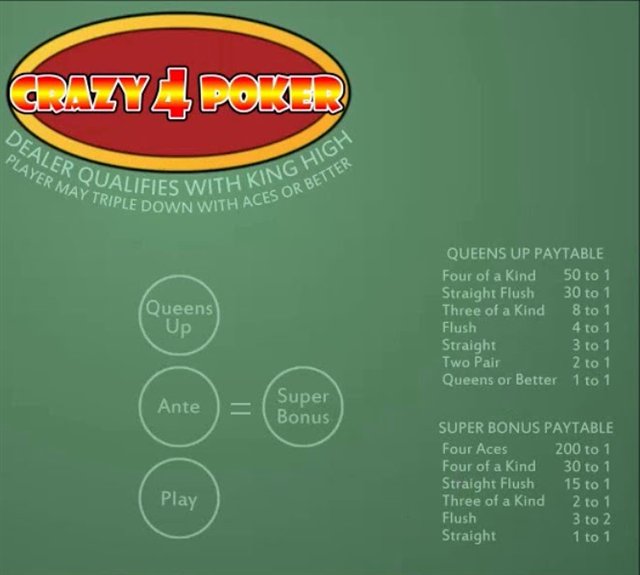
Crazy 4 poker charges two wagers before a card is dealt and refuses to let the player fold one of them away. The Super Bonus rides alongside the Ante on every hand, the dealer needs king high to qualify, and a pair of aces unlocks a raise three times the size of the Ante. For the wider market picture, start at our online casino Canada hub.
The table below sets out how the game behaves. Read it first, then work through the detail beneath.
| Trait | Detail |
|---|---|
| Cards | Five to the player and dealer, best four count |
| Required bets | Ante and Super Bonus, equal in size |
| Dealer qualifies | King high or better |
| Raise sizes | One times the Ante, or three times with a pair of aces or better |
| House edge | Roughly 3.4 percent on the Ante |
| Canadian supply | OLG, Fallsview, Ontario lobbies, provincial platforms |
What is crazy 4 poker?
A house banked poker variant where player and dealer each receive five cards and play their best four card hand. Two required wagers, one optional side bet and a single raise decision make up the whole game.
The name refers to the four card hand and the unusual raise. A crazy 4 poker table looks like any stud felt until the Super Bonus circle catches the eye.
That circle is the defining feature. No other common stud variant makes a bonus wager compulsory.
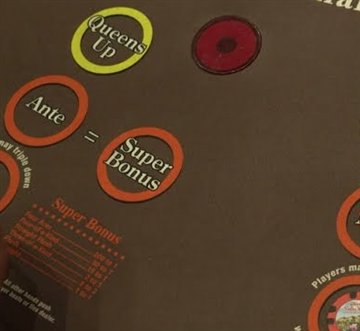
Every wager at the table settles on the same four counted cards. That shared hand makes crazy 4 poker quick to follow once the ranking is learned.
The dealer hand uses the same rules. Both sides pick four from five automatically.
Nothing is hidden from the player after the reveal.
Software and live versions follow identical rules. A crazy 4 poker hand online plays exactly as it does on a Niagara felt.
Only the pace differs.
Table minimums online start at one dollar on the Ante. That places the full starting stake at two dollars, with the optional side bet on top.
Maximums vary by operator. High limit tables exist in the larger Ontario lobbies.
The game belongs to the stud family rather than draw or community card poker. Every card a player receives stays in the hand until the round ends.
Crazy 4 poker tables sit in the speciality poker section of most lobbies.
Its rules screen fits on a single page, ranking chart included. New players read it once and start.
Who invented crazy 4 poker?
Roger Snow designed it for Shuffle Master, the company now part of Light and Wonder. The same designer produced four card poker and ultimate texas holdem, and all three share a variable raise.
The design arrived after four card poker had proved the four card format. Crazy 4 poker kept the hand size and rebuilt the betting around a compulsory bonus.
Casino floors across North America adopted it quickly.
Shuffle Master built a family of games around one idea. Players commit more money when their hand is strong, and crazy 4 poker is the version with the steepest threshold.
The patent family covers the betting structure. Clones under other names are uncommon.
Roger Snow remains among the most prolific table game designers in the industry. Crazy 4 poker sits beside his best known titles on casino floors.
Designers test new games against millions of simulated hands before release. The published edge figures come from that work and from independent laboratory checks.
Crazy 4 poker passed both stages before reaching Canadian floors.
Its felt layout has barely changed since launch. Players recognise the Super Bonus circle on any crazy 4 poker table they meet.
The title remains in active distribution across regulated markets.
How does a hand play out?
The player posts an Ante and a matching Super Bonus, plus the optional Queens Up bet. Five cards arrive, the player folds or plays, and the dealer reveals five cards to settle everything.
No cards are exchanged at any point. A crazy 4 poker round reaches its result after one player decision and one dealer reveal.
The interface enforces the order. Buttons appear only when a decision is due.
Round length is the same whether the player folds or plays. Crazy 4 poker reveals the dealer hand on every deal so the Queens Up and Super Bonus outcomes stay visible.
Results appear together on one screen.
Queens Up can be placed or skipped on each new deal. Crazy 4 poker keeps the Ante and Super Bonus fixed as the compulsory pair.
The deal follows immediately.
Five cards per side is the smallest deal that still allows a best four selection. The extra card gives each hand a choice without slowing the round.
Every decision happens before the dealer reveal.
A typical round takes under half a minute online. The reveal animation accounts for most of that time.
Crazy 4 poker rounds never include a second betting decision.
Why is the Super Bonus compulsory?
It funds the large payouts on premium hands. Making it mandatory guarantees every player contributes to that pool, which lets the game pay generously on straights and better without a separate optional bet.
An optional bonus attracts only a share of players. A compulsory one lets crazy 4 poker pay large premiums to every player holding a strong hand.
The cost is spread across every deal instead.
Premiums on four aces and straight flushes cost the house a great deal. Crazy 4 poker recovers that cost through the pushes and losses the Super Bonus takes on ordinary hands.
Players meet the bet on every deal, win or lose.
Other designs make the bonus optional and pay less on it. Crazy 4 poker chose the compulsory route and pays more on every premium hand.
A compulsory wager also removes a decision from the player. Nobody has to judge whether the bonus is worth placing on a given deal.
Crazy 4 poker keeps the choices short and clear.
The design choice is the single rule that separates this game from its siblings. Crazy 4 poker would be a different game without it.
The compulsory wager is printed plainly on every rules screen.
Compulsory wagers appear in ultimate texas holdem as well. The idea has proved durable across the designer catalogue.
Must the Ante and Super Bonus match?
They must be equal on every hand. A player cannot place ten dollars on the Ante and five on the Super Bonus, and the interface raises or lowers both together.
Matching stakes keep the paytable maths intact. A crazy 4 poker table allowing a smaller Super Bonus would break the balance the designer built.
Chip placement is automatic online.
A player raising the Ante raises total exposure twice as fast. Crazy 4 poker stakes therefore climb in pairs rather than single units.
Table limits apply to each wager separately.
The combined minimum is the real entry price.
Rebet buttons repeat both wagers together. Crazy 4 poker software never splits them.
Changing one changes both.
Live dealers check the two stacks before dealing. A mismatched pair of wagers is corrected at the table before any card is placed.
Software handles the check silently.
The Play bet is the only main wager that changes size. It is set after the deal and depends on the hand.
Crazy 4 poker stakes always move in matched pairs.
What is the Queens Up bet?
An optional side bet paying on the player hand alone. A pair of queens or better collects from a fixed ladder, and the dealer hand has no effect on the result.
It remains the only optional wager at the table. A crazy 4 poker player can skip it on every hand without affecting the Ante, the Super Bonus or the Play bet.
Pairs of queens, kings and aces all collect at the bottom rung. Crazy 4 poker treats every hand above that line as a winner on the side bet.
Lower pairs lose it. The dealer never matters.
The bet is named for its minimum qualifying hand. Crazy 4 poker players chasing it look for queens or better on every deal.
Queens Up predates online play and appears on the original felt design. Its circle sits beside the Ante and Super Bonus positions.
Crazy 4 poker layouts label it clearly.
A player can place Queens Up without any intention of reading its ladder. The rules screen still lists every rung for reference.
The side bet never changes the main game result.
What beats what in crazy 4 poker?
Four of a kind tops the ladder, then straight flush, three of a kind, flush, straight, two pair, pair and high card. Four card hands change the order from standard poker.
Straights and flushes use four cards rather than five. A crazy 4 poker straight needs four consecutive ranks, and a flush needs four cards of one suit.
Full houses do not exist here.
Two pair sits above a pair and below a straight. Crazy 4 poker hands can hold two pair inside four cards, which makes that rank more common than in five card games.
High card hands sit at the bottom.
A ranking chart sits on every rules screen. Crazy 4 poker players new to four card hands keep it open for the first session.
The order sticks quickly.
Hands that look strong in holdem can be ordinary here. A four card flush ranks below trips and only just above a straight.
Players adjust within a single session.
Flushes rank above straights, as in standard poker. That part of the crazy 4 poker ladder needs no adjustment.
Crazy 4 poker players memorise the ladder within one session.
Why does three of a kind beat a flush?
Frequency decides rank. Four card flushes appear more often than three of a kind when picking four from five cards, so trips take the higher rung in this game.
Players arriving from holdem misread this constantly. A crazy 4 poker hand holding trips outranks a four card flush every time.
The ladder is printed on the felt.
Picking four cards from five makes suited hands easier to build than trips. Crazy 4 poker ranks by that frequency, which is the only fair way to order the ladder.
Paytables follow the same order.
Five card poker ranks the flush higher because five suited cards are rarer than trips. Crazy 4 poker reverses the order because four suited cards are not.
Every paytable at the table uses the same reordered ladder. The Super Bonus and Queens Up both pay trips above flushes as a result.
Frequency ranking keeps payouts fair across the ladder. Rarer hands always pay more than common ones.
The reordering applies to both player and dealer hands.
Why does four of a kind beat a straight flush?
Four card straight flushes are more common than four of a kind in a five card deal. The ladder follows that frequency rather than the familiar five card order.
Quads need all four cards of one rank inside five dealt cards. That rarity puts them at the top of the crazy 4 poker ladder.
Four aces carry their own Super Bonus rung.
Four card straight flushes need four consecutive suited ranks. Crazy 4 poker deals them more often than quads because five cards offer more than one way to find four in a row.
The Super Bonus pays both generously.
Standard poker puts straight flushes on top. Crazy 4 poker flips that pair for the same frequency reason that flips trips and flushes.
Four of a kind is the rarest standard hand in the game. Its position at the top of the ladder reflects that rarity directly.
Crazy 4 poker adds a special rung for four aces above it.
Both hands sit above trips and far above any flush. Seeing either on a crazy 4 poker deal is a notable event.
Crazy 4 poker premiums reflect that same ordering.
What qualifies the dealer?
King high or better. A dealer hand topped by a queen or lower does not qualify, and that outcome changes how the Ante settles while the other wagers still play.
An ace high hand qualifies comfortably. A crazy 4 poker dealer showing king high with low supporting cards qualifies as well, however weak it looks.
Pairs of any rank qualify, as do straights and flushes. Crazy 4 poker dealers miss only with queen high or lower hands holding no made combination.
That leaves a narrow band of non qualifying hands.
King high is a low bar. Crazy 4 poker sets it there so the Ante push stays occasional rather than frequent.
Three card poker uses queen high.
The qualifier applies to the Ante alone. Every other wager ignores it, which keeps the rule simple to track during play.
Players see whether the dealer qualified at the same moment they see the result. The screen labels it plainly.
The king high bar applies identically on every deal.
What happens when the dealer does not qualify?
The Ante pushes. The Play bet and the Super Bonus are still settled against the dealer hand, so a non qualifying dealer does not end the round for the player.
This rule protects the player on weak dealer hands. A crazy 4 poker player still wins the Play bet against a non qualifying dealer holding a lower hand.
The Ante simply returns.
A non qualifying dealer still beats a player holding jack high. Crazy 4 poker players rarely reach that outcome, because correct strategy folds those hands first.
The Super Bonus follows its own ladder throughout.
Players holding strong hands lose nothing to the push. Crazy 4 poker still pays the Play bet on a win and the Super Bonus premium on a straight or better.
Weak hands that play for one unit gain from this rule most. A marginal king high hand facing a queen high dealer wins the Play bet outright.
Crazy 4 poker strategy accounts for that bonus.
Returning the Ante keeps the player whole on the base wager. That return is the qualifier rule in action.
Crazy 4 poker players collect nothing extra on the Ante here.
What happens when the dealer qualifies?
The Ante and Play both settle against the dealer. A winning player collects even money on each, and a losing player surrenders both along with the Super Bonus.
A win pays two units of profit on a minimum play. A crazy 4 poker win after a triple raise pays four units, plus any Super Bonus premium on the hand.
Ties with a qualifying dealer push the Ante and Play. Crazy 4 poker then settles the Super Bonus by its own rules, paying any straight or better in full.
Queens Up settles last.
Losing hands surrender the Ante, Play and Super Bonus together. Crazy 4 poker still pays a Super Bonus premium on a losing straight or better.
Most hands reach this branch because the qualifier is low. The main comparison therefore decides the outcome on nearly every deal.
A qualified dealer beats most folded hands, which confirms those folds were correct. Crazy 4 poker histories show that pattern clearly.
Every wager then settles against the dealer hand.
How is the Play bet sized?
It equals the Ante on most hands. A player holding a pair of aces or better may instead raise up to three times the Ante, which is the most important option in the game.
Players holding aces or better may choose any raise from one to three times. A crazy 4 poker chart always takes the full three times on those hands.
Smaller raises give value away.
The interface offers a one unit button on every hand. Crazy 4 poker adds the three unit button only when the cards qualify for it.
Players never check eligibility themselves.
Minimum and maximum Play sizes both appear before the reveal. Crazy 4 poker never lets a player change the raise after the dealer cards are shown.
A one unit Play on aces or better is legal but costly. The interface allows it, and strategy never uses it.
Crazy 4 poker rewards the full raise on those hands.
Raise sizes never depend on the dealer upcard, because there is no upcard. Every card stays hidden until the reveal.
Crazy 4 poker raises are fixed once the button is pressed.
What happens when the player folds?
Folding surrenders the Ante and the Super Bonus together. The Queens Up bet stays live and settles on the player hand, because it never depended on the dealer.
A fold ends the hand for the Ante, Super Bonus and Play positions. Crazy 4 poker settles the Queens Up bet on the cards the player already holds.
The dealer hand is still revealed after a fold. Crazy 4 poker shows it so the player can confirm the Queens Up result and review the decision.
No further action is required.
Folding takes one click and ends the decision. Crazy 4 poker moves straight to the reveal and the next deal.
Queens Up can still win after a fold, which surprises new players. A folded pair of queens collects on the side bet like any other qualifying hand.
The Ante and Super Bonus are collected at the reveal rather than the moment of the fold. The outcome is the same either way.
The next deal begins once the reveal finishes.
What does the Super Bonus pay?
It pays on straights and better from a fixed ladder. Common tables pay even money on a straight, better on a flush and trips, and two hundred to one on four aces.
Three of a kind pays two to one on common ladders, and flushes pay three to two. Crazy 4 poker straight flushes and four of a kind sit in the tens.
Operators publish the full table.
Four aces is the top rung on common tables. Crazy 4 poker pays it far above ordinary four of a kind because four aces arrive once in tens of thousands of hands.
Straights pay even money at the bottom.
Four of a kind pays above straight flushes on common tables. Crazy 4 poker ladders reward four aces most of all.
The ladder applies to the player hand only. Dealer premium hands earn the house nothing extra on the Super Bonus.
Crazy 4 poker publishes the full ladder on the rules screen.
Payouts are stated as multiples of the Super Bonus stake. A five dollar Super Bonus on a straight returns five dollars profit.
Crazy 4 poker premiums pay on top of any main game win.
When does the Super Bonus pay without winning?
A straight or better collects its multiple whatever the dealer holds. A hand below a straight pushes the Super Bonus on a win and loses it on a loss.
That property makes premium hands safe. A crazy 4 poker player holding a flush against a dealer straight still collects the flush premium on the Super Bonus.
A losing hand below a straight surrenders the Super Bonus. A winning hand below a straight pushes it, so crazy 4 poker returns the stake without profit.
Ties push as well.
Premium hands lose to a dealer only when the dealer holds a better premium hand. Crazy 4 poker still pays the Super Bonus in those rare cases.
The rule gives strong hands a floor. A losing straight still collects its premium, which cushions the rare bad beat.
A player never has to beat the dealer to collect a premium. That independence is the main appeal of the crazy 4 poker bonus.
Premium hands collect whatever the dealer shows.
Does a fold forfeit the Super Bonus on a big hand?
Folding a straight or better surrenders the bonus that hand would have collected. No correct strategy folds those hands, so the rule catches only careless play.
The interface prompts before a fold. A crazy 4 poker software table makes folding a made straight or better unlikely without a deliberate second click.
Live dealers usually pause before collecting a fold showing a premium hand. Crazy 4 poker floor staff protect players from that error as a courtesy.
Software cannot read intent.
No strategy chart ever recommends it. Crazy 4 poker players who fold a made straight or better are making a clicking error, not a decision.
Fold buttons sit far from play buttons on well designed interfaces. Misclicks remain the only realistic route to this outcome.
Crazy 4 poker players slow down on premium hands.
The rule exists to keep the Super Bonus tied to a live hand. Folded hands cannot claim premiums.
Crazy 4 poker never refunds a folded premium.
What does Queens Up pay?
Ladders start near even money on a pair of queens and climb through two pair, straights and flushes to large multiples for four of a kind. Operators publish the rungs.
Queens Up pays on the player hand even after a fold. Crazy 4 poker keeps that wager independent of every other decision on the table.
Ladders differ between operators.
Four of a kind carries the top Queens Up rung on standard ladders. Crazy 4 poker straight flushes, trips, flushes and straights fill the steps below it.
Two pair pays small.
Straights and flushes pay mid ladder multiples on Queens Up. Crazy 4 poker trips pay above them because trips rank higher in four card hands.
Pairs of queens, kings and aces share the bottom rung. That rung decides most Queens Up outcomes because pairs are the most common qualifying hand.
The bottom rung returns the stake plus even money. Higher rungs scale sharply with rarity.
Every rung is fixed before the deal.
Is Queens Up worth playing?
Its house edge sits above the main game on standard ladders and far above it on poor ones. The bet is optional and skipping it costs nothing.
Frequent small wins on pairs of queens mask the cost. The crazy 4 poker main game still returns more per dollar than the side bet.
The bet suits players chasing a separate outcome on each deal. Crazy 4 poker returns less on it than on the main game, so it remains a pure entertainment choice.
Leaving the circle empty keeps the session closest to the published edge. Crazy 4 poker loses nothing else when players skip it.
Budget the side bet separately if playing it at all. Mixing it into the main bankroll hides its cost across a session.
Crazy 4 poker main game results stay clearer without it.
Players who enjoy the extra sweat on each deal accept its cost knowingly. That is a personal choice rather than a strategy question.
Crazy 4 poker plays fully without the side bet.
When does a player raise three times?
Any pair of aces or better takes the full three times raise. The option exists only on those hands, and every one of them beats a qualifying dealer often enough to justify it.
The rule has no exceptions. Crazy 4 poker strategy takes the triple raise on every pair of aces, every two pair and every hand above.
Hesitating costs money.
Pairs of aces with weak side cards still take the triple raise. Crazy 4 poker hands at that level beat the dealer often enough that kickers make no difference.
Two pair and trips follow the same rule.
The rule is the easiest in the game to remember. Crazy 4 poker players learn it on the first deal they see.
Holding trips or better makes the decision automatic. The only thought required is confirming the hand reaches at least a pair of aces.
Aces with a straight draw earn nothing extra, because no more cards arrive. Crazy 4 poker hands are judged exactly as dealt.
The rule covers every hand at or above aces.
When does a player play for one unit?
The published chart plays king queen eight four or better for a single unit. Every pair below aces falls in this band, along with the stronger king high hands.
The band covers every pair from twos through kings. A crazy 4 poker player never folds a pair of any rank.
King high hands need a careful look.
King high hands need a queen, an eight and a four or better behind the king. Crazy 4 poker players compare card by card from the top down.
Ace high hands always play.
The single unit play is the default action. Crazy 4 poker players use it on every hand between the fold line and the aces line.
King queen eight four is the exact dividing hand. Anything that beats it card for card plays, and anything below it folds.
Crazy 4 poker charts print it in bold.
Ace high hands with no pair always play for one unit. The ace alone beats every non qualifying dealer.
Crazy 4 poker players use this option most often.
Hands that beat king queen eight four by a single card still play. The comparison is strict and literal.
When does a player fold?
Anything weaker than king queen eight four folds. Those hands lose to a qualifying dealer too often, and the cost of folding is the Ante and Super Bonus already committed.
Queen high and lower hands fold without exception. Crazy 4 poker punishes playing them because the dealer qualifies against them far more often than not.
King jack hands fold regardless of the lower cards. Crazy 4 poker players reach the fold decision quickly once the second card is lower than a queen.
The comparison takes seconds.
Folding correctly is harder than raising correctly. Crazy 4 poker players lose more to marginal plays than to missed folds.
Pairs never fold under correct strategy. Even a pair of twos beats a qualifying king high dealer often enough to justify one more unit.
King high hands below the threshold fold as well. Their second, third and fourth cards decide the matter.
Folds happen before the reveal and cannot be undone.
Why does folding cost two units?
The Super Bonus goes with the Ante on a fold. That makes folding more expensive than in four card poker, which is why the fold threshold sits lower than a new player expects.
The loss is fixed before the deal. A crazy 4 poker fold surrenders exactly the two units placed, and never more.
That certainty makes borderline decisions easier to price.
A player who folds too often loses two units each time. Crazy 4 poker therefore rewards playing marginal king high hands for one more unit.
The arithmetic favours the call.
Four card poker folds cost one unit. Crazy 4 poker doubles that price, which explains the lower fold line.
Players cannot recover the Super Bonus once the fold is made. That permanence is what pushes marginal hands toward playing.
Crazy 4 poker makes folding a considered act.
The Queens Up wager is not part of that cost because it stays live. Only the two compulsory wagers leave the table.
Crazy 4 poker folds always cost the same two units.
How often does the player fold?
Roughly one hand in four ends in a fold under correct play. The rate is lower than most stud variants because each fold surrenders two units rather than one.
A chart that folds rarely is working correctly here. Crazy 4 poker prices folds high enough that marginal hands play for a single unit.
Queen high and lower hands make up most folds. Crazy 4 poker players rarely fold ace high or any pair.
King high hands supply the remainder.
Fold frequency stays steady across long sessions. Crazy 4 poker players who fold far more often are likely folding playable king high hands.
Queen high hands appear often enough to shape the fold rate on their own. The rest of the folds come from weak king high holdings.
A fold rate near one hand in four matches the published crazy 4 poker chart closely.
The figure holds across long samples.
How often does the player raise three times?
Pairs of aces or better arrive on roughly one hand in nine. Those hands carry most of the return, so the three unit raise matters more than any other decision.
A long crazy 4 poker session produces a triple raise every ten hands or so. Missing any of them drains the return quickly.
Two pair and better add to the aces total. Crazy 4 poker deals those hands often enough that the triple raise appears at a steady rate across any session.
Aces or better anchors the return. Crazy 4 poker players who notice the rate dropping are usually raising once on qualifying hands.
Tracking raises across a session is a simple strategy check. A player raising three times far less often than expected is missing qualifying hands.
Crazy 4 poker histories make the check easy online.
The triple raise rate cannot be raised by strategy. It depends entirely on the cards dealt.
Crazy 4 poker deals qualifying hands at a steady rate.
What is the house edge?
Correct play leaves roughly three and four tenths percent against the Ante. Because the Super Bonus doubles the starting stake, the figure measured against all money wagered drops close to one percent.
The Queens Up bet is not included in that figure. Crazy 4 poker publishes the main game edge separately from the side wager.
Poor strategy raises it sharply.
The edge compares favourably with Caribbean stud poker on the element of risk measure. Crazy 4 poker looks costlier on the Ante measure alone.
Both numbers come from the same maths.
Operators cannot change the edge beyond their paytable choice. Crazy 4 poker builds fix every other number at certification.
Comparing edges across games requires the same basis. The Ante figure suits games without compulsory second bets, and the element of risk suits games with them.
Laboratory reports confirm the published figure for each certified crazy 4 poker build.
The figure assumes correct play on every decision.
Side bets carry separate figures. Adding Queens Up raises the total cost of a session.
Why are two house edge numbers quoted?
One divides the expected loss by the Ante alone. The other divides it by every dollar placed, Super Bonus and raises included, and that second figure is the fairer comparison between games.
Games with compulsory second wagers look expensive on the first measure. Crazy 4 poker is the clearest example of a game that looks worse than it plays.
Players comparing games need the same measure on both sides. Crazy 4 poker is best compared by element of risk against games with compulsory second bets.
Both figures appear in published references. Crazy 4 poker rules screens usually show the return to player instead.
Return to player shows the complement of the edge as a percentage. A table returning ninety eight point nine percent by that measure charges one point one percent.
Crazy 4 poker rules pages use that format often.
Neither figure is misleading on its own. Each answers a different question about cost.
Crazy 4 poker references usually print both.
How does the Super Bonus change the edge?
It adds a second unit to every hand at a small cost of its own. Spreading the expected loss across more money wagered is what brings the element of risk down so far.
The Super Bonus carries its own expected loss. Crazy 4 poker spreads that loss across a larger total stake, which lowers the element of risk.
Removing the Super Bonus from the calculation would shrink the total stake. Crazy 4 poker keeps it in, which is why the element of risk sits so far below the Ante figure.
The Super Bonus loses slightly on its own. Crazy 4 poker players accept that cost as the price of the premium payouts.
Premium hands recover part of the Super Bonus cost over time. Straights, flushes and trips arrive regularly enough to matter.
Without premium hands, the Super Bonus would lose far more. The ladder is what keeps its cost modest.
The effect is built into every published figure.
Does the paytable vary?
Super Bonus and Queens Up ladders both differ between operators. Comparing the four aces rung and the straight flush rung identifies the better table before a wager.
A single rung can move the return noticeably. Choosing the better crazy 4 poker table costs nothing but a moment on the rules screen.
Four aces pays two hundred to one on common tables and less on poorer ones. Crazy 4 poker players reading that rung first find the better table fastest.
Queens Up rungs vary as well.
Rules screens show both ladders in full. Crazy 4 poker players compare two tables side by side in under a minute.
Operators choose among approved ladders rather than inventing their own. Every variation still passes laboratory testing before release.
Crazy 4 poker ladders differ only within those limits.
The better crazy 4 poker ladder costs nothing extra to play. Choosing it is free value.
Crazy 4 poker ladders are printed in full before play.
How large is the deck?
A single fifty two card deck, shuffled before every hand. Software versions reshuffle digitally each round, and live tables use a continuous or automatic shuffler.
Card counting has no value with a fresh deck each hand. Crazy 4 poker removes that question from both live and software play.
A single deck changes the odds of every premium hand compared with a shoe. Crazy 4 poker paytables are calculated for exactly fifty two cards.
Automatic shufflers on live tables reset the deck between every hand. Crazy 4 poker software does the same instantly.
Jokers never appear in the deck. Wild cards would break every published figure for the game.
Single deck play makes card removal effects visible on paper. Online reshuffling means they never accumulate.
Fifty two cards are used on every deal.
How is a four card hand chosen?
The game picks the best four of five automatically. A player never discards by hand, and the interface highlights the four cards that count.
The best four always count, even when a different four would suit a bonus better. Crazy 4 poker settles every wager on the same four cards.
The discarded card never affects any wager. Crazy 4 poker players can ignore it entirely once the interface marks the counted four.
Live dealers arrange the cards the same way.
Manual selection would slow the game and invite errors. Crazy 4 poker removes that step entirely.
The best four sometimes exclude the highest card. A pair of fives with an ace kicker keeps the ace, while a four card flush may drop it.
Crazy 4 poker picks whichever four rank highest.
The counted four are highlighted on screen at the reveal. The fifth card is dimmed.
Crazy 4 poker always selects the strongest four.
Can a straight wrap around?
No. Ace plays high or low at the ends only, so queen king ace two is not a straight, while ace two three four and jack queen king ace both are.
Four card straights are easier to make than five card ones. Crazy 4 poker still ranks them below three of a kind for that reason.
Ace low straights rank as the lowest straight. Crazy 4 poker ranks ace high straights as the highest, with every other straight between them.
The rule matches every other poker variant in the lobby. Crazy 4 poker introduces no special straight rules.
Four card straights start as low as ace two three four. The highest runs jack queen king ace.
Wrap around straights appear in certain home games. No casino version of crazy 4 poker allows them.
Straights follow standard casino rules throughout.
How are ties settled?
Equal hands compare the highest card, then the next, down through the four counted cards. A complete tie pushes the Ante and Play, and the Super Bonus follows its own rule.
Suits never break ties. Two crazy 4 poker hands with identical ranks push, whatever suits the cards carry.
Ties are uncommon but real.
Pairs compare the pair rank first and then the side cards. Crazy 4 poker two pair hands compare the higher pair, then the lower pair, then the kicker.
The fifth card never breaks a tie. Crazy 4 poker compares the four counted cards and nothing else.
Straights and flushes compare the top card first. Equal straights with identical ranks push regardless of suit.
Crazy 4 poker applies the same logic to both sides.
Ties affect the Ante and Play only. Side bets settle on their own ladders regardless of the comparison.
Crazy 4 poker ties are uncommon on any single deal.
What is the most common player hand?
A pair appears more often than any other made hand. High card hands are slightly more frequent still, which is why the hardest strategy concerns king high borderline decisions.
King high and ace high hands sit near the fold threshold. Most crazy 4 poker decisions that require thought involve one of them.
Pairs appear on roughly two hands in five. Crazy 4 poker players meet them constantly, which is why every pair plays for at least one unit.
High card hands arrive slightly more often than pairs. Crazy 4 poker players fold the weakest of them and play the rest.
Two pair arrives less often than a pair but more often than a straight. It sits in the triple raise band because it beats a pair of aces.
Trips arrive on roughly one hand in fifty. Four card flushes and straights both arrive more often, despite ranking lower.
Hand frequencies are fixed by the single deck.
How often does the dealer qualify?
Roughly five hands in six qualify at king high. The Ante push is therefore an occasional relief rather than a regular event at the table.
A qualifying dealer is the normal case. Crazy 4 poker strategy is built around beating a dealer who plays almost every hand.
Pairs alone account for a large share of qualifying dealer hands. Crazy 4 poker dealers holding ace high or king high supply most of the rest.
A high qualification rate keeps the Ante in play. Crazy 4 poker players rarely see it push.
A dealer missing the qualifier still reveals every card. The comparison with the player hand continues for the Play bet.
Crazy 4 poker keeps the reveal consistent on every deal.
Qualification rates are identical for player and dealer hands. Both draw from the same five card distribution.
Crazy 4 poker dealers qualify on most deals.
How does it compare with four card poker?
Four card poker gives the dealer six cards and no qualifier, with no compulsory bonus. Crazy 4 poker keeps the deal even at five cards each and adds the mandatory Super Bonus.
Four card poker strategy takes its triple raise on a pair of tens. Crazy 4 poker sets the bar at a pair of aces, which reflects the even deal.
Both games share a designer.
Four card poker has no compulsory second wager and no Ante push. Crazy 4 poker keeps a qualifier and doubles the starting stake instead.
Players often enjoy both for different reasons.
Four card poker suits players who dislike compulsory bonus wagers. Crazy 4 poker suits players who want premiums paid on every strong hand.
Both games deal five cards to the player. The difference lies in the dealer card count and the compulsory wager.
Players moving between the two games adjust the raise threshold first. Tens in one, aces in the other.
Both titles share a designer and a supplier.
Both games appear side by side in most Ontario speciality lobbies. Trying each on demo reveals the difference quickly.
How does it compare with three card poker?
Three card poker qualifies the dealer on queen high and allows a single fixed raise. Crazy 4 poker qualifies on king high and allows a triple raise on the strongest hands.
Pair plus in three card poker is optional. The Super Bonus in crazy 4 poker is not, which changes how each game spends its bonus budget.
Three card poker hands resolve on three cards. Crazy 4 poker hands use four, which widens the ladder to include two pair and four of a kind.
Both use a single raise decision.
Three card poker pays its Ante bonus automatically. Crazy 4 poker pays its bonus through a dedicated wager instead.
Three card poker plays faster still because of the smaller hand. Crazy 4 poker adds depth through the extra card and the larger ladder.
Both suit short sessions.
Three card poker strategy is Q-6-4. The crazy 4 poker threshold adds a fourth card to the comparison.
Crazy 4 poker hands carry one extra counted card.
How does it compare with ultimate texas holdem?
Ultimate texas holdem spreads the raise decision across three betting rounds. Crazy 4 poker asks once, before any dealer card is seen, with the hand already complete.
Both games combine a compulsory bonus wager with a variable raise. Crazy 4 poker settles the raise before any dealer information, while holdem reveals community cards first.
Ultimate texas holdem hands take longer because of the community card rounds. Crazy 4 poker settles in one step, which suits players who prefer pace over sequence.
Both games reward aggressive raises on strong hands. Crazy 4 poker needs aces for the maximum while holdem takes it on a range of preflop hands.
Holdem players meet two pocket cards and five community cards. Crazy 4 poker players see a complete hand at once, which removes guesswork about future cards.
Ultimate texas holdem has a Blind bet as its compulsory second wager. Crazy 4 poker uses the Super Bonus in the same role.
Both games reward the maximum raise on premium hands.
Holdem tables attract players who enjoy reading the board. This game attracts players who prefer a complete hand immediately.
How does it compare with Caribbean stud poker?
Caribbean stud pays its bonus only through the raise and returns the Ante on a non qualifying dealer. Crazy 4 poker pays its bonus through a separate required wager.
Caribbean stud pays nothing extra when the dealer fails to qualify. Crazy 4 poker still settles the Play bet and the Super Bonus in that case.
Caribbean stud offers a progressive jackpot on most tables. Crazy 4 poker replaces that with fixed Super Bonus premiums on every strong hand.
The fixed premiums pay far more often.
Caribbean stud uses five card rankings. Crazy 4 poker uses four card rankings with the reordered ladder.
Caribbean stud needs ace king to qualify the dealer. Crazy 4 poker sets the bar lower at king high.
The Ante pushes less often as a result.
Caribbean stud allows a single raise size of two times. The flexible triple raise has no counterpart there.
Crazy 4 poker settles faster on every deal.
How does it compare with Mississippi stud?
Mississippi stud has no dealer hand and three raise decisions against a paytable. Crazy 4 poker keeps a dealer, a qualifier and a single decision.
Mississippi stud can reach ten units on one hand. Crazy 4 poker tops out at five units on the main game, plus the optional Queens Up.
Mississippi stud has no fold cost beyond the Ante. Crazy 4 poker folds cost two units, which changes how often each game folds.
Mississippi stud pays on its paytable without a dealer. Crazy 4 poker settles against a dealer and pays premiums through the Super Bonus.
Mississippi stud reveals community cards one at a time. The player hand in this game is complete on the deal.
Both games reward folding weak holdings early. Their fold costs differ by one unit.
Both games use a single deck per round.
Is crazy 4 poker good for beginners?
The rules fit on one screen and the strategy fits in two lines. A beginner who learns the aces rule and the king queen eight four threshold plays close to perfectly.
No bluffing and no opponents make it approachable. Crazy 4 poker asks only for a comparison against a printed threshold.
A demo table is enough practice.
The compulsory Super Bonus is the only surprise for a newcomer. Crazy 4 poker explains it on the rules screen before the first deal.
Everything else follows familiar poker logic.
Beginners make the fewest errors in games with a single decision. Crazy 4 poker fits that description exactly.
Free demo tables let a beginner learn the ranking without risking money. Fifty demo hands cover every common decision.
Crazy 4 poker demos match the real game exactly.
Beginners benefit from games where the correct play is visible on the cards. Crazy 4 poker hands show their strength at a glance.
Crazy 4 poker demos are the easiest place to start.
The fold line and the aces line are the only numbers to learn. Everything else follows from the ranking chart.
What mistakes cost the most?
Folding hands that belong in play and raising once on a pair of aces. Both leave money on the table, and the second wastes the most valuable option in the game.
Raising once on aces is the most expensive single error. Crazy 4 poker pays its best return on those hands, and a one unit raise throws away two thirds of it.
Playing queen high hands is the second costliest habit. Crazy 4 poker dealers qualify against them almost every time and win the comparison most of the time.
Folding them is correct.
Placing Queens Up on every hand is the third. Crazy 4 poker main game play returns more per dollar than the side bet.
Folding pairs is the fourth. Every pair beats a qualifying king high dealer often enough to justify the single unit play.
Every one of these errors is avoidable with the two line chart. None of them depend on luck.
The chart prevents all of them.
Chasing losses by raising stakes is the costliest habit of all. It has nothing to do with the cards.
Can a player raise three times without aces?
The option is not offered below a pair of aces. The interface restricts the larger raise, so the only possible error is failing to take it when it is available.
A pair of kings allows only a one unit play. Crazy 4 poker sets the bar precisely at aces, and the interface enforces it.
Two pair, trips, straights and flushes all qualify for the triple raise as well. Crazy 4 poker treats every hand above a pair of aces the same way.
Pairs of kings and queens play for one unit only. Crazy 4 poker players holding them accept the smaller raise.
The interface greys out the larger raise on ineligible hands. Players cannot make that error even by accident.
Crazy 4 poker enforces the line automatically.
Players holding kings sometimes wish for the larger option. The rule exists because kings do not beat the dealer often enough.
Crazy 4 poker enforces the threshold on every deal.
Is there a live dealer version?
Live studios run it occasionally, and land based floors carry it far more often. Software tables remain the reliable route for a Canadian player who wants it on demand.
Land based tables at Fallsview and other Ontario floors run it with real cards. Online, crazy 4 poker lives mostly in the software lobby.
Software tables run continuously at every hour of the day. Crazy 4 poker players rarely need a live studio because the game has no social element to lose.
Live floors allow players to watch the shuffle and handle chips. Crazy 4 poker at Fallsview offers that experience in person.
Live floors deal slower, which lowers hourly cost at the same stake. Players who prefer a gentler pace choose the land based table.
Live studio schedules change by season. Checking the live lobby before planning a session avoids disappointment.
Software tables deal the same rules around the clock.
Who supplies crazy 4 poker online?
Light and Wonder holds the rights and licenses software builds to operators. The loading screen and the rules page name the supplier behind each table.
Licensing decides which operators carry it. A crazy 4 poker table appears in lobbies whose supplier agreements include the Light and Wonder table catalogue.
Paytables differ between operator configurations of the same build. Crazy 4 poker players compare rules screens rather than supplier names.
The rules page names the supplier directly. Crazy 4 poker builds carry the Light and Wonder name on loading.
Aggregators distribute the Light and Wonder catalogue to a wide range of operators. Availability depends on which aggregator each lobby uses.
Crazy 4 poker follows the catalogue wherever it goes.
Clone games with similar rules carry different names and different paytables. Reading the rules screen identifies the genuine crazy 4 poker build.
Crazy 4 poker builds share one rule set.
Where can Canadians play crazy 4 poker?
OLG lists it on its online casino, Fallsview carries it on the floor, and Ontario registered operators stock it in their table sections. Provincial platforms elsewhere list it under speciality poker.
OLG lists the game on its own site with rules and paytables. Crazy 4 poker also sits in the Fallsview table games list for players visiting Niagara.
Registered Ontario operators carrying the full table catalogue list it by name. Crazy 4 poker appears less often on smaller operator lobbies.
Searching by name is quicker than browsing.
OLG publishes rules for its own version online. Crazy 4 poker players in Ontario compare that table with registered private operators.
Players outside Ontario check their provincial platform first. Coverage there varies by province and by catalogue agreement.
Fallsview lists it among its Niagara table games. The game also appears on other Ontario casino floors.
Ontario lobbies carry the widest selection.
Land based players in Windsor and Niagara find it on the floor. Online players find it through the lobby search.
Is crazy 4 poker certified in Ontario?
Registered operators run builds tested by an approved laboratory. The shuffle, the qualifier and every paytable are fixed at certification and cannot be altered afterwards.
Certification is granted per market as well as per title. A crazy 4 poker build approved elsewhere is retested before an Ontario release.
The operator displays its registration number in the site footer. Crazy 4 poker tables inherit that registration automatically.
Testing covers the shuffle and the paytable together. Crazy 4 poker builds apply exactly what their rules screens state.
Independent laboratories approved by the regulator carry out the testing. Their reports cover the random number generator and every paytable.
Crazy 4 poker builds meet those standards before launch.
Players can confirm an operator registration through the regulator public register.
Crazy 4 poker certification is renewed with each build update.
Does crazy 4 poker count toward wagering?
Table games usually contribute at a reduced rate, and certain bonus terms exclude them outright. Reading the contribution clause before depositing avoids a dead wagering requirement.
An excluded game can void a bonus rather than simply contributing nothing. That clause matters more than the rate printed beside crazy 4 poker.
Contribution rates for table games run from zero to twenty percent. The crazy 4 poker rate sits in the bonus terms beside other table games.
Reading the exclusion list takes a minute. Crazy 4 poker players who skip it risk a bonus they cannot clear.
Bonus terms often cap bet size while wagering is active. Reading that cap against the combined Ante and Super Bonus avoids a breach.
Cash play has no such restrictions. Players avoiding bonus terms play every table freely.
The rate is listed in the bonus terms.
Is crazy 4 poker good for a small bankroll?
Every hand starts at two units, and the triple raise pushes exposure to five. A table with a one dollar Ante therefore needs a bankroll sized for two dollar hands.
Folds cost two units rather than one. A crazy 4 poker bankroll therefore drains faster on cold runs than a four card poker bankroll of the same size.
Lower element of risk offsets the higher starting stake. Crazy 4 poker bankrolls last longer per dollar wagered than the Ante figure suggests.
Deposit limits sit inside every Ontario account.
A one dollar Ante table keeps the five unit maximum at five dollars. Crazy 4 poker stays affordable at that level.
Skipping Queens Up keeps every dollar on the lower edge wagers. That single habit stretches a small deposit further than any other choice.
Crazy 4 poker rewards disciplined staking.
Bankroll size sets the Ante, not the other way round. A comfortable crazy 4 poker bankroll holds fifty starting stakes or more.
Crazy 4 poker suits disciplined players at low stakes.
How fast does a hand play?
One decision and one reveal make it among the quickest poker variants. Software tables deal well over a hundred hands an hour at a comfortable pace.
Live tables run slower because of the shuffle and chip handling. Crazy 4 poker online removes both and keeps the pace steady.
Faster play raises hourly cost even when the edge stays fixed. Crazy 4 poker players on a budget slow the pace by pausing between hands.
Session reminders sit inside every registered Ontario account. Crazy 4 poker players on a budget set one before sitting down.
Hourly cost equals hands per hour multiplied by average stake and edge. Slowing down is the simplest way to reduce it.
Faster rounds also mean faster variance. Results swing more per hour on quick software tables.
Pace is the player choice at every table.
Players who want more time per decision simply wait before clicking. Single player software tables hold the hand until the click.
What does a Canadian check before playing crazy 4 poker?
Five lines decide the table. The Super Bonus ladder, the Queens Up ladder, the qualifier, the table minimum and the operator registration status all appear before any money moves.
None of it requires a deposit to read. Crazy 4 poker publishes every relevant number before the first Ante is posted.
The habit transfers to every table in the lobby.
Checking the four aces rung first saves time. Crazy 4 poker tables paying less there usually pay less elsewhere too.
Registration status is the last check. Crazy 4 poker operators display it in the site footer.
Responsible gambling tools sit in the account menu of every registered operator. Setting a deposit limit takes a minute.
Crazy 4 poker sessions stay predictable with one in place.
Every check listed here takes seconds. Together they cover everything that changes the cost of the game.
Crazy 4 poker rewards those checks on every session.
Which game pages are worth reading next?
Four pages sit closest to this one. Each covers a game or a rule that touches the subject above, and each stands on its own.
Crazy 4 poker hides a modest element of risk behind a compulsory second wager. Raise three times on aces, play king queen eight four and better, and the table does the rest.